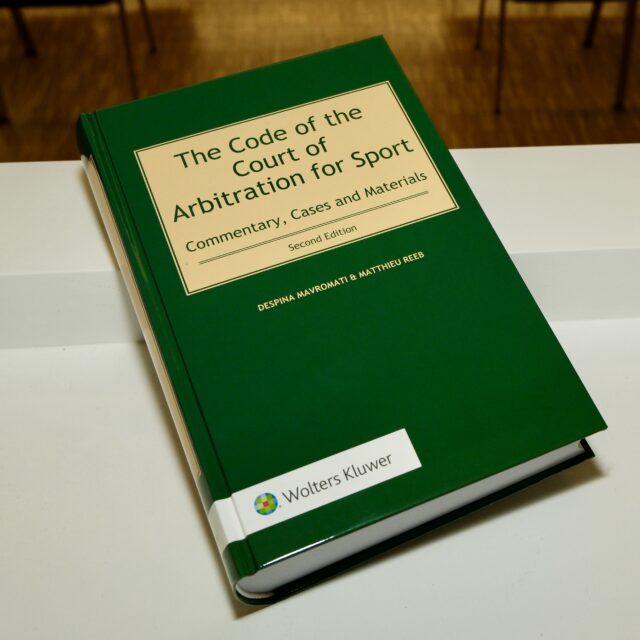
Case C-600/23 – Royal Football Club Seraing v. FIFA, UEFA et al, Opinion of AG Ćapeta of 16 January 2025
The judicial protection of EU-based rights and the definition of a ‘court or tribunal’ under the EU Charter – An effort to pierce the veil of res judicata in sports arbitration?
The recent opinion of the AG in the Seraing saga (see my older notes on the procedural history and the various decisions in this matter until 2018 here) undeniably created a turbulence in the long-haul flight of res judicata in international arbitration, a widely-recognized principle in every state that has adhered to the New York Convention of 1958 (NYC58). This cardinal principle of legal certainty traditionally grants a final and binding effect not only to final judgments passed by state courts, but also by tribunals that qualify as arbitral tribunals and whose decisions are asimilated to state court judgments. However, the recent Opinion of the AG Ćapeta in the Seraing case wants to revisit, to say the least, the binding effect of a very specific category of arbitral awards, namely in case of challenge of the regulatory framework of sports governing bodies and their compliance with EU law.
sport is an economic activity (§39) – its practice is subject to the provisions of EU law applicable to that economic activity;
FIFA rules require any dispute related to the challenge of its regulatory framework to be brought to the Court of Arbitration for Sport (CAS), rendering CAS arbitration in those (limited, as will be shown below) cases ‘mandatory’;
EU law guarantees the right to effective judicial protection (Art. 47 Charter) (§41);
Judicial protection of EU-based rights must be protected by a ‘court or tribunal’ under Article 267 TFEU (§ 43) and CAS / SFT are not such courts.
As a reminder, in the Seraing case, the Belgian courts granted res judicata effect to a CAS award based on their own national law and could subsequently not review the alleged breaches of EU law, which were dismissed in said award. According to AG Ćapeta, the res judicata rule anchored in Belgian law (and in almost all legal orders) is in ‘straightforward’ breach of the EU law principle of judicial protection to the extent that the CAS cannot be assimilated to a court in the sense of the TFEU (§ 49).
In view of the above, does the ‘mandatory’ character of sports arbitration warrant a limitation of res judicata and an enhanced review of CAS awards under EU law ?
After a reminder of the lengthy procedural history of this case, AG Ćapeta goes on to describe the FIFA system and the CAS jurisdiction established therein, that the AG considers to be ‘exclusive and mandatory’ (§ 55). This however, seems to ignore that exclusion of state courts jurisdiction in favor of arbitration is a core characteristic of arbitration clauses, either free of mandatory.
The AG also draws the parallel between human rights and EU law granting a rather broad effect to the Semenya v. Switzerland ECtHR judgment, when it says that the EctHR ‘found the review of a CAS award performed by the Swiss Federal Tribunal so limited that it was not capable of ensuring fundamental rights protection’ (§ 60). The findings of the ECtHR were indeed case specific, did not relate to the application of EU law and, most importantly, referred to the protection of ‘fundamental’ rights and not all rights as will be shown below.
Referring to previous judgments (inter alia the Achmea judgment, (C 284/16) and building upon the ISU judgment, the AG suggests a specific interpretation for mandatory arbitration.
Importantly, AG Ćapeta draws the distinction beween the Eco Swiss judgment (C 126/97) and the Seraing case: arbitral awards in commercial arbitration, albeit not ‘decisions’ in the sense of the TFEU a) are based on voluntary agreements and b) the lack of preliminary reference by a national court is ‘remedied’ by the need of exequatur based on the NYC58 as commercial arbitral awards are not self-enforceable.
On the other side, the AG says, following the analysis in the Mutu and Pechstein ECtHR judgment, the FIFA arbitration clause leads to a mandatory arbitration and this would impact on the width of judicial review needed and guaranteed under the current CAS regime. Other than in commercial arbitration, CAS awards do not require exequatur (and hence control by national courts) as they are issued in the self-enforcing football ecosystem (§ 77-78).
In my opinion, however, the self-enforcing character of CAS Awards by FIFA, undeniably one of the most potent practical advantages of sports / football arbitration, does not preclude recourse to the NYC58 recognition and enforcement mechanism and is not directly related to the issue of effective judicial review.
The AG then draws the distinction between this case and the Achmea judgment (related to the exclusion of possible EU law infringements from the system of judicial review in investment arbitration). Reiterating the utility of sports arbitration and the private character of sports governing bodies, AG Ćapeta repeats that the only connecting point between the two cases is the importance of effective judicial protection and the uniformity of EU law.
Finally, AG Ćapeta considers that the mandatory – and the self-enforcing character of sports arbitration (as opposed to voluntary commercial arbitration) warrant a specific assessment in light of the principle of effective judicial protection, both regarding the access to courts and the scope of judicial review (§ 95).
Building upon – and going some steps further from – the ISU judgment, AG Ćapeta suggests the adoption of a specific approach for mandatory arbitration. She considers that there should be a way to seek annulment of CAS awards that infringe EU law, since seeking damages cannot remedy the lack of effective judicial review (as already found in the ISUjudgment).
Therefore, AG Ćapeta considers that res judicata cannot stand in the way of a CAS award containing a finding on EU law and that national courts should be able to review FIFA’s rules against EU law (§ 107).
An equally thorny issue in the AG Seraing Opinion is the limited scope of review in sports arbitration. While in the Eco Swiss case the Court found that judicial review can be limited to issues of public policy (hence rules of higher public importance), AG Ćapeta considers that in mandatory sports arbitration national courts should be able to conduct a review of all EU issues.
Referring to the NYC58, which is taken into account by the Court based on the principle of good faith, AG Ćapeta initially expresses doubts as to its applicability (particularly regarding Article II (1) on the ‘free’ and ‘consensual’ submission of a dispute to sports arbitration) (§ 118). However, the NYC58 has been applied for years in all sorts of ‘mandatory’ arbitration without raising issues linked to the ‘free’ and ‘consensual’ submission.
She then considers that, if the NYC58 applies to CAS arbitration, its provisions on judicial review of public policy should include the principle of effective judicial protection under EU law and – in turn – ensure a full review of the CAS Award, granting direct access to challenge FIFA’s rules and their compatibility with all relevant EU law provisions (hence not the ones limited to public policy).
This approach arguably aims at (overly, in my opinion) broadening the traditionally limitative notion of public policy under the NYC58, suggesting a full review of all EU rights through the backdoor of effective judicial protection.
In conclusion, the AG opines that EU law is indeed breached when an arbitral award is granted res judicata without the possibility of subsequent review by a Member State, able to refer a question to the ECJ for a preliminary ruling.
With respect to the second question (whether a rule of national law granting rebuttable probative value to an arbitral award is in conformity with Article 267 TFEU when the control was carried out by a court of a third country), AG Ćapeta unsurprisingly accepts that said rule does not directly affect effective judicial protection, also because it is only applicable to questions of fact.
Overall, and even though AG Ćapeta seemingly wants to open the Pandora’s box in sports arbitration with the key of effective judicial protection under EU law, some issues must be put in perspective:
first, the core argument of the Opinion, namely the lack of effective judicial protection due to the fact that the CAS is based in a non-EU member and can therefore not request a preliminary ruling, has alredy been mentioned by the ISU judgment (which pinpointed the ISU EU Competition law ‘immunity’ through CAS and the need to review questions of EU public policy; ISU judgment § 184, 188, 202). In this regard, UEFA has already reacted by offering an alternative seat of the CAS in Ireland for specific questions touching upon EU competition law.
second, the Court (which is not bound by the Opinion) will ultimately have to strike the right balance between effective judicial protection and the (rather expansionist) broadening of the scope of ‘public policy’ under the NYC58, which would open the door to claims regarding all EU rights, and not only the hard core of what would constitute EU ‘public policy’.
third, and amidst the expected reforms following the Diarra judgment, it should be reminded that the Opinion only refers to a small pool of disputes that are ‘mandatorily’ brought before the CAS, namely challenges of regulations of sports governing bodies (in casu FIFA). However, the vast majority of FIFA-related cases brought before the CAS are not related to disciplinary matters or challenges of FIFA’s regulations but are rather horizontal disputes, i.e. disputes between football clubs and players in a wide variety of purely contractual matters. To the extent that AG Ćapeta’s main arguments are based on the ‘mandatory’ character of sports arbitration, the horizontal disputes are traditionally considered by the SFT as ‘voluntary’ arbitration and would therefore not be affected by the Opinion (see also my note on SFT judgment 4A_600/2020).
International sports-related disputes from 2024 and what to expect in 2025
An overview of selected CAS, Swiss Federal Tribunal & other sports-related judgments published in 2024 & what to expect in 2025
2024 was a year rich in major sporting events, including the Summer Olympic and Paralympic Games in Paris (from 26 July 2024 to 11 August 2024, “Paris 2024 Olympics”). The Paris 2024 Olympics generated numerous interesting disputes that were decided by the CAS Ad Hoc Division present on-site, including the well-publicized Jordan Chiles dispute that is still pending before the Swiss Federal Tribunal (SFT) in Switzerland.
Paris 2024 Olympics
In a nutshell, the CAS ad hoc Panels dismissed four applications for being filed outside of the 10-day jurisdictional window in which the CAS ad hoc Division has jurisdiction over a dispute related to the Olympics. In four other cases, the CAS ad hoc Panels considered that the disputes fell within the “field of play doctrine”, which would only allow them to review the case for very limited grounds. In most cases, the Panels examined the proportionality, the reasonableness or the well-founded of the challenged decision, and upheld four applications after interpretation of the applicable regulations (you can also see my overview of all cases heard by the CAS ad hoc Division during the Paris 2024 Olympics here).
UEFA Euro 2024
Another major event in 2024 was the UEFA Euro 2024 in Germany (from 14 June to 14 July 2024), which engendered some disciplinary cases for the UEFA CEDB, the UEFA Appeals Body (and for the first time before the CAS ad hoc Division for UEFA Euro 2024). Apart from the sanction of the Turkish Player Merih Demiral for two matches, Spanish Players Rodrigo Hernández Cascante and Álvaro Morata were also suspended for the conduct that occurred during the public presentation of the 2024 UEFA European Championship trophy in Madrid on 15 July 2024, all of them for violating the basic rules of decent conduct and bringing the sport into disrepute. Moreover, Jude Bellingham was fined with EUR 30,000 and suspended for one match (on a probationary period of one year) for violating the basic rules of decent conduct under the UEFA Disciplinary Regulations.
Doping-related CAS awards published in 2024
Many of the mediatized CAS awards of 2024 related to doping (or re-ranking of results following disqualification).
In January 2024 the CAS issued its award in the well-known case of Kamila Valieva that started during the Winter Olympic Games Beijing 2022 (with an unsuccessful request for provisional suspension, see my note here) and continued with this appeal by RUSADA, the ISU and WADA, in February 2023. The Panel decided that Ms. Valieva could not meet her burden to establish that the origin of the banned substance found in her sample (Trimetazidine), concluding that violation of the anti-doping rule violation was intentional by the athlete and imposed a four-year sanction, with a backdating of the starting point of the ineligibility period to the date of the positive doping test. The Panel decided that her status as a “Protected Person” (a minor) under the current WADA Code could not justify a different treatment compared to other athletes and as such, the CAS Award was unsuccessfully challenged by the athlete before the SFT (see my note here).
In the aftermath of Kamila Valieva’s disqualification of results since December 2021, the results of the Team Event in figure skating at the Olympic Winter Games Beijing 2022 were also disqualified by an ISU decision in February 2024. This resulted, in July 2024, in an unsuccessful appeal that was filed by the ROC, the Figure Skating Federation of Russia and Russian skaters. At the same time, the Canadian team and NOC also sought to adjust the results in order to be ranked third and awarded the Bronze medal following the re-ranking by the ISU. This case was equally dismissedin August 2024, as the Panel held that it did not have the possibility under the ISU Rules to re-allocate points in favour of the Canadian team following the retroactive disqualification of Kamila Valieva.
In March 2024, the CAS issued the operative part of its decision (here is the full award) in the highly publicized case of Romanian tennis player Simona Halep, who was sanctioned for two separate charges related to anti-doping rule violations by the International Tennis Integrity Agency. While the ITF Independent Tribunal had initially imposed a four-year ineligibility period on the athlete, the CAS reduced the sanction in appeal to nine months. In the view of the Panel, the prohibited substance found in the athlete’s sample (Roxadustat) was the result of a contaminated supplement and such violation was unintentional, and she bore no significant fault or negligence. With respect to the second charge (violation of the Athlete’s Biological Passport), the Panel considered, based on its full power of review and the applicable standard of proof, that the ITIA could not establish an anti-doping rule violation.
In June 2024, the CAS confirmed the first-instance decisions rendered by the World Athletics Disciplinary Tribunal clearing athlete Norah Jeruto (from alleged abnormalities in her Athlete Biological Passport, ABP) and Nigerian athlete Tobi Amusan, finding that he had not violated the applicable anti-doping regulations for alleged whereabouts failures within a 12-month period.
Shortly afterwards, again in athletics, the CAS imposed a two-year period of ineligibility on Romanian athlete Florentina Iusco, reversing the decision of the Romanian Anti-Doping Agency that had initially imposed a reprimand on the athlete for the presence of specified substance furosemide in her sample. The CAS found that the athlete had failed to exercise her duty of care that would otherwise justify a lower sanction.
In July 2024, the CAS reversed the ITF Independent Tribunal decision on tennis player Mikael Ymer and imposed a18-month ineligibility period for three whereabouts failures within a 12-month period.
In August 2024, after a mediatized public hearing, the CAS imposed a four-year ban on Croatian football player Mario Vušković, increasing the initial two-year sanction imposed by the first-instance decision of the German Football Association for the presence of the prohibited, non-specified substance recombinant erythropoietin (rEPO) in an out-of-competition doping control.
In September 2024, Russian athlete Tatyana Tomashova was sanctioned by CAS (which acted as a first-instance tribunal in this case in lieu of the suspended Russian Athletics Federation) for anti-doping rule violations, following re-tests of various doping controls form 2012 that revealed the presence of prohibited anabolic steroids in her sample. To the extent that this was the athlete’s second violation, the Sole Arbitrator imposed a ten-year ineligibility periodstarting from the date of the issuance of the award.
In October 2024, the CAS issued an operative part of its award reducing the initial four-year sanction imposed on football player Paul Pogba to 18 months. The player was initially sanctioned for the presence of DHEA, a “non-endogenous testosterone metabolite” under the WADA Rules. According to the CAS press release, the Panel considered the player’s ingestion of DHEA as non-intentional due to a supplement prescribed by a medical doctor in Florida.
Membership and eligibility-related issues
Beyond the doping-related cases, the CAS has issued some interesting decisions in membership and eligibility-related issues.
In February 2024, the CAS issued its award in the appeal filed by the Russian Olympic Committee against the IOC Executive Board decision to suspend its membership, due to the ROC decision to include as members regional sports organisations that are currently under the authority of the NOC of Ukraine. In its award, the Panel concluded that the appealed decision did not apply double standards, nor did it breach the principles of legality, equality, predictability or proportionality. In particular, the Panel found the length of the suspension (“until further notice”) to be a less intrusive measure than until the dispute between Russia and Ukraine is terminated, as the suspension could be lifted prior to that, if this was justified by future circumstances.
In April 2024, the CAS dismissed the appeal filed by the International Boxing Association (IBA) against the IOC Executive Board Decision to withdraw its recognition due to the IBA’s failure to address concerns related to its governance and financial stability, keeping however
In June 2024, the CAS issued the award dismissing the request of the US transgender Swimmer Lia Thomas that was initiated in January 2024. Lia Thomas had challenged certain parts of the World Aquatics’ Policy on the Eligibility for the Men’s and Women’s Competition Categories of 24 March 2023 and its associated Operational Requirements, considering them as invalid and unlawful as they go against the Olympic Charter, World Aquatics Constitution, and Swiss law including the European Convention on Human Rights and the Convention on the Elimination of All Forms of Discrimination against Women. The Panel dismissed the athlete’s request not after review of the legality of the disputed regulations but after bifurcation of the procedure, accepting the preliminary objection by World Aquatics. The Panel concluded that the athlete lacked standing to challenge the regulations under Swiss Law, as she was not registered to take part in World Aquatics international competitions.
Alongside the aforementioned doping-related cases and the football-related awards issued in 2024 in labour law and transfer-related disputes (see also the review of football cases challenged before the SFT below), the CAS has also dealt with the UEFA Club Licensing & Financial Fairplay Regulations (UEFA CL & FFP). In September 2024, the CAS issued an award confirming the UEFA CFCB Decision to sanction FC Barcelona with a fine of EUR 500’000 for breach of its reporting requirements under the UEFA CL & FFP for the 2022/23 season. The club was found to have wrongly reported, in the financial year 2022, profits on disposal of intangible assets as “relevant income”.
Selected Swiss Federal Supreme Court Judgments from 2024
In 2024, the Swiss Federal Supreme Court (SFT) issued, once again, numerous judgments in motions against awards rendered by the Court of Arbitration for Sport (CAS). As occurs each year, most of the pleas involve grievances of due process and violation of the parties’ right to be heard, but also violation of public policy.
The SFT did not uphold any of the challenges in 2024, reiterating the high admissibility threshold, in particular related to the ‘effet de surprise’ (see my note on the former President of the European Weightlifting Federation Hasan Akkus in 4A_112/2024). Generally, the SFT confirmed its view that CAS Panels generally enjoy broad powers in the assessment of the evidence under Art. R44.1 (see my note on 4A_598/2023) and their power of review under Art. R57 CAS Code (see my note on 4A_232/2024). Moreover, pleas of appellatory nature are generally inadmissible (see e.g. my note onthe challenge of the International Boxing Association against the IOC Decision to withdraw its recognition, 4A_264/2024).Importantly, the parties have an obligation to raise any procedural irregularities / violations of the right to be heard in an explicit and unequivocal manner as soon as they arise, all the more after the 2021 modification of Art. 182 paragraph 2 of the Swiss Private International Law Act (see my note on 4A_598/2023). Interestingly, the SFT held that the right to be heard does not include as such a right to cross-examine a witness who filed written statements (see my note on 4A_600/2023).
Furthermore, the SFT re-confirmed its very strict view of violation of public policy but also the notion of ‘abuse of rights’ in employment claims based on mandatory labour law in football (see my note on 4A_134/2024). There is, in principle, no violation of public policy in case of the filing of the statement of appeal by email only (see my note on 4A_346/2024) or in case of delays to issue the CAS Award, to the extent that they can be justified by the complexity of the proceedings and the parties’ requests (see my note on a case involving a Russian wrester 4A_442/2023). CAS Panels generally enjoy wide discretion in assessing and determining the amount of a contractual penalty if the latter is found to be excessive (see my note on 4A_456/2023), but also in reviewing disciplinary sanctions in sports proceedings as found in the Hasan Akkus judgment (see my note on 4A_ 504/2023). What is more, requests for joinder and intervention under the CAS Code are not ‘essential rules’ falling within the scope of public policy (see e.g., my note on the request of a Peruvian football club to join disciplinary proceedings before the CAS in 4A_154/2023).
The SFT also confirmed its view that violations of the European Convention of Human Rights (the Convention) cannot be directly invoked pending the Caster Semenya case before the ECHR Grand Chamber (see my note on 4A_448/2023). Moreover, there is no public policy violation if a panel imposes doping sanction on a minor athlete, to the extent that a different treatment depending on age would endanger the fight against doping (see the analysis in 4A_564/2023 but also in the widely known Valieva judgment 4A_136/2024).
In terms of jurisdiction, the SFT emphasized that CAS jurisdiction and arbitrability cannot be invoked in bad faith, notably, if said jurisdiction was accepted in previous proceedings (see in particular the Valieva judgment 4A_136/2024and my note on the proceedings before the CAS Ad Hoc Division). Finally, the SFT clarified the interpretation principles of jurisdiction clauses in international football disputes, especially where FIFA’s regulations allow parties to opt out of FIFA and CAS jurisdiction for labor law issues (see my note on 4A_430/2023).
Regulatory developments and what to expect in 2025
In 2024, the most important case that shook the football regulatory world was the Decision issued by the Court of Justice of the European Union (ECJ) on the Diarra case. The judgment ruled on FIFA’s transfer rules founding some aspects related to financial compensation and sporting sanctions to be incompatible with EU law, in particular Articles 45 (freedom of movement) and 101 (competition law) of the Treaty on the Functioning of the European Union (TFEU). According to the ECJ, rules on joint liability of players and new clubs for compensation along with automatic sporting sanctions are disproportionate and have a dissuading effect on clubs from recruiting players across Member States, restricting cross-border competition. Even though the protection of interclub football competitions is a legitimate objective and notwithstanding the specificities of football, the mechanisms used should be proportionate and with respect to the EU law principles.
The case will further unfold in 2025, as FIFA swiftly reacted to the ECJ judgment by opening “global dialogue on article 17 of the FIFA Regulations on the Status and Transfer of Players” with a view to amending Article 17 FIFA RSTP; most importantly, through an official letter sent by the FIFA Secretary General, FIFA informed all national associations that it would suspend, with immediate effect, all pending disciplinary cases against players, coaches and clubs related to the enforcement of financial entitlements based, in particular, on Article 17 FIFA RSTP. This suspension at the FIFA level will likely impact proceedings related to the aforementioned issues that are currently pending before the CAS in appeal against decisions already rendered by the FIFA Tribunal and the FIFA Disciplinary Committee. On 22 December 2024, FIFA adopted an interim regulatory framework (along with detailed explanatory notes), pending the conclusion of the new RSTP.
In 2025, the Grand Chamber of the European Court of Human Rights (ECHR) is expected to issue its final judgment following the hearing in the case of Semenya v. Switzerland that took place in Strasbourg on 15 May 2024. South African Athlete Caster Semenya had unsuccessfully challenged (before CAS and the SFT) the World Athletics Eligibility Regulations that required her to decrease her natural testosterone levels in order to be eligible to participate in international competitions in the female category. However, in 2023 the ECHR held, by majority, that there had been a violation of Articles 14, 8 and 13 of the Convention and the case was referred to the ECHR Grand Chamber, upon request of the Swiss Government and with the participation of several third parties.
In 2025, the CAS will also issue its decision in the appeal filed by the ITIA against the ITIA Independent Tribunal first-instance decision to clear Italian tennis player Jannik Sinner following the presence of prohibited and non-specified substance steroid Clostebol in his sample. The decision under appeal before the CAS found that the prohibited substance had been found by way of cross-contamination during a physiotherapy session and that the player had exercised “utmost caution” to avoid a positive test result.
Finally, the SFT is also expected to issue its decision in the requests for revision / to set aside the CAS award issued by the CAS ad hoc Division in the cases of US gymnast Jordan Chiles and Romanian gymnast Sabrina Maneca-Voinea. Ms. Chiles (who was an interested party and not a respondent in these proceedings) was initially awarded the Olympic bronze medal in the women’s gymnastics floor exercise final at the Paris 2024 Olympics after her coach’s inquiry led to an increase of her final score. However, as seen above, the CAS ad hoc Panel determined that the inquiry was submitted four seconds after the one-minute time limit, rendering it invalid, and reinstated the results. In her application, Jordan Chiles asserted a violation of her right to be heard due to the Panel’s disregard of evidence that the inquiry was made within the applicable time limit. Jordan Chiles also contends that the Panel was improperly constituted because the Panel Chair had a conflict of interest due to his ongoing legal relationship with Romania, which was not disclosed to Ms. Chiles during the entire CAS proceedings. The case is expected to rule on a number of interesting procedural and substantive questions, including the obligation of interested parties to be informed on disclosures regarding conflicts of interests in the same way as ‘formal’ parties.
2024 was a year rich in major sporting events, including the Summer Olympic and Paralympic Games in Paris (from 26 July 2024 to 11 August 2024, “Paris 2024 Olympics”). The Paris 2024 Olympics generated numerous interesting disputes that were decided by the CAS Ad Hoc Division present on-site, including the well-publicized Jordan Chiles dispute that is still pending before the Swiss Federal Tribunal (SFT) in Switzerland.
In a nutshell, the CAS ad hoc Panels dismissed four applications for being filed outside of the 10-day jurisdictional window in which the CAS ad hoc Division has jurisdiction over a dispute related to the Olympics. In four other cases, the CAS ad hoc Panels considered that the disputes fell within the “field of play doctrine”, which would only allow them to review the case for very limited grounds. In most cases, the Panels examined the proportionality, the reasonableness or the well-founded of the challenged decision, and upheld four applications after interpretation of the applicable regulations (you can also see my overview of all cases heard by the CAS ad hoc Division during the Paris 2024 Olympics here).
In the first case of the ad hoc Division CAS 24/01, the CAS panel dismissed the application filed by Jamaican athlete Nayoka Clunis. Notwithstanding the fact that the omission to include her name in the pre-entry list submitted to World Athletics (WA) was due to an administrative error by the Jamaican Athletics Association, World Athletics had already reallocated the slot to another athlete. The Panel found that it lacked jurisdiction as the dispute had arisen prior to the 10-day jurisdictional window leading to the Paris 2024 Olympics.
In CAS OG 24/02, the ad hoc Division the Cook Islands Aquatics Federation and NOC filed an application against World Aquatics against the decision not to allocate a ‘Universality Place’ under the World Aquatics rules for the Paris 2024 Olympics to Wesley Tikiairki Roberts for the swimming competition. The Sole Arbitrator found that the relevant provisions were reasonable and consistent, limiting the Universality Places to athletes who have not competed in more than two prior Olympic Games or are under 30 years old in order to encourage new athlete participation. In this case, the Sole Arbitrator accepted her jurisdiction holding that World Aquatics did not have a formal internal appeal process that would need to be exhausted prior to the application to the CAS.
The third case of the ad hoc Division CAS OG 24/03 dealt with an application of a Saudi weightlifter Mahmoud Al Hamid seeking an exceptional entry to the Paris 2024 Olympics because he was not able to participate in qualifying competitions due to a provisional suspension following a positive anti-doping test (A sample), that was however not confirmed by the test of the B sample. Similar to the first ad hoc case, the Sole Arbitrator found that the CAS lacked jurisdiction as the dispute arose in May 2024, largely beyond the 10-day jurisdictional window leading to the Paris 2024 Olympics within which the CAS ad hoc Division has jurisdiction.
In this interesting fourth case of the ad hoc Division CAS OG 24/04 related to eligibility, the Israeli Football Association and player Roy Revivo sought permission to participate in the Israeli football team’s first Olympic match and any subsequent matches. The player was suspended for two matches by UEFA and FIFA subsequently decided that the suspension should apply to the Paris 2024 Olympics based on the UEFA Disciplinary Regulations. The Panel dismissed the application finding that FIFA had the power to enforce sanctions imposed in confederation competitions that have not been served in the competition in which they are imposed, in its own tournaments, notwithstanding the wording of the decision that it would apply to “UEFA representative team competition matches”.
In the fifth, sixth and seventh cases, the CAS ad hoc Division upheld the challenges of three Brazilian athletes, Livia Avancini, Max Batista, and Hygor Bezerra, who challenged their disqualification due to failure to meet additional anti-doping testing requirements. The issue stemmed from the misinterpretation of World Athletics rules by Brazil’s anti-doping body, which resulted in incomplete testing for the applicants. The panel found that such misinterpretation amounted to “truly exceptional circumstances” under the applicable rules and set aside the challenged decisions, allowing them to compete in the Paris 2024 Olympics.
Outdoor floodlit stadium full of spectators under evening sky and rain. Image made in 3D.
In CAS OG 24/08, Czech cyclist Jitka Čábelická challenged her non-selection for the Paris 2024 Olympics, arguing that the nomination criteria were unfairly altered to favor another athlete. The panel found however that the national federation had acted within its discretion and allowed for a “comprehensive assessment process”, which favoured domestic race performance over international rankings, and dismissed allegations of bias, bad faith or procedural violations.
The ninth case (CAS OG 24/09) heard by the ad hoc Division was the appeal filed by the Canadian Olympic Committee and Canada Soccer against the decision issued by the FIFA Disciplinary Committee to issue a six-point deduction on the Canadian women’s soccer team for the football tournament at the Paris 2024 Olympics due to the use of flying drones over training sites of other competing teams. In this very interesting case, the panel dismissed arguments raised by the applicants and found that the sanction for the violations of the FIFA Disciplinary Code (against the principles of fair play, security and safety and reputation) was not “grossly disproportionate” nor did it fail to consider mitigating factors.
In CAS OG 24/10, the panel dismissed the application by French wrestler Tatiana Debien against the IOC decision rejecting the additional quota place for France in her weight category, finding that the dispute arose beyond the 10-day jurisdictional window, namely, when the quota places were published.
The CAS OG 24/11 related to the application of athlete Adrien Coulibaly against the decision rendered by the French NOC not to register him for the 4×400 m relay event at the Paris 2024 Olympics. In this case the Sole Arbitrator found that the dispute fell outside the 10-day jurisdictional window provided for in the CAS AHD Rules and had therefore no jurisdiction.
In the twelfth case, CAS OG 24/12, the panel dismissed the application of the Spanish weightlifter David Sánchez López against the decision of the IWF Independent Member Federation Sanctioning Panel (Sanctioning Panel), which had imposed a financial sanction on the Turkish Weightlifting Federation after three of its athletes were found guilty of anti-doping rule violations. The athlete considered that the offences should have led to all athletes being sanctioned and banned from the Paris 2024 Olympics, which would in turn lead to his own qualification and participation in the Games. As was expected, the Sole Arbitator dismissed the application, considering that the applicant lacked standing to challenge the decisionand, in any case, the IWF Sanctioning Panel could, pursuant to the applicable regulations, impose sanctions or exclude athletes at its own discretion.
In CAS OG 24/13, Swiss athlete Dany Brand challenged his exclusion from the men’s 400m hurdles event at the Paris 2024 Olympics, requesting to be declared eligible to compete further to the withdrawal of a French competitor due to injury. The Sole Arbitrator dismissed the appeal after considering that World Athletics did not have the authority to declare the athlete eligible and that the French NOC had not acted arbitrarily by failing to reallocate the quota place to another athlete.
In the CAS OG 24/14, the CAS ad hoc Division heard a challenge filed by Brasilian football player Marta against a sanction she received by the FIFA Disciplinary Committee for serious foul play. Even though the athlete acknowledged that the decision made by the referee in the field of play was final, and hence non reviewable by the panel, she disputed the qualification of the sanction as a “serious foul play” rather than an “unsporting behaviour”. The Sole Arbitrator dismissed the application holding that the athlete had not adduced evidence to establish bad faith or bias in order to overturn the field of play decision.
The applications of two Romanian gymnasts, Ana Maria Bărbosu and Sabrina Maneca-Voinea and the Jordan Chiles case
In the fifteenth and sixteenth cases, the CAS ad hoc Division heard the application filed by the Romanian Gymnastics Federation and two Romanian gymnasts, Ana Maria Bărbosu and Sabrina Maneca-Voinea, who challenged the Women’s Floor Exercise Final results at the Paris 2024 Olympics. The challenge sought to conclude that the 0.1 penalty assessed to Sabrina Maneca-Voinea was given without legal basis and requested to increase her score. At the same time, they challenged the timeliness of the inquiry by the coach of US Gymnast Jordan Chiles, which resulted in an increased score for Chiles, moving her to third place and awarding her the bronze medal.
As it was expected, the Panel confirmed the field of play doctrine for the 0.1 penalty in the case of Sabrina Maneca-Voinea, which could not be reviewed as such. However, and most interestingly, the same Panel ruled that challenge of the inquiry for violation of the one-minute rule contained in the applicable regulations did not fall within the field of play doctrine – and even if it did – the same result would be reached as the case would fall under one of its exceptions. As such, the Panel decided that, based on the evidence heard during the proceedings, Jordan Chiles’ inquiry was filed beyond the one-minute rule foreseen in the applicable regulations and should not have been considered, reinstating Ana Maria Bărbosu’s original score that brought her to the third place, Sabrina Voinea to the fourth place and Jordan Chiles to the fifth place. At the same time, the Panel dismissed the request to award multiple bronze medals, as falling outside its jurisdiction. As will be seen below, these cases are currently pending before the SFT.
In CAS OG 24/17, the CAS ad hoc Division heard the application of Indian wrestler Vinesh Phogat who challenged the United World Wrestling decision to replace her because of her failed second weigh-in (exceeding the weight limit by 100 grams) during the second-day weigh-in before the gold medal match that was due to start in the evening of the application day. The Sole Arbitrator dismissed her application, considering that the applicable rules were clear and did not provide room for interpretation, so that failing the weigh-in should lead to elimination from the entire competition and not only the final round.
In CAS OG 24/18, the Italian Swimming Federation filed a protest after the exclusion of Italian water polo player Francesco Condemni during the quarterfinal for a “violent action” found by referees to breach competition rules. The referees imposed a four-minute penalty against Italy, who ultimately lost the game. As expected, the Sole Arbitrator considered that this decision falls within the field of play doctrine and that the referees acted within their discretion, dismissing the application.
In the last case registered by the ad hoc Division (CAS OG 24/19), the Sole Arbitrator head the challenge of Slovenian canoeist Benjamin Savšek and the Slovenian Olympic Committee regarding a 50-second penalty imposed by the Chief Judge during the Men’s Canoe Slalom C1 final at the Paris 2024 Olympics, which dropped Savšek’s rank from third to eleventh. They argued the penalty was arbitrary, violating due process and fairness. Again, the Sole Arbitrator considered that the case fell within the field of play doctrine and the decision was in line with competition rules, with no evidence of improper conduct or unfairness.
A Summary of the key Swiss Federal Supreme Court judgments published in 2024
In 2024, the Swiss Federal Supreme Court (SFT) issued, once again, numerous judgments in motions against awards rendered by the Court of Arbitration for Sport (CAS). As occurs each year, most of the pleas involved grievances of due process and violations of a parties’ right to be heard, but also quite common this year were violations of public policy.
The SFT did not uphold any of the challenges in 2024, reiterating the high admissibility threshold, in particular, casesrelated to the ‘effet de surprise’ (see also my note on 4A_112/2024). Generally, the SFT confirmed its view that CAS Panels generally enjoy broad powers in the assessment of the evidence under Art. R44.1 (see my note on 4A_598/2023) as well as their power of review under Art. R57 CAS Code (see my note on 4A_232/2024). Moreover, pleas of appellatory nature are generally inadmissible (see my notes on 4A_264/2024 and 4_456/2023) and the parties must raise any procedural irregularities / violations of the right to be heard in an explicit manner as soon as they arise, all the more after the 2021 modification of Art. 182 paragraph 2 of the Swiss Private International Law Act, PILA (see my note on 4A_598/2023). Importantly, the right to be heard does not include as such a right to cross-examine a witness who filed written statements (see my note on 4A_600/2023). Alleged violations of the equality of the parties must relate to the CAS proceedings and not challenges under e.g. the WADA rules (see my note on 4A_442/2023).
Furthermore, the SFT re-confirmed its very strict view of violation of public policy but also the notion of ‘abuse of rights’ in employment claims based on mandatory labour law in football (see my note on 4A_134/2024). There is, in principle, no violation of public policy in case of the filing of the statement of appeal by email only (see my note on 4A_346/2024) or in case of delays to issue the CAS Award (to the extent that they can be justified by the complexity of the proceedings and the parties’ requests) (see my note on 4A_442/2023). CAS Panels generally enjoy a wide discretion in assessing and dermining the amount of a contractual penalty if the latter is found to be excessive (see my note on 4A_456/2023) but also in reviewing disciplinary sanctions in sports proceedings (see my note on 4A_ 504/2023). What is more, requests for joinder and intervention under the CAS Code are not ‘essential rules’ falling within the scope of public policy (see my note on 4A_154/2023).
The SFT also confirmed its view that violations of the European Convention of Human Rights (the Convention) cannot be directly invoked pending the Caster Semenya case before the ECHR Grand Chamber (see also my note on 4A_448/2023). Moreover, there is no public policy violation if a panel imposes doping sanction on a minor athlete, to the extent that a different treatment depending on age would endanger the fight against doping (see my notes on 4A_564/2023 and the Valieva case 4A_136/2024).
In terms of jurisdiction, the SFT reiterated that CAS jurisdiction and arbitrability cannot be invoked in bad faith, e.g., if said jurisdiction was accepted in other proceedings, see my note on the Valieva case 4A_136/2024). What is more, the SFT clarified the interpretation principles of jurisdiction clauses in international football disputes, especially where FIFA’s regulations allow parties to opt out of FIFA and CAS jurisdiction for labor law issues (see my note on 4A_430/2023).
Decision to reduce a contractual penalty in a football-related dispute and right to be heard
This SFT judgment dealt with a legal dispute between a football club (the Club) and a football player (the Player) over a contractual penalty, after the Club unilaterally terminated the player’s contract in February 2021. The employment contract included a salary of USD 4,000, a signing fee of USD 50,000, and a penalty of USD 2,000,000 in the event of a breach. The Player successfully claimed compensation before the FIFA DRC, and the CAS reduced the penalty to USD 500,000 on appeal by the Club.
The CAS had argued that the penalty was valid but excessive, reducing it based on the Player’s salary and Swiss law (Article 163 para. 1 SCO). The Club then filed a motion to the Swiss Federal Tribunal (SFT), arguing a violation of its right to be heard (Article 190 para. 2 d PILA). Specifically, the Club claimed that the CAS had not justified its decision to reduce the penalty or explained how it reached its conclusion.
The SFT rejected the Club’s claims, ruling that the CAS had considered the arguments raised and that it was not required to respond to every point in detail. The SFT also dismissed the Club’s argument that the penalty should be reduced to six months’ salary (USD 24,000), stating it was an inadmissible criticism of appellatory nature. Ultimately, the SFT reinforced the principle that the right to be heard ensures participation in the decision-making process, but not necessarily a correct decision.
Pleas of inequality of the parties and delay to issue the CAS Award in a doping-related case
In this doping case involving a Russian wrestler, the athlete’s sample initially tested negative in 2015 but was re-examined in 2020 at WADA’s request, showing traces of a prohibited anabolic steroid. The Russian Anti-Doping Agency (RUSADA) but the CAS suspended the Athlete for four years in appeal.
In the subsequent SFT judgment, the SFT scrutinized the time limits for CAS awards, generally set at three months under the CAS Code. In this case, the CAS took nine months to issue the award after receiving the case file, including multiple extensions. The SFT noted that delays could violate procedural public policy under certain conditions but concluded that the overall circumstances of the case—including the complexity of consolidating proceedings and the Athlete’s own requests for extensions—meant that the delay was not excessive.
The SFT also addressed the athlete’s claim of inequality of the parties due to difficulties in finding a scientific expert. Interestingly, this was deemed outside the scope of the appeal as the Athlete did not criticize the CAS proceedings as such but rather his challenges under WADA rules. The SFT dismissed this claim, noting that the athlete eventually found experts.
In conclusion, while not a landmark case, the decision highlights the SFT’s scrutiny of time limits for CAS awards and emphasizes that the reasonableness of delays must be assessed in the context of the overall case, not just the duration of proceedings.
European Convention of Human Rights invoked directly before the Swiss Federal Tribunal after the Semenya judgment
In this doping-related case, a Russian female triathlete was disciplined by her international federation for failing to report the use a banned substance found in her samples from 2014 and 2015. After a four-year suspension imposed by the CAS Anti-Doping Division in 2022, the athlete sought to overturn the decision, citing human rights violations and invoking Article 13 of the European Convention on Human Rights (ECHR).
In this post-Semenya judgment, the Swiss Federal Tribunal (SFT) ruled that the Semenya judgment was not binding on the SFT because the case was still pending before the ECHR Grand Chamber, therefore declining to modify its established case law. The SFT also dismissed the Athlete’s plea that CAS lacked institutional independence, reaffirming its support for the CAS based on previous rulings, including the Mutu & Pechstein case.
Furthermore, the Athlete argued a violation of her right to be heard for not being able to access or test three contested urine samples from 2014 and 2015, which had been destroyed. This was dismissed to the extent that, following the destruction of the samples, it was naturally impossible to provide evidence in the arbitration proceedings. What is more, the argument that WADA unlawfully prevented the Athlete from obtaining the evidence was deemed inadmissible to the extent that it was directed against one of the opposing parties and not the panel. Finally, the SFT found no violation of public policy, concluding that the Athlete’s claims did not demonstrate a breach of fundamental procedural principles.
This judgment is significant as the first post-Semenya case in which the SFT addressed Article 13 ECHR directly, reinforcing that it was not yet ready to integrate such arguments into its case law pending the ECHR Grand Chamber’s final decision. The SFT also emphasized the narrow scope of Article 190(2)(d) PILA, which does not address factual disputes or appeals.
Proportionality of a doping sanction imposed on a minor athlete and violation of public policy
SFT Judgment 4A_564/2023 of 26 January 2024, motion to set aside TAS 2023/A/9466 and TAS 2023/A/9625
In this case, a taekwondo athlete – a minor at the time of the violation – tested positive for furosemide, a banned masking agent, during an in-competition test. Following a two-year first-instance decision, the athlete was subsequently banned for four years by the CAS.
In his motion to the SFT, the athlete argued that the four-year sanction was disproportionate, particularly because he was only 17 years old at the time of the violation, and discriminatory as he should not be sanctioned in the same way as an adult athlete, given his inexperience with doping controls.
The SFT clarified that it could only intervene in cases where a decision violated public policy as to its result and further noted the sanction should be manifestly unjust or shockingly inequitable. In this case, the SFT upheld the CAS decision, which found that the athlete had intentionally ingested the substance to aid weight loss for competition, ignoring that it was prohibited. As such, the athlete’s young age and inexperience did not excuse him from verifying the substances he ingested, particularly given his prior international competition experience.
The SFT also dismissed the discrimination argument, stating that anti-doping rules apply equally to all athletes, regardless of age, and there was no compelling reason to treat the minor athlete differently from adults. The SFT concluded that the athlete’s criticisms were not sufficient to overturn the decision, and the four-year sanction was neither disproportionate nor discriminatory.
Non-timely filing of the statement of appeal due to non-established technical problems and excessive formalism
In 4A_254/2023 of 12 June 2023, a doping-related sanction was issued by the disciplinary body of the International Fencing Federation (FIE) on 31 January 2023. The athlete’s counsel filed the statement of appeal within the 21-day time limit by email only, requesting at the same time the “Case Registration Form” in order to upload the statement via the CAS e-filing platform. On the last day of the time limit, the counsel uploaded the submission on the e-filing platform, noticing that the platform was particularly slow but without receiving an error notification from the system. Several days later, the CAS informed the athlete that the statement of appeal was filed late. In the subsequent challenge proceedings, the SFT confirmed that the parties uploading their statement of appeal on the e-filing platform bear the burden to establish the valid filing of their submissions, whereas the inadmissibility for non-timely filing cannot amount to excessive formalism (cf also my note on 4A_692/2016).
Conflict of interests in sports administration and the (high) threshold to establish violation of public policy in sports disciplinary sanctions
SFT Judgment 4A_504/2023 of 22 February 2024, motion to set aside CAS 2022/A/9297
This case involved Paolo Barelli, the President of the Italian Swimming Federation, former President of European Aquatics (LEN) from 2012 to 2022, and former Vice-President of World Aquatics (formerly FINA) from 2017 to 2021. In March 2021, while serving as LEN President, Barelli signed a contract with Italy to host the 2022 European Aquatics Championships, requiring Italy to pay EUR 3 Mio. However, in May 2021, an addendum to the contract was signed, reducing the payment due to Covid-19 restrictions, and increasing Italy’s commercialization rights from 50% to 60%.
Both LEN and FINA became aware of this arrangement, and FINA launched proceedings against Barelli for conflicts of interest, imposing a one-year sanction. The Court of Arbitration for Sport (CAS) upheld this sanction on appeal.
Barelli then challenged the decision before the Swiss Federal Tribunal (SFT), arguing that FINA’s actions were contradictory and violated public policy, as FIFA had allowed him to hold these roles for nearly a decade and had given him a tacit approval to sign the addendum with Italy.
The SFT rejected this argument, noting that while FINA had permitted him to hold both positions, it did not give him the right to act in Italy’s interests. The SFT also dismissed a claim regarding a violation of personality rights, emphasizing that, as found in the Platini judgment, it only reviews decisions in sports disciplinary cases if the sanction is manifestly unjust.
Football-related labour law disputes of ‘international dimension’ and jurisdiction of state courts
SFT Judgment 4A_430/2023 of 23 February 2024, motion to set aside CAS 2022/A/8571
In August 2020, a Hungarian football club (the “Club”) signed a contract with a Russian football player (the “Player”), which included an arbitration clause specifying that disputes could be resolved through negotiation, and if those failed, by either the Hungarian state courts or FIFA’s authority for labor disputes, or through the Sports Standing Arbitration Court for other disputes under Hungarian Sports Law.
When a dispute arose regarding unpaid wages, the Player terminated his contract and filed a claim before FIFA’s Dispute Resolution Chamber (DRC). The FIFA DRC partially upheld the Player’s claim, ordering the Club to pay various amounts. On appeal to the CAS, the Sole Arbitrator ruled that the CAS did not have jurisdiction over the matter, and that the dispute should have been brought before Hungarian state courts.
The SFT Court confirmed the interpretation of the arbitration clause by the CAS, as the clause clearly distinguished between labor law disputes (which should go to state courts) and other disputes (which could be resolved through FIFA and then CAS). The SFT rejected the Player’s argument that the clause allowed for “alternative jurisdiction” between state courts and FIFA DRC, affirming that this interpretation was not supported by the CAS award.
This case is notable for clarifying the interpretation of jurisdiction clauses in international disputes, especially where FIFA’s regulations allow parties to opt out of FIFA and CAS jurisdiction for labor law issues. The SFT emphasized that the parties’ intent to exclude state courts from jurisdiction must be clear and referenced a similar case (4A_2/2023), where the SFT confirmed the jurisdiction of Hungarian state courts over labor law disputes in a similar context.
Importance of clear evidence in arbitration proceedings and limited scope of review of alleged procedural violations by the SFT
SFT Judgment 4A_16/2024 of 26 June 2024, motion to set aside CAS 2023/A/9876
This case involved a dispute between a Turkish football club (the “Club”) and a Lithuanian player (the “Player”) regarding disciplinary sanctions imposed by FIFA on the Club that was confirmed by the CAS.
In the SFT challenge, the Club raised a violation of its right to be heard and a violation of public policy, alleging that the CAS award had falsely accused it of producing a forged document. Both arguments were swiftly dismissed by the SFT based on the elements of the file.
This judgment highlights the importance of clear evidence in arbitration proceedings and the limited scope for challenging arbitration awards based on alleged procedural violations or public policy concerns.
Requests for joinder and intervention under the CAS Code are not ‘essential rules’ falling within the scope of public policy
SFT Judgment 4A_154/2024 of 10 June 2024, motion to set aside the CAS Award TAS 2023/A/10194
The case involved four Peruvian football clubs: Club C, which competed in the first division, and Clubs A, B, and D, which were relegated to the second division. Following investigation, the PFF imposed a financial penalty and a four-point deduction for the 2023 season on Club C for failing to meet its financial obligations. Club C appealed the decision, as did Clubs A and D; the latter Clubs arguing that the sanction should apply to the 2022 season, which would have kept them in the first division. PFF upheld the sanction, but adjusted it to apply to the 2022 season, prompting appeals to CAS from Club C and Club B. Club A requested to intervene in the CAS proceedings, but the Sole Arbitrator dismissed this request.
Club A then sought to annul the CAS decision refusing its intervention request before the SFT. The SFT confirmed that a decision on intervention is not just a procedural order, but a challengeable decision, citing previous jurisprudence (cf. SFT 4A_416/2020). Moreover, the SFT held that the decision on intervention did not fall within the jurisdictional scope of Art. 190(2)(b) of PILA, but rather public policy under Art. 190(2)(e) PILA. Most importantly, however, the SFT referenced another recent judgment whereby it found that Art. 41.4 was not an essential rule that would lead to the violation of public policy (4A_340/2023, at 6.4).
The SFT further dismissed Club A’s argument that its right to be heard had been violated as being largely appellatory and confirmed the CAS’ finding that the appellant should have filed a proper appeal and not an intervention request. Finally, the SFT held that the coherence of the CAS reasoning was beyond the SFT scope of review. (NB: see also the linked cases 4A_156/2024, 4A_180/2024 and 4A_182/2024 of 10 June 2024).
On the limited scope of the ‘effet de surprise’ – the case of the former President of the European Weightlifting Federation Hasan Akkus
SFT Judgment 4A_112/2024 of 3 July 2024, motion to set aside CAS 2023/A/9398 and CAS 2023/A/9493
This judgment relates to the former President of the European Weightlifting Federation (EWF) Hasan Akkus (A), who was initially sanctioned for anti-doping violations by the CAS Anti-Doping Division (ADD) and subsequently cleared by the CAS in appeal. A was accused by the IWF of backdating a document from January 2013 to November 2012 to avoid sanctions for doping violations of approximately 20 Turkish weightlifters and the Turkish Weightlifting Federation (TWF).
The IWF then sought to have the CAS award set aside by the Swiss Federal Tribunal (SFT), claiming a violation of its right to be heard. The SFT quickly dismissed the appeal and ruled that a new piece of evidence submitted for the first time before the SFT was inadmissible under Article 99(1) of the Swiss Federal Tribunal Act (LTF).
Regarding A’s resignation as EWF president, the SFT found that the exact date of his resignation was not crucial. It also ruled that the falsification of the document was immaterial, as it occurred after A had left his position with the EWF.
The SFT further rejected the IWF’s argument of “effet de surprise” concerning the scope of the anti-doping regulations, stating that the issue of whether the regulations applied after A’s resignation was a central point in the case, and the CAS was justified in thoroughly examining it. Lastly, the SFT concluded that the CAS’s reference to Article 7.7 of the IWF Anti-Doping Regulations was not the foundation of its decision, but merely supported the conclusion that the regulations did not apply to former officials like A.
Very restrictive notion of ‘abuse of rights’ in employment claims based on mandatory labour law in football
SFT Judgment 4A_134/2024 of 28 June 2024, motion to set aside CAS 2023/A/9574
In this case, a dispute arose from an agreement between a Turkish Club and a Brasilian Player to terminate their employment contract prematurely in order to facilitate the Player’s transfer to another club. The Club initially obtained a favorable decision from the FIFA DRC but lost in appeal to the CAS, as the Sole Arbitrator essentially found that the Club had not proven damages.
More specifically, the Sole Arbitrator awarded the Player’s counterclaims on the grounds that the termination agreement was null and void due to a breach of mandatory law (Art. 341 para. 1 CO), as it did not provide for balanced mutual concessions and lacked reciprocity. At the same time, the Sole Arbitrator rejected the Club’s objection that the Player had acted in abuse of rights by subsequently invoking the nullity of the agreement despite his concessions and the payment of instalments. Accordingly, it was decided that the Club should pay outstanding wages due to the nullity of the cancellation agreement and repay the partial payments to the Player for unjust enrichment.
In the subsequent motion to set aside the CAS Award, the Club alleged that the Sole Arbitrator had not recognized the player’s conduct as an abuse of rights (venire contra factum proprium), amounting to a violation of public policy.
The SFT reiterated the very restrictive notion of abuse of rights falling within the scope of public policy, which is possible for an employer only if special circumstances exist (BGE 131 III 439 E. 5.1 with references), in view of the very limited view of labor law claims based on mandatory law, the SFT could not establish – on the basis of the binding findings in the award – that the Sole Arbitrator granted legal protection to abusive conduct by the Player and therefore could not annul the award for violation of public policy.
Proportionality of a doping sanction imposed on a minor athlete – the SFT Judgment in the case of Kamila Valieva
SFT Judgment 4A_136/2024 of 5 September 2024, motion to set aside CAS 2023/A/9451, CAS 2023/A/9455 and CAS 2023/A/9456
The Swiss Federal Tribunal (SFT) reviewed the case of Russian figure skater Kamilla Valieva, who was disqualified from the 2022 Beijing Olympics after testing positive for the banned substance trimetazidine. The CAS had earlier imposed a four-year ineligibility period starting from December 25, 2021, and disqualified all results since that date. The CAS found that Valieva could not prove, on the balance of probabilities, that the violation was unintentional or explain the source of the banned substance, dismissing her claims of sabotage, contamination, or ingestion via a dessert. Despite her status as a minor, the CAS applied the same standards for intentional anti-doping rule violations and noted that further protection for young athletes would require changes to the WADA Code.
The SFT addressed Valieva’s challenges to the CAS’s jurisdiction and the arbitrability of the case. It rejected her claims, noting that the CAS had jurisdiction based on applicable regulations for international-level athletes and she had already accepted such jurisdiction in CAS Ad Hoc proceedings that dealt with her provisional suspension (see my note here). The SFT also held that the dispute remained arbitrable even though Russian law incorporated WADA’s rules, emphasizing the importance of maintaining a unified anti-doping framework.
Valieva argued that her young age warranted a less severe sanction under public policy. The SFT dismissed this, stating that lowering sanctions solely due to age would undermine anti-doping efforts. Additionally, the SFT found no merit in her grievance about excessive media coverage by the CAS, as the publicity complied with WADA rules given the high-profile nature of the case during the Olympics.
No excessive formalism in case of filing the statement of appeal at the CAS only by email
SFT Judgment 4A_346/2024 of 2 September 2024, motion to set aside CAS Decision of 15 May 2024
Following a FIFA DRC decision ordering a Turkish professional football Club to pay unpaid salaries to a player on 4 April 2024, the Club filed a statement of appeal to the CAS by email on 3 May 2024. Several days later, the CAS Court Office acknowledged receipt of the email and called attention to Art. R31 of the CAS Code. The Club confirmed that it had sent its statement of appeal by post on 6 May 2024, the date on which it had allegedly delivered its submission in person to a company called C.
However, CAS determined the decisive dispatch date to be May 13, 2024, based on DHL’s shipment tracking. This fell outside the deadline set by Art. R31 of the CAS Code. Consequently, CAS declined to hear the case due to the late filing of the appeal.
Before the SFT, the Club argued that CAS had committed excessive formalism, claiming Art. R31 para. 3 only required the appeal to be sent “by post” without specifying the need for a traceable system. The SFT dismissed this argument and noted that failing to meet formal requirements for filing appeals does not constitute a formal denial of justice (Art. 190(2) c PILA). The SFT emphasized that compliance with Art. R31 para. 3 is an admissibility condition, not a mere procedural formality and as such the CAS did not commit excessive formalism by not accepting the appeal.
Evidence submitted late pursuant to Art. R44.1 of the CAS Code and right to be heard
SFT Judgment 4A_598/2023, of 2 September 2024, motion against the CAS Award CAS 2021/O/7669
A Colombian football Club signed an exclusive representation agreement with an Agency in Brasil for the transfer of a football Player, and signed a contract providing for the payment of a sum depending on the transfer fee of the player.
The Agency subsequently filed a request for arbitration with the CAS requesting the payment of the agreed amount. The Sole Arbitrator considered that it was not necessary to hold a hearing but ordered a new round of submissions and requested the Agency to provide documents showing the role played in the negotiations. The Agency provided its written statements of the Player, while the Club contested the admissibility of such written statement. The Sole Arbitrator upheld the claim and ordered the Club to pay the agreed amount plus interest, considering that the agency had indeed assisted the Club in the negotiations.
In its challenge before the SFT, the Club alleged a violation of its right to be heard, holding that the CAS had not offered the possibility to cross-examine the player and failed to decide on the requested nullity of the witness statement that was provided late (cf. also 4A_600/2023). However, the SFT swiftly dismissed this argument as the challenged award confirmed that such evidence was validly submitted under Art. R44.1 of the CAS Code.
Right to be heard does not include a right to cross-examine a witnesses who provided written statement
SFT Judgment 4A_600/2023 of 2 September 2024, motion to set aside CAS 2021/O/7670
In this case, an Agency sought a commission for assisting a football Club in its negotiations for the transfer of a football Player to another football club. In the CAS proceedings, the Sole Arbitrator decided not to hold a hearing but to have a second round of submission, then invited the Agency to submit the documents that would establish the role played in the negotiations for the transfer. The Agency filed its second submissions and a written statement of the Player, which was contested by the Club as inadmissible. The Sole Arbitrator upheld the claim and the Club brought a challenge before the SFT for violation of its right to be heard, for not allowing it to cross-examine the Player.
The SFT discarded this argument, confirming that the Club had the possibility to express itself on the content of the witness statement. It could also have filed its written submissions with a list of additional questions for the Player during the second round of submissions, but only requested the inadmissibility of the witness statement. Other elements that were considered included the fact that the Club explicitly requested the CAS not to hold a hearing in the end of the second round of submissions, and signed the Order of Procedure without reservations. Most importantly, the SFT reiterated that Art. 182 paragraph 3 PILA does not grand the right to ask questions to the witnesses who provide written statements (4A_199/2014 at 6.2.3).
De novo review and wide powers in the assesment of the evidence by the CAS in appeal.
SFT Judgment 4A_232/2024 of 3 October 2024, motion to set aside CAS 2022/A/9157
This case involved a dispute between a football club (Club A), a player, and another club (Club C) regarding the validity of a contract and the authenticity of the player’s signature. The FIFA Tribunal and the CAS annulled the contract after finding the signature invalid, dismissing the graphological evidence presented as being insufficient.
Club A challenged the CAS award before the SFT, claiming a violation of its right to be heard and alleging bad faith by the player and Club C in opposing the graphological analysis. The SFT dismissed these claims, noting that the respondents’ conduct did not constitute bad faith and affirmed the broad authority of the CAS under Article R57 of the CAS Code. The SFT also upheld the Panel’s evaluation of evidence, including its conclusion that the disputed signatures were not authentic.
The case underscores the significance of robust evidence evaluation in sports arbitration, particularly in contractual disputes, and reaffirms the wide autonomy of the CAS panels in fact-finding and applying legal principles.
Inadmissible criticisms of appellatory nature – the challenge of the IOC Decision to withdraw its recognition of the International Boxing Association.
SFT Judgment 4A_264/2024 of 12 September 2024, motion to set aside CAS 2023/A/9757
This is the SFT judgment in the motion to set aside the CAS Award that confirmed IOC decision to withdraw its recognition of the International Boxing Association (IBA) as an Olympic federation and to ban IBA from the next version of the Olympic Games (in Los Angeles, 2028) but to keep boxing as a discipline during the Paris Olympics 2024 in order to protect the athletes’ interests. The IBA, previously recognized by the IOC as the governing body for international boxing, faced allegations of corruption and governance issues, particularly after the 2016 Rio Olympics. Investigations revealed serious governance, financial, and ethical concerns and, despite attempts to address these, the IOC suspended its recognition in June 2023.
Before the SFT, the IBA invoked procedural errors, including the violation of its right to be heard. In essence, the SFT dismissed the grievances as being largely inadmissible criticisms of appellatory nature but also holding that the IBA’s arguments were duly considered and implicitly – if not explicitly – discarded by the CAS Panel.
The only interesting remark in this case was that the parties had signed the Order of Procedure opting for the 12th Chapter of the PILA (governing international arbitration and providing for a more limited review of the arbitral award), even though the arbitration was domestic (as both parties were based in Switzerland.
Sports Lawyers Association Fall Symposium and Board Meeting in New Orleans
December 13, 2024
Despina Mavromati attended the SLA Fall Symposium in New Orleans and participated in the SLA Board Meeting on 6 November 2024. The Fall Symposium was entitled ‘Tech and Sports: Data, Deals and Decisions’ and included a series of very interesting and practical sports law topics and the latest developments in the sector. You can find the full program of the Symposium here.
After the Symposium Despina Mavromati participated in the annual SLA Board Meeting and planned the 50th Annual Conference in Nashville but also the next Fall Symposium that will be hosted in London for the first time, expanding the association’s international outreach efforts. Read more about the goals and vision of SLA here
LawInSport Global Summit in London on 7-8 October 2024
Despina Mavromati attended the 10th LawInSport Global Summit that was hosted by A&O Shearman in London. The two-day conference included a series of interactive panel discussions on sports-law topics and the latest developments in international sports law and regulations. You can find the full program of the conference here.
SFT Judgment 4A_232/2024 of 3 October 2024, motion to set aside CAS 2022/A/9157
In this case, a dispute arose between a professional footall club (Club A), a football player (the Player) and another football club (Club C) over the validity of a contract between Club A and the Player and the authenticity of the Player’s signature. The case involved various claims to the FIFA Tribunal and then to the CAS. The main contentious point related to the validity of the contract, which was annuled by FIFA and the CAS and the graphological expertise (handwriting analysis) of the signatures on the contract, which the CAS ultimately dismissed as insufficient.
Club A filed a motion to challenge the award alleging a violation of its right to be heard but this was immediately dismissed by the SFT based on the elements of the award. Club A also alleged that the Player and Club C had acted in bad faith by opposing the graphological analysis and adopted a contradictory conduct regarding the appeal, however the respondents’ conduct could not amount to bad faith, all the more based on the wide powers granted to the CAS Panel based on Article R57 of the CAS Code. The SFT also confirmed the assesment of the evidence made by the CAS, which found that the signatures in the disputed contract were not authentic.
The SFT reiterated the large authority of CAS Panels in reviewing facts and applying the law in CAS appeal proceedings
This case emphasizes the importance of thorough evidence assessment in sports arbitration, especially regarding contract validity and the authentication of signatures. The SFT also reaffirmed the large autonomy of the CAS in reviewing facts and applying legal principles, such as those related to the burden of proof and the scope of review under the CAS Code.
SFT Judgment 4A_600/2023 of 2 September 2024, motion to set aside CAS 2021/O/7670
In this case, an Agency sought a commission due for assisting a football Club in its negotiations for the transfer of a football Player to another football club. In the CAS proceedings, the Sole Arbitrator decided not to hold a hearing but to have a second round of submission, invited the Agency to submit the documents that would establish the role played in the negotiations for the transfer. The Agency filed its second submissions and a written statement of the Player, which was contested by the Club as inadmissible. The Sole Arbitrator upheld the claim and the Club brought a challenge before the SFT for violation of its right to be heard, for not allowing it to cross-examine the Player. The SFT discarded this argument, confirming that the Club had the possibility to express itself on the content of the witness statement. It could also have filed its written submissions with a list of additional questions for the Player during the second round of submissions but only requested the inadmissibility of the witness statement.
The SFT reiterated that Art. 182 paragraph 3 PILA does not grand the right to ask questions to the witnesses who provide written statements
Other elements that were considered included the fact that the Club explicitly requested the CAS not to hold a hearing in the end of the second round of submissions and signed the Order of Procedure without reservations. Most importantly, the SFT reiterated that Art. 182 paragraph 3 PILA does not grand the right to ask questions to the witnesses who provide written statements (4A_199/2014 at 6.2.3).
SFT Judgment 4A_598/2023, of 2 September 2024, motion against the CAS Award CAS 2021/O/7669
A Colombian football Club signed an exclusive representation agreement with an Agency in Brasil for the transfer of a football Player, and signed a contract providing for the payment of a sum depending on the transfer fee of the player.
The Agency subsequently filed a request for arbitration with the CAS requesting the payment of the agreed amount. The Sole Arbitrator considered that it was not necessary to hold a hearing but ordered a new round of submissions and requested the Agency to provide documents showing the role played in the negotiations. The Agency provided its written statements of the Player, while the Club contested the admissibility of such written statement. The Sole Arbitrator upheld the claim and ordered the Club to pay the agreed amount plus interest, considering that the agency had indeed assisted the Club in the negotiations.
The SFT confirmed the wide powers of the CAS Panel in the administration of the evidence based on Art. R44.1 of the CAS Code
In its challenge before the SFT, the Club alleged a violation of its right to be heard, holding that the CAS had not offered the possibility to cross-examine the player and omitted to decide on the requested nullity of the witness statement that was provided late (cf. also 4A_600/2023). However, the SFT swiftly dismissed this argument as the challenged award confirmed that such evidence was validly submitted under Art. R44.1 of the CAS Code.
SFT Judgment 4A_346/2024 of 2 September 2024, motion to set aside CAS Decision of 15 May 2024
Following a FIFA DRC decision ordering a Turkish professional football Club to pay unpaid salaries to a player on 4 April 2024, the Club filed a statement of appeal to the CAS by email on 3 May 2024. Several days later, the CAS Court Office acknowledged receipt of the email and drew the appellant’s attention to Art. R31 of the CAS Code. The Club confirmed that it had sent its statement of appeal by post on 6 May 2024, the date on which it had allegedly delivered its submission in person to a company called C.
On 15 May 2024, the CAS acknowledged receipt of the original statement of appeal sent by post. Pointing out that the DHL shipment mentioned 13 May 2024 as the date of dispatch – which, incidentally, corresponded to the date on which the Appellant had sent various documents to the CAS electronically purporting to show that the statement of appeal had been delivered to C. The CAS Court Office considered that only the dispatch date of 13 May 2024, as evidenced by DHL’s electronic shipment tracking system, was decisive and informed the Club that it would not hear the case for non-compliance with Art. R31 of the CAS Code and due to the clearly late filing of the statement of appeal.
In a single plea alleging excessive formalism, the Club supported that Art. R31 para. 3 of the CAS Code requires the statement of appeal to be sent ‘by post’, without providing any further details, and considered that the appellant could choose the carrier of its choice, without it being necessary for the carrier to use a system that allows the consignments to be traced.
The SFT dismissed these arguments referring to numerous prior SFT judgments where it had left open whether excessive formalism could fall within Art. 190 (2) e PILA (public policy) but excluded that such plea could fall within Art. 190 (2) c PILA (ne infra petita). More specifically, the SFT held that when the CAS considered that it would not proceed with the case because the appeal was not validly submitted it did not commit a formal denial of justice that would fall within Art. 190 (2) c PILA.
The SFT confirmed that the filing conditions enshrined in Art. R31 of the CAS Code are not mere administrative formalities but an admissibility condition
In conclusion, the SFT confirmed that there is no excessive formalism in case of formal defect in sending a statement of appeal by fax or e-mail (4A_54/2019 at 4.2.2): While Art. R31 para. 3 of the CAS Code does indeed allow a statement of appeal to be filed in advance by fax or e-mail, the validity of this filing is subject to the condition that the appeal is also sent by post or uploaded onto the online filing platform on the first working day following the expiry of the applicable deadline. This is not a mere procedural formality but an admissibility condition (4A_54/2019, at 4.2.2).
SFT Judgment 4A_136/2024 of 5 September 2024, motion to set aside CAS 2023/A/9451, CAS 2023/A/9455 and CAS 2023/A/9456
This case relates to the motion filed by Russian figure skater Kamilla Valieva (the Athlete), born in 2006, who was disqualified from the OG in Beijing for the presence of the prohibited substance Trimétazidine in her sample. In January 2024, the CAS issued its final decision sanctioning the Athlete for anti-doping regulations, issuing a four-year ineligibility period starting from 25 December 2021 and ordering a disqualification of all results obtained since then.
In essence, the Panel had considered that the substance found in her sample was a non-specified substance, which would entail a four-year ban, unless the athlete could establish, based on the balance of probabilities, that the violation was unintentional. The Panel considered that it was not necessary to treat protected persons (as minor athletes) differently when considering the intentional character of the violation. The Panel also considered the three scenarios for the origin of the adverse analytical finding namely a) sabotage, b) a contaminated supplement and c) a strawberry dessert prepared by her grandfather and concluded that the Athlete could not establish the origin based on the balance of probabilities. The Panel concluded that the Athlete could not establish that the ADRV was unintentional and imposed 4 years of ineligibility, however considering the delays in the antidoping procedure, it exceptionally backdated the ineligibility period to the date of the sample collection and disqualified all results since that date.
With respect to the proportionality principle, the Panel considered that the case law of CAS is not favourable to reducing even more the ineligibility period from the minimal suspension provided for in the WADA Code and concluded that if an additional protection of young athletes is deemed necessary, it should be for the WADA governing bodies to edict the necessary rules and modify them respectively (Award par. 421-425).
Lack of jurisdiction as the first ground for challenge – the issue of good faith
The Athlete raised an argument similar to the one raised already before the CAS Ad Hoc division regarding the lack of jurisdiction of the CAS to hear the case in appeal. The SFT drew the distinction between an athlete who had never consented to an arbitration clause and an athlete who signed a document referring to the CAS, without having another choice.
The SFT also held that the new Art. 178 par. 4 PILA provides that the 12th chapter also applies by analogy to statutory arbitration clauses (enshrined in the statutes of federations, which could led some authors to support that athletes could be bound by those statutes even if they did not sign the entry form to those statutes. The SFT left however this question unanswered finding that the CAS had, in any event, jurisdiction.
In this case, the applicable regulations provided that appeals against decisions involving international level athletes could be brought to the CAS. In the CAS Ad Hoc Proceedings, the Athlete had contested the jurisdiction of the Ad Hoc Division holding that art. 15.2 referred to the CAS Appeals division in Lausanne. The SFT considered that these statements confirmed the jurisdiction of the CAS in Lausanne and that her conduct was contrary to the rules of good faith.
The SFT further dismissed the Athlete’s grievance of violation of public policy for not considering the young age of the athlete as inadmissible appellatory criticism and confirmed the fact that imposing a less severe sanction on athletes merely based on their young age would go against the fight against doping and WADA’s objectives.
In another grievance founded on jurisdictional grounds, (at 6) the Athlete held that the panel issued a decision on a non-arbitrable matter, which would entail the nullity of the CAS award or the annulment as the sanctions had been issued based on public Russian law and not a private sports federation regulation. The SFT held that the arbitrability check follows the same rules as jurisdiction and left open the question of whether arbitrability had to be examined by the panel ex officio or not (ATF 143 III 578), considering that her conduct was again contrary to the rules of good faith (since she had not raised this before the previous instance). In any event, the simple fact that the Russian state chose to codify the WADA Code into state legislation would not render the dispute inarbitrable, as the contrary would endanger the fight against doping.
The SFT further dismissed the Athlete’s grievance of violation of public policy for not considering the young age of the athlete as inadmissible appellatory criticism and confirmed the fact that imposing a less severe sanction on athletes merely based on their young age would go against the fight against doping and WADA’s objectives.
Finally, the SFT dismissed the argument on the excessive mediatization of the case by the CAS (at 7.5), which had failed to preserve the confidentiality, to the extent that Art. 14.3.7 WADA Code explicitly allows the publication of a case involving a protected person, but it has to be adapted to the circumstances. The CAS did so as there was an excessive publicity of the case during the Beijing Olympic Games in 2022 and the Athlete was widely known at that moment.
SFT Judgment 4A_264/2024 of 12 September 2024, motion to set aside CAS 2023/A/9757
This is the SFT judgment in the motion to set aside the CAS Award that confirmed IOC decision to withdraw its recognition of the International Boxing Association (IBA) as an Olympic federation and to ban IBA from the next version of the Olympic Games (in Los Angeles) but to keep boxing as a discipline during the Paris Olympics 2024 in order to protect the athletes’ interests. The IBA, previously recognized by the IOC as the governing body for international boxing, faced allegations of corruption and governance issues, particularly after the 2016 Rio Olympics. Investigations revealed serious governance, financial, and ethical concerns and, despite attempts to address these, the IOC suspended its recognition in June 2023.
Before the SFT, the IBA invoked procedural errors, including the violation of its right to be heard. In essence, the SFT dismissed the grievances as being largely inadmissible criticisms of appellatory nature but also holding that the IBA’s arguments were duly considered and implicitly – if not explicitly – discarded by the CAS Panel.
In domestic arbitration cases, the parties can opt for the application of the 12th Chapter of PILA if this is provided in the Order of Procedure signed without reservations
The only relatively interesting remark in this case was that the parties had signed the Order of Procedure opting for the 12th Chapter of the PILA (governing international arbitration and providing for a more limited review of the arbitral award), even though the arbitration was domestic (as both parties were based in Switzerland).
SFT Judgment 4A_134/2024 of 28 June 2024, motion to set aside CAS 2023/A/9574
In this case, the dispute arose from an agreement between a Turkish Club and a Brasilian Player to terminate their employment contract prematurely in order to facilitate the Player’s transfer to another club. The Club initially obtained a favourable decision from the FIFA DRC but lost in appeal to the CAS, as the Sole Arbitrator essentially found that the Club had not proven damages.
More specifically, the Sole Arbitrator awarded the Player’s counterclaims on the grounds that the termination agreement was null and void due to a breach of mandatory law (Art. 341 para. 1 CO), as it did not provide for balanced mutual concessions and lacked reciprocity. At the same time, the Sole Arbitrator rejected the Club’s objection that the Player had acted in abuse of rights by subsequently invoking the nullity of the agreement despite his concessions and the payment of instalments. Accordingly, it was decided that the Club should pay outstanding wages due to the nullity of the cancellation agreement and repay the partial payments to the Player for unjust enrichment.
In the subsequent motion to set aside the CAS Award, the Club alleged that the Sole Arbitrator had not recognized the player’s conduct as an abuse of rights (venire contra factum proprium), amounting to a violation of public policy.
The SFT reiterated the very restrictive notion of abuse of rights falling within the scope of public policy, which is possible for an employer only if special circumstances exist
The SFT reiterated the very restrictive notion of abuse of rights falling within the scope of public policy, which is possible for an employer only if special circumstances exist (BGE 131 III 439 E. 5.1 with references), in view of the very limited view of labour law claims based on mandatory law, the SFT could not establish – on the basis of the binding findings in the award – that the Sole Arbitrator granted legal protection to abusive conduct by the Player and therefore could not annul the award for violation of public policy.
9th Conference on Sports Arbitration organised by the CAS and the Swiss Bar Association
September 13, 2024
Despina Mavromati attended the 9th Conference on Sports Arbitration in Lausanne, organised by the Court of Arbitration for Sport and the Swiss Bar Association.
Apart from the great program and expert speakers who discussed a number of interesting issues related to sports arbitration, the conference was a unique opportunity to interact with colleagues from all over the world. You can find more information about the conference here.
On the limited scope of the ‘effet de surprise’ under the scope of the parties’ right to be heard – the case of the former President of the European Weightlifting Federation Hasan Akkus
SFT Judgment 4A_112/2024 of 3 July 2024, motion to set aside CAS 2023/A/9398 and CAS 2023/A/9493
On June 23, 2021, the International Testing Agency (ITA), acting on behalf of the International Weightlifting Federation (IWF), notified Mr Hasan Akkus (A), then president of the European Weightlifting Federation (EWF), of the opening of a disciplinary procedure due to potential violations of IWF anti-doping regulations. A was accused of backdating a document from January 2013 to November 2012 to prevent sanctions for doping violations against approx. 20 Turkish weightlifters and the Turkish Weightlifting Federation (TWF).
In his defense, A presented new evidence on September 25, 2021, claiming that the document had not been altered. However, on October 1, 2021, he was accused of submitting a falsified piece of evidence. Subsequently, the ITA, acting on behalf of the IWF, filed a case before the CAS Anti-Doping Division (CAS ADD).
The SFT rejected IWF’s argument on the ‘effet de surprise’ regarding the scope of its anti-doping regulations, asserting that the issue of whether the regulations applied after A’s resignation was a central point of the case, and it was reasonable for the CAS to examine this aspect thoroughly.
The CAS ADD found A guilty of violating anti-doping rules, noting the alteration of the document and the handling of anti-doping control results. The CAS also considered the second infraction to be an aggravating factor rather than a separate violation. A appealed this decision to the CAS Appeals Division, which annulled the original ruling and found no violation.
The IWF then sought to set aside the CAS award before the SFT, arguing a violation of its right to be heard. The SFT swiftly dismissed the appeal and rejected a new piece of evidence submitted for the first time before the SFT as inadmissible under Article 99(1) of the Swiss Federal Tribunal Act (LTF).
Regarding the specific issue of A’s resignation as president of the EWF, the SFT noted that the exact date was not crucial and that the falsification of the document in the disciplinary procedure was immaterial as it occurred after A’s departure from the EWF.
Additionally, the SFT rejected IWF’s argument on the ‘effet de surprise’ regarding the scope of its anti-doping regulations, asserting that the issue of whether the regulations applied after A’s resignation was a central point of the case, and it was reasonable for the CAS to examine this aspect thoroughly. Finally, the SFT concluded that the CAS’s reference to Article 7.7 of the IWF Anti-Doping Regulations was not the basis for its decision but simply supported the outcome after reviewing the regulations’ scope, which did not extend to former officials like A.
SFT Judgment 4A_154/2024 of 10 June 2024, motion to set aside the CAS Award TAS 2023/A/10194
In this case, four teams were competing at the Peruvian Football Federation (FPF), with the first one competing at the first league (Club C), while the other three (A, B and D) were relegated to the second division. After opening an investigation against Club C for non-respect of certain financial obligations, the Licence Commission of the FPF issued a decision and decided that the club had violated its regulations, imposing a financial sanction and four points deduction from the 2023 championship season of the Peruvian 1st division championship.
Club C appealed against the decision, as did Clubs D and A, considering that the sanction should apply for the 2022 season and this would lead to their non-delegation. In appeal, the FPF confirmed the sanction and deducted the points from the 2022 season. The Club C and B appealed to the CAS, while Club A filed a request for intervention based on Art. 41.3 of the CAS Code. Such request was dismissed by the Sole Arbitrator.
In the subsequent motion to annul the decision of the Sole Arbitrator to refuse the request for intervention filed by Club A, the SFT confirmed that a decision on intervention is not a mere procedural order but a challengeable decision (cf. 4A_416/2020 of 4 November 2020, at 2.2).
In reviewing the well-founded of the challenge, the SFT considered that the decision of the Sole Arbitrator based on Art. 41.3 of the Code was not a jurisdictional matter falling within Art. 190 para. 2 (b) PILA but rather within public policy (Art. 190 (2) e PILA). Most importantly, however, the SFT referenced another recent judgment whereby it was found that Art. 41.4 was not an essential rule that would lead to the violation of public policy (SFT 4A_340/2023 of 1 March 2024, at 6.4).
Dismissing a plea of violation of its right to be heard, the SFT found the arguments raised to be largely of appellatory nature. In any event, such arguments were rightly found by the CAS to be unconvincing before being rejected, implicitly or explicitly. The CAS had further rightly considered that the appellant’s intention was to challenge the original decision, and therefore, it should have filed an appeal rather than attempting to address this through an intervention request. Finally, the SFT held that the question of whether the CAS reasoning was coherent and convincing could not fall under the right to be heard and could not be reviewed by the SFT. (NB: see also the linked cases 4A_156/2024, 4A_180/2024 and 4A_182/2024 of 10 June 2024).
SFT Judgment 4A_504/2023 of 22 February 2024, motion to set aside CAS 2022/A/9297
This case involved Paolo Barelli (Barelli or the Applicant), the President of the Italian Swimming Federation, former President of European Aquatics (LEN) from 2012 to 2022, and World Aquatics (formerly FINA) Vice-President from 2017 to 2021. In March 2021, while serving as LEN President, Barelli signed a contract with his home country for the European Aquatics Championships in 2022. Under this contract, his country was required to pay EUR 3,000.000 to host the event. However, in May 2021, an addendum to the contract was signed, reducing the payment to between EUR 500,000 and EUR 1.5 million, depending on COVID-19 restrictions in Italy. The commercialization rights for Italy were also increased from 50% to 60%.
Both LEN and FINA became aware of this arrangement, and FINA initiated proceedings against Barelli for conflicts of interest, resulting in a one-year sanction. The Court of Arbitration for Sport (CAS) upheld this sanction on appeal.
In his challenge before the SFT, the Applicant argued that FINA’s actions were contradictory and violated substantive public policy, to the extent that FINA had allowed him to simultaneously lead both LEN and Country B for nearly a decade. Despite the conflict of interest, he argued that this tacit approval gave him the right to sign the addendum with Italy.
The SFT emphasised that in sports disciplinary cases, it only reviews the panel’s decisions if they are manifestly unjust.
The SFT rejected this argument, noting that while FINA had allowed him to hold both positions, this did not grant him carte blanche to act in the interests of Italy. The SFT found that by signing the addendum on behalf of LEN, he had primarily served the interests of Italy, securing significant financial reductions for them and concluded that he should have refrained from signing the contract or at least sought guidance before proceeding.
The SFT also dismissed the argument on the violation of personality rights, emphasizing that in sports disciplinary cases, it only reviews arbitrators’ decisions if they are manifestly unjust. Citing the Platini case (which reached a similar result from the scope of arbitrariness, wider than the narrow scope of public policy), the SFT affirmed that it would only intervene if it found a clear violation or excessively severe sanction, which were clearly not met in this case.
SFT Judgment 4A_564/2023 of 26 January 2024, motion to set aside TAS 2023/A/9466 and TAS 2023/A/9625
A taekwondo athlete positive sample in-competition showing presence of furosemide, a masking agent prohibited under the WADA Prohibited List. The athlete did not contest the positive finding and was provisionally suspended. After the hearing, the Anti-doping tribunal of World Taekwondo issued a decision sanctioning the athlete for two years, ending on 22 December 2023.
Both the athlete and World Taekwondo filed an appeal to the CAS. The Sole Arbitrator held a hearing and issued a decision sanctioning the athlete for 4 years.
Alleged violation of the principles of proportionality and the prohibition of discrimination
In his challenge before the SFT, the athlete invoked a violation of public policy (Art. 190 para. 2 (e) PILA), alleging that the Sole Arbitrator infringed the principle of proportionality and violated the prohibition of discrimination.
The SFT recalled that it is only possible to invoke violations falling within the scope of Article 190 (2) PILA and not directly the ECHR or even the Swiss Constitution (notwithstanding the Semenya judgment and pending a final judgment by the Grand Chamber).
More specifically, the athlete considered the duration of the sanction disproportionate, all the more because he was only seventeen years old when the positive sample occured, and that there was a lack of balance between the federation’s interest to preserve the equity of competitions and his own interests.
No disproportionality due to the young age of the athlete
The Athlete further alleged that it was discriminatory to sanction a minor athlete who is discovering the world of elite sport in the same way as an adult athlete, all the more as he had never been subject to a doping control before and it was accepted that the substance could be freely found in the state of his domicile and the athlete had no doping education from the national federation (at 5.3).
The SFT repeated the very limited scope of the public policy violation under Art. 190 para. 2 e PILA, which requires not only the opposition of the award with a norm of Swiss law (even constitutional law), but also that the panel violated public policy in its finding (i.e. by imposing a four-year suspension, at 5.4.1).
With respect to sanctions, the SFT repeated that it can only intervene in the panel’s appreciation if it reaches a result that is manifestly unjust or shockingly against equity. Referring to the Platini case, it held that this was not even the case under the narrower scope of arbitrariness of Art. 393 let. e Swiss Code of Civil Procedure (CCP).
After considering that the Athlete’s criticisms were of appellatory nature, the SFT concluded that the four-year suspension was not disproportionate in view of the underlying facts of the challenged award : more specifically, the athlete had accepted having ingested a pill in order to lose weight and compete at the specific competition, he ignored that the ingested substance was prohibited under the WADA Code. At the same time, the Sole Arbitrator held that it was not credible that an athlete competing in a sport where the level of athletes depends on their weight, and that the product ingested would have a have an impact on such weight without preoccupations about the ingested product. The Athlete’s young age and lack of experience would not exonerate him from his obligation to verify the substance ingested, all the more as he had participated in other international competitions in the past. As such, the Sole Arbitrator had considered all pertinent factors before reaching the decision. As such, even considering that proportionality is part of public policy, which is doubtful, he failed to show how the sanction would be incompatible with substantive public policy, as the ADRV was accepted and the athlete acted intentionally.
Conclusion
The SFT concluded that the same applied to the prohibition of discrimination, where it questioned the applicability of the principle in the case at hand, a private person (where the principle does not have a horizontal effect (ATF 147 III 49 at 9.4). Also, the anti-doping regulation provides for an identical sanction for athletes, independent of their age and origin, showing that these criteria are not pertinent in anti-doping. In the absence of any convincing reason that would justify a dinstictive treatment from his fellow adult athletes, and that he approached majority and also had some experience with international competitions that did not justify a special treatment compared to his fellow major athletes.
NEW BOOK RELEASE
The Code of the Court of Arbitration for Sport – Commentary, Cases and Materials
by Despina Mavromati / Matthieu Reeb, Wolters Kluwer 2025
Ιn its fully revised second edition, The Code of the Court of Arbitration for Sport offers a comprehensive, article-by-article commentary of the CAS Rules. Drawing on leading CAS and Swiss Federal Tribunal case law, CAS practices and international arbitration principles, the book is an indispensable reference for practitioners, arbitrators, and scholars working in sports arbitration.
This second edition introduces significant updates, including new model documents and new chapters on the ICAS, the CAS ad hoc Rules and the CAS Anti-Doping Division Rules during the Olympic Games.
This site uses cookies to improve site functionality - you can manage your preferences. Legal Notice & Privacy Policy
Functional
Always active
The technical storage or access is strictly necessary for the legitimate purpose of enabling the use of a specific service explicitly requested by the subscriber or user, or for the sole purpose of carrying out the transmission of a communication over an electronic communications network.
Preferences
The technical storage or access is necessary for the legitimate purpose of storing preferences that are not requested by the subscriber or user.
Statistics
The technical storage or access that is used exclusively for statistical purposes.The technical storage or access that is used exclusively for anonymous statistical purposes. Without a subpoena, voluntary compliance on the part of your Internet Service Provider, or additional records from a third party, information stored or retrieved for this purpose alone cannot usually be used to identify you.
Marketing
The technical storage or access is required to create user profiles to send advertising, or to track the user on a website or across several websites for similar marketing purposes.