Launch of the 2nd Edition of “The Code of the Court of Arbitration for Sport: Commentary, Cases and Materials”
September 15, 2025
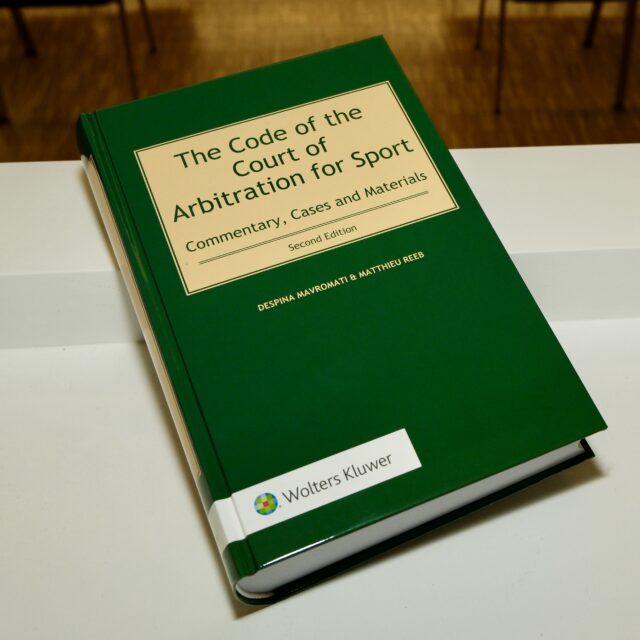
On 9 September 2025, the Court of Arbitration for Sport (CAS) hosted an event to launch the second edition of The Code of The Court of Arbitration for Sport – Commentary, Cases and Materials by Despina Mavromati & Matthieu Reeb (Wolters Kluwer 2025).
This book is a follow up to the first edition published in 2015 and includes comprehensive commentary on updated jurisprudence, CAS rules, landmark rulings and the latest evolutions in sports arbitration. It also serves as an indispensable guide to CAS proceedings for practitioners, arbitrators and scholars of sports law.
During the event, CAS arbitrator Prof. Luigi Fumagalli and ICAS representative Corinne Schmidhauser OLY spoke alongside the co-authors.
This judgment addresses the complex interplay between the jurisdiction of the FIFA DRC and CAS on the one hand, and national labour courts on the other, and is significant in several respects. In setting aside a CAS award in a football employment dispute in Hungary, the SFT confirmed that Clause 49 grants exclusive jurisdiction to the Hungarian labour courts for employment disputes, irrespective of the clause’s imprecise wording or of the international character of the dispute.
Facts
An employment dispute arose in 2022 after a contract signed between Hungarian club FC A (“the Club”). and player B (“the Player) from 2020 until 2023. As per Clause 49 of their contract, “The Parties agree that they shall make efforts to settle (…). If these efforts fail (…) the Parties may turn to the organizational units with MLSZ or FIFA scope of authority, in case of labour dispute to the Administrative and Labour Court having competence and scope of authority, and in all other disputes arising out of their legal relationship the Parties stipulate the exclusive jurisdiction of the Sports Standing Arbitration Court based on the Article 47 of the Sports Law. (…)” (emphasis added).
In parallel, Article 22(1)(b) FIFA RSTP (2022 edition) stipulates that FIFA is competent to hear employment-related disputes of an international dimension, unless the parties have opted in writing for an independent national arbitration tribunal that satisfies certain requirements (equal representation, fair proceedings, etc.).
The Player filed a claim before the FIFA DRC after terminating the contract with immediate effect, claiming salary and damages. In 2023, the FIFA DRC partially upheld the claim and ordered the Club to pay compensation.
The Club subsequently appealed to the CAS, arguing that the FIFA DRC lacked jurisdiction due to the exclusive jurisdiction of the Hungarian labour courts and that a claim was already pending before the Hungarian Labour Court. In September 2023, the Club informed CAS that the Hungarian Labour Court had rendered its final judgment holding that the Player had terminated the employment contract unlawfully.
The CAS found that FIFA DRC had jurisdiction and partially upheld the claim.
The Motion to set aside the CAS Award
In its subsequent motion to set aside the CAS Award against the Player and FIFA, the Club relied on lack of jurisdiction (Article 190(2)(b) PILA) as well as on a violation of res judicata (Article 190(2)(e) PILA). However, the SFT, having confirmed the lack of jurisdiction, did not examine the res judicata argument.
With respect to the lack of jurisdiction, the Club did not allege “the arbitral tribunal’s lack of jurisdiction” but rather the “dismissal of the player’s claim on the grounds of lack of jurisdiction” (“die Abweisung der Klage zufolge Unzuständigkeit.”). Interestingly, the SFT held that the interpretation of the disputed Clause 49 was admissible, however the request of dismissal of the Player’s claim due to lack of jurisdiction was inadmissible.
The SFT reiterated that the ground for challenge of Article 190 (2) b PILA only covers the jurisdiction of the arbitral tribunal (in casu the CAS) that rendered the contested decision and not the instance prior to the CAS (e.g. the first-instance non-arbitral proceedings (at 4.2).
However, in this case the claimant did not contest FIFA’s jurisdiction but rather CAS’ (wrong) reliance on Article 22 RSTP, which according to the Club was rendered inapplicable due to a valid opting-out in favour of the Hungarian Labour Court. In order to determine this, the SFT had to interpret Clause 49 and whether there is any other court alongside the Hungarian Labour Court, so that the Club’s claim fell within Article 190 (2) b PILA.
The Findings of the SFT
The SFT confirmed the Sole Arbitrator’s finding that the CAS’ appellate jurisdiction cannot extend beyond that of the internal FIFA body and its jurisdiction depends on whether there is a valid arbitration agreement in favour of the CAS (and FIFA) for this international employment dispute (at 5.3).
Restrictive Interpretation of the Waiver to the State Court Jurisdiction
The SFT reiterated that an arbitration agreement waives the state court jurisdiction and limits venues of appeal, so that such waiver should not be easily assumed, requiring a restrictive interpretation (at 5.4). In essence, the SFT considered that the interpretation of Clause 49 made by the CAS (i.e. whether the Parties had derogated the FIFA DRC’s jurisdiction by a valid opting-out in favour of state courts) failed to consider the aforementioned restrictive interpretation of the waiver of state court jurisdiction. As such, the Sole Arbitrator wrongly considered that the jurisdiction of Clause 49 for the state Administrative and Labour Court was invalid or at least not exclusive (at 6.1).
Lack of Precedent in Arbitration: Yes, but…
Another noteworthy point is that the SFT had already examined Clause 49 on three prior occasions (see also my note on an earlier case here). Although the factual background differed – since those cases concerned players appealing CAS decisions that had declined FIFA DRC jurisdiction over the merits – the substantive interpretation of the clause itself remained unchanged (at 6.2). In fact, in all three cases, the SFT had confirmed that Clause 49 provided for the exclusive, rather than merely alternative, jurisdiction of Hungarian state courts for employment disputes (4A_430/2023 of 23 February 2024 at 5.5).
As such, and notwithstanding the lack of precedent in arbitration, the present case raised the exact same question related to Clause 49 and there were no “different factual circumstances” requiring a different assessment (cf. 4A_460/2024 of 10 March 2025 at 1).
Impact of Voluntary and Compulsory Arbitration on the Waiver of State Court Jurisdiction
The SFT then turned to Clause 49, noting that its nature as a standard, non-negotiable clause did not distinguish the present case from the three earlier ones. Importantly, it emphasized that the discussion around voluntary versus compulsory arbitration becomes relevant only where the parties choose arbitration in place of state court jurisdiction, not the reverse. This is logical because arbitration constitutes a departure from the ordinary recourse to state courts: what matters, therefore, is the restriction of access to judicial remedies resulting from a mandatory submission to arbitration, rather than the hypothetical imposition of “forced” state court proceedings (at 6.4.3).
On the other hand, the fact that Clause 49 was standard in these contracts would only affect the way of interpreting it, i.e. following principles of objective / statutory interpretation (at 6.3.1 and 6.3.3).
The distinction between international and domestic employment disputes was found to be equally irrelevant.
Alternative Jurisdiction of State Courts
With respect to the argument that Clause 49 would only confer alternative jurisdiction, the SFT reiterated its findings in the other three previous cases considering that neither the word “may” nor the imprecise description of the “Administrative and Labour Court” would change the confirmed SFT interpretation of Clause 49 as an exclusive jurisdiction clause in favour of the competent Hungarian labour court (cf 4A_64/2025 of 16 June 2025 at 3.3).
Finally, the SFT considered irrelevant the Player’s argument who had informed the Club that he would seize the FIFA DRC and the Club had not objected, to the extent that the latter contested FIFA DRC’s jurisdiction from the outset of the CAS proceedings, so that the Club’s conduct could not amount to an “Einlassung” or an abuse of rights (at 6.6).
Some Takeaways
This judgment is significant in many respects. First, it confirms that Clause 49 grants exclusive jurisdiction to Hungarian labour courts for employment disputes, regardless of the imprecise formulation of the clause or of whether the dispute is international.
It equally reaffirms the scope of Article 190(2) b PILA, which only extends to the jurisdiction of CAS and not of previous non-arbitral bodies; in the present case, however, the question was whether Clause 49 allowed the CAS to accept jurisdiction and thus made the matter fall squarely within Article 190 (2) b PILA.
The ruling further reiterates SFT’s jurisprudence requiring a restrictive interpretation of arbitration agreements that waive state court jurisdiction.
Interestingly, this SFT judgment clarifies that the distinction between voluntary and compulsory arbitration is not relevant where the clause preserves state court jurisdiction. Moreover, parties cannot be held to have tacitly waived jurisdictional objections (“Einlassung”) by mere silence and are not required to raise objections before the initiation of the arbitration proceedings.
In practical terms, this SFT judgment consolidates a series of SFT judgments based on the interpretation of Clause 49, signalling that Hungarian state labour courts retain exclusive competence for employment disputes (national and international) unless there is an explicit and unequivocal agreement to arbitrate within the FIFA/CAS system.
As such, even though arbitration does not follow a strict system of precedent, the SFT confirmed that when a case raises the exact same issue – as here with Clause 49, whose wording had already been examined in earlier SFT judgments – it should normally be decided in the same way, without departing from prior federal case law.
The wider interest of the Seraing Judgment lies primarily in the extent of reviewability of CAS awards by EU-based national courts when it comes to rights falling within EU public policy.
A lot has already been said and written about said judgment, specifically on its potential effect on CAS arbitration and the international dispute resolution more generally. For a more detailed timeline of the case since the beginning you can see my earlier note on the Swiss Federal Supreme Court (SFT) judgment against the Seraing CAS Award;see also TAS 2016/A/4490).
Very briefly, the case started in 2015 when FIFA enacted its ban on Third Party Ownership (TPO) agreements arguing that they threaten, among others, integrity, club independence and fairness. FIFA then imposed a ban imposed on the Belgian Club Seraing, which was partially confirmed – following a detailed review of the compatibility of the TPO regulations with EU law – by the CAS in the Seraing CAS award and the SFT.
Seraing also opened proceedings before the Belgian courts, invoking a breach of EU competition law and EU fundamental freedoms. In 2023, the Belgian Court de Cassation filed a request for preliminary ruling to the Court of Justice of the EU (CJEU, the Court), on the extent to which national courts can review CAS awards when compulsory arbitration is involved and EU public policy rights are at stake. AG Tamara Ćapeta issued her opinion in January 2025 (see my note on the opinion here) and the Court issued its decision on 1 August 2025. Below are some core elements of the judgment, followed by considerations on the potential implications, limitations and perspectives for CAS and the international sports dispute resolution system more generally.
2. Compulsory arbitration and effective judicial review: some not so new findings
In essence, most of the findings of the Seraing Judgment are not new and have already been addressed in previous judgments, either by the CJEU itself or (based on a different legal framework) by the European Court of Human Rights (ECHR).
Compulsory Arbitration – Is it compatible with EU law?
In its analysis, the Court recalls that recourse to arbitration is possible insofar as it is consistent with EU public policy, along with the possibility to obtain interim relief and to have a reference made to the Court of Justice for a preliminary ruling. Similar to other judgments (e.g. Pechstein ECHR Judgment, Semenya ECHR Judgment, ISU Judgment), the Court confirms the legitimacy of compulsory arbitration in some types of CAS proceedings, highlighting its significant advantages (see e.g. Seraing, §94, with reference to the European Superleague Company (ESL) Judgment, §75 and §142).
Similar to other judgments (e.g.Semenya ECHR Judgmentand the Mutu & Pechstein ECHR Judgment) the CJEU finds that compulsory CAS arbitration entails consequences (see the reference to the Mutu & Pechstein ECHR Judgment in Seraing, §80), only that in this case they are linked to the effective judicial review of rights falling within EU public policy rather than the enhanced institutional and procedural guarantees or the level of review of CAS awards by the SFT based on Article 6 of the Convention.
Effective Judicial Review: Must EU-based courts be able to review CAS awards in cases involving EU public policy?
Similar to the ISU Judgment (Case C-124/21 P), the Seraing judgment deals with the autonomy of sports federations and touches upon its cardinal principle of effective judicial protection. In both judgments, the Court acknowledged the numerous advantages linked to a centralized sports arbitration system in terms of consistency, integrity and efficiency, even if said advantages – and the autonomy of arbitration – cannot override the primacy of effective judicial protection within the EU.
The Court further recalls that effective judicial protection by member states (Art. 19(1) TEU) obliges EU national courts to interpret and apply EU law and meet effective judicial protection standards, while the right to an effective remedy (Art. 47 Charter) means effective judicial review of acts infringing rights or freedoms conferred by EU law.
Importantly, in the present case, the Court firmly (and rightly, in my opinion) departs from the AG Ćapeta Opinion in the scope of rights amenable to review by the EU national courts, limiting them to the core of what constitutes EU public policy, i.e., competition law and fundamental freedoms (therefore not all EU-based rights). As such, this is nothing new or revolutionary (so far).
Furthermore, like in the Semenya ECHR judgment, the focal point for the departure from the virtually all-mighty autonomy of arbitration is the compulsory character of certain sports arbitration disputes / a system requiring compliance for participation in competitions.
The Court therefore considers that in cases where CAS arbitration is imposed upon the parties, effective judicial review by EU-based national courts should be possible when the case touches upon a sports-related economic activity within the EU. National courts could also have the right to grant interim relief to comply with such effective judicial protection(§ 106 f.).
3. So what is new? Scope of review of EU national courts
What powers do EU-based courts have when reviewing CAS awards?
The novelty lies not so much in the control of compatibility with the EU public policy as such – which is already possible through the New York Convention of 1958 (NYC58) public policy angle – but rather its scope and the powers conferred to national courts. Accordingly, the Court holds that EU-based national courts could not be limited to merely determining whether such infringement of EU public policy exists (or not) and awarding damages for the harm caused: they should also have the power to invalidate any rules that hinder such effective judicial protection as regards individuals, within the framework of their respective powers and in accordance with the applicable national provisions (Seraing, §102-103).
National courts will therefore be able to review the interpretation of those principles or provisions that fall within the boundaries of EU public policy, the legal consequences and the legal classification given, to the facts as they were established and assessed by the arbitration body (Seraing, §86 and §95).
Interaction with International Arbitration Law – How does the New York Convention (NYC 1958) fit with EU principles of effective judicial protection?
When it comes to the application of the NYC58 to compulsory CAS arbitration, the Court finds a correlation (“goes hand in hand”) rather than a conflict between the effective judicial review principle and the review available under the NYC58 of the compatibility of EU public policy through its public policy angle (cf also the Eco Swiss Judgment, §37).
Importantly, however, the Seraing judgment concludes that a national rule granting res judicata effect to a final arbitral award (valid only between the parties) and the ensuing probative value of the award (towards third parties) should be disregarded in the name of effective judicial protection under EU law (Seraing, §120).
4. Not a full / de novo review – limited by the factual findings of the CAS award
Notwithstanding the enlarged review mentioned above, national courts will still be bound by the factual findings established by the arbitral tribunal and the national court will not proceed to a de novo review: This means that, in the case at hand, the Belgian court will have to determine the validity of the TPO rules based on the factual findings as they were established in the CAS Award.
It is noteworthy that the CAS panel in the Seraing CAS Award (composed of three eminent EU-qualified CAS arbitrators) dedicated a large part of its analysis to the compatibility of the TPO ban with EU competition law and the fundamental freedoms falling within EU public policy. Interestingly, the CAS award included several factual findings that will eventually bind the Belgian court (c.f. §106 of the Seraing CAS Award, where the Panel considered that the Club had not adduced any convincing element to refute the TPO regulations’ legitimate objectives raised by FIFA).
5. Implications, perspectives and concluding remarks
Overall, the Seraing Judgment essentially confirms and builds upon the ISU Judgment, while it departs from AG Ćapeta’s opinion on the scope of the rights that may be reviewed (re-opened) by EU national courts, limiting said control to the hard core of what constitutes “EU public policy”. In this regard, it seems to somehow dilute the internationally recognized principle of res judicata effect through the enhanced review of EU public policy principles, even though not completely undermining the principle of arbitration autonomy. By so doing, it incorporates the principle of effective judicial review into the sports arbitration system, when arbitration is compulsory and for the specific category of disputes that touch upon EU public policy.
For this reason, and notwithstanding the enlarged review by national courts, the Seraing Judgment has a relatively limited practical scope within the wide range of CAS disputes currently being decided before the CAS, as most CAS cases are either non-EU-law-related or fall outside the compulsory arbitration considerations of the Court.
Still, for the scope of disputes covered by the Seraing Judgment, the main risk is the delay in finality and the potential fragmentation of the international sports dispute resolution system, the advantages and efficiency of which have also been highlighted not only by the CJEU in this judgment but also by the ECHR (see also my note on the Semenya Grand Chamber Judgment).
To the extent that CAS arbitrations have their seat in Lausanne, Switzerland, the courts of which cannot file a request for preliminary ruling before the CJEU, the offer of an alternative seat to an EU country could offer some advantages. It has been suggested (and already adopted by UEFA in certain types of disputes following the ISU Judgment) to amend Article R28 of the CAS Code and allow for an alternative CAS seat in an EU member state (e.g. in Dublin as an English-speaking EU member state) for cases falling within the scope of the Seraing Judgment. In such a case, it should be incumbent upon the parties to choose an EU seat or a Swiss seat for their CAS arbitration. If the parties still opt for a seat in Switzerland, with the efficiency and finality advantages linked thereto, the compulsory element – which plays a crucial role in the considerations of the Court regarding the extent of review – would likely lose some of its relevance.
Since the arbitration seat is not linked to the physical hearing location, no physical move from Lausanne would be needed for the CAS. If such alternative seat is e.g. Dublin (as in the case of UEFA), the Irish High Court (in lieu of the SFT) would be able to formally review the CAS award and potentially file requests for preliminary rulings directly to the CJEU. As such, the parties would naturally seize the courts of that EU state rather than courts in multiple jurisdictions.
All in all, the exact depth of scrutiny by EU national courts will need to be tested in practice. When arbitration is compulsory and the questions raised touch upon the scope mentioned in the Seraing Judgment, the parties’ choice of arbitrators with deep EU law knowledge (from among the CAS list of arbitrators), will be key in order to ensure that awards are resistant to subsequent national court review.
Swiss Federal Supreme Court Judgment of 16 June 2025, A. v. FC B
Motion to set aside CAS Award CAS 2023/A/9923 of 17 December 2024
This case forms part of a series of SFT judgments relating to the “famous” Clause 49 in Hungarian football contracts of employment (see also my note on the more recent – and important – case 4A_92/2025 here). This case concerned the termination, by a player (the Player) of his contract of employment with Hungarian Football Club (Club B) after a disagreement regarding his relegation to the second team and alleged contractual breaches. The Player filed a claim with the FIFA Dispute Resolution Chamber (DRC), which asserted jurisdiction under Art. 22 RSTP and awarded him compensation. The Club appealed to the CAS, arguing that Clause 49 of the contract conferred exclusive jurisdiction to the Hungarian Administrative and Labour Court for labour disputes. CAS Accepted the claim and overturned the FIFA decision.
Clause 49 read as follows: “49. The Parties agree that they shall make efforts to settle their possible dispute in amicable way by negotiations. lf these efforts fail – in cases determined by the rules of MLSZ and FIFA – the Parties may turn to the organizational units with MLSZ or FIFA scope of authority, in case of labour dispute to the Administrative and Labour Court having competence and scope of authority, and in all other disputes arising out of their legal relationship the Parties stipulate the exclusive jurisdiction of the Sports Standing Arbitration Court based on the Article 47 of the Sports Law. The number of arbitrators is three; the procedure is determined by the Procedural Rules of the Arbitration Court.”
In the motion to the SFT, the Player invoked an erroneous judgment on jurisdiction (Art. 190 para. 2 b PILA), arguing that the dispute was of international dimension and that FIFA had correctly asserted jurisdiction based on Art. 22 para. 1 (b) RSTP unless the parties opted clearly and expressly in favour of a national arbitration body, conditions that the Player considered as not fulfilled.
The SFT confirmed the CAS’ finding that its jurisdiction as an appellate body could not go beyond the first instance jurisdiction (FIFA DRC) (at 1.1). It further confirmed that FIFA jurisdiction enshrined in Art. 22 (1) RSTP is not absolute but depends on the choice of the parties – who could opt for the exclusive jurisdiction of the state courts. In this regard, the CAS had rightly interpreted Clause 49 of the contract, which foresees different competent instances such as MLSZ, FIFA, Administrative and Labour Court and a “Sport Standing Arbitration Court” depending on the scope of the dispute. More specifically, the jurisdiction of the Hungarian Administrative and Labour Court was foreseen for labour law disputes, whereas the Sport Standing Arbitration Court for all other disputes. Therefore, a literal interpretation would lead to the jurisdiction of Hungarian state courts for labour law disputes such as the present dispute. The CAS also considered the fact that the football player was an experienced player aware of the terms of the contract he had signed and that there was no structural imbalance between the parties.
This is an interesting SFT judgment which clarifies the widely discussed “alternative” jurisdiction of Art 22 (1) b RSTP, providing for both the FIFA DRC and for state courts. Accordingly, and other than suggested by the Player, the SFT did not consider that there was no consent of the parties to Clause 49. The judgment confirmed that (experienced) players remain bound by forum-selection clauses in standard contracts, absent clear evidence of imbalance or coercion. Moreover, the SFT stressed that the material element in the interpretation of the jurisdiction clause was the referral to state courts, irrespective of the unclear designation of the “Administrative and Labour Court”. This brings us back to the well-established federal case law whereby the waiver to state court jurisdiction should not be easily assumed, with the SFT following a restrictive interpretation of such waiver. This applies irrespective of who seizes the arbitral tribunal, hence the distinction between employee or employer cannot be considered to be decisive.
Following the adoption, by World Athletics, of the “DSD Regulations”, South African champion Caster Semenya (Semenya, the Athlete) was excluded from international women’s middle-distance races unless she medically – or surgically – lowered her naturally high testosterone levels. The Athlete lost before the Court of Arbitration for Sport (CAS) in April 2019 and the Swiss Federal Supreme Court (SFT) in 2020 (see my note here) and subsequently filed an application against Switzerland with the European Court of Human Rights (ECHR). In July 2023, the ECHR issued its judgment (the First Semenya Judgment) considering that Switzerland had violated Articles 8, 13, and 14 (privacy, effective remedy, non-discrimination) and indirectly Article 6 (right to a fair hearing) of the European Convention on Human Rights (the Convention).
Switzerland subsequently referred the case to the ECHR Grand Chamber, whose final judgment was delivered on 10 July 2025 (the Grand Chamber Semenya Judgment). Below I address some key findings of this interesting judgment -but also what was left undecided and why – along with some takeaways and potential implications for the CAS and the SFT.
2. Main legal points addressed in the Grand Chamber Semenya Judgment
As will be shown in more detail below, the Grand Chamber departed from the findings of the First Semenya Judgment and considered that the SFT had no jurisdiction over the Athlete’s substantive grievances (based on Articles 8, 13 and 14) to the extent that she is a South African athlete and the International Federation (World Athletics) is based in Monaco. As such, all these substantive violations of the Convention alleged by the Athlete were left undecided by the Grand Chamber.
On the other side, the Grand Chamber found that Article 6 did apply, finding by fifteen votes to two that the Athlete had been deprived of her right to a fair hearing. Similar to the recent Seraing CJEU Judgment (albeit based on a different legal framework), the central point of the Grand Chamber’s analysis was the standard of effective judicial review of fundamental human rights when arbitration is compulsory: in so doing, the Grand Chamber included a large number of references to its own case law (Mutu & Pechstein v. Switzerland) but also to the case law of the CJEU, in particular the ISU Judgment (when it comes to the standard of effective judicial review of EU public policy provisions).
The Grand Chamber considered that the SFT, in the particular circumstances of the case (where fundamental civil rights of bodily integrity, dignity and discrimination are at stake) should have conducted a “particularly rigorous examination” instead of the narrow control through the public policy angle, which however is a well-established and longstanding practice of the SFT under Article 190 para. 2 (e) PILA.
3. Compulsory arbitration and effective judicial review: Another consequence of compulsory arbitration under Article 6 ECHR?
Similar to previous ECHR and CJEU judgments (Mutu & Pechstein v. Switzerland, ISU v. Commission, Seraing v. FIFA) the decisive argument for the Grand Chamber’s finding was the compulsory character of arbitration.
The Grand Chamber albeit recalled the numerous advantages of arbitration and, more specifically, sports arbitration (§ 195 ff.) but also the findings of its Mutu & Pechstein Judgment when it comes to the advantages of sports arbitration (“a specialized body which is able to give a ruling swiftly and inexpensively”, “recourse to a single and specialized international arbitral tribunal facilitates a certain procedural uniformity and strengthens legal certainty” § 199). However, the Grand Chamber also noted the regulatory character of (private) sports federations and the structural imbalance between sportspersons and sport governing bodies in the international sports arbitration system that would justify an enhanced review of the CAS awards by the SFT, which did not occur in this case. Among others, the Grand Chamber criticized the SFT for simply rejecting, without thoroughly examining, the Athlete’s arguments based on the SFT Matuzalem Judgment (the only judgment where the SFT accepted a violation of substantive public policy), even though both cases bore significant similarities (Grand Chamber Semenya Judgment, § 235).
Accordingly, in those cases where the athletes are compelled to bring their case to the CAS (compulsory arbitration), when fundamental civil rights are involved, the review by the SFT should be “particularly rigorous” as opposed to the very strict control within the realms of public policy shown by the SFT so far. The SFT will therefore need to impose higher scrutiny standars – again not for all CAS awards but for those cases involving compulsory arbitration and fundamental human rights.
3. What was left undecided and what happens next
As seen above, the substantive claims of Semenya, i.e. whether the DSD regulations themselves are discriminatory or violate privacy (Articles 8, 13 and 14), were left undecided by the Grand Chamber, considering that their substantive assessment was reserved for domestic or sports tribunals. The Grand Chamber thus (rightly, in my opinion) departed from the First Semenya Judgment on the extraterritorial aspects of the case and accepted that only the arbitration proceedings had taken place in Switzerland (hence the territorial link to Article 6, relating exclusively to procedural rights). Accordingly, neither the events in question (Athlete’s ineligibility following the DSD Regulations) took place in Switzerland nor the parties were Swiss residents or nationals, and Switzerland had no influence on the activities of World Athletics, itself based in Monaco (Grand Chamber Judgment, § 136 ff). Interestingly, the Grand Chamber differentiated this case from the Platini ECHR Judgment, where FIFA was based in Switzerland. Moreover, the compulsory arbitration argument raised by the Athlete was not sufficient to establish extraterritorial jurisdiction (§ 149).
The Grand Chamber further refused to review the Athlete’s claim based on Article 3 of the Convention to the extent that this was already found inadmissible in the First Semenya Judgment.
Another noteworthy element was that the claim questioning the independence of the CAS was also not reviewed by the Grand Chamber because the Athlete, in her application to the ECHR, had merely relied on Article 6 para. 1 and Article 13 of the Convention arguing a lack of effective remedy rather than a lack of access to an independent and impartial tribunal (Grand Chamber Semenya Judgment, § 87-89).
4. Concluding remarks
The case is not over, as it will return to the SFT which will conduct the “particularly vigorous review” of the CAS award as dictated by the Grand Chamber. The DSD will remain in force as the Grand Chamber did not invalidate them. Even if the SFT concludes that the CAS Panel violated public policy by not invalidating the DSD Regulations and finding violations of the Convention, the CAS award could be annulled but the DSD Regulations as such would not be automatically invalidated. Meanwhile, the World Athletics Council approved in March 2025 a reform of its eligibility framework, replacing the contested testosterone-suppression regime for DSD athletes with a one-time SRY gene test, applicable from 1 September 2025. The test, determines the Y chromosome and establishes a biological rather than a hormonal criterion for participation in the female category at world ranking competitions. Unlike the previous DSD Regulations, which required lowering the athletes’ testosterone levels in order to be eligible to compete, a positive SRY result excludes the athlete from elite female competition, irrespective of hormonal treatment. This regulatory change will likely have consequences for the broader legal debate between sporting fairness and fundamental rights.
It is undeniable that the Semenya Grand Chamber Judgment is important to the extent that it now reframes the level of judicial review in compulsory sports arbitration. Even though the Grand Chamber Semenya Judgment does not directly affect the CAS, the latter is still indirectly concerned in that it will be subject to a more robust judicial review of its awards by the SFT. It seems that athletes and other parties challenging rules on the basis of violation of fundamental human rights in compulsory arbitration proceedings will have the right of an extended review by the SFT, something that was denied .
The “particularly rigorous” examination expressed by the Grand Chamber will still need to be tested in practice: will it be more akin to the control of “arbitrariness” (a wider standard of review of manifestly unjustified decisions applicable to domestic arbitration only) or an even more thorough control of the Convention’s fundamental rights? The Grand Chamber criticised in particular the narrow scope of public policy according to the SFT, which is only violated if the consequences of the award (and therefore not the assessment of the arbitral tribunal) infringe public policy. Interestingly, pending the Semenya case before the Grand Chamber, the SFT showed reluctant to accept a direct application of the ECHR provisions – beyond the exhaustively enumerated grounds of Article 190 para. 2 PILA (see my note here). In any event, the SFT can still not be converted into an appellate tribunal or perform a de novo examination.
All in all, this new judgment is a welcome development to the extent that it raises the bar of review by the SFT but does not necessarily imply a further or significant delay of CAS awards or fragmentation of the centralized sports dispute resolution system by allowing claims in different fora (as the Seraing CJEU Judgment did).
Swiss Federal Supreme Court Judgment of 20 May 2025, A. v. UIB
Motion to set aside CAS Award CAS 2020/A/7509 of 18 November 2024
The case concerns a former Russian biathlete, multiple Olympic medallist, whose Athlete Biological Passport (ABP), based on 17 blood samples collected between 2010 and 2014, showed highly abnormal haemoglobin values suggesting blood manipulation. After a multi-year expert review process – including four successive joint expert reports – the International Biathlon Union (IBU) brought the case before the CAS Anti-Doping Division (CAD). In October 2020, CAD found an anti-doping rule violation (ADRV), imposed a four-year suspension, and disqualified all results from 2010–2014. The athlete appealed to the CAS Appeals Division and, in parallel, filed a motion with the Swiss Federal Tribunal (SFT), which the SFT dismissed as inadmissible in June 2021 (see my note on the SFT 4A_612/2020 here). After CAS confirmed CAD’s jurisdiction in 2022, the SFT again dismissed the athlete’s challenge (see my note on SFT 4A_232/2022 here). The CAS ultimately rejected the appeal in November 2024, confirming the ADRV, which led to the present motion before the SFT.
In essence, the CAS Panel held that all ABP samples were valid and found that the genetic variation invoked by the athlete (EGLN2 mutation) could not explain the haemoglobin patterns. It accepted as admissible the genetic expert report prepared at WADA’s request and reasoned that, even hypothetically assuming elevated baseline haemoglobin, the significant fluctuations documented remained unexplained. The Panel highlighted circumstantial indicators: peaks coinciding with major competitions and the athlete’s status as a “protected athlete” in the Sochi-era Russian doping system. It concluded, to its comfortable satisfaction, that an ADRV occurred between 2010 and 2014 and confirmed the full set of sanctions.
Before the SFT, the athlete relied exclusively on material public policy (Art. 190 para. 2 (e) PILA), framing his arguments as violations of the presumption of innocence, the in dubio pro reo principle, and legal certainty. He claimed that CAS had improperly shifted the burden of proof, failed to resolve scientific doubt regarding genetic explanations, and relied on evidence from long-past events in breach of legal security. He also argued that the SFT should directly apply Art. 6 ECHR in light of the ECtHR’s Semenya judgment.
The SFT rejected the appeal. Similar to other judgments, and since the Semenya ECHR judgment was still pending before the Grand Chamber (see my note here) it reiterated that Art. 6 ECHR cannot be invoked directly in challenges against international arbitration awards. Moreover, disciplinary proceedings of private sports bodies do not trigger the criminal-law standards of presumption of innocence or in dubio pro reo. It also noted that CAS had no reasonable doubts regarding the ADRV after assessing the full evidentiary record. The allegation of breach of “legal certainty” was dismissed as unfounded, since the athlete had been informed of the investigation as early as 2017, and the applicable 10-year prescription period had not expired. The SFT held that none of the athlete’s objections reached the extremely high threshold required to establish a violation of Swiss ordre public, and the appeal was therefore rejected.
Swiss Federal Supreme Court Judgment of 20 May 2025, A. v. IBU
Motion to set aside CAS Award CAS 2020/A/6834 of 9 September 2024
The case concerns a former elite Russian biathlete (the Athlete) sanctioned by the International Biathlon Union (IBU) for an anti-doping rule violation based on data extracted from the Moscow laboratory’s LIMS system. According to the IBU, her 22 March 2013 urine sample initially tested positive for a prohibited substance (ostarine) but was falsely recorded as negative in ADAMS, which was later discovered through the LIMS 2015 data. After disciplinary proceedings, the IBU suspended the athlete for two years and disqualified all results from March 2013 to her retirement. The Athlete appealed to the CAS, which rejected her case in September 2024, finding the LIMS 2015 data authentic and concluding that the Athlete had used a prohibited substance.
In her subsequent motion for annulment to the SFT, the Athlete invoked a violation of her right to be heard (Art. 190 para. 2 (d) PILA) and violation of public policy (Art. 190 para. 2 (e) PILA based on the principle in dubio pro reo, claiming that the panel had relied on insufficiently reliable evidence and that doubts should have favoured her innocence.
The SFT dismissed both grievances. First, it held that the CAS had thoroughly analysed the evidence—including the re-analysis statistics highlighted by the Athlete—and had implicitly but clearly rejected her arguments on the alleged unreliability of the LIMS system. Second, and similar to several other prior judgments, the SFT confirmed its case law that the ECHR presumption of innocence does not apply directly to discplinary proceedings of private sports bodies. With respect to the arguments raised by the Athlete following the ECHR Semenya judgment, the SFT repeated that the Grand Chamber ECHR judgment was, at that time, still pending; interestingly, said judgment was issued shortly afterwards, i.e. in July 2025 (see my note here) so that it will be interesting to see the SFT’s reaction to this argument in its subsequent judgments, now that the ECHR Semenya judgment is final.
All in all, the SFT judgment repeats the well-established federal jurisprudence on the very narrow scope of review within the scope of public policy (it should be the result, not the reasoning of the CAS award, that should be incompatible with Swiss public policy) and the non-application of criminal-law principles to sports disciplinary cases (see also the similar SFT 4A_546/2024 of 20 May 2025).
This is the SFT judgment following the CAS award involving Croatian professional football player Mario Vušković (the Athlete) and NADA, WADA and the German Football Federation (DFB). The Athlete had undergone an out-of-competition doping test and the results showed an adverse analytical finding for prohibited substance rEPO in November 2022. He was provisionally suspended a couple of days later, whereas the opening of the B sample confirmed the presence of rEPO in December 2022, and the result of the second expert opinion was also issued shortly afterwards. In March 2023, the Athlete was issued a two-year suspension from the federation’s sports tribunal (as of 15 November 2022), but after an appeal from all parties involved (the Athlete, NADA, WADA and DFB), the CAS dismissed the Athlete’s appeal and confirmed WADA / NADA’s appeal, imposing 4 years on the Athlete.
In the subsequent motion to the SFT, the Athlete invoked a violation of his right to be heard denying his right to submit evidence. The SFT held that the Athlete should have expected a full review of the evidentiary record, however it is inadmissible to invoke an incorrect assessment of the evidence before the SFT.
The SFT further dismissed the Athlete’s argument that the CAS did not inform the parties prior to the hearing that it would rely decisively on a particular element of the file for its decision, to the extent that said element was on record and was the subject of an oral hearing. It follows that the CAS does not need to draw the parties’ attention to a specific element of the file.
With respect to the alleged violation of public policy, the Athlete invoked a violation of Art. 27 para. 2 CC (excessive commitment) considering that he was forced to submit to the SAR-PAGE method, which is used to determine whether an athlete’s urine sample should be considered positive or negative for rEPO. More specifically, the CAS panel, composed of non-medical experts, was called to issue sanctions based on the examination of technical images. The Athlete also alleged a violation of public policy to the extent that WADA prohibits the eight experts in its EPO Working Group from assisting him, preventing him from providing exculpatory proof and violating his personality rights.
The SFT swiftly dismissed these arguments confirming its longstanding case law whereby the CAS panel may issue “far-reaching sanctions” against an athlete and enjoys broad discretion in doing so (cf. SFT 4A_318/2018 of 4 March 2019, paras. 4.5.2 and 4.5.4). The interpretation of samples forms part of the examination of whether an anti-doping rule violation occurred and this is not incompatible with ordre public. Similarly, there is no proof of public policy violation through the allegations concerning the purported impossibility of proving the Athlete’s innocence, as the presumption of doping under the “strict liability principle”, and the athlete’s rebutting that presumption having both been accepted by the SFT (SFT 134 III 193 para. 4.6.2.3; SFT 4A_528/2022 of 13 March 2023 para. 4.3.1). The assertion that the Athlete was not capable of submitting evidence was also discarded in view of the fact that the Athlete himself had submitted expert reports from several experts.
Interestingly, the argument invoking WADA rendering the exculpatory proof impossible does not lead to a violation of public policy, since it should be the CAS itself – and therefore not a party – that would rende the exculpatory proof impossible. The subsequent question of whether the appellant succeeded in producing exculpatory evidence pertains to the assessment of evidence, which is not subject to ordre public review by the Federal Supreme Court (BGE 144 III 120 para. 5.1).
Finally, with respect to the principles in dubio pro reo and lex mitior, the SFT repeated its longstanding jurisprudence that disciplinary measures imposed by private sports federations in cases of doping findings are not to be assessed under criminal law principles such as the presumption of innocence or the principle of in dubio pro reo (judgments 4A_528/2022 of 13 March 2023 para. 4.3.3; 4A_470/2016 of 3 April 2017 para. 3.4; 4A_178/2014 of 11 June 2014 para. 5.2; each with references) and that, in any event, the CAS panel did not have any doubts as to the doping violation.
The allegation that the CAS violated the principle of lex mitior was also dismissed as he could not establish how the new version applied by the CAS was actually harsher than the previous version, and even questioned whether the violation of this principle could fall within public policy altogether. Finally, the Athlete relied on Art. 6 ECHR, and more specifically to the right to a fair trial. However, the SFT found that the Athlete did not meet these strict requirements by merely equating the alleged violation of a fair trial under Art. 6 ECHR with the objections raised through the previous grounds (alleged violation of the principles in dubio pro reo etc.) and discarded this argument as inadmissible.
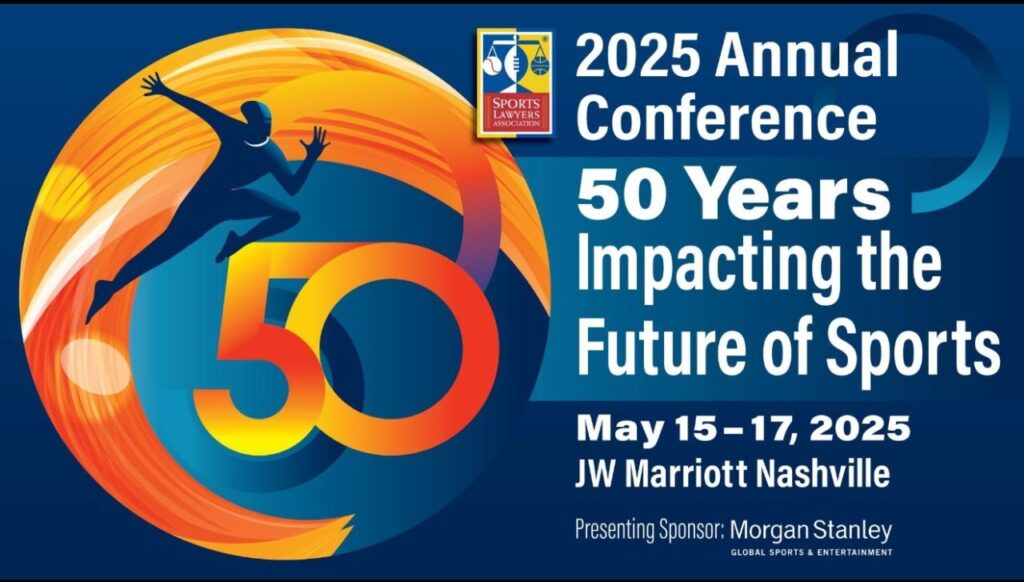
50th SLA Annual Conference in Nashville, Tennessee and Seminar for CAS Arbitrators
The 50th Annual Sports Lawyers Association (SLA) Conference took place in Nashville from 15–17 May 2025, bringing together hundreds of legal professionals from around the world to discuss current trends and challenges in sports law.
As part of the conference program, an internal seminar for CAS arbitrators was held, featuring a panel of distinguished speakers including Dr. Despina Mavromati, ICAS Vice President Mr. Michael Lennard, CAS Director General Mr. Matthieu Reeb, and CAS Manager of Education Programs Mr. William Sternheimer.
The seminar addressed a broad range of procedural and substantive issues arising in CAS arbitration, including questions of standing, the independence and impartiality of arbitrators, the handling and assessment of evidence, and the use of expert opinions. It provided an important platform for CAS arbitrators to exchange perspectives, deepen their understanding of current procedural challenges, and contribute to the continued evolution of CAS jurisprudence.
More information on the SLA Conference can be found here.
Swiss Federal Supreme Court Judgment of 3 March 2025
Motion to set aside CAS Award TAS 2021/A/8388 of 4 December 2024
This case forms part of several FIFA’s wide-ranging ethics proceedings after allegations of systemic sexual abuse within the national football federation of Haiti started in 2020 (see also my note on another related case here). During the investigation, a vice-president of that federation (the Official) was identified as a potential perpetrator and provisionally suspended. In July 2021, FIFA’s adjudicatory chamber issued a life ban and a CHF 100,000 fine, finding that he had committed repeated acts of sexual harassment, abuse, coercion and misuse of authority against women referees over several years. A three-member CAS panel confirmed the violations of the FIFA Code of Ethics, upheld the lifetime ban, and reduced the fine to CHF 35,000, relying in particular on the consistent testimony of a protected victim, supported by additional corroborating evidence.
The subsequent motion to the SFT included primarily allegations of violation of the right to be heard (Art. 190 para. 2 (d) PILA). The Official claimed that the CAS failed to justify its refusal to hear 11 other alleged victims, relied improperly on anonymous testimony, and prevented him from effectively contesting the allegations. He further asserted a breach of procedural and substantive ordre public (Art. 190 para. 2 (e) PILA), contending that the award was based solely on unverified anonymous statements and that it was “arbitrary” to impose a lifetime ban based on the testimony of a single alleged victim.
The SFT dismissed this grievance, considering that the CAS had sufficiently explained why additional witness hearings were unnecessary: the facts deemed proven through the principal victim’s testimony – supported by corroborating evidence from another protected witness and a journalist – were already sufficiently serious to decide the case. The SFT further noted that the CAS had implemented appropriate safeguards for anonymous witnesses (voice distortion, identity checks, supervised questioning) and that the appellant had been able to participate in the examination. Complaints about the CAS’s evaluation of evidence were characterised as impermissible appellate criticisms.
In conclusion, the SFT rejected the ordre public arguments, recalling that neither alleged arbitrariness nor dissatisfaction with the assessment of evidence meets the very high threshold of Art. 190 para. 2 (e) PILA. Anonymous testimony is admissible where procedural protections exist, and the result of the CAS award – upholding a lifetime ban for sexual-abuse misconduct – was not incompatible with fundamental Swiss values. Overall, this judgment confirmed the SFT’s consistent deference to CAS fact-finding in ethics cases and its very narrow approach to reviewing challenges based on procedural fairness and public policy.
Swiss Federal Supreme Court Judgment of 24 March 2025
A. v. B. & C. SRL, Motion to set aside a CAS Award CAS 2022/O/9269 of 22 October 2024
A Swiss professional footballer (A. or the “Player”) had entered into two consecutive agency agreements with a French-registered intermediary (B. or the “Agent”) and a Romanian company (C. SRL; together with B. “the Agents”). Both agreements appointed the Agents exclusively and entitled them to a 10% commission on all employment contracts concluded for the Player. Each contract contained a broad arbitration clause designating the CAS as the sole forum and expressly excluding the applicability of Swiss employment-placement legislation (LSE/AVG). In September 2022 the Player terminated the second agreement, shortly before signing a new employment contract with FC St. Gallen. The Agent initiated CAS proceedings, seeking CHF 207,600 plus a percentage of potential bonuses; the CAS upheld its jurisdiction and partially granted the claim, ordering the Player to pay CHF 100,000.
In his motion to the SFT, the Player argued that the CAS lacked jurisdiction (Art. 190 para. 2 (b) PILA), contending that the Agents, lacking the required Swiss licence under the Arbeitsvermittlungsgesetz (AVG), had only been able to structure the contract as “international” to circumvent Swiss mandatory law, and therefore the arbitration clause should be invalid. Alternatively, he argued that the dispute was not arbitrable or that the arbitration agreement was void due to illegality. In addition, the Player invoked a violation of both procedural and substantive public policy under Art. 190 para. 2 (e) PILA, claiming that the award enforced a “void” contract, disregarded employee-protection norms, and imposed a penalty comparable to “bribery.”
The SFT dismissed the jurisdictional challenge, emphasising that it is bound by the facts as established by the CAS (Art. 105 BGG). Accordingly, alleged breaches of the AVG by the Agents were irrelevant for determining their actual domicile or seat, which was outside Switzerland, thus making the 12th Chapter of the PILA applicable. The SFT also confirmed the arbitrability of the dispute under Art. 177 para. 1 PILA and rejected arguments on the alleged nullity of the arbitration clause, recalling the autonomy of arbitration agreements and considering all the Player’s appellate criticisms as inadmissible. The SFT equally rejected the allegation of public policy violation as it did not find that the award’s outcome, i.e. a damages payment resulting from early termination, contradicted fundamental principles such as pacta sunt servanda or procedural fairness.
Overall, the judgment reinforces settled jurisprudence on the autonomy of arbitration clauses, the narrow scope of public-policy review, and the strict limits on factual reassessment by the SFT. It also confirmed that alleged violations of Swiss licensing or employment-placement rules do not retroactively alter the international character of the relationship nor undermine the validity of an arbitration clause governed by Art. 178 PILA.
Swiss Federal Supreme Court Judgment of 27 March 2025, FC A v. B
Motion to set aside a CAS Award CAS 2021/A/8268 of 31 October 2024
FC A (the Club) and Portuguese Coach B (the Coach) signed an employment contract in 2020 (the Contract). Article 5 of this Contract provided that “If any party for what so ever reason terminates the contract before the end of the contract, the terminating party will pay the other party an amount of EUR 204,000 […] NET of any taxes.” In March 2021, the Club dismissed the Coach, and later that year, in August 2021, the Club won the national championship. Following his dismissal, the Coach filed a claim before the FIFA Players’ Status Chamber (PSC) in April 2021 seeking salaries and compensation. The PSC partially upheld his claim, prompting him to appeal to the CAS. The CAS confirmed the PSC’s findings regarding the salaries and bonus owed and reformed the decision by granting additional compensation for breach of contract and a bonus linked to the Club winning the championship.
The Club filed a motion to the Swiss Federal Tribunal (SFT), invoking solely a violation of public policy under Art. 190 para. 2 (e) PILA and, more specifically, a breach of the principle of pacta sunt servanda. The Club argued that the CAS improperly disregarded Article 5 of the Contract of Employment, which, in its view, clearly governed the compensation due in case of early termination.
The SFT recalled its very limited scope of review under Art. 190 para. 2 (e) PILA and reiterated that public policy is only violated when the result of the award – not its reasoning – contradicts fundamental legal principles. In the present case, the CAS Panel had concluded that the Club had terminated the employment contract without just cause, applying both FIFA regulations and Swiss law. As to the consequences of this breach, the Panel held that Article 5 of the contract was null and void because it contravened Art. 337c para. 1 CO, a mandatory provision, leading the Panel to award a higher compensation. The SFT found no inconsistency in the Panel’s reasoning: although the Panel initially acknowledged that the contractual clause could potentially be valid, it correctly held that, under Art. 341 para. 1 and Art. 362 CO, an employee cannot waive rights arising from mandatory legal provisions during the employment relationship or within one month after its end, and that Art. 337c CO is one such mandatory rule.
Overall, the SFT held that the CAS acted consistently and within the framework of Swiss mandatory employment law when it declined to apply Article 5 of the contract and instead applied Art. 337 para. C (1) CO. Since the result of the award did not violate public policy, the complaint based on pacta sunt servanda was dismissed, reaffirming the limited scope of this principle.
5th Sports Law Arbitration Moot (SLAM) and Dispute Resolution Conference
April 9, 2025
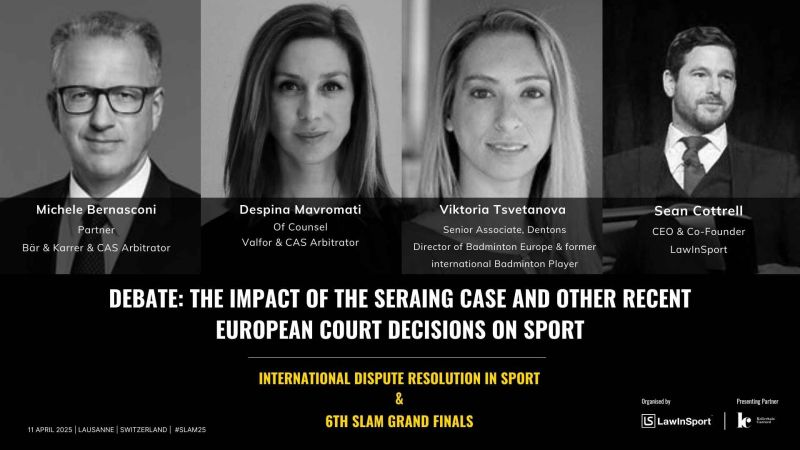
Dr Despina Mavromati was a panelist at the Sports Dispute Resolution Conference organized by LawInSport in Lausanne. The panel provided insights into current legal challenges and the broader implications of high-profile cases pending before European and arbitral bodies.
Dr Mavromati also served as a judge in the grand final of the Sports Law Arbitration Moot competition, an event that showcased the talent and advocacy skills of participating law students. You can find more information on the SLAM competition here.
Swiss Federal Supreme Court Judgment of 10 March 2025, FC A v. Player B
Motion to set aside CAS Award CAS 2022/A/9311 of 3 December 2024
A contract of employment between a Chinese football club A (A FC) and a Player from Ecuador (B) included the following clause (Art. 12): “Any dispute … shall be settled alternatively and at the election of the claiming party, to the legal bodies of FIFA or the CAS. In the event the claiming party decides that FIFA shall settle any dispute arising out of or in connection with the present contract as first instance Body, any appeal to a ruling of the FIFA Dispute Resolution Chamber shall be addressed to the CAS (…).”
Apart from that agreement, the Player signed an “Advertising Image Endorsement Agreement” with company C, which included a “liability for breach contract” clause as follows: “If a dispute is caused by this contract, Party A and Party B shall be settled through friendly negotiation. If the negotiation fails, any dispute (…) in connection with the present contract shall be solved exclusively by the CAS”.
Upon termination of the contract of employment, the Player brought the case to the FIFA DRC, requesting several amounts under both the Contract of Employment and the Image Rights Contract. The FIFA DRC partially upheld some claims based on the Contract of Employment and dismissed all other requests. The Club appealed to the CAS, seeking annulment of the FIFA DRC decision and a declaration that the Club owes nothing to the Player. The CAS fully dismissed the appeal.
In the subsequent motion to the SFT, the Applicant invoked erroneous findings on jurisdiction (Art. 190 para. 2 (b) PILA) on the ground that the FIFA DRC had wrongly assumed jurisdiction. The Club supported, among others, that the CAS lacked jurisdiction because the FIFA DRC had wrongly accepted its jurisdiction: due to the arbitration agreement in the Image Rights Contract, the FIFA jurisdiction should be excluded, also because Company C is not a FIFA member.
The SFT reiterated its position that it can only review the jurisdiction of the CAS and not the jurisdiction of the previous instance (here the FIFA DRC), apart from cases where the first-instance body and then the CAS declared themselves incompent (4A_232/2022 at 5.2.4; 4A_180/2023 of 24 July 2023 para. 3.3).
However, what was decisive in this case was that the Club had not raised any challenge to FIFA DRC’s jurisdiction before the CAS, all the more that it was the Club that brought the appeal to the CAS. As such, the SFT declared the motion inadmissible.
Global Perspectives on Sports Law: Highlights from the 2025 SLA Webinar
March 28, 2025
Key Developments in Sports Law 2025: Insights from the SLA Expert Panel
On March 27, 2025, the Sports Lawyers Association hosted a webinar titled “Global Insights: Key Developments in Sports Law 2025”, featuring leading international experts in the field. Among the panelists was Dr Despina Mavromati, who shared her insights on recent legal trends and challenges from Europe, shaping international sports arbitration.
The panel also included Peter Czegledy (Aird & Berlis LLP), Tiran Gunawardena (Bird & Bird), Aarij Wasti (Gowling WLG), and Prof Maureen Weston (Pepperdine University), providing a global perspective on current developments in sports law.
Soirée de l’Association Suisse de Droit du Sport (ASDS) à Lausanne
March 20, 2025
On 18 March 2025, the Soirée de droit du sport organized by the Association Suisse de Droit du Sport (ASDS) took place at the Maison du Sport International in Lausanne. The event brought together legal professionals and academics to discuss pressing issues in sports law.
Dr. Despina Mavromati spoke alongside Giulio Palermo, addressing the recent Opinion of Advocate General Ćapeta in the Seraing case, examining its implications in the context of the Achmea judgment and the ongoing debate over the compatibility of arbitration clauses with EU law.
Swiss Federal Supreme Court Judgment of 22 January 2025
A. v. FIFA, Motion to set aside CAS Award CAS 2023/A/10002 of 14 October 2024
A Latvian professional football club (the Club) disputed a FIFA decision that determined the training compensation owed to a Ghanaian club (Club C) following the transfer of a player in March 2023. Under the applicable procedure, an Electronic Player Passport (EPP) was generated and reviewed. During this process, FIFA invited two times the Club to upload any waiver of training compensation. The club failed to do so within the deadlines and only submitted a renunciation document from Club C on 14 September 2023, i.e. after the final EPP and the training compensation had been issued. The CAS dismissed the club’s appeal, holding that the Club should have joined Club C a respondent, since said club had a direct interest in the procedure, and that the late-uploaded waiver could not be considered.
In the subsequent motion to the SFT, the Club invoked a violation of its right to be heard (Art. 190 para. 2 (d) PILA), arguing that the arbitrator ignored key arguments concerning regulatory inconsistencies, the absence of a time limit for filing waivers, and the allegedly disciplinary nature of the procedure. It also invoked a violation of public policy (Art. 190 para. 2 (e) PILA), claiming that the award disregarded fundamental principles such as contractual freedom, personal freedom, pacta sunt servanda, and the burden of proof.
The SFT swiftly rejected the claim of a violated right to be heard, noting that the motion merely reframed its disagreement with the arbitrator’s assessment of the evidence, as the CAS had implicitly – yet clearly – considered and dismissed arguments about regulatory contradictions and the alleged abuse of rights. The Court also held that criticisms about the arbitrator’s legal expertise were irrelevant under Art. 190 para. 2 (d) PILA. On the allegations of violation of public policy, the SFT emphasised that the misapplication of rules or erroneous factual findings cannot establish a breach. The club failed to demonstrate any result incompatible with Swiss ordre public, as the arbitrator’s conclusion – that Club C should have been a co-respondent and that the waiver was filed too late – was neither arbitrary nor shocking to fundamental legal values.
Once again, the SFT judgment confirmed well-established SFT jurisprudence on the strict limits on the right to be heard complaints in international arbitration, the extremely narrow scope of public policy, and the deference afforded to CAS in procedural matters, especially where parties fail to respect regulatory deadlines (see also the almost identical judgments involving other players SFT 4A_612/2024 & SFT 4A_614/2024 of 22 January 2025).
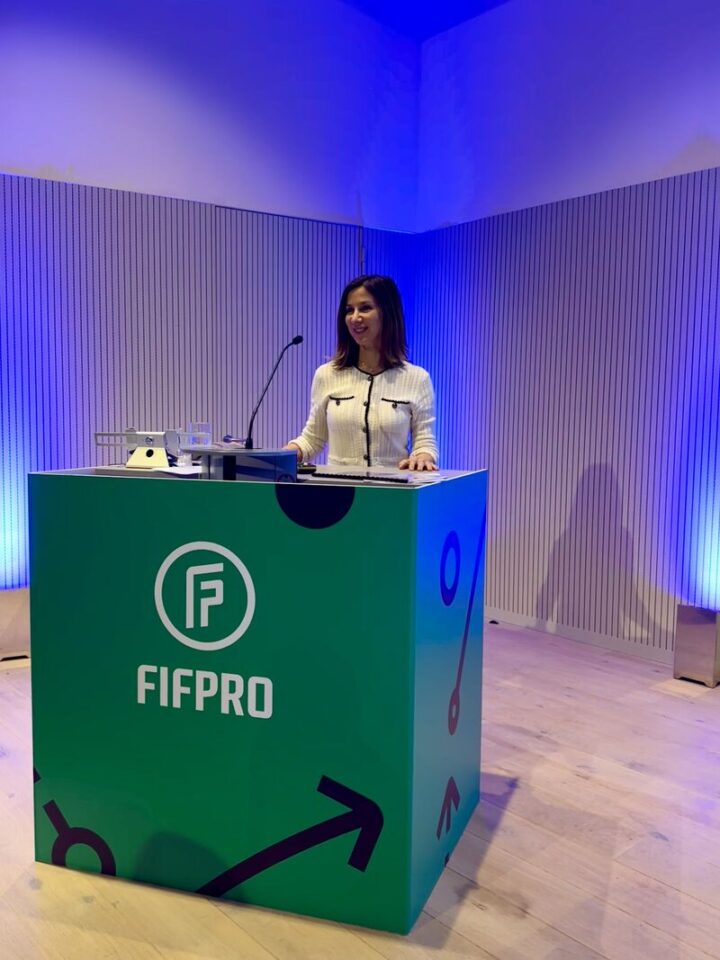
Despina Mavromati was invited to speak at the Turkish Football Federation Symposium “Current Issues in Player Contracts” on 24 May 2024. She discussed “Termination of Player Contracts with Just Cause: Selected Issues under Swiss law, CAS – and Swiss Federal Tribunal Jurisprudence” alongside FIFA DRC Chair Franz de Weger, sports lawyer Marcos Motta and FIFPro Legal Director Roy Vermeer. You can find more information about the Symposium here.
NEW BOOK RELEASE
The Code of the Court of Arbitration for Sport – Commentary, Cases and Materials
by Despina Mavromati / Matthieu Reeb, Wolters Kluwer 2025
Ιn its fully revised second edition, The Code of the Court of Arbitration for Sport offers a comprehensive, article-by-article commentary of the CAS Rules. Drawing on leading CAS and Swiss Federal Tribunal case law, CAS practices and international arbitration principles, the book is an indispensable reference for practitioners, arbitrators, and scholars working in sports arbitration.
This second edition introduces significant updates, including new model documents and new chapters on the ICAS, the CAS ad hoc Rules and the CAS Anti-Doping Division Rules during the Olympic Games.
This site uses cookies to improve site functionality - you can manage your preferences. Legal Notice & Privacy Policy
Functional
Always active
The technical storage or access is strictly necessary for the legitimate purpose of enabling the use of a specific service explicitly requested by the subscriber or user, or for the sole purpose of carrying out the transmission of a communication over an electronic communications network.
Preferences
The technical storage or access is necessary for the legitimate purpose of storing preferences that are not requested by the subscriber or user.
Statistics
The technical storage or access that is used exclusively for statistical purposes.The technical storage or access that is used exclusively for anonymous statistical purposes. Without a subpoena, voluntary compliance on the part of your Internet Service Provider, or additional records from a third party, information stored or retrieved for this purpose alone cannot usually be used to identify you.
Marketing
The technical storage or access is required to create user profiles to send advertising, or to track the user on a website or across several websites for similar marketing purposes.