
Sportlegis ×
Notes

International Sports-Related Disputes in 2025 and What to Expect in 2026

December 22, 2025 | 18-min read

International Sports-Related Disputes in 2025 and What to Expect in 2026 - www.sportlegis.com

As every year, I prepared my 2025 compilation of notable international sports-related cases. This year included a number of major sporting events, such as the FIFA Club World Cup in the United States and the UEFA Women’s Euro 2025 in Switzerland, but these events did not give rise to many notable disputes decided by the Court of Arbitration for Sport (CAS). The year was nevertheless marked by several landmark rulings – primarily from the European Court of Human Rights (ECtHR) and the Court of Justice of the European Union (CJEU), as well as from the CAS and the Swiss Federal Supreme Court (SFT) – which are briefly presented below.

1) Compilation of Sports-related Judgments rendered by the Swiss Federal Supreme Court (SFT) in 2025 

This year was rich in SFT findings regarding CAS’ jurisdiction. In two important judgments, the SFT clarified and reconfirmed the scope of the arbitration agreement in favour of the FIFA tribunal vis-à-vis state courts. Accordingly, FIFA’s jurisdiction under Art. 22 para. 1 (b) RSTP is default for international-dimension disputes but not exclusive, and the parties may validly opt-out or seize national courts for the specific category of labour-law disputes (see my notes on 4A_64/2025 and 4A_92/2025). The SFT also clafiried the admissibility threshold for review of the FIFA jurisdiction by the SFT, which must be raised during the CAS proceedings, even though it is not necessary to explicitly object at the outset of the FIFA proceedings (see my note on 4A_92/2025).

In another judgment, the SFT held that it is immaterial for the validity of the arbitration agreement that an agent lacked the required Swiss licence under the national laws: so long as the foreign seat of the agent is established, alleged breaches of Swiss employment-placement licensing rules cannot retroactively alter the international character of the relationship or invalidate an otherwise autonomous arbitration clause governed by Art. 178 PILA, nor render the dispute non-arbitrable under Art. 177 para. 1) PILA (see my note on 4A_616/2024).

In an interesting dispute related to the extension of the arbitration agreement to non-signatories due to alleged sporting succession, the SFT held that sporting succession is not recognized as a Swiss legal institution (see my note on 4A_188/2025): The fact that the SFT has found sporting succession to be in line with international public policy does not render it part of the Swiss legal order for jurisdictional purposes, limiting thus the effect of sporting succession – or other concepts of lex sportiva – when it comes to the interpretation of arbitration agreements under Art. 178 PILA. In another dispute, the SFT clarified the consequences of the distinction between admissibility and jurisdiction in multi-tier (FIFA & CAS) dispute resolution clauses: accordingly, when a case is rejected by FIFA as being time-bared, the parties cannot bring the claim to CAS and thus circumvent an agreed jurisdiction hierarchy by allowing time limits to lapse (see my note on 4A_230/2025).

With respect to the violation of public policy, the SFT reiterated on numerous occasions that it must be the outcome of the award – and not the panel’s reasoning – that violates public policy, showing the high admissibility threshold for such grievance (see e.g. my notes on 4A_616/20244A_608/2024, and 4A_28/2025). In 2025, and prior to the ECHR Grand Chamber judgment in Semenya v. Switzerland issued in July 2025, the SFT still denied to apply directly the ECHR provisions and repeated that these guarantees fall within the restrictive scope of Art. 190 para. 2 (e) PILA (see my notes on 4A_682/2024 and 4A_544/2024). It is equally found inadmissible to reiterate due process grounds separately invoking Art. 6 ECHR (4A_474/2024). It is now settled federal case law that criminal law principles are not directly applicable in disciplinary proceedings (see my notes on 4A_682/2024 and 4A_544/20244A_474/2024). Furthermore, the disregard of a contractual provision regarding liquidated damages is not violating public policy /pacta sunt servanda when the arbitral tribunal considers said provision as void (see my note on SFT 4A_638/2024). 

Moreover, 2025 marked numerous alleged violations of the parties’ right to be heard, which were all dismissed by the SFT: accordingly, there is no such violation when the panel (only) implicitly considers and rejects raised arguments (see my notes on 4A_608/2024 and 4A_168/2025; on arguments regarding the reliability and authenticity of the LIMS evidence, see my note on4A_544/2024); objections to the weighing of testimony typically amount to inadmissible appellate criticism (see my note on 4A_28/2025). The CAS is further not obliged to highlight specific elements of the file relied upon so long as they were on record and discussed at the hearing (see my note on 4A_474/2024). 

Finally, the SFT issued two interesting cases regarding requests for revision of CAS Awards under Art. 190a PILA: the first was filed by Russian figure skater Kamila Valieva and relied on an undisclosed expert report allegedly withheld by RUSADA and WADA during the CAS proceedings: the SFT dismissed the request considering that there was no procedural fraud and not a basis to reopen the CAS Award (see my note on 4A_654/2024). In the second, published in December 2025, the SFT admitted the request for revision in view of a final state court decision establishing forgery of a document linked to the outcome of the CAS award (see my note on 4A_268/2025).  

2)         Landmark sports-related judgments from the European Court of Human Rights (ECtHR) and the Court of Justice of the EU (CJEU) rendered in 2025: the Semenya ECtHR Judgment, the Seraing CJEU Judgment and AG Spielmann’s Opinion of 18 December 2025 

Semenya v. Switzerland, Application no. 10934/21 / Judgment of the ECHR Grand Chamber of 10 July 2025

The landmark judgment issued by the ECtHR Grand Chamber in Semenya v. Switzerland (see my note here) originates from the exclusion of Caster Semenya (the Athlete) from international women’s competitions under World Athletics’ DSD Regulations, upheld by the CAS in 2019 and by the SFT in 2020 (see also my earlier note on the CAS and SFT proceedings). In its final judgment, the Grand Chamber significantly narrowed the case’s scope, declining jurisdiction over the alleged substantive violations of Articles 8, 13 and 14 ECHR, but finding a violation of Article 6 ECHR, holding that the Athlete had been deprived of her right to a fair hearing due to insufficient judicial review by the SFT.

In essence, the Grand Chamber’s parallels, at a human-rights level, developments seen in Seraing one month later, though based on Article 6 ECHR rather than EU law. While reaffirming the legitimacy and systemic advantages of CAS arbitration, the ECtHR stressed that compulsory arbitration fundamentally alters the standard of judicial review where core human rights are at stake. In this context, the Grand Chamber held that the SFT should not have confined itself to its traditional, extremely narrow public-policy review under Article 190 para. 2 (e) PILA, but should instead have conducted a “particularly rigorous examination” of the CAS award. 

Overall, the judgment left unresolved both the substantive legality of the DSD Regulations and the exact contours of such “particularly rigorous” standard imposed on the SFT, confining its intervention strictly to procedural guarantees. The ambiguity remains however critical: it seems highly doubtful that the SFT’s enhanced scrutiny will resemble an expanded arbitrariness test; what seems more likely is that such standard will be akin to a proportionality review of fundamental rights. Unlike Seraing, the judgment does not risk systemic fragmentation through parallel national proceedings, but it nonetheless calls the SFT to raise the bar of review of CAS awards in the specific category of compulsory, human-rights-sensitive cases. With the time limit to request a revision of the CAS Award having now elapsed, the SFT will not deal with the same case again but new challenges remain open, in particular following the reform, by World Athletics, of its eligibility framework imposing a genetic test for all its athletes as of September 2025. It will therefore be for the SFT to establish the contours of this “particularly rigorous examination”. 

RFC Seraing SA v. FIFA, C-600/23, Judgment of 1 August 2025, ECLI:EU:C:2025:617 (Seraing Judgment)

The landmark ruling of RFC Seraing SA v. FIFA started with the FIFA’s 2015 ban on Third-Party Ownership (TPO). Following the sanction imposed on Belgian football club RFC Seraing (the Club) by the FIFA Disciplinary Committee, partially upheld by the CAS after an in-depth EU-law compatibility analysis, the case was confirmed by the SFT. Meanwhile, parallel proceedings before the Belgian courts led the Belgian highest instance (Cour de cassation) to refer questions to the CJEU on the extent of national-court review of CAS awards (see also my previous notes on the procedural history of the Seraing sagathe SFT judgment, and the AG Ćapeta Opinion). 

In essence, the CJEU found that – consistently with its own case law and the ECHR – compulsory CAS arbitration is not per se incompatible with EU law, provided that effective judicial protection is ensured. Departing from the broader approach suggested in AG Ćapeta’s Opinion (see my note here), the CJEU limited mandatory national-court review to the hard core of EU public policy, namely EU competition law and fundamental freedoms, rather than all EU-law rights. Notwithstanding the numerous advantages of centralized sports arbitration, where such arbitration is imposed as a condition of participation in economic activity within the EU, national courts must be able to review CAS awards effectively, grant interim relief if necessary, and ensure compliance with Articles 19 para. 1 TEU and 47 of the Charter.

The CJEU’s stance regarding its authoritative interpretation of EU law is not new, nor is the existence of EU-public-policy review (already available via the NYC 1958). The novelty here lies rather in its depth and remedial consequences: EU courts may review the interpretation, legal classification, and consequences of EU-public-policy norms applied by CAS, albeit without reopening factual findings (i.e. not a de novo review). Interestingly, the CAS panel in the Seraing CAS Award (composed of three eminent EU-qualified CAS arbitrators) dedicated a large part of its analysis to the compatibility of the TPO ban with EU competition law and the fundamental freedoms and included several factual findings that will eventually bind the Belgian court (c.f. §106 of the Seraing CAS Award). Therefore, it seems that the parties’ choice of arbitrators with deep EU law knowledge (from among the CAS list of arbitrators), will be key in order to ensure that awards are resistant to subsequent national court review. 

All in all, national rules conferring res judicata or probative effects on CAS awards must be set aside insofar as they undermine effective judicial protection under EU law. As explained in my note on the CJEU judgment, this produces a calibrated but real tension with arbitration finality, with limited practical reach but tangible risks of delay and fragmentation in the category of compulsory, EU-law-sensitive sports disputes.

Opinion of Advocate General Spielmann of 18 December 2025, Joined Cases C-424/24 and C-425/24, Requests for a Preliminary Ruling from the Lazio Administrative Court, FIGC & CONI

In his Opinion issued just before Christmas (see my full note here), AG Spielmann considers that the principle of effective judicial protection under EU law requires that national courts be able to annul unlawful sporting sanctions and, where appropriate, grant interim relief. While EU law does not, as such, preclude disciplinary sanctions imposed by sports federations – provided they pursue legitimate objectives such as the integrity of competitions and comply with the requirements of transparency, objectivity, non-discrimination and proportionality – the absence of review powers at national level may infringe the right to effective judicial review.

Crucially, however, the AG’s conclusions depend on whether the judicial bodies established under Italian sports law qualify as a “court or tribunal” within the meaning of EU law. If that qualification were met, national legislation excluding further judicial review would not necessarily be incompatible with EU law. It is interesting to note that the assessment of that qualification (which is left to the referring court, § 72-113) draws heavily on the criteria developed under Article 6 para. 1 ECtHR in the Ali Riza v. Turkey EctHR Judgment (see also my note on the Ali Riza v. Turkey ECtHR Judgment here). 

3)         Notable CAS Awards rendered in 2025

Disciplinary / Ethics

From the disciplinary cases issued in 2025, a notable case is the one of the former President of the Royal Spanish Football Federation Luis Rubiales, who appealed the FIFA disciplinary sanctions imposed for breaches of the FIFA Disciplinary Code and Code of Ethics arising from conduct at the 2023 FIFA Women’s World Cup medal ceremony. The CAS upheld FIFA’s assessment that the conduct constituted a serious violation of ethical principles and personal integrity, rejecting arguments based on consent, proportionality, and procedural irregularities. (CAS 2024/A/10384 – Luis Rubiales v. FIFA).

Another interesting CAS Award is the one of Laureano González against the sanction imposed by FIFA on the basis of his ethical responsibility as a federation president for financial governance failures and suspicious transactions. Here again, the CAS confirmed the FIFA decision and the accountability of presidents of member associations for financial conduct occurring during their mandate under the FIFA Code of Ethics, regardless of delegation to internal bodies (TAS 2023/A/9362 Laureano González v. FIFA).

Doping-related disputes

The CAS heard and decided several noteworthy doping-related cases in 2025. 

In weightlifting, the CAS Anti-Doping Division (CAS ADD) partially upheld the request by the International Weightlifting Federation (IWF) against Chinese weightlifter Lyu Xiaojun, whose out-of-competition test revealed recombinant erythropoietin (rEPO). The CAS ADD confirmed an ADRV under Art. 2.1 IWF ADR and imposed a four-year ineligibility period, backdating to the date of sample collection due to procedural delays not attributable to the athlete. 

In wrestling, the CAS issued its award in the appeal of WADA and the International Wrestling Federation against the Georgian Anti-Doping Agency (GADA) & four Georgian athletes, finding that the sabotage theory retained by the appealed decision was unsupported, due to lack of factual investigation and contradicted by scientific evidence, imposing thus a four-year sanction for intentional use on the athletes (CAS 2024/A/10960, IWF v. G. Giorbelidze & GADA).

In football, the CAS issued its award in the appeal filed by Paul Pogba against a four-year ban imposed for an ADRV following a positive test for DHEA (a prohibited non-specified substance).  CAS partially upheld the appeal and reduced the sanction to 18 months for non-intentional ingestion, finding no performance-enhancing evidence and inadvertent consumption (CAS 2024/A/10443, Paul Pogba v. NADO Italia). 

In cycling, Miguel Ángel López appealed his four-year sanction due to possession and use of prohibited substance menotropin to the CAS. The appealed decision was fully confirmed by the CAS which concluded that the athlete possessed and used Menotropin during the relevant period, with the ineligibility running from 25 July 2023.

In tennis, the CAS issued its award in the appeal of International Tennis Integrity Agency (ITIA) against a decision finding that Tara Moore had no fault or negligence after she tested positive for prohibited substances boldenone and nandrolone at the 2022 Bogotá tournament, where she argued meat contamination in Colombia. The CAS upheld ITIA’s appeal and imposed a four-year period of ineligibility finding that she had failed to prove the nandrolone concentration was consistent with contaminated meat ingestion and therefore did not establish that the ADRV was not intentional. Moore’s cross-appeal was declared inadmissible. 

Finally, the biggest doping-related case of the year did not result – as many would expect – in a CAS award: Tennis player Jannik Sinner, after testing positive for the banned steroid clostebol and being cleared of fault and negligence by an independent tribunal, had this decision appealed by WADA to the CAS, ultimately resulting in a negotiated three-month suspension agreed in early 2025.

Selection / eligibility

2025 also marked several eligibility cases, not least due to geopolitical tensions but also due to genetic testing: With respect to the Russian – and Belarussian athletes’ exclusion from international competitions, the CAS issued its award (operative part only) in the appeal of the Russian Luge Federation together with 6 athletes against the international Luge Federation (FIL), challenging their refusal to implement a programme allowing Russians to compete as Individual Neutral Athletes (AIN), impacting OWG Milano/Cortina 2026 qualification. CAS held the blanket prohibition on AIN participation was disproportionate to the stated safety aim and therefore set aside that prohibition, but maintained the exclusion of RLF athletes from FIL competitions; the athletes’ request for immediate participation was dismissed. 

Moreover, the Russian Ski Association (RSF) and 12 Russian athletes and para-athletes together with the  Russian Paralympic Committee appealed against the FIS Council resolution “not to facilitate” Russian/Belarusian participation as AINs in FIS qualification events for OWG/Paralympics 2026: CAS partially upheld both appeals (operative part only), ruling the resolution amounted to a blanket exclusion by nationality inconsistent with FIS Statutes (including political neutrality/non-discrimination protections), so athletes meeting IOC AIN criteria must be allowed into FIS qualification events. What is more, Russian para-athletes were allowed to participate under the same conditions as other para-athletes absent an IPC AIN framework, while broader requests were dismissed as within FIS remit. 

On the other side, speed skater Daria Kachanova unsuccessfully appealed against the ISU’s refusal to include her on the list of AIN-eligible athletes for OWG 2026 qualifiers, reportedly based on affiliation with CSKA Moscow (linked to the Russian Ministry of Defence). 

In October 2025, CAS rejected urgent requests by the Israel Gymnastics Federation (and, in a parallel appeal, six qualified gymnasts) seeking provisional measures to secure Israeli participation in the 2025 World Artistic Gymnastics Championships after Indonesia denied visas. The CAS held that the conditions for interim relief were not met. One appeal was also terminated for lack of jurisdiction, while the other remained pending on the merits (most likely expected in 2026).

Another eligibility decision that is still pending and is expected in 2026 is the one of Olympic champion Imane Khelif, who appealed to CAS against World Boxing’s decision conditioning her eligibility on mandatory genetic sex testing. She sought provisional measures to compete without undergoing the test, but CAS denied the request, leaving the rule in force pending the arbitration proceedings

Multi-Club Ownership

The CAS also decided several cases relating to multi-club ownership. In FK DAC 1904 v. UEFA, CAS dismissed FK DAC 1904’s appeal against its removal from the 2025/26 UEFA Conference League, holding that UEFA lawfully amended the assessment date and that DAC breached the multi-club ownership rules because the same individual exercised decisive influence through senior management roles at both clubs. 

An important case that was heard this summer on an expedited basis by the CAS was the appeal  filed by Crystal Palace FC against the decision rendered by UEFA, excluding the club from the 2025/26 UEFA Europa League. CAS dismissed the appeal, ruling that the club was non-compliant with UEFA’s multi-club ownership rules at the fixed assessment date and that UEFA had no discretion to accept governance changes implemented after the regulatory deadline.

Another interesting case arose from the Club World Cup 2025 multi-club ownership rules (Art. 10.1). The CAS, after an expedited procedure and a hearing in May 2025, dismissed consolidated appeals by Club León and CF Pachuca against FIFA’s decision, confirming that governance and trust arrangements were insufficient to remove common control and upholding León’s exclusion while Pachuca remained qualified. CAS also rejected Liga Deportiva Alajuelense’s separate appeal seeking admission in their place (operative decisions with reasons to follow).

4)         Selected regulatory and other developments in international sport from 2025 and what to expect in 2026

In September 2025, World Athletics enacted its reforms on the DSD and Female Eligibility regulations, replacing old eligibility rules with a unified framework, requiring athletes wishing to compete in the female category to undergo a one-time SRY gene test to confirm biological sex and establishes eligibility criteria (e.g., restrictions on testosterone exposure after male gender-affirming treatment). In 2026, the federation will enforce these new eligibility rules across its major competitions through an expanded testing schedule (i.e. World Athletics Series, Diamond League, and other leading events). This will likely generate new disputes and challenges concerning privacy, discrimination and proportionality of the regulatory measures. 

Also, and while the IOC 2021 framework on Fairness, Inclusion and Non-Discrimination remains in force, the IOC aims to come up with a new policy on eligibility in female sports in early 2026.  

Furthermore, in 2025 FIFA continued its FIFA RSTP revision process following the Diarra CJEU judgment following extensive consultation with various stakeholders. In 2026, FIFA will continue and likely proceed to regulatory amendments, softening the effects of joint and several liability and narrowing sporting sanctions for unilateral contractual termination without just cause. Overall, these regulatory developments will further unfold in 2026 and show that international federations are moving towards smoother sanctions and eligibility rules, embedded proportionality tests, in anticipation of review by EU but also national courts and the CAS. With the Milano-Cortina Winter Olympic Games 2026, the FIFA World Cup and the Glasgow Commonwealth Games on the horizon, 2026 is set to be a busy year for sports governance, eligibility and selection – and, inevitably, for sports disputes.

Notes

Key Judgments in Sports Arbitration Rendered by the Swiss Federal Supreme Court (SFT) in 2025

December 16, 2025 | 23-min read

Key Judgments in Sports Arbitration Rendered by the Swiss Federal Supreme Court (SFT) in 2025 - www.sportlegis.com

This compilation reflects a selection of the SFT judgments in sports arbitration rendered in 2025, focusing on jurisdiction, due process, public policy, and the revision of CAS awards.

2025 was rich in SFT findings regarding the jurisdiction of the Court of Arbitration for Sport (CAS). In two important judgments, the SFT clarified and reconfirmed the scope of the arbitration agreement in favour of the FIFA tribunal vis-à-vis state courts. Accordingly, FIFA’s jurisdiction under Art. 22 para. 1 (b) RSTP is default for international-dimension disputes but not exclusive, and the parties may validly opt-out or seize national courts for the specific category of labour-law disputes (see my notes on 4A_64/2025 and 4A_92/2025). The SFT also clafiried the admissibility threshold for review of the FIFA jurisdiction by the SFT (see my note on 4A_12/2025), which must be raised during the CAS proceedings, even though it is not necessary to explicitly object at the outset of the FIFA proceedings (see my note on 4A_92/2025). 

In another judgment, the SFT held that it is immaterial for the validity of the arbitration agreement that an agent lacked the required Swiss licence under the national laws: so long as the foreign seat of the agent is established, alleged breaches of Swiss employment-placement licensing rules cannot retroactively alter the international character of the relationship or invalidate an otherwise autonomous arbitration clause governed by Art. 178 PILA, nor render the dispute non-arbitrable under Art. 177 para. 1) PILA (see my note on 4A_616/2024). 

In an interesting dispute related to the extension of the arbitration agreement to non-signatories due to alleged sporting succession, the SFT held that sporting succession is not recognized as a Swiss legal institution (see my note on 4A_188/2025): The fact that the SFT has found sporting succession to be in line with international public policy does not render it part of the Swiss legal order for jurisdictional purposes, limiting thus the effect of sporting succession – or other concepts of lex sportiva – when it comes to the interpretation of arbitration agreements under Art. 178 PILA. In another dispute, the SFT clarified the consequences of the distinction between admissibility and jurisdiction in multi-tier (FIFA & CAS) dispute resolution clauses: accordingly, when a case is rejected by FIFA as being time-bared, the parties cannot bring the claim to CAS and thus circumvent an agreed jurisdiction hierarchy by allowing time limits to lapse (see my note on 4A_230/2025).

With respect to the violation of public policy, the SFT reiterated on numerous occasions that it must be the outcome of the award – and not the panel’s reasoning – that violates public policy, showing the high admissibility threshold for such grievance (see e.g. my notes on 4A_616/20244A_608/2024, and 4A_28/2025). In 2025, and prior to the ECHR Grand Chamber judgment in Semenya v. Switzerland issued in July 2025, the SFT still denied to apply directly the ECHR provisions and repeated that these guarantees fall within the restrictive scope of Art. 190 para. 2 (e) PILA (see my notes on 4A_682/2024 and 4A_544/2024). It is equally found inadmissible to reiterate due process grounds separately invoking Art. 6 ECHR (4A_474/2024). It is now settled federal case law that criminal law principles are not directly applicable in disciplinary proceedings (see my notes on 4A_682/2024 and 4A_544/2024;4A_474/2024). Furthermore, the disregard of a contractual provision regarding liquidated damages is not violating public policy /pacta sunt servanda when the arbitral tribunal considers said provision as void (see my note on SFT 4A_638/2024). 

Moreover, 2025 marked numerous alleged violations of the parties’ right to be heard, which were all dismissed by the SFT: accordingly, there is no such violation when the panel (only) implicitly considers and rejects raised arguments (see my notes on 4A_608/2024 and 4A_168/2025; on arguments regarding the reliability and authenticity of the LIMS evidence, see my note on 4A_544/2024); objections to the weighing of testimony typically amount to inadmissible appellate criticism (see my note on 4A_28/2025). The CAS is further not obliged to highlight specific elements of the file relied upon so long as they were on record and discussed at the hearing (see my note on 4A_474/2024).

Finally, the SFT issued two interesting cases regarding requests for revision of CAS Awards under Art. 190a PILA: the first was filed by Russian figure skater Kamila Valieva and relied on an undisclosed expert report allegedly withheld by RUSADA and WADA during the CAS proceedings: the SFT dismissed the request considering that there was no procedural fraud and not a basis to reopen the CAS Award (see my note on 4A_654/2024). In the second, published in December 2025, the SFT admitted the request for revision in view of a final state court decision establishing forgery of a document linked to the outcome of the CAS award (see my note on 4A_268/2025). 

Jurisdiction – Football (contractual)

4A_64/2025 – FIFA vs. National Courts: Contractual State Jurisdiction Clauses override FIFA Jurisdiction, SFT Judgment of 16 June 2025, A. v. FC B, Motion to set aside CAS Award CAS 2023/A/9923 of 17 December 2024

A football employment dispute arising from the unilateral termination of a Hungarian player’s contract governed by the widely debated “Clause 49”. While the FIFA tribunal accepted its jurisdiction, the CAS found that it lacked jurisdiction and said award was later confirmed by the SFT. In essence, the SFT held that CAS, as an appellate body, could not extend its jurisdiction beyond that of the FIFA DRC; moreover, FIFA jurisdiction under Art. 22 para. 1 (b) RSTP is not absolute nor exclusive but subject to the parties’ contractual choice of forum, including state courts. The SFT further upheld the CAS’s interpretation of Clause 49 as conferring jurisdiction on the Hungarian Administrative and Labour Court for labour-law disputes and on a sports arbitration body only for other types of disputes, stressing that a literal and contextual reading of the clause, the player’s experience, and the absence of structural imbalance supported the conclusion that the parties validly opted for state court jurisdiction. This was an opportunity for the SFT to reiterate its restrictive approach to waivers of state court jurisdiction, holding that the decisive element was the clear reference to state courts irrespective of any imprecision in their designation. Moreover, FIFA’s alternative jurisdiction under Art. 22 RSTP does not prevail over a valid contractual choice of state courts. 

4A_92/2025 – Football Disputes of International Dimension: SFT upholds Exclusive Jurisdiction of Hungarian Labour Courts, SFT Judgment of 4 July 2025FC A. v. B. & FIFA, Motion to set aside CAS Award CAS 2023/A/9636 of 15 January 2025

This is an important football employment dispute arising from the termination of a Hungarian player’s contract governed by the widely litigated “Clause 49”, which provides for the jurisdiction of Hungarian state courts for labour-law disputes. In this judgment, the SFT set aside the CAS award, holding that the CAS had wrongly assumed jurisdiction in breach of Art. 190 para. 2 (b) PILA: the SFT reiterated that CAS appellate jurisdiction cannot exceed the jurisdiction of the FIFA body appealed from and depends on the existence of a valid arbitration agreement; as such, FIFA’s competence under Art. 22 para. 1 (b) RSTP is default but not absolute, and  subject to the parties’ contractual choice of forum. 

After interpreting Clause 49 restrictively, in line with its settled case law, the SFT held that the clause grants exclusive jurisdiction to the competent Hungarian labour courts for employment disputes, notwithstanding its imprecise wording, the use of the term “may,” the standardised nature of the clause, or the international character of the employment relationship. Therefore, the CAS had erred in treating the state-court jurisdiction as merely alternative or non-exclusive. The SFT further clarified that the distinction between voluntary and compulsory arbitration is irrelevant where the clause preserves state-court jurisdiction and that parties do not tacitly waive jurisdictional objections by silence during the FIFA proceedings, so long as these objections were validly raised at the outset of the CAS proceedings. Having found a lack of CAS jurisdiction, the SFT did not examine the subsidiary res judicata argument under Art. 190 para. 2 (e) PILA. Overall, it is now settled federal case law that now “famous” Clause 49 excludes FIFA and CAS jurisdiction in favour of Hungarian labour courts for both domestic and international employment disputes.

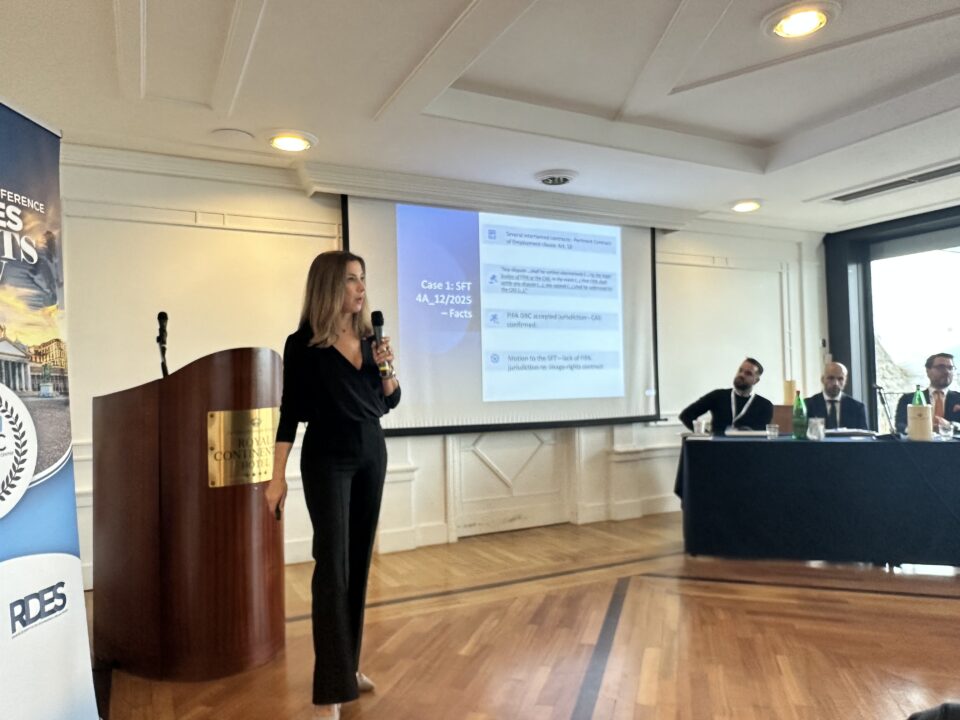
4A_12/2025 – FIFA Jurisdiction can only be challenged before the SFT if raised during the CAS Proceedings, SFT Judgment of 10 March 2025, FC A v. Player B, Motion to set aside CAS Award CAS 2022/A/9311 of 3 December 2024

The case related to a football employment dispute involving a Chinese club  (the Club) and an Ecuadorian player and arose from the termination of an employment contract containing an optional FIFA/CAS jurisdiction clause and parallel claims under an image rights agreement providing for exclusive CAS arbitration. Both FIFA and subsequently CAS upheld jurisdiction; the SFT dismissed the Club’s motion for erroneous findings on jurisdiction as inadmissible: it reiterated that, in principle, it may review only CAS jurisdiction – and therefore not that of the prior instance (here the FIFA DRC) – save for exceptional cases where both bodies decline jurisdiction; it also emphasised that any objection to FIFA DRC jurisdiction must be raised during the CAS proceedings; since the Club itself had appealed to CAS and had failed to challenge FIFA’s jurisdiction before the arbitral tribunal, it was precluded from doing so for the first time before the SFT, thereby reaffirming the strict procedural preclusion rules governing jurisdictional challenges in FIFA–CAS dispute resolution.

4A_12/2025 – FIFA Jurisdiction can only be challenged before the SFT if raised during the CAS Proceedings, SFT Judgment of 10 March 2025, FC A v. Player B, Motion to set aside CAS Award CAS 2022/A/9311 of 3 December 2024

The case related to a football employment dispute involving a Chinese club  (the Club) and an Ecuadorian player and arose from the termination of an employment contract containing an optional FIFA/CAS jurisdiction clause and parallel claims under an image rights agreement providing for exclusive CAS arbitration. Both FIFA and subsequently CAS upheld jurisdiction; the SFT dismissed the Club’s motion for erroneous findings on jurisdiction as inadmissible: it reiterated that, in principle, it may review only CAS jurisdiction – and therefore not that of the prior instance (here the FIFA DRC) – save for exceptional cases where both bodies decline jurisdiction; it also emphasised that any objection to FIFA DRC jurisdiction must be raised during the CAS proceedings; since the Club itself had appealed to CAS and had failed to challenge FIFA’s jurisdiction before the arbitral tribunal, it was precluded from doing so for the first time before the SFT, thereby reaffirming the strict procedural preclusion rules governing jurisdictional challenges in FIFA–CAS dispute resolution.

4A_230/2025 – Consequences of the Distinction between Admissibility and Jurisdiction in Multi-Tier Dispute Resolution Clauses, SFT Judgment of 10 November 2025, Motion to set aside CAS Award CAS 2024/O/10564 of 15 April 2025

A cooperation agreement between two football clubs provided for FIFA as the primary forum and CAS arbitration only on a subsidiary basis if FIFA lacked jurisdiction. After FIFA declined to hear the claim as time-barred under Article 23 para. 3 FIFA RSTP, the claimant sought to seize CAS, arguing that FIFA’s refusal triggered CAS jurisdiction. Both the CAS and the SFT rejected this view, holding that FIFA’s decision was based on inadmissibility, not lack of jurisdiction, since FIFA remained competent in principle but was procedurally barred from examining the case. The SFT confirmed that a procedural time bar cannot activate CAS’s subsidiary jurisdiction and reaffirmed the distinction between jurisdiction and admissibility: Parties cannot circumvent an agreed jurisdictional hierarchy in multi-tier dispute resolution clauses by allowing time limits to lapse.

Jurisdiction and Public Policy – Football (contractual)

4A_616/2024: Validity of CAS Jurisdiction in Player-Agent Agreements and Limited Scope of Public Policy, SFT Judgment of 24 March 2025, A. v. B. & C. SRL, Motion to set aside a CAS Award CAS 2022/O/9269 of 22 October 2024

In a football-related contractual dispute between a Swiss professional player (the Player) and his intermediaries (the Agents) arising from the early termination of exclusive player-agent agreements providing for CAS arbitration and a 10% commission on employment contracts, the SFT rejected the motion to set aside the CAS award, holding that none of the grounds invoked under Art. 190 para. 2 PILA were established: the Player challenged CAS jurisdiction (Art. 190 para. 2 (b) PILA) contending that the Agents lacked the required Swiss licence under the Arbeitsvermittlungsgesetz (AVG, LSE) and only structured their contract as “international” in order to circumvent Swiss mandatory law, rendering the arbitration clause invalid. The SFT held that it was bound by the facts as established by the CAS, in particular the Agents’ foreign seat, and alleged breaches of Swiss employment-placement licensing rules could not retroactively alter the international character of the relationship or invalidate an otherwise autonomous arbitration clause governed by Art. 178 PILA, nor render the dispute non-arbitrable under Art. 177 para. 1) PILA. 

The alleged violation of procedural and substantive public policy (Art. 190 para. 2 (e) PILA), based on claims that the award enforced a void contract, disregarded employee-protection norms, or imposed a sanction akin to bribery, was likewise rejected, as the outcome – ordering payment of damages for premature termination – did not contradict fundamental principles such as pacta sunt servanda or procedural fairness, thereby reaffirming the SFT’s settled jurisprudence on the autonomy of arbitration agreements, the extremely narrow scope of ordre public review, and the prohibition on factual re-assessment at the annulment stage.

Public Policy – Football (contractual)

4A_638/2024 – Pacta Sunt Servanda and Liquidated Damages Clauses in International Football Contracts, SFT Judgment of 27 March 2025, FC A v. B, Motion to set aside CAS Award CAS 2021/A/8268

A football employment dispute arose after the early termination of a Portuguese coach (the Coach) by his club (the Club), with a contract including a contractual liquidated-damages clause. The SFT held that the alleged violation of public policy under Art. 190 para. 2 (e) PILA based on pacta sunt servanda was not established: the SFT reiterated that public policy review is strictly limited to whether the result of the award, and not its reasoning, contradicts fundamental legal principles. It also found that the CAS had acted consistently in holding the Club liable for termination without just cause while refusing to apply the contractual compensation clause because it conflicted with mandatory Swiss employment law (notably Art. 337c para. 1 CO in conjunction with Arts. 341 para. 1 and 362 CO). To the extent that an employee cannot validly waive rights arising from mandatory provisions during the employment relationship or shortly thereafter, the CAS was entitled to disregard Article 5 of the contract as null and void and to award a higher compensation. The SFT found no inconsistency or violation of pacta sundt servanda in the Panel’s reasoning: although the Panel initially acknowledged that the contractual clause could potentially be valid, it correctly held that, under Art. 341 para. 1 and Art. 362 CO, an employee cannot waive rights arising from mandatory legal provisions during the employment relationship or within one month after its end, and that Art. 337c CO is one such mandatory rule.

Right to be heard and Public Policy – Football (contractual)

4A_608/2024 – Training Compensation, Late Waivers and Necessary Parties in FIFA TMS Procedures, SFT Judgment of 22 January 2025, A. v. FIFA, Motion to set aside CAS Award CAS 2023/A/10002 of 14 October 2024

In a football-related dispute (training compensation) arising from a player transfer processed through FIFA’s TMS and EPP system, a Latvian club (the Club) unsuccessfully sought to rely on a late-submitted waiver from the training club and saw its CAS appeal dismissed for failure to join the training club as a necessary party. The SFT subsequently rejected the motion to set aside the CAS award based on the alleged violation of the right to be heard (Art. 190 para. 2 (d) PILA), to the extent that the Club merely criticized CAS’s assessment of the facts and law and the arbitrator had implicitly but clearly addressed and rejected all arguments: as such, submissions concerning regulatory inconsistencies, the absence of a time limit for waivers and the allegedly disciplinary nature of the procedure. Importantly, criticisms of the arbitrator’s expertise were found to be irrelevant. With respect to the alleged violation of public policy (Art. 190 para. 2 (e) PILA), the SFT rejected grievances based on contractual freedom, personal freedom, pacta sunt servanda and the burden of proof, as misapplication of FIFA regulations or erroneous factual findings cannot amount to a breach of ordre public. the outcome of the award – requiring the joinder of the training club as a necessary party and disregarding a waiver filed after the final EPP – was neither arbitrary nor incompatible with fundamental Swiss legal values (see also the almost identical judgments involving other players SFT 4A_612/2024 & SFT 4A_614/2024 of 22 January 2025).

Right to be heard and public policy – Football (ethics)

4A_28/2025 – Anonymous Witnesses, Sexual-Abuse Allegations and Limits of Review in FIFA Ethics Cases, SFT Judgment of 3 March 2025, Motion to set aside CAS Award TAS 2021/A/8388 of 4 December 2024

In a FIFA ethics case arising from allegations of systemic sexual abuse within the Haitian Football Federation, a federation vice-president (the Official) was sanctioned with a lifetime ban and fine later upheld by CAS on the basis of protected victim testimony and corroborating evidence. The SFT dismissed the Official’s motion to set aside the CAS award, finding no violation of the right to be heard (Art. 190 para. 2 (d) PILA). More specifically, the CAS had sufficiently reasoned its decision not to hear additional alleged victims, had lawfully relied on anonymous witness testimony subject to adequate procedural safeguards, and had afforded the official an effective opportunity to participate in – and challenge – the examination of evidence, while objections to the weighing of testimony amounted to inadmissible appellate criticism. The alleged violation of procedural and substantive public policy (Art. 190 para. 2 (e) PILA) was equally dismissed, as neither claims of arbitrariness nor disagreement with the evidentiary assessment meet the stringent ordre public threshold, and the outcome – confirming a lifetime ban for serious sexual-abuse misconduct – was not incompatible with fundamental Swiss legal values, thereby reaffirming the SFT’s consistent deference to CAS fact-finding and its restrictive review of ethics-related sanctions.

Right to be heard and Public Policy (Doping)

4A_474/2024 – CAS Discretion in rEPO Analysis in Doping-Related Proceedings – SFT Judgment of 6 February 2025, A. v. NADA, WADA & DFB, Motion to set aside CAS Award CAS 2023/A/9550, CAS 2023/A/9586 & CAS 2023/A/9607 of 27 August 2024

Croatian football Player Mario Vušković (the Athlete) was sanctioned for an anti-doping rule violation following an out-of-competition test revealing rEPO in November 2022 following a CAS award that increased the first-instance sanction from two to four years. The SFT rejected the alleged violation of the Player’s right to be heard (Art. 190 para. 2 (d) PILA) as he should have expected a full review of the evidentiary record; moreover, the CAS was under no duty to highlight specific elements of the file relied upon if they were on record and discussed at the hearing. The Athlete also invoked a violation of public policy (Art. 190 para. 2 (e) PILA), based on the excessive commitments provision under Art. 27 para. 2 CC, the use of the SAR-PAGE method, the CAS panel’s reliance on technical images (without the expertise to do so), and the purported impossibility of producing exculpatory evidence due to WADA’s regulatory framework. All the pleas were rejected in line with the SFT’s settled case law recognising the CAS’s broad discretion in doping matters and the compatibility of strict liability and anti-doping evidentiary rules with ordre public; arguments relying on in dubio pro reo and lex mitior were also dismissed as inapplicable to disciplinary sanctions imposed by private sports federations and, in any event, they were not shown to be violated. The Athlete’s reliance on Art. 6 ECHR was found inadmissible to the extent that it reiterated previously rejected grounds without satisfying the strict threshold required to establish a breach of public policy.

4A_544/2024 – LIMS Evidence, Presumption of Innocence & Limits of SFT Review in Anti-Doping Procedures, SFT Judgment of 20 May 2025, A. v. IBU, Motion to set aside CAS Award CAS 2020/A/6834 of 9 September 2024

A former elite Russian bi-athlete was sanctioned by the IBU for an anti-doping rule violation relating to the use of prohibited substance ostarine in 2013, later discovered through the LIMS data from the Moscow laboratory; his CAS appeal was dismissed and the SFT rejected the motion to set aside the CAS award: the alleged violation of the right to be heard (Art. 190 para. 2 (d) PILA) was dismissed because the CAS had comprehensively examined the evidentiary record, including the statistical arguments relied upon by the athlete, and had implicitly but clearly rejected arguments regarding the reliability and authenticity of the LIMS evidence; the alleged violation of public policy (Art. 190 para. 2 (e) PILA), based on the presumption of innocence and the principle of in dubio pro reo, was equally rejected in line with the SFT’s settled case law that criminal-law guarantees under Art. 6 ECHR do not directly apply to disciplinary proceedings conducted by private sports federations; moreover, the SFT reconfirmed the non-application of criminal law principles in disciplinary sanctions and the limitation of public policy review to the outcome – rather than the reasoning – of the CAS award, showing the limits of the SFT control in anti-doping cases relying on LIMS evidence.

4A_682/2024: Athlete’s Biological Passport Review and Presumption of Innocence in Long-Term Doping Cases, SFT Judgment of 20 May 2025, A. v. UIB, Motion to set aside CAS Award CAS 2020/A/7509 of 18 November 2024

In a long-term doping dispute relating to the Athlete Biological Passport (ABP) of a former Russian biathlete and Olympic medallist, the CAS ultimately confirmed an anti-doping rule violation covering the period 2010–2014 and imposed a four-year suspension with disqualification of results. The subsequent motion to the SFT for violation of public policy was also dismissed: similar to other judgments, and since the Semenya ECHR judgment was still pending before the Grand Chamber (see my note here), the SFT reiterated that Art. 6 ECHR cannot be invoked directly in challenges against international arbitration awards. Also, criminal-law principles such as the presumption of innocence and in dubio pro reo do not apply to disciplinary proceedings of private sports bodies; it further found that the CAS had not reversed the burden of proof, had assessed the ABP and genetic evidence without harbouring any reasonable doubt, and was entitled to rely on circumstantial indicators in reaching its “comfortable satisfaction”; finally, the allegation of a breach of legal certainty was dismissed, as the Athlete had been notified of the investigation well within the applicable ten-year limitation period, confirming once again the exceptionally high threshold for establishing a violation of Swiss ordre public in complex, long-running anti-doping cases.

4A_168/2025 – Implicit Reasoning and Violation of the Right to be Heard, SFT Judgment of 4 August 2025, A. v. USADA, Motion to set aside CAS Award CAS 2024/A/10291 of 21 June 2024

In an anti-doping dispute involving an American elite swimmer sanctioned on the basis of abnormal ABP findings, the SFT dismissed the motion to set aside the CAS award for alleged violation of the right to be heard under Art. 190 para. 2 (d) PILA. In essence, the SFT found that the CAS panel had sufficiently considered the athlete’s key defence that the hematological abnormalities could be explained by “detraining” following a reduction in training load and a Covid-19 infection, even though it did not address this argument in detail, noting that the panel implicitly rejected the explanation by reasoning that such detraining could equally support the blood-doping hypothesis. Reiterating its settled case law, the SFT confirmed that an arbitral tribunal is not required to respond expressly to every argument, that implicit reasoning suffices where the issue has been addressed, and that Art. 190 para. 2 (d) PILA cannot be used to challenge the assessment of scientific evidence or the persuasiveness of expert testimony.

Request for Revision – Doping (dismissed)

4A_654/2024 – Revision Request Dismissed: No New Evidence, No Fraud, No basis to Reopen the CAS Award, SFT Judgment of 8 October 2025, A. v. RUSADA, ISU & WADA, Request for revision of the CAS Award CAS 2023/A/9451, CAS 2023/A/9455 and CAS 2023/A/9456 of 29 January 2024

This judgment concerns Russian figure skater Kamila Valieva’s (the Athlete) request for revision of the CAS award of 29 January 2024, imposing a four-year ineligibility for trimetazidine. The SFT dismissed the request,  holding that the stringent requirements of Art. 190a PILA were not met. The Athlete had claimed that an allegedly undisclosed expert report constituted new, outcome-determinative evidence or established procedural fraud by RUSADA or WADA. The SFT rejected these arguments, noting that the report’s existence was unproven (could not constitute a pre-existing fact under Art. 190a para. 1 (a) PILA) and, in any event not conclusive as it stated that the contamination scenario was theoretically possible. In any event, the CAS had rejected the contamination defence for lack of factual proof rather than scientific uncertainty. Emphasising that revision is exceptional and cannot function as a disguised appeal or a second attempt to relitigate the merits, the SFT reaffirmed the finality of CAS awards and the high threshold for reopening international sports arbitration decisions. 

Request for Revision – Football (admitted) 

4A_268/2025 – Revision Request admitted following a Final Court decision establishing Forgery, SFT Judgment of 22 October 2025, A. v. B., Request for Revision of the CAS Award CAS 2018/O/5735 of 8 August 2019

In 2025, the SFT exceptionally admitted a request for revision of a CAS award pursuant to Article 190a para. 1 (b) PILA, holding that the 2019 decision had been decisively influenced by criminal conduct. The case arose from a dispute between a professional footballer and his agent, in which the CAS had ordered the payment of a commission on the basis of representation contracts and an email later proven to be forged. Final Swiss criminal judgments established that the agent had fabricated the contracts and falsified the email to mislead the arbitral tribunal and obtain an undue payment. The Federal Supreme Court found a clear causal link between these criminal acts and the outcome of the arbitral award, annulled the CAS decision in its entirety, and remitted the case to CAS for a new decision. The judgment stands out as a rare but important illustration of the revision mechanism operating as an exceptional corrective measure, where the finality of arbitral awards is disregarded due to proven fraud affecting both jurisdiction and the merits. 

Notes

SFT 4A_313/2025: Reaffirming the Limits of FIFA Jurisdiction in Employment Disputes

April 14, 2026 | 3-min read

SFT 4A_313/2025: Reaffirming the Limits of FIFA Jurisdiction in Employment Disputes - www.sportlegis.com

Swiss Federal Supreme Court Judgment 4A_313/2025 of 27 January 2026; challenge of CAS Award CAS 2024/A/10709 of 21 May 2025

This judgment forms part of a wider series of SFT judgments on jurisdictional challenges based on Art. 22 FIFA Rules on the Status and Transfer of Players (RSTP). The dispute arose from an employment dispute between a national football association and a national team coach. The coach, dismissed prematurely, brought a claim before the FIFA Players’ Status Chamber seeking outstanding salary and compensation. FIFA upheld its jurisdiction and partially granted the claim, a position later confirmed by the Court of Arbitration for Sport (CAS). The federation challenged the CAS award before the SFT, arguing that the underlying employment contract referred disputes to “the competent court,” thereby excluding FIFA jurisdiction. 

From a legal standpoint, the core issue concerned – once again – the interpretation of the dispute resolution clause in light of Article 22 RSTP. The CAS adopted a broad reading, considering that the wording “competent court” did not necessarily exclude arbitral or FIFA bodies and that FIFA jurisdiction operated alternatively. The SFT, however, confirmed its restrictive interpretation of arbitration agreements, emphasizing that any waiver of state court jurisdiction must be clear and unequivocal. 

The SFT ultimately annulled the CAS award, finding that the clause “the dispute shall be referred to the competent court”must, under the principle of good faith, be understood as referring to state courts. It rejected CAS’s expansive interpretation and clarified that such wording does not encompass arbitral tribunals or FIFA bodies. Importantly, the SFT highlighted – probably for the first time so explicitly – that Article 22 RSTP establishes only a subsidiary jurisdiction of FIFA: once the parties designate state courts, FIFA jurisdiction is excluded, without the need for an explicit opt-out. The SFT also rejected arguments based on the employee’s weaker position and found no abuse of rights in invoking state jurisdiction. In those respects, the judgment adopts a similar approach to SFT 4A_92/2025. 

In terms of practical consequences, the judgment seems to restrict the scope of Art. 22 RSTP, since jurisdiction depends on the existence of a valid arbitration agreement. In this respect, even relatively generic clauses referring to “courts” may suffice to exclude FIFA and CAS jurisdiction, provided they can reasonably be interpreted as designating state courts.

Even though consistent with the SFT’s long-standing jurisprudence, this judgment does suggest a more restrictive approach in jurisdictional matters related to Art. 22 RSTP, exposing a structural tension in the FIFA system: the assumption of “default” jurisdiction under Article 22 RSTP is fragile when confronted with broadly drafted contractual clauses. In light of this, FIFA may indeed wish to consider amending its rules, for example by requiring express and specific arbitration clauses referring to FIFA/CAS jurisdiction.

News

FIFA Football Law Annual Review 2026

April 14, 2026

FIFA Football Law Annual Review 2026 - www.sportlegis.com

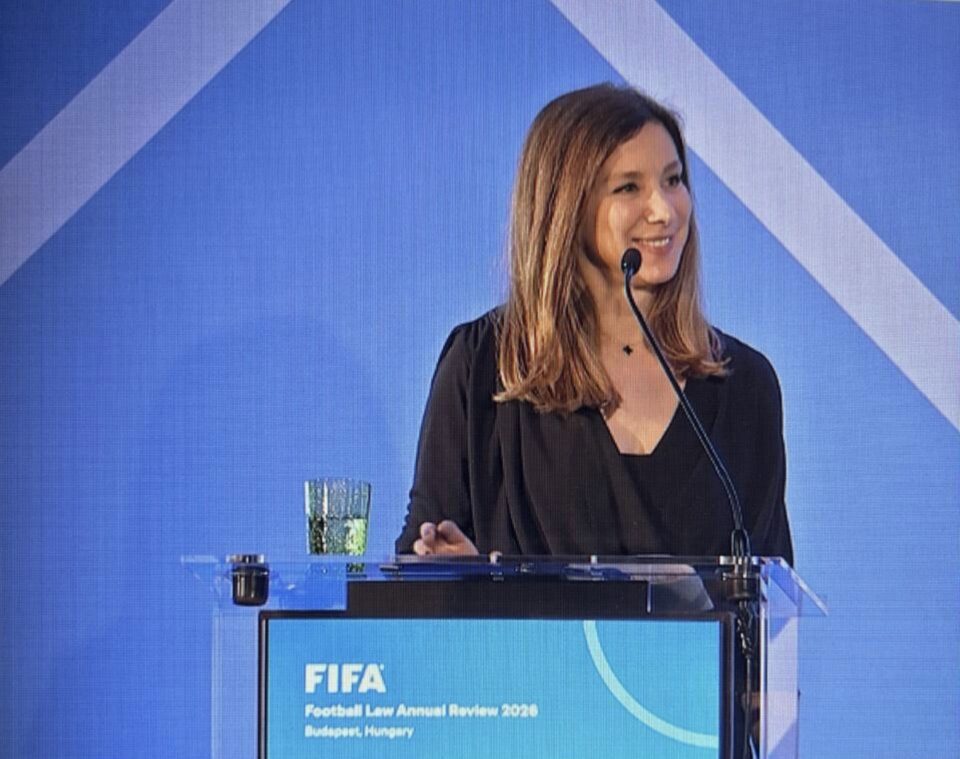
Dr Despina Mavromati participated as a speaker at the FIFA Football Law Annual Review (FLAR) Conference held in Budapest on 19–20 February. In her presentation, she addressed recent jurisprudence of the Swiss Federal Supreme Court in motions to set aside CAS Awards. She highlighted key jurisdictional challenges arising from recent case law and discussed their potential impact on the governance and dispute resolution framework in global football. You can watch her presentation here.

Notes

SFT 4A_324/2025: CAS May Apply Swiss Law by Analogy in Ukraine War Football Employment Disputes

April 2, 2026 | 3-min read

SFT 4A_324/2025: CAS May Apply Swiss Law by Analogy in Ukraine War Football Employment Disputes - www.sportlegis.com

The Swiss Federal Tribunal (SFT) addressed an appeal against a CAS award rendered in the context of the contractual fallout from the war in Ukraine. The dispute opposed a Russian football club and a Norwegian player who had unilaterally terminated his employment contract in May 2022 after leaving Russia and subsequently signing with an Italian club. While the FIFA DRC had partially upheld the player’s claim, the Court of Arbitration for Sport (CAS 2023/A/9686) ultimately dismissed all claims from both parties. 

The CAS found that the player had terminated the contract without just cause but refused to award any compensation to the club. The panel held that neither the contractual penalty clause (EUR 30 million) nor Article 17(1) of the FIFA Regulations on the Status and Transfer of Players (RSTP) was appropriate in light of the exceptional circumstances created by the war. In particular, the CAS reasoned that the club had not suffered a definitive loss of the player’s services, since Annex 7 RSTP allowed players to temporarily suspend their contracts. It further identified a legal gap and applied Swiss law subsidiarily, relying by analogy on Article 337b CO to conclude that no compensation was due. 

Before the SFT, the club relied solely on a violation of the right to be heard under Article 190(2)(d) of the Swiss Private International Law Act (PILA). It argued that the CAS had based its decision on an unforeseeable legal reasoning, namely the application of Article 337b CO by analogy, without giving the parties a proper opportunity to comment.

The SFT rejected the appeal, reaffirming its restrictive approach to judicial review of arbitral awards and the principle of iura novit curia. A duty to invite further submissions arises only where the legal reasoning is truly unforeseeable. In the present case, the SFT found that the CAS had expressly invited the parties to address the applicability of Articles 337 et seq. CO, including Article 337b, and that the club had in fact argued against its application during the arbitration. Accordingly, the reasoning could not be considered surprising (at 5.4). 

From a practical perspective, the judgment confirms the extremely limited scope of review of the “effet de surprise” under Article 190(2)(d) PILA, the broad discretion of CAS panels to rely on legal concepts not pleaded by the parties, and the tribunal’s flexibility to apply Swiss law subsidiarily next to the RSTP and Annex 7 thereof.

Notes

SFT 4A_226/2025: systemic implications – and limited effect – of the Semenya ECHR judgment in sports arbitration

February 16, 2026 | 4-min read

SFT 4A_226/2025: systemic implications – and limited effect – of the Semenya ECHR judgment in sports arbitration - www.sportlegis.com

Swiss Federal Supreme Court Judgment 4A_226/2025 of 11 December 2025; challenge of CAS Award CAS 2024/A/10279, 2024/A/10280 und 2024/A/10281 of 31 March 2025

Facts of the case

In this judgment, the Swiss Federal Supreme Court (SFT) ruled on a challenge against a CAS award arising out of the war-related contractual framework introduced by FIFA. A Norwegian footballer (the Player) had been under contract with a Russian club (the Club) until 2025. Following Russia’s invasion of Ukraine, FIFA issued temporary regulatory measures (Annex 7 to the RSTP) allowing foreign players to suspend contracts with Russian clubs. The Player initially made use of these measures, later “reactivated” his contract, and returned to Russia.

In summer 2023, amid escalating security concerns – the Player sought to terminate his employment with immediate effect, invoking just cause and force majeure. Shortly thereafter, he signed with a Saudi Arabian club. The FIFA DRC partially upheld the Club’s claim for compensation for breach of contract and said decision was confirmed by the CAS in appeal. The CAS ruled that the termination was without just cause and ordered the Player and his new club to pay over EUR 3 million in compensation. 

Arguments invoked before the SFT

In his challenge before the SFT, the Player relied primarily on Article 190(2)(e) PILA, alleging a violation of substantive public policy (ordre public). He argued that the CAS award resulted in an excessive personal commitment contrary to Article 27(2) CC and amounted, in substance, to indirect forced labour. In his view, remaining contractually bound in a war-affected territory exposed him to unacceptable risks to life and health, such that immediate termination was justified.

He further invoked force majeure and challenged the CAS’s assessment of just cause. In addition, he relied on Articles 2, 4(2), 5(1) and 8 ECtHR, arguing that the award violated fundamental rights. For the first time before the SFT, he contended that he had not freely consented to CAS arbitration and referred to the recent Grand Chamber judgment of the European Court of Human Rights (ECHR in Semenya v. Switzerland (see my note on this judgment here).

The SFT’s approach to ordre public

The SFT reiterated its well-established, restrictive review under Article 190(2)(e) PILA: only awards that are incompatible with fundamental and widely recognised principles of the Swiss legal order may be set aside, and only if the incompatibility affects not merely the reasoning but also the result. The SFT does not review the panel’s application of substantive law, nor does it reassess the evidence as an appellate court. 

Applying this standard, the SFT rejected the player’s reliance on excessive commitment and forced labour. The CAS had found that the continuation of the contract was not objectively intolerable and that the player had other options (including pursuing a loan or transfer) rather than immediate termination. The mere fact that termination without just cause triggers damages does not amount to forced labour or an intolerable violation of the Player’s personality rights. The same applied for the amount of compensation decided by the CAS, which could not reach a level comparable to situations previously found problematic under public policy (as in the Matuzalem case). 

The SFT also dismissed the force majeure argument, considering that the Player’s renewed return to Russia after the outbreak of war was a relevant factual element but not issues of public policy. 

The direct reference to the ECHR provisions, the reference to Semenya and the limits of its reach

The most notable aspect of the judgment lies in the SFT’s reaction to the Player’s direct reliance on the ECtHR provisions (Articles 2, 4, 5 and 8 ECtHR) and on the Semenya judgment. The Court declared inadmissible the argument – raised for the first time before it – that CAS arbitration had not been freely accepted. In any event, it distinguished the case from Semenya. The SFT reiterated  that simple references to the ECHR are not sufficient to substantiate a violation.

Most importantly, and even though it did not reiterate its previous position that the ECtHR provisions cannot be directly invoked before the SFT (see, for example, my note on the SFT 4A_682/2024), it found said general criticisms to be unsubstantiated (at 4.2). Moreover, the Court signalled that Semenya does not automatically extend to all CAS-related disputes. The concept of “forced arbitration” developed by the ECHR does not apply in ordinary contractual disputes between clubs and players. The judgment is therefore interesting, as it confirms the continued narrow scope of review under Article 190 PILA, according to which all pleas must be sufficiently substantiated, and illustrates the SFT’s careful review of the systemic implications of Semenya for international sports arbitration.

Notes

The Jordan Chiles CAS  Award from the Paris Olympics before the Swiss Federal Supreme Court: One Bronze Medal, Four Judgments

February 3, 2026 | 9-min read

The Jordan Chiles CAS  Award from the Paris Olympics before the Swiss Federal Supreme Court: One Bronze Medal, Four Judgments - www.sportlegis.com

Swiss Federal Supreme Court Judgments 4A_494/2024; 4A_510/2024 and 4A_512/2024; SFT 4A_438/2024; 4A_594/2024, rendered on 23 January 2026. Challenges of CAS Award CAS OG 24-15 & CAS OG 24-16 of 10 August 2024

Background Facts

On 23 January 2026, the SFT issued four judgments – all stemming from the women’s floor final at the Paris 2024 Olympic Games, where the allocation of the bronze medal became contested: The coach of US gymnast Jordan Chiles lodged an inquiry against the difficulty score after her routine, which was accepted by the superior jury and resulted in Chiles provisionally moving into third place instead of Romanian gymnast Ana Maria Bărbosu. However, the Romanian Gymnastics Federation (RGF) challenged that outcome before the CAS ad hoc Division, arguing that the inquiry had been submitted outside the strict one-minute deadline set out in Article 8.5 of the FIG Technical Regulations. 

The CAS ad hoc Division issued a joint award on this occasion (CAS OG 24-15 & CAS OG 24-16, the Award), that resulted in four SFT judgments as will be shown below: in its CAS award OG 24-15, the Panel found that the inquiry was indeed filed late and was therefore legally ineffective, rejecting arguments that the review of such inquiry fell under the “field of play” doctrine (which prevents CAS from reviewing a case). It further reinstated Chiles’ original score and ordered the International Gymnastics Federation (FIG) to reassign the bronze medal to Ana Maria Bărbosu. At the same time, in CAS OG 24-16, the Panel rejected another Romanian gymnast’s separate challenge (the one of Sabrina Maneca-Voinea) concerning the 0.1 out-of-bounds penalty imposed on her exercise, holding that this challenge fell squarely within the field of play doctrine and was therefore non-reviewable. 

Proceedings before the SFT

The CAS Award triggered several proceedings before the SFT. The RFG and Maneca-Voinea filed a setting-aside motion regarding the field-of-play decision (4A_438/2024), followed by a request for revision (4A_594/2024), Both challenges were rejected as inadmissible and do not present any interesting findings (apart from the confirmation of the Award’s finding on what constitutes a “field of play” decision), so that they will not be further discussed here. 

On the other side, Jordan Chiles filed a motion to set aside the part of the award concerning her inquiry (4A_494/2024), while both Chiles and USA Gymnastics separately sought revision of the award based on newly discovered evidence (4A_510/2024 and 4A_512/2024). The SFT thus had to address, in parallel, ordinary setting-aside proceedings under Article 190 (2) PILA and revision requests under Article 190a PILA.

4A_494/2024: Jordan Chiles’ setting-aside proceedings: field of play and procedural forfeiture

The SFT started its analysis by offering an interesting review of the field of play doctrine. While reaffirming that performance evaluation, scoring, and penalties imposed on the field remain immune from judicial review, the SFT accepted that procedural rules governing the validity of inquiries may, in exceptional cases like in this one, fall outside that doctrine. This is particularly so in this case, where FIG had failed to provide a proper mechanism to ensure finality and fairness in competition.

In a plea alleging a violation of her right to be heard, Jordan Chiles argued that the CAS ad hoc Division should have reopened the proceedings after she submitted additional and conclusive evidence one day after notification of the operative part of the award. The SFT rejected this argument and, in doing so, addressed the issue of when an arbitral award acquires res judicata effect. Without taking a definitive position, the SFT indicated that, by analogy with state courts, arbitral awards appear to acquire res judicata upon notification of the operative part, irrespective of whether the reasoning has been issued, and even though the 30-day time limit to challenge the award before the Tribunal runs from notification of the grounds. In the specific circumstances of the case, the CAS ad hoc Panel was therefore not required – and actually not permitted – to reopen the proceedings. This approach was found to be consistent with the very purpose of the CAS ad hoc Division, namely to ensure the rapid and final resolution of Olympic disputes in the interest of athletes, sports bodies, and the public.

The SFT then rejected Jordan Chiles’ challenge of the constitution of the arbitral tribunal (Art. 190(2)(a) PILA) as both inadmissible and, in the alternative, unfounded. The SFT held that the challenge to the independence of the CAS panel president was time-barred, since the relevant information had been disclosed during the arbitration and no timely objection had been raised: the Panel Chair had disclosed, in his declaration of independence, that he was acting as counsel for Romania in unrelated ICSID investment arbitrations, so that the applicant had failed to exercise the required “duty of curiosity” during the arbitral proceedings. Even accepting the severe time constraints of CAS ad hoc proceedings and the fact that the applicant joined the case late (due to no fault of her own), the SFT considered that she should at least have conducted basic checks, such as consulting the arbitrators’ publicly available CVs on the CAS website. Since the relevant information was easily accessible and could have been discovered with minimal diligence, the challenge was time-barred. 

In any event, the SFT held that the disclosure did not reveal an evident conflict of interest considering that it was speculative, the FIG had not raised any objection, and the award appeared to have been rendered unanimously. What is more, the Panel chair had in fact ruled against the Romanian parties in part of the case. The ground under Article 190(2)(a) PILA was therefore both inadmissible and unfounded.

4A_510/2024 and 4A_512/2024: Jordan Chiles’ revision proceedingspotentially decisive new evidence that could not reasonably have been obtained later

Interestingly, in the joined cases 4A_510/2024 and 4A_512/2024, after confirming the Panel’s finding that this dispute was, exceptionally, not a field-of-play dispute (at 6.3), the SFT admitted the revision requests filed by Jordan Chiles and USA Gymnastics. It held that the interest of the applicants in overturning the CAS award was obvious (at 8.2), and that the audio-visual recording produced after the award constituted a) potentially decisive new evidence that b) could not reasonably have been obtained earlier. As a result, the Tribunal partially annulled the CAS award insofar as it concerned CAS OG 24-15 and remitted the case to the CAS for a new decision taking the new evidence into account. 

More specifically, the decisive factual issue was whether the verbal inquiry lodged by Jordan Chiles’ coach had been submitted within the one-minute deadline prescribed by Article 8.5 of the FIG Technical Regulations. The CAS panel had concluded that the inquiry was late, relying essentially on the Omega timing report and on the absence of any contrary contemporaneous evidence. The new recording produced by Jordan Chiles, however, directly captured the immediate post-routine sequence and the interactions between the coach and the inquiry desk. According to the SFT, this material was capable of calling into question the factual reconstruction adopted by the CAS, either by suggesting that the inquiry was made within the deadline or by undermining the reliability of the timing evidence on which the CAS had relied. At the revision stage, and contrary to what the other parties’ arguments, the SFT highlighted that it was not required to determine whether this new evidence effectively proved timeliness of the protest, but it sufficed that said evidence could influence the outcome if assessed by the arbitral tribunal. On that basis, the “potentially decisive” criterion was met. 

Most importantly, on the due diligence requirement under Article 190a PILA, the SFT found that such recording (a “pseudo-novum”, since it existed prior to the issuance of the award, at 9.5.1) could not reasonably have been obtained earlier, as it was shot by an independent third-party documentary crew, not affiliated with any party to the arbitration and not subject to the FIG’s evidentiary control. At the time of the CAS ad hoc proceedings, neither Jordan Chiles nor USA Gymnastics knew that such footage existed. Interestingly, the SFT placed particular emphasis on the specific character and the extreme temporary constraints of the ad hoc proceedings (at 9.5.5). It also considered the fact that a notification error by the CAS resulted in Jordan Chiles and her federation being notified of the CAS ad hoc proceedings only on 9 August 2025, i.e. three days after the filing of the applications. The SFT also took into account what it characterised as “gross negligence” on the part of the FIG, which had failed to put in place a system to ensure compliance with the time limit for lodging a protest during the competition. All in all, and much like in Sun Yang (albeit in a completely different context), the SFT delineated the limits of the diligence required under Article 190a PILA, while at the same time acknowledging the highly specific circumstances of the case. 

On this basis, the Federal Tribunal admitted the revision requests, partially annulled the CAS award insofar as it concerned CAS OG 24-15, and remitted the case to the same CAS Panel. 

First revision of an award rendered by the CAS ad hoc division during the Olympic Games

Overall, these two judgments in the motions filed by Jordan Chiles and USAG offer a rich set of legal findings and mark the first successful revision of an award rendered by the CAS ad hoc division during the Olympic Games. The matter will now be back to the original CAS Panel, which will be required to reassess the case in light of the newly admitted evidence. At the same time, the SFT confirmed the Award’s approach to the scope of the field-of-play doctrine, as well as its settled case law on the forfeiture of procedural objections that are not raised in due time. Together, these judgments strike a balance between the finality of Olympic dispute resolution and the exceptional corrective function of revision under Swiss arbitration law. 

SFT 4A_494/2024 of 23 January 2026, Jordan Chiles v. FRG, Ana Maria Barbosu & FIG, motion to set aside CAS Award CAS OG 24-15 of 10 August 2024 (dismissed)

SFT 4A_510/2024 of 23 January 2026, Jordan Chiles v. FRG, Ana Maria Barbosu & FIG and 4A_512/2024, of 23 January 2026, USA Gymnastics v. FRG, Ana Maria Barbosu & FIG requests for revision of CAS Award CAS OG 24 -15 of 23 January 2026 (upheld)

SFT 4A_438/2024 of 23 January 2026, FRG & Sabrina Maneca-Voinea v. FIG, motion to set aside CAS Award CAS OG 24-16 (inadmissible)

SFT 4A_594/2024 of 23 January 2026, Sabrina Maneca-Voinea v. FIG, request for revision of CAS Award CAS OG 24-16 of 10 August 2024 (inadmissible)

Notes

4A_298/2025, No Surprise in the Application of Mandatory Law to a Settlement Agreement in a Domestic Football Employment Dispute 

January 23, 2026 | 2-min read

4A_298/2025, No Surprise in the Application of Mandatory Law to a Settlement Agreement in a Domestic Football Employment Dispute  - www.sportlegis.com

Swiss Federal Supreme Court (SFT) Judgment of 25 November 2025

Motion to set aside CAS Award TAS 2020/A/7609 of 30 April 2025

The case concerned a (domestic) employment dispute between a Venezuelan professional football player (the Player) and a national club (the Club) and arose out of salary claims under successive employment contracts concluded between 2018 and 2020. After a settlement agreement was signed in June 2020, disagreements persisted as to whether that agreement validly extinguished all outstanding claims. The Player first brought his claims before the Venezuelan FA’s dispute resolution chamber, which dismissed them, and then filed an appeal to the Court of Arbitration for Sport (CAS), which partially upheld the appeal and ordered the Club to pay approximately USD 99,000. 

The Club challenged the CAS award before the SFT on the ground of violation of the right to be heard under Article 190 (2)(d) Private International Law Act (PILA). Invoking the famous “effet de surprise”, it supported that the Sole Arbitrator had relied on provisions of the Venezuelan FA’s regulations and, by reference, on mandatory Venezuelan labour law, without offering the Club the possibility to comment on their applicability. This was a “surprising” legal basis that led the Sole Arbitrator to invalidate the settlement agreement for non-compliance with Venezuelan statutory formal requirements, whereas Swiss law – which the club considered applicable – would not have imposed such limitations.

The SFT dismissed the challenge, holding that parties do not have a constitutional right to be heard on the legal characterisation of facts already introduced into the proceedings. Importantly, given the purely domestic nature of the employment relationship between a Venezuelan club and a Venezuelan player, the Parties would not consider the application of mandatory Venezuelan labour law as “unexpected”. Even when there is a choice of foreign law, mandatory domestic provisions may still apply (cf also BGE 130 III 35 at 6.2). Overall, the judgment confirms, once again, the SFT’s restrictive approach to challenges based on the “effet de surprise” in international arbitration under Article 190(2)(d) PILA. 

Notes

4A_334/2025: Sanctions, Duty of Payment and Limits of the Right to be Heard

January 7, 2026 | 3-min read

4A_334/2025: Sanctions, Duty of Payment and Limits of the Right to be Heard - www.sportlegis.com

Swiss Federal Supreme Court (SFT) Judgment of 18 November 2025, A. v. UIB

Motion to set aside CAS Award CAS 2023/A/9669 of 30 May 2025

The case concerned the non-payment of the second instalment of a transfer fee owed by an English football club (West Ham, the English Club) to a Russian club (CSKA Moscow, the Russian Club) under an international transfer agreement concluded back in 2021. Following the introduction of UK and US sanctions against various Russian entities after the invasion of Ukraine, the English Club took the position that payment was legally impossible, notably due to the designation of certain Russian banks and uncertainties surrounding the ownership and control of the creditor club. 

The case was brought to FIFA’s Players’ Status Chamber, which ordered immediate payment, while the CAS partially upheld the appeal, holding that the debt subsisted but that payment was temporarily suspended until the sanctions regime was lifted or the necessary authorisations were obtained. The Russian Club challenged the CAS award before the SFT, invoking a violation of its right to be heard under Article 190 para. 2 (d) PILA, to the extent that the CAS had only considered its arguments raised in the answer but not the ones during the hearing or the post-hearing submissions (at 5.2).

The SFT rejected the appeal in its entirety, reiterating that it is bound by the facts as established by the arbitral tribunal and that the CAS has only a minimum duty to examine and address the relevant issues but is not not required to discuss every argument or evidence in detail. 

Accordingly, the SFT found the Russian Club’s grievances to be appellatory in nature, seeking to obtain a substantive review of the CAS panel’s sanctions analysis. It further observed that the panel had expressly examined the core issue of whether payment was legally possible under the UK and US sanctions regimes with a specific section of the award to this question (at 5.3). It further noted that the panel had analysed the role of the UK Office of Financial Sanctions Implementation (OFSI), the uncertainty surrounding the club’s ownership and control, and the absence of authorised alternative payment routes. The fact that the panel did not expressly address all the claimant’s subsidiary arguments – such as the alleged availability of other banks or the adequacy of the debtor’s efforts – did not amount to a denial of the right to be heard, as these points were either implicitly rejected or not found to be decisive. 

All in all, the judgment confirms the SFT’s restrictive understanding of the right to be heard in international sports arbitration. In sanctions-related disputes, the judgment also (indirectly) validated the panel’s approach of treating regulatory impediments as a temporary hindrance to performance but not an extinction of the debt itself.

Notes

Opinion of Advocate General Spielmann of 18 December 2025 – Effective Judicial Review & Annulment of Unlawful Sporting Sanctions

December 19, 2025 | 5-min read

Opinion of Advocate General Spielmann of 18 December 2025 – Effective Judicial Review & Annulment of Unlawful Sporting Sanctions - www.sportlegis.com

Joined Cases C‑424/24 and C‑425/24, Requests for a Preliminary Ruling from the Lazio Administrative Court, FIGC & CONI

In his – interesting but not really surprising – Opinion issued just before Christmas, Advocate General (AG) Spielmann essentially considers that competent national courts must be able to annul unlawful sanctions imposed by sports federations and, where appropriate, grant interim measures in line with the principle of effective judicial review under EU law. 

Factual and Procedural Background

The underlying cases concern a former chairman and a former administrator of professional football club Juventus FC, who were sanctioned by the Italian Football Federation (FIGC) for having participated in a system of artificial capital gains, resulting in the declaration of profits and assets greater than the real ones. The FIGC Appeal Tribunal prohibited them from carrying on any professional activity in Italian football for two years; this sanction was extended worldwide by FIFA and confirmed by the Italian National Olympic Committee (CONI). 

Following a further challenge before the Administrative Court of Lazio, the latter stated that national law – providing for an enhanced autonomy of sports federations – does not allow to annul or suspend a sports disciplinary sanction, but only award financial compensation if the sanction is found unlawful. 

Referral to the CJEU and the AG Spielmann Opinion

The Italian court therefore referred the case to the CJEU, asking whether that system is compatible with EU law, in particular with regard to the right to effective judicial review. The referring court also asked the CJEU whether national legislation allowing sports tribunals to impose on the club manager a sanction prohibiting them from exercising any professional activity in Italian football for two years is compatible with the free movement of people and free competition (Arts. 45, 56, 101 and 102 TFEU).

AG Spielmann considered that the admissibility threshold was met as the matter was “capable of causing cross-border effects” (§ 50). It was still found that EU rules on the free movement of persons do not preclude national legislation allowing disciplinary sanctions, provided that there is justification (e.g. integrity of sporting competitions) and such legislation is based on transparent, objective, non-discriminatory and proportionate criteria. Nothing new here as the Opinion seems to reiterate the criteria of the European Superleague (C-333/21) and the FIFA (C-650/22) Judgments (cf. 68 of the Opinion). There is further no evidence that such individual sanctions may distort competition or lead to an abuse of dominant position (§ 59). 

At the same time, AG Spielmann considered that national courts should be able to annul unlawful sporting sanctions and grant interim measures as needed, in line with the right to effective judicial protection under EU law. An important caveat the AG’s view rests on the assumption that review by the Italian administrative courts constitutes the only review carried out by a body qualifying as a ‘court or tribunal’ within the meaning of EU law. This assessment is left to the referring court. 

Consequently, if the disciplinary body that imposed the sanction were to qualify as a “court of tribunal” under EU law, national legislation excluding further review would not, as such, be incompatible with EU law. In this respect, the Opinion seems to refer to some findings of the Seraing Judgment on the effective judicial review (see my notes on the AG Opinion and the CJEU Seraing Judgment).

Some Preliminary Remarks

This Opinion – not binding on the CJEU – is interesting but not surprising. It builds upon previous judgments delineating the boundaries of sporting autonomy (cf.  European Super League, Seraing). Most interestingly, it incorporates into its discussion on effective judicial review under EU law the criteria relating to the independence of a tribunal as established by the ECHR in Ali Riza v. Turkey Judgment (see my note on the Ali Riza v. Turkey ECHR Judgment). 

There is an increasing reliance on references and comparisons to Art. 6 para. 1 of the Convention, which is logical to the extent that the determination of a “court or tribunal” under EU law is similar to the one of a “tribunal établi par la loi” under the Convention (particularly in terms of the independence of the court). As AG Spielmann notes (§ 105), the right to effective judicial protection corresponds to the right guaranteed under Art. 6 para. 1 of the Convention and has the same meaning. In this respect, the Opinion reiterates the analysis carried out in Ali Riza v. Turkey  and applies the same test to the members of the Italian sports tribunals, examining their independence in light of factors such as remuneration, the existence of challenge procedures, and the predominant presence of club or sports federation representatives on their panels (§ 107 – 112).

The decisive point, therefore, is that the AG’s conclusions on review powers and interim relief ultimately depend on whether the referring court finds that the judicial bodies established under Italian sports law qualify as a “court or tribunal” within the meaning of EU law (§ 72, 113). 

Notes

SFT 4A_230/2025: Distinction between Admissibility and Jurisdiction in Multi-Tier Dispute Resolution Clauses

December 15, 2025 | 2-min read

SFT 4A_230/2025: Distinction between Admissibility and Jurisdiction in Multi-Tier Dispute Resolution Clauses - www.sportlegis.com

Swiss Federal Supreme Court Judgment of 10 November 2025, Motion to set aside CAS Award CAS 2024/O/10564 of 15 April 2025

A cooperation agreement between two professional football clubs (the Agreement) provided for FIFA jurisdiction as a primary forum, with CAS arbitration as a subsidiary mechanism if FIFA proved to be incompetent. After the expiration of the Agreement, one club (the Club) initiated proceedings before FIFA, which declined to hear the case on the ground that the claim was time-barred under Article 23 para. 3 of the FIFA Regulations on the Status and Transfer of Players (RSTP). The Club subsequently brought the claim to the CAS, arguing that FIFA’s refusal triggered CAS jurisdiction as per the Agreement. 

The CAS panel rejected this argument, holding that FIFA’s decision was based on inadmissibility rather than lack of jurisdiction. According to the panel, FIFA remained competent in principle to hear the dispute, but was prevented from examining it due to the expiry of the regulatory time limit in the FIFA RSTP. As a result, the condition for CAS’s subsidiary jurisdiction – namely, FIFA’s lack of competence – was not fulfilled and declined jurisdiction.

In the subsequent motion before the SFT, the Club argued that the arbitration clause should be interpreted broadly and that the term “competent” encompassed all situations in which FIFA refused to hear a case, including issues related to the time barred claim. The SFT swiftly rejected this position. Following the contractual interpretation principles, the SFT held that the parties had clearly intended FIFA to be the primary forum and CAS to act only where FIFA lacked jurisdiction. As such, a procedural rule rendering a claim inadmissible does not affect FIFA’s jurisdictional power (ratione temporis) but rather the underlying right and therefore cannot activate CAS’s subsidiary jurisdiction (at 5.4).

Altogether, this is an interesting judgment that reinforces the distinction between jurisdiction and admissibility (with respect to the time limit to bring a claim to the competent instance) but also the practical consequences arising out of it. Accordingly, regulatory deadlines – whether before FIFA or CAS – are procedural conditions governing access to a forum: Parties cannot circumvent an agreed jurisdictional hierarchy in multi-tier dispute resolution clauses by allowing time limits to lapse. 

Notes

SFT 4A_180/2025: Sporting Succession and the Limits of Lex Sportiva in the Interpretation of the Arbitration Agreement 

December 14, 2025 | 3-min read

SFT 4A_180/2025: Sporting Succession and the Limits of Lex Sportiva in the Interpretation of the Arbitration Agreement  - www.sportlegis.com

Swiss Federal Supreme Court Judgment of 6 November 2025, A. v. B.

Motion to set aside CAS Award CAS 2023/O/10217 of 7 March 2025

This is an interesting case that arose from an unpaid agent commission for a high-value player transfer and involved a football agent (the Agent) and a newly created Italian club  (the new Club) alleged to be the “sporting successor” of a former club (the original Club). Although the Agent had previously obtained a CAS award against the original Club, the latter subsequently entered insolvency proceedings and was excluded from the Italian federation, prompting the Agent to pursue the claim against the new Club that had taken over sporting activities. 

At the core of the dispute was whether the arbitration clause contained in the original commission agreement could be extended to the new Club on the basis of alleged sporting succession. The CAS panel held that it lacked jurisdiction, finding no valid arbitration agreement binding the new Club. Before the SFT, the Agent argued that the CAS had adopted an overly restrictive approach to Article 178 para. 2 PILA by refusing to recognise sporting succession as a basis for extending the arbitration clause, despite its widespread acceptance in CAS jurisprudence and FIFA regulations.

The SFT rejected these arguments, confirming the wording of Art. 178 PILA: in the absence of a choice of law by the parties, the subjective scope of an arbitration agreement must be assessed under Swiss substantive law as the law of the seat. While Swiss law allows the extension of arbitration clauses to non-signatories under specific circumstances (e.g. in cases of debt assumption, transfer of contract, or clear conduct evidencing an intention to be bound), the concept of “sporting succession” as developed in lex sportiva is not recognised as a legal institution under Swiss law. The fact that such a construct is valid under the FIFA regulations or recognized in CAS case law does not transform it into a source of Swiss law for the purposes of Article 178 PILA. What is more, neither FIFA rules nor CAS precedent are sources of arbitration and a fortiori Swiss law (at 5.5).

Importantly, the SFT also clarified that the fact that sporting succession is not contrary to international public policy under federal law does not render this concept part of the Swiss legal order. The review of public policy under Article 190 para. 2 (e) PILA is autonomous and does not render non-Swiss legal concepts valid for jurisdictional purposes. What matters is to establish the new Club’s intention to assume the contractual obligations of the original Club, as such the CAS Panel was right to decline jurisdiction.

This interesting judgment reinforces the strict, consent-based approach in arbitration agreements in (voluntary) sports arbitration and limits the effect of sporting succession – or other concepts of lex sportiva – when it comes to the interpretation of the agreement. 

Notes

SFT 4A_268/2025 – Revision of an Award based on Criminal Forgery and Fraud

December 12, 2025 | 3-min read

SFT 4A_268/2025 – Revision of an Award based on Criminal Forgery and Fraud - www.sportlegis.com

Swiss Federal Supreme Court Judgment of A. v. B. of 22 October 2025

Request for Revision of a CAS Award (CAS 2018/O/5735) of 8 August 2019

A professional football player (the Player) sought the revision of a CAS award rendered on 8 August 2019, by which he had been ordered to pay an agent (the Agent) approximately EUR 84,900 in commission. The CAS had accepted that the parties were bound by a representation agreement containing an arbitration clause in favour of CAS and had rejected the Player’s allegations that the underlying contracts and related email evidence were forged. The award was therefore based on the existence and validity of contractual documents allegedly signed and transmitted by the Player. 

Following the CAS award, the Player initiated criminal proceedings in Switzerland against the Agent. These proceedings resulted in final criminal judgments establishing that the Agent had indeed committed forgery and fraud by fabricating the representation contracts and forging the email purportedly sent by the Player. Swiss criminal courts found, on the basis of expert handwriting and IT evidence, that the signatures had been copied and pasted and that the email relied upon before CAS had been entirely fabricated, with the aim of misleading the arbitral tribunal and obtaining an undue commission. These findings were definitively confirmed by the SFT in criminal matters (a 4.1.2). 

Relying on the final decision, the Player filed a request for revision before the SFT pursuant to Art. 190a para. 1 (b) PILA (in force since 2021), arguing that the CAS award had been influenced to his detriment by criminal conduct. He submitted that the falsified contracts and fabricated email were decisive for the arbitral tribunal’s jurisdiction and for the outcome of the case, and that the causal link required by Art. 190a para. 1 (b) PILA was clearly established. 

The SFT upheld the request for revision, holding that the CAS award had indeed been directly influenced by the Agent’s criminal acts. While rejecting the argument that the award was absolutely null (nullité absolue), which can be invoked at any time, the SFT found that all conditions for revision were met. It therefore annulled the CAS award in its entirety and remitted the case to CAS for a new decision. 

This judgment is particularly noteworthy given the exceptional nature of revision proceedings in international arbitration. Requests for revision are rarely admitted, reflecting the SFT’s consistently restrictive approach (“une arme à manier avec prudence”) as a more extended use would endanger legal certainty and the finality of arbitral awards (cf. also the Valieva Judgment, SFT 4A_654/2024 of 8 October 2025). The decision illustrates that, in truly extraordinary circumstances, the system provides an effective corrective mechanism where an arbitral award has been decisively influenced by proven criminal conduct. 

Notes

SFT 4A_654/2024 : Request for Revision of a CAS Award Dismissed: No New Evidence, No Fraud 

December 8, 2025 | 3-min read

SFT 4A_654/2024 : Request for Revision of a CAS Award Dismissed: No New Evidence, No Fraud  - www.sportlegis.com

Swiss Federal Supreme Court Judgment of 8 October 2025, A. v. RUSADA, ISU & WADA

Request for revision of the CAS Award CAS 2023/A/9451, CAS 2023/A/9455 and CAS 2023/A/9456 of 29 January 2024

This decision concerns the Russian figure skater Kamila Valieva’s (the Athlete) request for revision of the CAS award issued on 29 January 2024 in the widely publicised doping case involving prohibited substance trimetazidine (see also my earlier notes on the CAS Ad Hoc Decision on her provisional suspension). The subsequent CAS award had imposed a four-year period of ineligibility starting 25 December 2021 and disqualified all results thereafter. The Athlete had already challenged the award before the SFT, but her motion to annul the decision was rejected on 5 September 2024 (see my note on the SFT judgment 4A_136/2024 here). The Athlete then sought to reopen the proceedings, relying on an allegedly undisclosed expert report by Professor B., which she claimed supported her contamination explanation and had been deliberately withheld by RUSADA and WADA during the CAS proceedings. The revision request was filed on 10 December 2024. 

The revision proceedings were procedurally complex, marked by late filings and disputes over admissibility – particularly RUSADA’s failure to comply with Swiss procedural rules on notifications abroad, leading to its submissions being declared inadmissible. The SFT emphasised that revision under Art. 190a PILA is exceptional and strictly limited to situations where a party discovers pre-existing facts or evidence, not previously accessible despite due diligence, and which would be conclusive for the outcome. WADA and the ISU contested the admissibility and relevance of the alleged “new evidence”, and WADA produced a September 2022 document from Prof. B. (the only version it claims to have received), arguing that the report was not favourable and certainly not outcome-determinative. 

The SFT held that the revision request was inadmissible or unfounded for multiple independent reasons. First, the alleged “new evidence” was not produced and its existence was based primarily on a media article from September 2024, which cannot constitute a pre-existing fact under Art. 190a para. 1 (a) PILA. Even assuming the 19 September 2022 document constituted the report in question, it was not conclusive: it merely stated that contamination was “theoretically possible”, but still considered iintentional ingestion the most plausible scenario, and this was fully consistent with CAS’s own findings. The CAS panel had rejected the contamination explanation not on scientific grounds but due to insufficient factual proof by the athlete. The SFT further found no substantiation of alleged procedural fraud by WADA or RUSADA from the non-production of a private expert report : the non-production of a private expert report that was not a part of the investigation file. 

The SFT dismissed the request, reaffirming the strict and exceptional nature of revision in international arbitration (“une arme à manier avec prudence”) and its role in preserving legal certainty: revision cannot serve as a disguised appeal nor provide a second opportunity to litigate issues already assessed by CAS. Most importantly, the alleged report – even if it existed – would not have altered the outcome, as the CAS award focused on factual deficiencies in the athlete’s contamination scenario.

News

Italian Sports Lawyers Association Annual Conference in Napoli

November 25, 2025

Italian Sports Lawyers Association Annual Conference in Napoli - www.sportlegis.com

Dr Despina Mavromati participated as a speaker at the Annual Conference of the Italian Sports Lawyers Association, held in Napoli on 20–21 November 2025. During the conference, Dr Mavromati delivered a presentation on the latest jurisprudence of the Swiss Federal Tribunal (SFT) concerning jurisdictional issues between FIFA and state courts.

Her presentation focused on recent developments in international football disputes, with particular emphasis on the interaction between sports arbitration mechanisms and national judicial systems. Dr Mavromati participated in a panel discussion alongside Roy Vermeer, Giovanni Maria Fares, Michele Bernasconi, Giulio Palermo and Antonio Rigozzi.

Notes

4A_192/2025, SFT Confirms CAS Award on Agent Commission and Penalty

November 22, 2025 | 2-min read

4A_192/2025, SFT Confirms CAS Award on Agent Commission and Penalty - www.sportlegis.com

Swiss Federal Supreme Court Judgment of 6 November 2025, A. v. B. & C.

Motion to set aside CAS Award (CAS 2020/O/7140) of 18 March 2025

On 6 November 2025, the Swiss Federal Supreme Court (SFT) dismissed a motion against a CAS award concerning a football agent commission dispute (4A_192/2025). The case arose from a three-year exclusive representation agreement between a professional player (the Player) and his agent (the Agent). The contract provided for a minimum 10% commission on the player’s gross annual salary in case of transfer or renewal. It also included fixed contractual penalties if the Player signed without the Agent’s involvement. The Player transferred to a new Chinese club without including the agent.

The CAS Sole Arbitrator partially upheld the claim, ordering the Player to pay 10% of his gross salary for three seasons, plus USD 500,000 as a contractual penalty, with interest. Before the SFT, the Player argued that CAS had ruled ultra petita because it awarded amounts in different currencies. The Court rejected this argument, holding that the claim sought 10% of the gross salary, without limiting the currency. There was therefore no decision beyond the request.

The Player also alleged a violation of his right to be heard, challenging the method used to calculate the gross salary and arguing that an expert report should have been ordered. The SFT recalled that it does not review evidence freely in international arbitration, but only verifies procedural guarantees under Article 190 PILA. As such, it reiterated that disagreement with the assessment of evidence is not a ground for annulment and that the Player had been able to present his arguments.

Finally, the Player invoked a breach of substantive public policy. He argued that awarding both commission and contractual penalty was excessive and violated fundamental principles. The SFT dismissed the plea, stressing that CAS had applied the contract as agreed by the parties. Pacta sunt servanda was respected, and the case did not involve compulsory arbitration within the meaning discussed in the recent Semenya v. Switzerland judgment (see my note here). The appeal was dismissed in full, confirming the very restrictive scope of public policy in cases related to agency commissions .

News

WISLaw Member Awards 2025: Despina Mavromati selected as Arbitrator of the Year

November 10, 2025

WISLaw Member Awards 2025: Despina Mavromati selected as Arbitrator of the Year - www.sportlegis.com

Dr Despina Mavromati has been selected as this year’s recipient of the Arbitrator of the Year Award in the 2025 WISLaw Member Awards. Women In Sports Law – WISLaw was founded in 2016 in Lausanne and is an international, non-profit association that unites women from more than 50 countries who specialize in sports law. More information about WISLaw can be found here.

Notes

4A_168/2025: Implicit Reasoning and Violation of the Right to be Heard

October 4, 2025 | 2-min read

4A_168/2025: Implicit Reasoning and Violation of the Right to be Heard - www.sportlegis.com

Swiss Federal Supreme Court Judgment of 4 August 2025, A. v. USADA

Motion to set aside CAS Award CAS 2024/A/10291 of 21 June 2024

An American elite swimmer (the Athlete) whose Athlete Biological Passport (ABP) showed abnormalities in two blood samples (and for which a panel of three ABP experts concluded that blood manipulation was highly likely) was cleared of the charges in first instance and the case was brought to CAS in appeal. After a hearing in May–June 2024, the CAS Panel found an anti-doping rule violation, imposed a four-year suspension (crediting the provisional period), and disqualified results from 20 July to 31 December 2022.

The motion to the SFT invoked solely a violation of the Athlete’s right to be heard under Art. 190 para. 2 (d) PILA, arguing that the panel had failed to consider a key defence: that the observed hematological anomalies could be attributed to “detraining,” i.e., a steep reduction of training load between mid-May and mid-July 2022, partly due to a Covid-19 infection. He maintained that he had presented scientific literature and expert testimony supporting this explanation but that the Panel had overlooked or failed to address it. 

The SFT dismissed this grievance by reiterating that the arbitral tribunal must examine issues that are pertinent to the resolution of the dispute, but not to address each argument explicitly. In this respect, the CAS had considered the detraining argument and noted that the first-instance arbitrator had deemed it plausible, but rejected it implicitly. More specifically, the panel’s reasoning was that such detraining could even speak in favour of the blood doping scenario, implicitly discarding the arguments raised by the Athlete. 

Overall, this is just another affirmation of the limits of the SFT review of the right to be heard grievance under Art. 190 para. 2 (d) PILA, which cannot be used to revisit evidentiary assessments, and implicit reasoning by a CAS Panel suffices when the point was considered but deemed unconvincing. 

Book Promotion - www.sportlegis.com

NEW BOOK RELEASE

The Code of the Court of Arbitration for Sport – Commentary, Cases and Materials

by Despina Mavromati / Matthieu Reeb, Wolters Kluwer 2025

Ιn its fully revised second edition, The Code of the Court of Arbitration for Sport offers a comprehensive, article-by-article commentary of the CAS Rules. Drawing on leading CAS and Swiss Federal Tribunal case law, CAS practices and international arbitration principles, the book is an indispensable reference for practitioners, arbitrators, and scholars working in sports arbitration.

This second edition introduces significant updates, including new model documents and new chapters on the ICAS, the CAS ad hoc Rules and the CAS Anti-Doping Division Rules during the Olympic Games.

Order Here