Turkish Football Federation Symposium “Current Issues in Player Contracts” in Istanbul
May 29, 2024
Turkish Football Federation Symposium “Current Issues in Player Contracts” in Istanbul
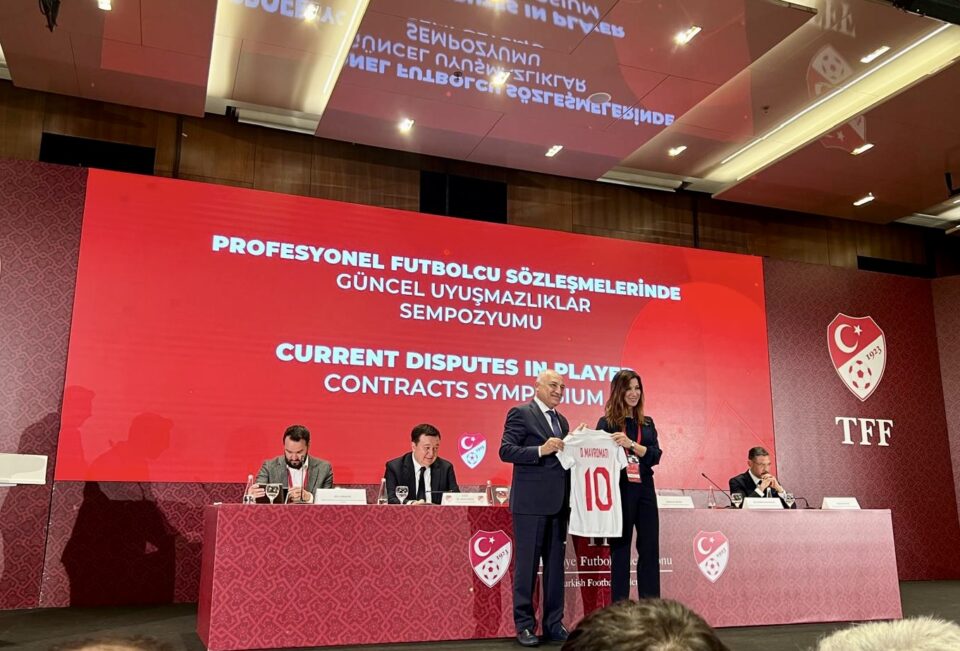
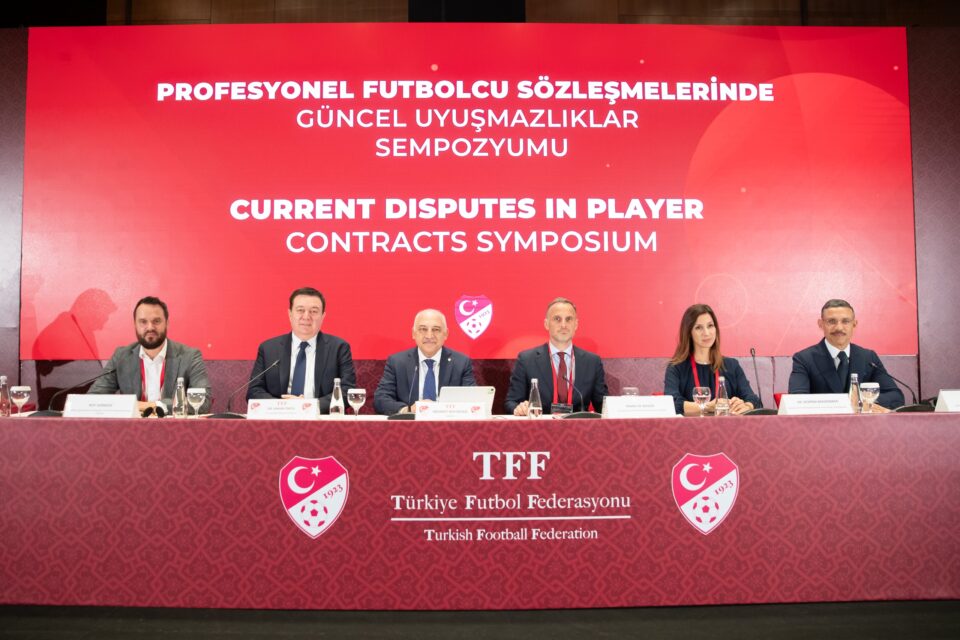
Despina Mavromati was invited to speak at the Turkish Football Federation Symposium “Current Issues in Player Contracts” on 24 May 2024. She discussed “Termination of Player Contracts with Just Cause: Selected Issues under Swiss law, CAS – and Swiss Federal Tribunal Jurisprudence” alongside FIFA DRC Chair Franz de Weger, sports lawyer Marcos Motta and FIFPro Legal Director Roy Vermeer. You can find more information about the Symposium here.
Sports Lawyers Association Outreach Event in Lausanne hosted by the CAS
May 22, 2024
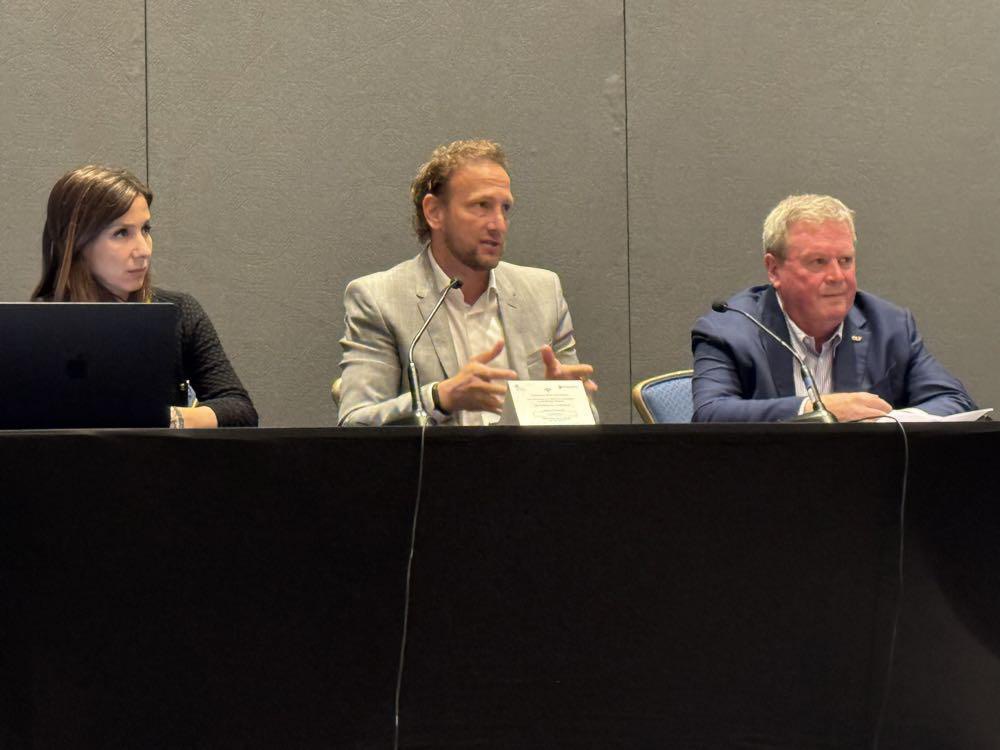
On 22 May 2024, Despina Mavromati, Raphaëlle Favre-Schnyder and Jeff Benz discussed dispute resolution during the Olympic Games at the 1st Sports Lawyers Association Outreach Event in Lausanne, hosted by the Court of Arbitration for Sport. You can learn more about the SLA here.
49th Sports Lawyers Association Annual Conference in Baltimore: Latest Developments and Recent CAS Case Law
May 10, 2024
Despina Mavromati was a speaker at the 49th SLA Annual Conference that took place on 8-10 May 2024 in Baltimore, alongside ICAS VP Michael Lenard and World Aquatics CEO Brent Nowicki. You can find more information about the SLA Annual Conference program here.
4A_430/2023, judgment of 23 February 2024, challenge of the CAS Award 2022/A/8571 of 6 July 2023
This judgment is interesting as it delves into the cases “of international dimension” where the FIFA RSTP provide for the jurisdiction of the FIFA tribunals and the CAS in appeal, however allowing them to opt out of the FIFA-CAS jurisdiction for labour law disputes as in the case at hand. In those cases, the panel must interpret the agreement in question and establish whether the clause includes an “alternative jurisdiction” or excludes the FIFA jurisdiction altogether. In line with consistent case law of the SFT, the parties’ wish to exclude state court jurisdiction must be clear in order to accept to have recourse to a court of arbitration, which was not the case here.
In 2020, a Hungarian football club (the Club) signed a contract with a Russian football player (the Player) which included the following arbitration clause in its Article 49:
“The Parties agree that they shall make efforts to settle their possible dispute in amicable way by negotiations. If theseefforts fail (…). the Parties may turn to the organizational units with MLSZ or FIFA scope of authority, in case of labourdispute to the Administrative and Labour Court having competence and scope of authority, and in all other disputes arising out of their legal relationship the Parties stipulate the exclusive jurisdiction of the Sport Standing Arbitration Court based on the Article 47 of the Sports Law. (…)”
In 2021, the Club informed the player that he would evolve in its reserve team with a 50% reduced salary according to Article 49 of the contract. The Player contested this decision and requested his unpaid salaries and his reinstatement to the first team, with no answer from the Club. The Player terminated his contract of employment and brought a claim before the FIFA DRC requesting the payment of the salaries and a compensation for termination of breach of contract.
The FIFA DRC partially accepted the claim, ordering the Club to pay various amounts to the Player. In appeal to the CAS, the Sole Arbitrator held that the CAS did not have jurisdiction to decide on the matter, which should have been brought before the Hungarian state tribunals.
In the subsequent challenge to the SFT by the Player for wrongly denying jurisdiction, the SFT repeated its general theory on the interpretation of the arbitration agreement as a contract (at 5.2) and confirmed the interpretation of the Sole Arbitrator.
The SFT endorsed the Sole Arbitrator’s interpretation of the relevant arbitration clause, notwithstanding the fact that the dispute had an international dimension under Art. 22 (b) RSTP.
More specifically, the Sole Arbitrator proceeded to an interpretation of the relevant arbitration clause, finding that the parties distinguished between labour law disputes (that should go exclusively to the state courts) and other disputes enshrined in the FIFA RSTP that should go to FIFA and then to CAS.
The SFT therefore dismissed the Player’s argument that the clause included “an alternative jurisdiction” in favour of both the state courts and FIFA DRC (TAS 2018/A/6016). The SFT held that the Player’s interpretation was inadmissible before the SFT as it could not be traced in the contested award itself (at 5.4).
The SFT also noted the similarities of this case to another judgment (judgment 4A_2/2023 of October 6, 2023, at 3.4 in appeal against CAS 2021/A/7775), where the CAS panel had also reached a similar conclusion related to the interpretation of a jurisdiction clause involving the jurisdiction of Hungarian state courts for labour law disputes.
“Arbitration and the Olympic Games” conference hosted by the French Olympic Committee in Paris
March 3, 2024
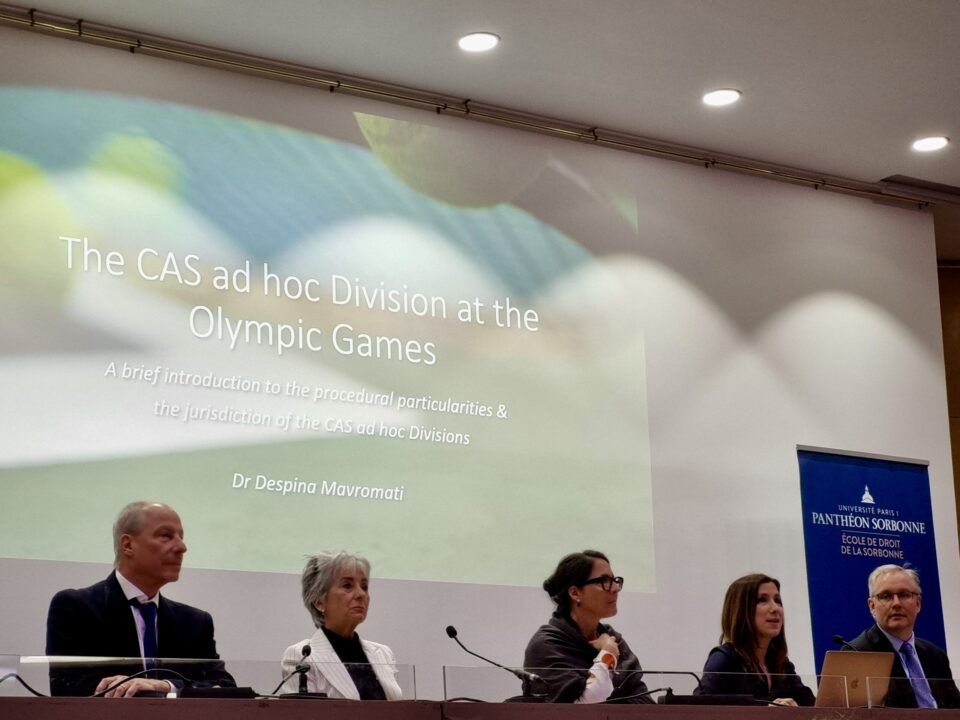
Dr Despina Mavromati spoke at the conference “Arbitration and the Olympic Games” hosted by the French Olympic Committee in Paris on 29 February 2024.
In the session on the CAS ad hoc Divisions chaired by the CAS Director General Matthieu Reeb, she spoke about the procedural particularities of the CAS ad hoc Divisions at the Olympic Games, focusing on the material- and temporal jurisdiction of these Divisions. The full program of the conference can be found here. The speakers’ contributions will be compiled and published in the Paris Journal of International Arbitration (Revue de l’Arbitrage) before the Paris Olympic Games.
4A_488/2023, judgment of 23 January 2024, A v. B & WADA, motion to set aside the CAS award of 30 August 2023 (CAS 2022/A/8653)
This doping-related case was part of the LIMS’ investigation launched by WADA following the Russian doping scandal. In this context, a disciplinary procedure was opened against a Russian female triathlete (the Athlete) by her international federation (now World Triathlon), for irregularities in the reporting of the prohibited substance Trimetazidin which was found in her sample on three occasions in 2014 and 2015 but was not further reported to WADA.
After a four-year suspension by the CAS Anti-Doping Division in 2022, the CAS panel partially upheld the appeal, changing only the starting point of ineligibility period and considering as established that the Athlete used the prohibited substance Trimetazidin in 2014 and 2015.
In her subsequent motion to set aside the CAS award, the Athlete directly invoked a violation of Article 13 of the European Convention on Human Rights (ECHR). This seems to be the first attempt to directly invoke the provisions of the ECHR after the Semenya ECHR judgment in July 2023: the SFT held that the Semenya judgment is not binding on the SFT so long as the case is still pending before the ECHR Grand Chamber, showing its unwillingness to change its well-established jurisprudence, at least pending the finality of the Semenya’s referral to the Grand Chamber.
The Athlete further invoked the lack of institutional independence of the CAS since she had raised her objection “immediately” in the arbitral proceedings: this was swiftly dismissed by the SFT since the Athlete had not sufficiently substantiated her objections based on Article 190 (2) a PILA nor had she objected to the particular arbitrators appointed on her case. The SFT still went on to note that such grievance would in any event have been dismissed, in view of the Mutu & Pechstein ECHR judgment on the criticized influence of the ICAS. In this respect, the dissenting opinion of the two judges in the Mutu & Pechstein ECHR judgment was not considered as decisive by the SFT – to the extent that it was not followed in the judgment itself. As a result, the SFT reiterated its endorsement of the CAS as a true court of arbitration, including the panel / ICAS appointment mechanism or the closed list of CAS arbitrators by referring to its previous case law (see my note on the 4A_232/2022 of 22 December 2022).
The Athlete also attacked the CAS award for violation of her right to be heard through numerous angles, including the fact that she could not access nor test the three contested samples from 2014 and in 2015. The fact that the urine samples no longer existed after the Moscow laboratory had destroyed them was not found to be a violation of the Athlete’s right to evidence, as it was naturally impossible to provide evidence in the arbitration proceedings. What is more, the argument that WADA unlawfully prevented the Athlete from obtaining the evidence was deemed inadmissible to the extent that it was directed against one of the opposing parties and not the panel.
Finally, there was no violation of public policy based on the principle “negativa non sunt probanda” (see also 4A_530/2013 of 2 May 2014, at 6.1) nor the protection of legitimate expectations, based on the fact that the international federation discontinued the proceedings in 2017 and reopened them four years later without a new analysis of the Athlete’s samples: Again, such plea was directed against a party in the proceedings (the international federation) and the Athlete had failed to establish that the CAS panel had disregarded fundamental procedural principles.
All in all, this is an interesting judgment and apparently the first post-Semenya SFT judgment where an applicant directly invoked a violation of Article 13 ECHR as opposed to the narrower scope of public policy under Article 190 (2) e PILA. The SFT showed that it is not yet ready to accept these arguments, at least pending the referral of the Semenya case to the ECHR Grand Chamber.
What is more, through the swift dismissal of the Athlete’s various pleas of violation of her right to present evidence, the SFT reiterated the narrow scope of Art. 190 (2) d PILA that does not encompass “factual reasons” which fall outside the scope of a specific conduct of the arbitral tribunal or criticisms of appellatory nature.
Article 190 (2) d PILA and the parties’ right to evidence does not encompass “factual reasons” that do not arise from the conduct of the arbitral tribunal
4A_456/2023, judgment of 11 December 2023, FC A. v. B, motion to set aside the CAS Award of 25 July 2023 (CAS 2022/A/8754)
A football employment-related dispute between a football club (the Club) and a football player (the Player) was brought before the CAS: the employment contract provided for a salary of USD 4’000 and a signing on fee of USD 50’000, whereas the parties also agreed on a USD 2’000’000 compensation in case of unilateral contractual breach. The Club unilaterally terminated the contract with the Player in February 2021 and the Player filed a successful claim before the FIFA DRC; following an appeal to the CAS by the Club, the Panel partially upheld the appeal and reduced the awarded compensation (from USD 2’000’000 to UDS 500’000).
The Club subsequently filed a motion to the SFT invoking, primarily, a violation of its right to be heard (Article 190 para. 2 d PILA). More specifically, the Club held that the CAS had not justified its assessment of the compensation nor had it substantiated how it reached its decision. The CAS Panel had found that the compensation foreseen in the contract was a contractual penalty that was validly negotiated between the parties. As such, the Panel went on to reduce it amount to the extent that this was found to be excessive (under Article 163 para. 1 SCO), also considering the Player’s salary.
In its judgment, the SFT was not convinced that there was a procedural irregularity to the extent that the Panel had considered the arguments raised. The SFT reiterated that the arbitral tribunal is not obliged to answer explicitly to every and single argument raised in the appeal.
The Club’s argument, that the CAS should have reduced the contractual penalty to the equivalent of six salaries (i.e. USD 24’000) was swiftly dismissed by the SFT, rightly considering that this was an inadmissible plea of appellatory nature. In its conclusion that shows the (high) threshold of a procedural violation under Article 190 para. 2 d PILA, the SFT referred to well-established federal case law according to which the right to be heard does not entitle the parties to a materially correct decision but rather safeguards their right to participate in the decision-making process.
4A_442/2023, judgment of 11 January 2024, A. v. WADA) & RUSADA, motion to set aside the CAS Award 2021/A/8263 & 8381
In this doping-related case, the sample of a Russian wrestler (the Athlete) had been first tested negative by the Moscow Laboratory (accredited by WADA) in 2015. Following WADA’s request, the sample was re-examined in April 2020 and showed the presence of a prohibited anabolic steroid. This led to the issuance of a notice of charge in May 2020 and the subsequent acquittal of the Athlete by the RUSADA Disciplinary Commission.
This decision was subsequently challenged by both RUSADA and WADA before the Court of Arbitration for Sport (CAS). The Sole Arbitrator appointed ordered the consolidation of both proceedings, held a hearing and issued its decision, admitting both appeals. The Sole Arbitrator found that the Athlete had violated the RUSADA anti-doping rules and issued a four-year suspension from the notification of the decision (after deducting any provisional period served by the Athlete) and disqualified his competitive results from 2015 until 2020.
In his subsequent motion to the Swiss Federal Tribunal, the Athlete filed a request for a stay of the appealed decision that was rejected.
Determination of the “reasonable time limit” to render a CAS award
The SFT also examined the issue of the time limits to render a CAS award within scope of public policy: pursuant to the time limit enshrined in Article R59 para. 5 of the CAS Code, the Panel has 3 months from the transfer of the file. In the case at hand, the Sole Arbitrator had received the files in May 2022 and issued the award in July 2023, 9 months after the hearing and 8 extensions of the time limit. What is more, the CAS never informed the Athlete of the reasons that the extensions were granted notwithstanding his request to this effect.
The SFT held that the delay of the proceedings can, under conditions, violate procedural public policy and referred to previous case law in which it found that the conditions were not met (4A_22/2023 of 16 May 2023, at 7.3.2; 4A_668/2020 of 17 May 2021, at 4.2). In determining whether the case was decided within a “reasonable time limit”, it is necessary to consider the totality of circumstances, the legal and factual complexity of the matter, the nature of the procedure and the stakes for the parties, as well as their conduct during the proceedings. The case at hand presented a certain level of complexity including the consolidation of the proceedings and the hearing of several experts. What is more, the Athlete had himself contributed to the delay of the procedure requesting several extensions and never complaining about the extensions, reason why the duration of the proceedings in this case could not be considered as excessive and thus leading to a violation of procedural public policy as per Article 190 (2) e Swiss Private International Law Act (PILA).
Difficulty in finding an expert in doping-related proceedings and alleged violation of the equality of the parties
The SFT also examined the plea of violation of equality of the parties, as the Appellant invoked difficulties in finding a scientific expert to comment on the sample analysis conducted by the Lausanne Anti-Doping Laboratory. This argument was found to fall outside the scope of Article 190 (2) d PILA, as it did not criticize how the Sole Arbitrator conducted the proceedings but rather deplored the Athlete’s difficulties in finding an expert based on the applicable rules (the WADA Code). In any event, this argument was dismissed also because the Athlete, notwithstanding his difficulties, had eventually managed to find experts in the CAS proceedings.
Concluding remarks
Even though this judgment is not a groundbreaking one, it still shows that the time limit to issue an award in a sports-related matter is a sensitive issue that is subject to the scrutiny of the Swiss Federal Tribunal (SFT) through the prism of procedural public policy. The judgment reiterated several of the considerations of a previous, relatively recent SFT judgment that also related to a CAS award (see my note here) and confirmed that the “reasonable delay” must be assessed by taking into account the totality of circumstances rather than the actual length of the proceedings or the extensions to the time limit to issue the decision.
A review of CAS, Swiss Federal Tribunal and other important judgments rendered in 2023 & major regulatory reforms
Several major sporting events took place in 2023, including the Womens World Cup in Australia in the summer of 2023, that ended with a widely publicised case of the “Rubiales kiss” and a FIFA Disciplinary Committee decision suspending the President of the Spanish Football Federation for three years (the decision is currently under appeal). The Asian Games also took place in September 2023 in China but did not generate any disputes for the CAS Ad Hoc Division present on site during the games. July was the busiest month in terms of important international sports law judgments rendered, with the most important being the European Court of Human Rights (ECtHR) judgment in the application of the South African athlete Caster Semenya against Switzerland. December was an equally crucial month for European sports law, as the CJEU rendered its judgment in the Super League case, in the International Skating Union (ISU) case and the Antwerp case on the “home-grown players rule”.
Swiss Federal Tribunal judgments in motions against CAS Awards
In 2023, the Swiss Federal Supreme Court (SFT) issued several noteworthy judgments in motions against awards rendered by the Court of Arbitration for Sport (CAS). In most of them, it reiterated the high admissibility threshold. Accordingly, pleas of appellatory nature are generally inadmissible, but also the parties have an obligation to raise any procedural irregularities / violations of the right to be heard in an explicit and unequivocal manner as soon as they arise.
With respect to the irregular constitution of the arbitral tribunal, the SFT reiterated that there is no analogy between barristers belonging to the same Chambers (who are all independent and thus not partners) and Swiss lawyers belonging to the same law firm. Therefore, in the absence of additional criteria, such connection cannot on its own establish bias or lack of independence of arbitrators. Inversely, the SFT reinforced its view on the parties’ and the parties’ counsel duty of curiosity, which is clearly violated when they fail to examine notorious facts related to the appointed arbitrators in a timely manner; at the same time, the appointed arbitrators are not obliged to disclose publicly available -and easily discoverable- information.
Selected CAS Awards rendered in 2023
In February 2023, the CAS issued its decision in the appeal filed by the Haitian Football Federation (HFF) President Yves-Jean Bart against a decision of the FIFA Ethics Commission sanctioning him for several violations of the FIFA Code of Ethics for allegations of sexual abuse of members of the female technical team of the HFF. The CAS annulled the FIFA decision holding that there was insufficient evidence and a lack of coherence or credibility in the witness testimony by the alleged victims during the hearing. The decision was unsuccessfully appealed to the SFT.
In March 2023, the CAS partially upheld the appeal of the Ukrainian gymnast Oleg Verniaiev against a decision issued by GEF Disciplinary Commission and reduced the four-year suspension for the presence of Meldonium in his sample to two years. In July 2023, the CAS issued its award in the case of the Swedish tennis player Mikael Ymer, in an appeal filed by the ITF against the decision of the ITF Independent Tribunal that had exonerated the player for whereabouts failures. In appeal, the CAS imposed an 18-month ineligibility period on the player for three whereabouts failures within a 12-month period. Following the CAS award, the player decided to retire from professional tennis.
In July 2023, the CAS issued an award CAS 2023/O/9370 on the legality of FIFA’s Agents Regulations (FFAR), notwithstanding -or rather amid – the pending challenges before state courts in several European countries but also the expected preliminary ruling by the Court of Justice of the European Union (CJEU). In the arbitration proceedings between the Professional Football Agents Association (PROFAA) and FIFA, the CAS Panel confirmed the legality of FFAR and dismissed all claims filed by PROFAA. In essence, the Panel found that Article 15 FFAR (imposing a cap on agents’ fees) does not contravene EU competition law in the sense of Articles 101- 102 of the Treaty on the Functioning of the European Union (TFEU). In the Panel’s opinion, FIFA is authorized to regulate football agents to the extent that the latter directly engage in the core aspects of the football system. It held that whether imposing a service cap leads to FIFA acting as an “association of undertakings” must be assessed under the Wouters / Meca-Medina test.
Interestingly, the CAS found that there was insufficient evidence filed by the claimant to establish abuse of a dominant position and concluded that Article 15 (2) FFAR pursues several legitimate objectives (e.g. fighting contractual instability, conflicts of interest etc.) and any restrictive effects are proportionate to achieve the legitimate objectives sought. The views of the CAS panel have however not been endorsed by other courts: for example, the Madrid Commercial Court, the Dortmund Regional Court or the Mainz Regional Court which referred several questions to the CJEU. The UK FA Rule K Tribunal has already rendered an award on 30 November 2023 finding that an implementation of the fee cap and other rules would infringe the Competition Act 1998.
In July 2023 the CAS also rendered another noteworthy decision in the football transfer of the Senegalese player Pape Alassane Gueye to the French football club Olympique de Marseille from Watford Association FC Ltd. The CAS confirmed the FIFA DRC decision that the player had breached his employment contract with Watford FC and the amount of compensation for breach but annulled the four-month ban of ineligibility on the player and the two registration periods ban on Olympique de Marseille.
The ECtHR Judgment in the case of Caster Semenya v. Switzerland
One of the most important cases of 2023 was undeniably the ECtHR judgment in the matter of South-African, 3-time Olympic champion Caster Semenya. The athlete initially contested the validity of the World Athletics regulations regarding the participation in competitions of Athletes with Differences of Sex Development (DSD Regulations) before the CAS in 2019, which confirmed the validity of said regulations. The SFT subsequently confirmed the CAS award, repeating its long-standing position, whereby a party cannot directly invoke violations of the Convention but only through the very limited scope of public policy and the Swiss Constitution.
However, Semenya filed an application before the ECtHR which essentially found that Switzerland had violated Article 14 in conjunction with Article 8 of the Convention (prohibition of discrimination and respect of private life) but also Article 13 (right to an effective remedy). The ECtHR held that Switzerland failed to provide sufficient institutional and procedural safeguards to protect the athlete from discrimination and exceeded its margin of appreciation (which is narrow for aspects linked to the identity of the individual concerned). In summary, any justification for the discriminatory character of the DSD Regulations on grounds of sex and sexual characteristics required “very weighty reasons” which were not given in the present case.
Interestingly, the Court admitted jurisdiction irrespective of the fact that the athlete was South African and World Athletics is based in Monaco, as long as the review of the CAS award was made by the SFT. As the judgment included a strong dissent (four to three dissenting judges), the request for referral to the Grand Chamber was admitted and the case is still pending.
Beyond the practical effect of the judgment on federations’ future rulemaking and sanctions , it will be particularly interesting to see if the Grand Chamber will confirm the expanded duty of review of CAS awards by the SFT. If confirmed, the SFT would find itself obliged not only to control the compatibility of CAS awards with ordre public but also review the assessment made by the CAS in similar cases. This could have far-reaching consequences for both the CAS and the SFT review and lead to a shift of the long-standing SFT jurisprudence.
Regulatory changes in 2023 and what to expect in 2024
Regulatory changes in 2023
In February 2023, the ICAS enacted new guidelines on legal aid for football-related matters, the Football Legal Aid Fund (FLAF), which is financed directly by FIFA and is available to both natural persons and, exceptionally also to football clubs in a difficult financial situation (excluding those under judicial administration due to insolvency or bankruptcy). Such legal aid fund exists in parallel with the ICAS legal aid fund for all other Olympic sports.
2024 will be a year rich in major sporting events, including the Summer Olympic and Paralympic Games in Paris (from 26 July 2024 to 11 August 2024) and the UEFA Euro 2024 in Germany (from 14 June to 14 July 2024). Both events will likely generate sports-related disputes prior, during and after their termination.
In terms of IOC governance, in June 2023, the CAS dismissed the urgent request for a stay filed by the International Boxing Association (IBA) of the decision rendered by the Executive Board of the International Olympic Committee (IOC), which withdrew the IOC’s recognition of IBA according to Rule 3.7 of the Olympic Charter. The IBA has also filed an appeal to the CAS seeking to annul the decision to recommend the withdrawal of the IOC and a decision should be expected in the coming year.
Another important decision expected in 2024 relates to the appeal of the Russian Olympic Committee (ROC) against the decision of the IOC EB to suspend the former following breaches of the Olympic Charter (namely ROC’s decision to include as its members regional sports organizations which are attached to the NOC of Ukraine).
In terms of doping-related cases, the Romanian tennis player and multiple ATP champion Simona Halep has appealed to the CAS her four-year ineligibility period imposed by the ITF Independent Panel, whereas the award in the case of the Russian figure skater Kamila Valieva is also expected in 2024.
There are also other important proceedings pending before the CAS related to compliance with the WADA Code, involving the Russian Anti-Doping Agency (RUSADA) and the South African Institute for Drug-Free Sport (SAIDS): following a decision by the WADA Executive Committee in September 2023 to declare RUSADA and SAIDS non-compliant with the WADA Code, both agencies have disputed their non-compliance and the matters were submitted to the CAS Ordinary Arbitration Division for a binding decision.
Last but not least, shortly before 2023 came to a close, the CJEU Super League judgment found that certain FIFA and UEFA rules requiring prior approval of new interclub football projects and giving them exclusive control over the commercial exploitation of rights were incompatible with the EU rules on competition and free movement of services. As this was only a preliminary ruling by the CJEU, the Madrid commercial court will be the ultimate arbiter of determining whether the rules are justified, among others by benefitting different stakeholders in football through a solidarity redistribution of the profits generated by media rights. Similarly, following the CJEU judgment on the “home-grown players” rules, it will be for the First Instance Brussels Court to determine whether the Belgian football federation’s rules pursue a legitimate objective by encouraging the recruitment and training of young professional players and are proportionate and necessary for the purpose sought. Finally, as seen above, the FIFA FFAR have triggered numerous legal challenges across several European countries, which are still pending.
4A_256/2023, judgment of 6 November 2023, Equatorian Football Federation v. Peruvian & Chilean Football Federations
Motion to set aside the CAS Awards TAS 2022/A/9175 & 9176
The case related to the FIFA World Cup 2022 and a disciplinary sanction imposed by the CAS on the Equatorian Football Federation (the Federation) for violation of the FIFA Disciplinary Code regarding forgery and falsification of documents of one of its football players. In the subsequent motion to the SFT, the FEF first invoked a violation of ultra petita which was immediately dismissed by the SFT, holding that the parties’ requests for relief included the Federation’s exclusion from the 2026 edition of the World Cup. The SFT also clarified that the parties’ legal interest falls obviously outside the scope of the plea of ultra / infra petita of Art. 190 (2) c PILA.
In a very interesting part of the judgment, the SFT dealt with the Federation’s grievance of violation of procedural public policy (res judicata). The SFT reiterated that the effect of res judicata of a foreign judgment in Switzerland is limited to its operative part and does not extend to its grounds (determined according to the lex fori). Moreover, res judicata extends to all facts that existed at the moment of the first judgment, irrespective of whether they were known to the parties, but not to a request that is based on the change of circumstances after the first judgment (at 6.1.3).
Most importantly, and according to the principle of “subjective relativity”, res judicata can only be invoked in a new process if it opposes the same parties / their direct successors or it stems from a “Gestaltungsurteil” opposable to third parties. In the particular case, the Federation supported that the question of nationality of one of its players had already been examined and decided by the Ecuadorian courts, having an erga omnes effect.
However, the SFT confirmed that FIFA had enacted its own regulations regarding forgery and falsification of identity documents and the fact that the state of Ecuador has its own statutory provisions to combat falsified identity documents could not deprive FIFA of the right to exercise its disciplinary power over its members by virtue of its own enacted rules. In other words, the two bodies of rules are considered to be autonomous and can coexist.
An interesting admissibility obiter related to the standing of FIFA in the federal proceedings. Distinguishing between the standing of FIFA in the CAS proceedings and in the federal proceedings, the SFT did not invite FIFA to submit its observations considering that this situation was akin to the one of a first-instance tribunal.
The SFT concluded that there was no identity of the parties and that the subject matter of the proceedings brought before the Ecuadorian judicial authorities (an action habeas data filed by the player in order to unblock the information related to his identity) and the FIFA disciplinary proceedings (forgery and falsification of documents) was different.
Overall, the judgment seems to confirm previous SFT case law and the restrictive approach regarding res judicata, which is not violated in parallel proceedings enacted upon different sets of rules (e.g. national statutory rules vs. international disciplinary regulations).
A summary of selected Swiss Federal Tribunal judgments in motions to set aside CAS awards published in 2023
In 2023, the Swiss Federal Supreme Court (SFT) issued several noteworthy judgments in motions against awards rendered by the Court of Arbitration for Sport (CAS). In most of them, it reiterated the high admissibility threshold. Accordingly, pleas of appellatory nature are generally inadmissible, but also the parties have an obligation to raise any procedural irregularities / violations of the right to be heard in an explicit and unequivocal manner as soon as they arise.
With respect to the irregular constitution of the arbitral tribunal, the SFT reiterated that there is no analogy between barristers belonging to the same Chambers (who are all independent and thus not partners) and Swiss lawyers belonging to the same law firm. Therefore, in the absence of additional criteria, such connection cannot on its own establish bias or lack of independence of arbitrators. Inversely, the SFT reinforced its view on the parties’ and the parties’ counsel duty of curiosity, which is clearly violated when they fail to examine notorious facts related to the appointed arbitrators in a timely manner; at the same time, the appointed arbitrators are not obliged to disclose publicly available -and easily discoverable- information.
Determination of the nature of the CAS Anti-Doping Division proceedings by the SFT
The judgment 4A_232/2022 of 22 December 2022 examined for the first time the nature of the CAS Anti-Doping Tribunal (ADD) proceedings when the latter acts as a first instance body. A first challenge was dismissed back in 2021 (see my note on 4A_612/2020). A former biathlete’s doping-related case was heard by the CAS ADD acting as the first-instance tribunal, and then by the CAS Appeals Division. In a nutshell, the SFT found that the CAS ADD merely acted through delegation of the disciplinary power over anti-doping matters by an international federation and therefore did not qualify as a “true” arbitral tribunal (see my note on 4A_346/2021). The SFT therefore dismissed the jurisdictional grievance as inadmissible but would have in any case been unfounded based on the de novo review by an independent arbitral tribunal which is the CAS Appeals Division. The SFT also held that the coexistence of two instances within the same tribunal is not unusual (cf. the International Criminal Court, the ECtHR etc.). Overall, the SFT largely accepted the legitimacy of the CAS ADD, to the extent that such instance replaces the internal disciplinary instance of sports federations and is sufficiently independent from the CAS Appeals Division.
FIFA PSC Jurisdiction to hear Set-off Claims for Damages Against Contractual Claims in Football Transfer Disputes
In March 2023, the SFT issued a very interesting 4A_420/2022 of 30 March 2023 related to the Emiliano Sala transfer fee owed by Cardiff to FC Nantes following his tragic plane crash shortly after the transfer. The judgment essentially relates to the scope of the arbitration clause between the parties to a transfer agreement but also the scope of disputes decided by the FIFA dispute resolution bodies and, subsequently, by the CAS. In essence, the SFT confirmed that CAS jurisdiction could not go beyond the jurisdiction of the FIFA PSC and that there were no reasons to justify the concurrent ruling on claims based on the transfer agreement and on (the unrelated) set-off against a tort claim. The SFT equally interpreted the pertinent parts of the FIFA Regulations and confirmed the limited material scope of the FIFA PSC jurisdiction, which does not extend to ruling on civil disputes of football stakeholders that are unrelated to football. This was a thorough judgment that highlights the specificities of sports arbitration with respect to the jurisdictional scope of the FIFA decision-making bodies, which draw the limits of the subsequent jurisdiction of the CAS.
Ne bis in idem in disciplinary proceedings initiated at both the national- and the international level
In April 2024, the SFT issued two factually very similar judgments related to match-fixing in tennis. Both judgments 4A_484/2022 and 4A_486/2022 of 26 April 2023 primarily dealt with the principle of ne bis in idem as part of public policywhen disciplinary proceedings are opened for allegations of match-fixing by both the national federation (NF) and the international federation (IF). In a case where the athlete was acquitted by the NF but convicted by the IF, the SFT held that there was no violation of the principle ne bis in idem and that the material and temporal link between both proceedings constitute “two sides of a unique system”, which would be jeopardized if not triggered in parallel. Consequently, concurrent or subsequent national and international disciplinary proceedings do not infringe Swiss public policy / ne bis in idem, at least as long as national proceedings do not have an automatic international effect.
In addition to the aforementioned plea of ne bis in idem, the decision 4A_484/2022 of 26 April 2023 dealt with the independence and impartiality of an arbitrator belonging to a barristers’ Chamber: The panel chair Mr. Michael J. Beloff KC was challenged by the athlete as two out of the four Anti-Corruption Commissioners worked in the same Chambers. The SFT disregarded the argument that such arbitrator would be inclined to “defend” the decision rendered by his colleagues in order to protect their reputation. After seriously questioning the admissibility of the grievance to the extent that the player had not raised any objection during the hearing, the SFT dismissed the plea as unfounded, confirming that there is no analogy between barristers belonging to the same Chambers and lawyers belonging to the same law firm. Therefore, in the absence of additional criteria, such connection cannot on its own establish bias under Art. 190 (2) a PILA.
Impact of several extensions to issue the CAS award in a match-fixing case on the arbitration agreement and the principle of celerity
In 4A_22/2023 of 16 May 2023, the SFT addressed the questions of numerous extensions to issue the CAS award in a complex match-fixing case related to tennis and its impact on the validity of the arbitration agreement / the celerity of the proceedings. A professional tennis player suspended for eight years for violations appealed his sanction to the CAS in December 2020; a hearing was held one year later and the CAS issued its award in November 2022, after eight extensions of the time limit under the CAS Code. In the subsequent challenge proceedings, the SFT held that the player could not rely on procedural rules that entered into force after his filing of the appeal and that the arbitrators were authorized to render the award as long as their mandate had not been revoked. The SFT equally held that there was no violation of the principle of procedural celerity, finding the procedural length reasonable in view of the complexity of a case related to match-fixing.
Right of a complainant to obtain the full decision in sports disciplinary proceedings
In 4A_184/2023 of 5 June 2023, the SFT addressed the right of a complainant to obtain the full decision in sports disciplinary proceedings. In 2020, a French female semi-professional cyclist had filed a complaint against her team’s manager for sexual harassment before the UCI Ethics Commission. Her request to participate in the proceedings was denied, according to the applicable rules at the time, and she only received a three-page summary of the final decision. In her subsequent motion to the SFT, the latter considered that there was no violation of imperative Swiss law and no violation of public policy because the summary of the decision was sufficient to inform the cyclist on the outcome of the procedure. Similarly, the SFT found that the non-transmission of a disciplinary decision rendered by an association’s organs to the person that filed a complaint does not violate human dignity.
This was a rather unsurprising judgment of the SFT which confirmed its strict approach regarding the limited review of procedural rules of sports federations but also the inadmissibility of arguments of appellatory nature in the federal proceedings.
Non-timely filing of a statement of appeal due to non-established technical problems and excessive formalism
Non-timely filing of the statement of appeal due to non-established technical problems and excessive formalism
In 4A_254/2023 of 12 June 2023, a doping-related sanction was issued by the disciplinary body of the International Fencing Federation (FIE) on 31 January 2023. The athlete’s counsel filed the statement of appeal within the 21-day time limit by email only, requesting at the same time the “Case Registration Form” in order to upload the statement via the CAS e-filing platform. On the last day of the time limit, the counsel uploaded the submission on the e-filing platform, noticing that the platform was particularly slow but without receiving an error notification from the system. Several days later, the CAS informed the athlete that the statement of appeal was filed late. In the subsequent challenge proceedings, the SFT confirmed that the parties uploading their statement of appeal on the e-filing platform bear the burden to establish the valid filing of their submissions, whereas the inadmissibility for non-timely filing cannot amount to excessive formalism (cf also my note on 4A_692/2016).
Publicly available information and duty of curiosity of the parties in a CAS procedure
Publicly available information and duty of curiosity of the parties in a CAS procedure
In June 2023 the SFT rendered several judgments, starting with the unusual 4A_100/2023 of 22 June 2023, which annulled a CAS award, for the first time due to the erroneous challenge of an arbitrator by the ICAS Challenge Commission. In a contractual dispute between an Austrian coach and a Croatian club, a Croatian Arbitrator appointed by the Club signed his declaration without mentioning that he was also an arbitrator at the Croatian Football Tribunal, only disclosing this during the deliberations. Following such disclosure, FIFA challenged his appointment and the ICAS replaced the arbitrator. In this case, the SFT narrowed down the arbitrators’ ongoing duty of disclosure as it does not apply to notorious facts that can be easily discovered (see also my note on 4A_520/2021). Inversely, it highlighted the importance of the parties’ duty to investigate as the starting point for the admissibility of the challenge.
SFT Judgment in the motion to set aside the CAS award in the Yves-Jean Bart judgment
The judgment 4A_170/2023 of 23 June 2023 put an end to the disciplinary proceedings initiated by FIFA against the Haitian Football Federation President Yves-Jean Bart (Respondent) for allegations of sexual abuse vis-à-vis several female players of the national technical center. Following a decision by the FIFA Ethics Committee sanctioning him for several violations of the FIFA Code of Ethics, the CAS annulled the FIFA decision holding that there was insufficient evidence and a lack of coherence or credibility in the witness testimony by the alleged victims during the hearing. In a rather unusual procedural move, FIFA filed a motion to set aside the CAS award in March 2023, invoking a violation of its right to be heard by the CAS panel for refusing to hear one of the victims online by means of a voice distortion mechanism. Interestingly, the SFT considered that FIFA had not validly and explicitly raised an objection to the modalities of the hearing. In any event, such plea was unfounded to the extent that the panel simply suggested an alternative hearing mode of such witnesses. The SFT also held that there is (currently) no statutory obligation to hear witnesses through video conference. In any event, the efficient protection of the identity of witnesses in similar cases remains a very sensitive issue that could be crucial for the outcome of the proceedings. In this respect, it must be noted that the CAS has just published its “Guidelines for the hearing of vulnerable witnesses and testifying parties in CAS Procedures (December 2023)”.
No violation of res judicata in case of an action filed before the national courts and a subsequent FIFA disciplinary procedure.
The judgment 4A_256/2023 related to the FIFA World Cup 2022 and a disciplinary sanction imposed by the CAS on the Equatorian Football Federation (the Federation) for violation of the FIFA Disciplinary Code regarding forgery and falsification of documents of one of its football players. In the subsequent motion to the SFT, the FEF first invoked a violation of ultra petita which was immediately dismissed by the SFT, holding that the parties’ requests for relief included the Federation’s exclusion from the 2026 edition of the World Cup. The SFT also clarified that the parties’ legal interest falls obviously outside the scope of the plea of ultra / infra petita of Art. 190 (2) c PILA.
In a very interesting part of the judgment, the SFT dealt with the Federation’s grievance of violation of procedural public policy (res judicata). The Federation supported that the question of nationality of one of its players had already been examined and decided by the Ecuadorian courts. However, the SFT confirmed that FIFA had enacted its own regulations regarding falsification of documents and could exercise its disciplinary power over its members irrespective of any national rules combatting falsified identity documents. In other words, the two bodies of rules are considered to be autonomous and can coexist. The SFT concluded that there was no identity of the parties and that the subject matter of the proceedings brought before the Ecuadorian judicial authorities and the FIFA disciplinary proceedings was different.
Overall, the judgment seems to confirm previous SFT case law and the restrictive approach regarding res judicata, which is not violated in parallel proceedings enacted upon different sets of rules (e.g. national statutory rules vs. international disciplinary regulations).
Note: a comprehensive compilation of the 2023 SFT judgments has been published on LawInSport
4A_170/2023 of 28 June 2023 FIFA v. Yves-Jean Bart, motion to set aside the CAS award TAS 2021/A/7661
This is the SFT judgment which put an end to the disciplinary proceedings initiated by FIFA against the Haitian Football Federation President Yves-Jean Bart for allegations of sexual abuse vis-à-vis several female players of the national technical center.
Following several articles alleging that Yves-Jean Bart had committed acts of sexual abuse vis-à-vis several female players of the national technical center, the FIFA Ethics Commission opened a preliminary investigation, concluding that the Yves-Jean Bart had violated several provisions of the FIFA Ethics Code against minor female football players, threatening witnesses and victims by abusing his position within the Federation. Shortly afterwards, the state courts in Yves-Jean Bart’s home country had cleared him of any wrongdoing for lack of sufficient evidence; however the FIFA Ethics Commission sanctioned him for several violations of the FIFA Code of Ethics, imposing a ban from any activity linked to football and a fine of CHF 1 mio (the FIFA Decision).
In the subsequent appeal to the CAS, the three-member panel heard more than twenty witnesses, some of them under a specific regime in order to protect their identity. The CAS panel issued its award and annulled the FIFA Decision, holding that FIFA could not establish its allegations to the applicable standard of proof (comfortable satisfaction). More specifically, the documents established by various organizations could not constitute sufficient evidence and there was a lack of coherence or credibility in the witness testimony by the alleged victims during the hearing. Additionally, the CAS panel noted that the state authorities had dropped the proceedings against the Respondent for lack of evidence.
In a rather unusual procedural move, FIFA filed a motion to set aside the CAS award in March 2023. The motion was swiftly dismissed by the SFT, which first noted that it is bound by the facts established by the CAS panel and FIFA could not present its own version of factual and procedural circumstances
In essence, FIFA invoked a violation of its right to be heard by the CAS panel for refusing to hear one of the victims even though it had considered necessary to protect the anonymity of the alleged victims and witnesses. The CAS panel held that online hearing platform did not dispose a voice distortion mechanism and suggested to hear the witnesses in a secret place in Switzerland, through a phone equipped with a voice distortion mechanism. FIFA therefore accused the panel of not having an online hearing platform which could enable the witnesses to provide their testimony, as several witnesses could not physically travel to Switzerland for reasons beyond their will. According to FIFA, this led to the failure to hear several witnesses, including a specific person whose testimony could be decisive for the outcome of the case. FIFA supported that it had already raised this procedural deficiency at the outset of the hearing but the CAS panel ignored its request and equally refused to allow written testimony from these persons.
The SFT considered that FIFA had not validly and explicitly raised an objection to the modalities of the hearing and the hearing of witnesses: accordingly, FIFA had only said that it was “rather regrettable” (“plutôt regrettable”) or “unfortunate” that the CAS online hearing system cannot guarantee the protection of witnesses but failed to file an explicit objection in this respect. What is more, at the end of the hearing FIFA confirmed that its right to be heard was totally respected. The SFT held therefore that FIFA’s request was inadmissible at this stage but it also held that such plea would have in any event been dismissed: the panel did not refuse to hear the witnesses but rather suggested an alternative hearing mode of such witnesses.
FIFA also invoked a violation of its right to be heard as the panel had refused its request to produce the unredacted declarations made by the various respondents, which would have shown that their declarations were coherent and credible. Apart from finding this plea inadmissible (for not having invoked such plea before the federal proceedings), the SFT considered such plea as unfounded: the CAS panel had indeed requested FIFA to produce (for the panel only) the entire file of the FIFA proceedings, which de facto included the unredacted declarations; had FIFA wished to draw the panel’s attention to a specific element of the file, it should have done so at an earlier stage and not wait until the end of the CAS proceedings to raise such objection.
Finally, FIFA invoked a violation of public policy due to the impossibility to hear the protected witnesses and specifically one witness through video conference disposing a voice distortion mechanism. The SFT held that the impossibility to hear witnesses online does not infringe public policy, all the more since such possibility does not exist by law in several countries, including Switzerland (even though an amendment of art. 170a of the Swiss Code of Civil Procedure is currently underway, cf. at 6.2.1).
Overall, this was an expected outcome of FIFA’s motion to set aside the CAS award: the SFT stressed the importance of explicitly raising a procedural objection in a timely manner, but also held that there is (currently) no statutory obligation to hear witnesses through video conference. In any event, the efficient protection of the identity of witnesses in similar cases remains a very sensitive issue that could be crucial for the outcome of the proceedings
4A_184/2023, judgment of 5 June 2023, A v. UCI, appeal against the award rendered by the CAS on 27 February 2023 (CAS 2021/A/7663)
The dispute involved a French female semi-professional cyclist (the Cyclist) and the International Cycling Federation (UCI): In 2020, the cyclist had filed a complaint before the Ethics Commission of the UCI against her team’s manager for sexual harassment. Her request to participate in the proceedings was denied, because according to the UCI Code of Ethics (enacted in 2018) only the persons against which a complaint was filed could participate in the procedure. Later in 2020, the cyclist forwarded to the Ethics Commission of the UCI a copy of her criminal complaint before the French authorities and requested to be informed on the disciplinary proceedings. She then received a press release whereby the case had been transmitted to the Disciplinary Commission of the UCI, which later refused to send her a copy of the decision as she was not a party to the proceedings. The UCI subsequently sanctioned the manager from any activity linked to cycling for 3 years due to sexual harassment and forwarded a summary of three pages of the decision to the Cyclist.
The Cyclist filed an appeal to the CAS, which dismissed her appeal to the merits and then a civil law appeal to the SFT, also requesting legal aid.
Before the SFT, the Cyclist first invoked a violation of her right to be heard as the minimal guarantees granted to victims of sexual harassment under Swiss law had been violated. The SFT swiftly dismissed the plea as it held that it was an effort to inadmissibly attack the merits of the award. In any event, the CAS had indeed taken into account the arguments raised by the cyclist and found that the UCI Code of Ethics did not go against imperative Swiss law. There was equally no contradiction between the fact that the sole arbitrator considered as “unsatisfactory” the refusal of the UCI to send a copy of the decision and the fact that the UCI was in its rights to do so.
Second, the cyclist invoked a violation of procedural public policy: on a preliminary basis, the SFT reiterated the strict and limited review by the SFT: accordingly, when the SFT is called to review an arbitral award rendered by a tribunal seated in Switzerland and empowered to apply Swiss law subsidiarily (like in the case at hand), it should keep the same distance as if such tribunal had applied any other law and not proceed to a full review of the interpretation of Swiss law by the arbitrators (at 6.2.1). As such, the SFT held that the pleas on the violation of procedural public policy were inadmissible to the extent that they merely intended to establish that the contested award was against a norm of Swiss law (at 6.2.2).
Third, the Cyclist invoked a violation of substantive public policy, among others a violation of personality rights of Art. 27 par. 2 Civil Code due to the UCI’s refusal to give her a copy of the decision: the SFT considered that such violation was not established to the extent that the Cyclist could still be informed of the outcome of the procedure through the summary of the decision.
The Cyclist further invoked a discriminatory behaviour as to the procedural rights to the parties of a disciplinary procedure under the UCI Code of Ethics and those granted to third non-parties to the procedure: the SFT left – again – the question open as to whether an athlete can invoke discrimination in a dispute with a private association and referred to the Semenya SFT judgment (which is currently under review by the ECtHR Grand Chamber, cf ATF 147 III 49 at 9.4). The SFT went on to dismiss such plea as unfounded, as there was no discrimination in this case and drew the difference between differentiation (“distinction”) and discrimination (at 6.3.2).
What is more, the plea of violation of the principle of human dignity of a victim which is found outside of “her own process” was equally dismissed by the SFT: according to the judgment, sports federations in Switzerland can dictate the procedural rules of their choice and the SFT can only annul a CAS award, which, by confirming said rules, reaches a result contrary to public policy. As such, the non-transmission of a disciplinary decision rendered by an association’s organs to the person that filed a complaint does not violate human dignity.
Overall, this is a rather expected judgment by the SFT, which confirmed its strict approach regarding the limited review of procedural rules of sports federations but also the inadmissibility of arguments of appellatory nature in the federal proceedings.
4A_22/2023 of 16 May 2023 Civil law appeal against the award rendered by the CAS 2020/A/7616
In a tennis case linked to match-fixing, a professional tennis player was suspended for eight years for violations of the relevant integrity program of his international federation. The appeal to the CAS was filed in December 2020, a hearing was held one year later and the CAS panel issued its award in November 2022, after eight extensions of the time limit to issue the award under the CAS Code. In the subsequent challenge proceedings, the SFT exceptionally considered procedural elements subsequent to the issuance of the challenged award as they were pertinent to establish the player’s case (at 5).
The SFT held that an award rendered after the expiration of its mission is not void but voidable (at 6.1.2). As expected, the SFT held that the player could not rely on the subsequent amendment of the CAS Code (Art. R59) as said rules only applied to procedures initiated after 2022. To the extent that the parties had not revoked the mandate of the arbitrators, they were fully authorized to render their award so that there was no violation of Art. 190 (2) b PILA.
The SFT also found that there was no violation of the principle of celerity of the proceedings, after leaving the question open as to whether such principle indeed falls within the scope of procedural public policy: in the specific circumstances of the present case, the SFT considered its complexity and the various exchange of submissions as well as the fact that the player only raised an objection with respect to the delay of the proceedings after the seventh request for extension by the CAS panel.
The SFT concluded that, notwithstanding the length of the proceedings compared to other CAS cases, the duration of the proceedings was still reasonable for a case related to match fixing that required a more complex assessment.
Harvard Law School discussion on athletes’ rights and regulatory drafting in international sports
November 6, 2023
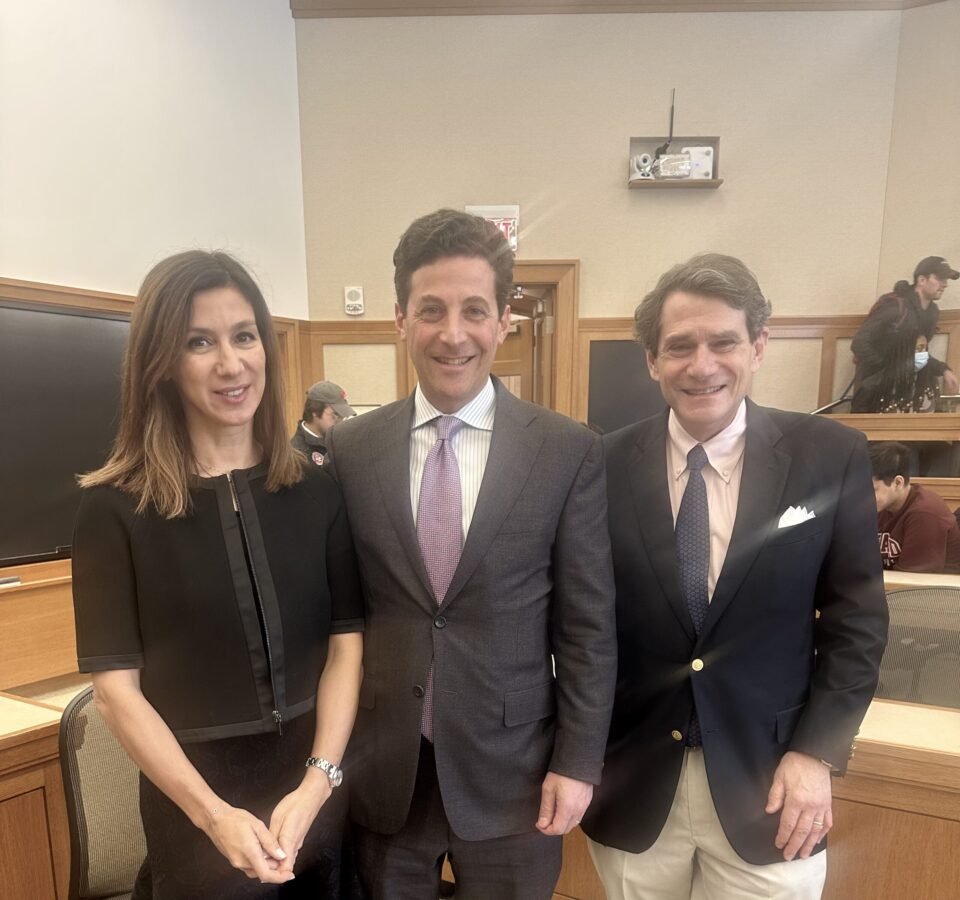
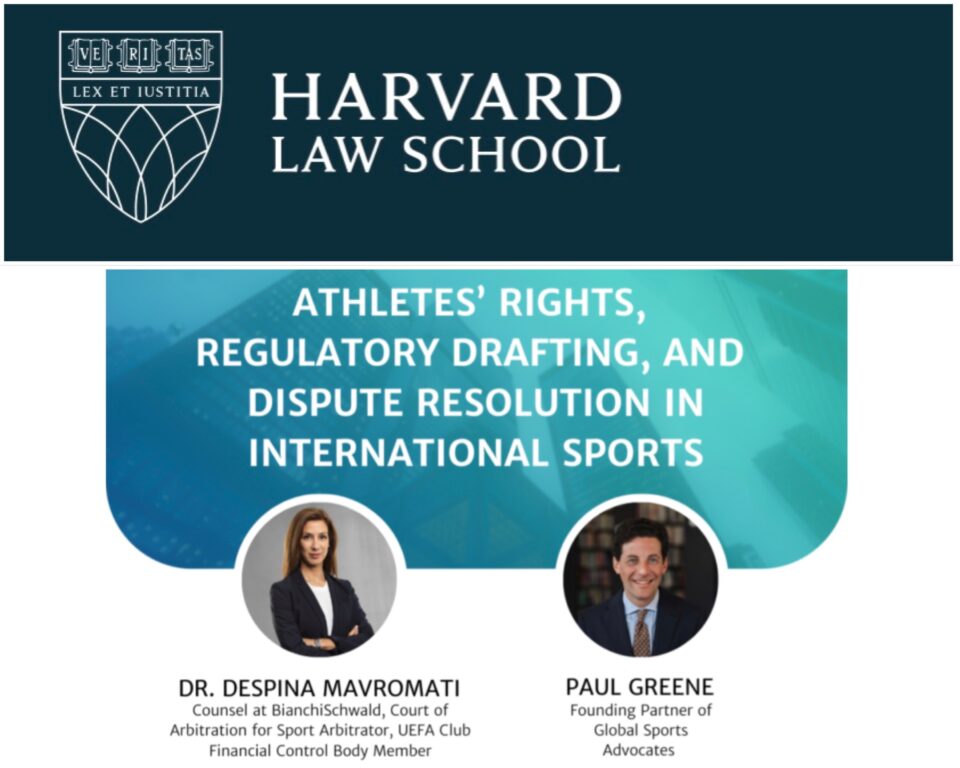
Despina Mavromati spoke at the Harvard Law School on 2 November 2023. Together with Paul Greene, they discussed the Semenya judgment rendered by the European Court of Human Rights and its potential implications on athletes’ rights, regulatory drafting and dispute resolution in international sports. More information can be found here.
4A_254/2023 of 12 June 2023, A. v International Fencing Federation (FIE) Motion to set aside the award CAS 2023/A/9453
A doping-related sanction was issued by the disciplinary body of the International Fencing Federation (FIE) on 31 January 2023. According to the applicable rules, the athlete had 21 days to file an appeal to the CAS. The athlete’s counsel filed the statement of appeal by email only, requesting at the same time the “Case Registration Form” in order to upload the statement via the CAS e-filing platform. On the last day of the time limit, the counsel uploaded the submission on the e-filing platform, noticing that the platform was particularly slow but without receiving an error notification from the system. Several days later, the CAS sent a letter noting that the statement of appeal was filed late.
In the subsequent challenge proceedings, the SFT did not consider that the CAS committed excessive formalism by not admitting the late filed statement of appeal, to the extent that the athlete’s counsel could not adduce any documents showing the inability to upload such submission. It also highlighted that the athlete’s counsel should have verified that the submission was successfully uploaded with the CAS Court Office if he had any doubts to this effect, all the more as such counsel was experienced in the filing of submissions with the CAS. It thus reiterating the importance of the respect of procedural rules (cf also my note on 4A_692/2016).
Ultimately, the SFT considered that there was no violation of the principle of good faith in the proceedings due to the CAS’ letter that the time limit to file the appeal brief was not suspended : in the SFT’s view, such letter does not infringe the principle of good faith as it is without prejudice to the question of the timely filing of the statement of appeal.
All in all, this was a confirmation that the parties uploading the statement of appeal on the e-filing platform bear the burden to establish the valid and timely filing of their submissions, whereas inadmissibility for non-timely filing can in principle not amount to excessive formalism on behalf of the CAS.
4A_100/2023, judgment of June 22, 2023 Croatian Club v. Austrian Coach & FIFA, motion to set aside the CAS Award (CAS 2021/A/7794)
This case dealing with the independence and impartiality of the arbitral tribunal is particularly interesting, not least because it annulled a CAS award for the erroneous challenge of an arbitrator by the ICAS Challenge Commission.
The dispute arose out of a typical contract of employment between an Austrian coach and a Croatian club, which included a clause granting jurisdiction to the Arbitral Tribunal of the Croatian Football Federation (Croatian Football Tribunal). The Club unilaterally terminated the contract and the Coach seized the FIFA Players Status Committee (PSC) instead of going to the Croatian Football Tribunal.
FIFA PSC accepted its jurisdiction based on Art. 22 (c) Rules on the Status and Transfer of Players (RSTP) which gives FIFA jurisdiction over disputes of international dimension, unless an independent arbitral tribunal exists at the national level. The FIFA PSC also held that the arbitration clause in the contract did not contain an exclusive clause in favor of the Croatian Football Tribunal. In this case the arbitration clause was not “exclusive”.
In the subsequent appeal to the CAS, the Club appointed a Croatian Arbitrator who signed his declaration without mentioning that he was also an arbitrator at the Croatian Football Tribunal. It is noteworthy that a disputed element of the case – also in order to corroborate the Club’s argument of lack of the FIFA PSC and CAS’ jurisdiction -that the Croatian Football tribunal was an independent and impartial tribunal in the terms of Art. 22 (c) of the FIFA RSTP. The three-member panel appointed on this case was constituted, held an online hearing and during the deliberations the Croatian Arbitrator revealed for the first time that he was also a member of the arbitral tribunal of the CFF, reason why he knew the structure and the functioning of such tribunal.
The CAS Head of arbitration then told him that he should step down or at least disclose this to the parties, and the Croatian Arbitrator filed the following disclosure: “I serve as one of the twelve arbitrators of the list of Croatian FootballFederation Court of Arbitration. I note this to be a public information, that can be seen from my CV on CAS profile.” This led to an immediate request for challenge by FIFA (the second respondent in this case) and the acceptance of such request through an ICAS Challenge Commission decision, leading to the replacement of the Croatian Arbitrator.
An interesting admissibility obiter related to the standing of FIFA in the federal proceedings. Distinguishing between the standing of FIFA in the CAS proceedings and in the federal proceedings, the SFT did not invite FIFA to submit its observations considering that this situation was akin to the one of a first-instance tribunal.
Findings of the SFT
An interesting admissibility obiter related to the standing of FIFA in the federal proceedings. Distinguishing between the standing of FIFA in the CAS proceedings and the standing of FIFA in the federal proceedings, the SFT did not invite FIFA to submit its observations considering that its situation was akin to the one of a first-instance tribunal in the Swiss cantonal proceedings (referring to the Guerrero case).
The SFT also confirmed that, notwithstanding the unusual character of the demand (it is typically against a challenge decision dismissing the challenge that the parties file a motion to the SFT), such situation fell within the scope of Article 190 (2) a PILA on the irregular constitution of the panel to the extent that the ICAS decision to remove the Club’s appointed arbitrator deprived the Club from its right to appoint its arbitrator.
After reiterating the essential principles on the duty of independence and impartiality of arbitrators, referring both to the Constitutional guarantees applying to state judges and the specificities of arbitration pursuant to the IBA Guidelines, the SFT referred to the ongoing duty of disclosure of arbitrators: even though, since the last amendment of 2021, Article 179 PILA explicitly requires the ongoing disclosure from arbitrators in international arbitration proceedings, such duty does not apply to notorious / published facts that can be easily traced (4A_520/2021 at 5.5).
Inversely, all parties / their counsel have a high due diligence duty (duty of curiosity / duty of investigation) and should not rely exclusively on the arbitrator’s declaration of independence. As such, FIFA had blatantly violated its duty of curiosity by failing to raise the challenge upon the appointment of the arbitrator.
Key takeaways
In this judgment, the SFT highlighted the importance of the parties’ duty of curiosity as the starting point for the admissibility of the challenge. To the extent that arbitrators are not obliged to disclose known / published facts (in casu the arbitrator had this information on the CAS website and other social media pages), the burden is on the parties to show that they complied with their duty of curiosity. This case is thus different from the Sun Yang case (ATF 147 III 65 at 6.5) as the parties would not be expected to look into all social media and search engines to the extent that the information was easily accessible through the official CAS website.
Interestingly, once the SFT confirmed that FIFA’s challenge was inadmissible and that the ICAS Commission should not have removed the Croatian Arbitrator, it left the question open as to whether the fact that he was a member of the Croatian Football Tribunal could raise serious doubts on his independence / impartiality in the present case. This is different than what the SFT has traditionally done in other cases related to Art. 190 (2) a PILA, such as in the Del Nero case (4A_520/2021) where it still considered that the challenge was unfounded, or the 4A_484/2022 case.
To the extent that arbitrators are not obliged to disclose known / published facts (in casu the arbitrator had this information on the CAS website and other social media pages), the burden is on the parties to show that they complied with their duty of curiosity.
NEW BOOK RELEASE
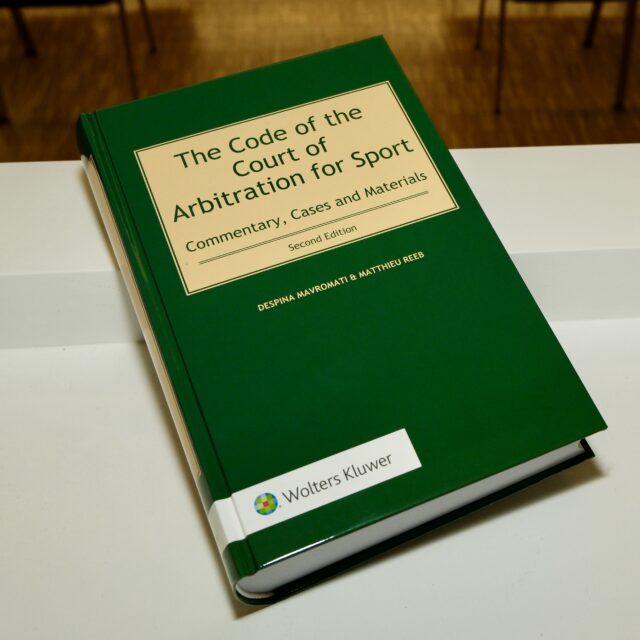
The Code of the Court of Arbitration for Sport – Commentary, Cases and Materials
by Despina Mavromati / Matthieu Reeb, Wolters Kluwer 2025
Ιn its fully revised second edition, The Code of the Court of Arbitration for Sport offers a comprehensive, article-by-article commentary of the CAS Rules. Drawing on leading CAS and Swiss Federal Tribunal case law, CAS practices and international arbitration principles, the book is an indispensable reference for practitioners, arbitrators, and scholars working in sports arbitration.
This second edition introduces significant updates, including new model documents and new chapters on the ICAS, the CAS ad hoc Rules and the CAS Anti-Doping Division Rules during the Olympic Games.
This site uses cookies to improve site functionality - you can manage your preferences. Legal Notice & Privacy Policy
Functional
Always active
The technical storage or access is strictly necessary for the legitimate purpose of enabling the use of a specific service explicitly requested by the subscriber or user, or for the sole purpose of carrying out the transmission of a communication over an electronic communications network.
Preferences
The technical storage or access is necessary for the legitimate purpose of storing preferences that are not requested by the subscriber or user.
Statistics
The technical storage or access that is used exclusively for statistical purposes.The technical storage or access that is used exclusively for anonymous statistical purposes. Without a subpoena, voluntary compliance on the part of your Internet Service Provider, or additional records from a third party, information stored or retrieved for this purpose alone cannot usually be used to identify you.
Marketing
The technical storage or access is required to create user profiles to send advertising, or to track the user on a website or across several websites for similar marketing purposes.