SFT Judgments 4A_484/2022 and 4A_486/2022 of 26 April 2023
The disciplinary proceedings at national – and international level constitute “two sides of a unique system” that would be jeopardised if not triggered in parallel.
These two factually very similar judgments related to match-fixing in tennis. Both judgments 4A_484/2022 and 4A_486/2022 of 26 April 2023 primarily dealt with the principle of ne bis in idem as part of public policywhen disciplinary proceedings are opened for allegations of match-fixing by both the national federation (NF) and the international federation (IF). In a case where the athlete was acquitted by the NF but convicted by the IF, the SFT held that there was no violation of the principle ne bis in idem and that the material and temporal link between both proceedings constitute “two sides of a unique system”, which would be jeopardized if not triggered in parallel. Consequently, concurrent or subsequent national and international disciplinary proceedings do not infringe Swiss public policy / ne bis in idem, at least as long as national proceedings do not have an automatic international effect.
In addition to the aforementioned plea of ne bis in idem, the decision 4A_484/2022 of 26 April 2023 dealt with theindependence and impartiality of an arbitrator belonging to a barristers’ Chamber: The panel chair Mr. Michael J. Beloff KC was challenged by the athlete as two out of the four Anti-Corruption Commissioners worked in the same Chambers. The SFT disregarded the argument that such arbitrator would be inclined to “defend” the decision rendered by his colleagues in order to protect their reputation. After seriously questioning the admissibility of the grievance to the extent that the player had not raised any objection during the hearing, the SFT dismissed the plea as unfounded, confirming that there is no analogy between barristers belonging to the same Chambers and lawyers belonging to the same law firm. Therefore, in the absence of additional criteria, such connection cannot on its own establish bias under Art. 190 (2) a PILA.
In the absence of additional criteria, the fact that an arbitrator belongs to the same chambers as one of the members of the previous instance body cannot establish bias under Article 190 (2) a PILA.
Swiss Federal Supreme Court (SFT) Judgment 4A_420/2022 of March 30, 2023, Cardiff City FC v. SASP FC de Nantes
Motion to set aside the CAS Award CAS 2019/A/6594 of August 26, 2022
This case relates to the internaDonal transfer of the ArgenDnean football player Emiliano Sala to FC Cardiff (“Appellant”) from FC Nantes (“Respondent”, jointly referred to as the “Par5es”) in January 2019 and his tragic plane crash which occurred shortly aQerwards. The SFT judgment essenDally relates to the scope of the arbitraDon clause between the parDes to a transfer agreement but also to the interpretaDon of the scope of disputes that can be decided by the FIFA dispute resoluDon bodies and, subsequently, by the CAS. The ParDes had agreed on a transfer price of EUR 17,000,000, to be paid in three installments, with the first installment of EUR 6,000,000 payable within five days aQer the registraDon of the player with FC Nantes. Hours aQer the finalizaDon of the transfer agreement with the FIFA Transfer Matching System (“TMS”), the player tragically died in a plane crash over the English Channel. FC Nantes filed a claim before the FIFA Players Status Chamber (“PSC”) requesDng payment of the first instalment, but FC Cardiff argued that FC Nantes was liable for the circumstances that led to the player’s death, thusit intended to claim set-off for damages against the claims raised by FC Nantes. The FIFA PSC upheld FC Nantes’ claim and held that it had no jurisdicDon to hear the claim for damages. FC Cardiff appealed against the FIFA PSC decision to the CAS which dismissed the appeal. The CAS panel bifurcated the procedure and decided, as preliminary ma_ers, the validity of the transfer contract, the PSC and CAS had jurisdicDon to hear the claim for damages, and the possibility to exDnguish a contractual claim by a set-off tort claim. AQer declaring that the transfer had already taken place before the player’s accident, the panel held that neither the FIFA PSC nor the CAS had jurisdicDon to rule on a claim of extra-contractual nature (i.e., the claim that FC Nantes was responsible for the player’s death). In the subsequent appeal to the SFT, the Appellant invoked a violation of Art. 190 (2) (b) of the Federal Act on Private InternaDonal Law (“PILA”) considering that the CAS panel had erroneously interpreted the arbitraDon agreement enshrined both in the contract and in the FIFA regulaDons. In a very interesDng analysis, the SFT reiterated the various principles of statutory interpretaDon applying to the regulaDons of large sports federaDons, such as FIFA. This note discusses the key findings in the SFT judgement.
Interpretation of the contractual agreement by the CAS and the SFT
The SFT confirmed the CAS panel’s view that its own jurisdicion could not go beyond the jurisdiction of the FIFA PSC. Even though Art. 377 para. 1 Swiss Code of Civil Procedure (“CPC”) provides for the right of the panel to deal with a counterclaim for damages, there were no reasons that justified the concurrent ruling on claims based on the transfer agreement and on (the unrelated) set-off against a tort claim (at 5.3). Notwithstanding the broad formulation of the arbitration agreement in the transfer contract (“Any dispute arising out of or in connec:on with this transfer agreement…”), the contract did not extend to the clearly distinct set-off claim for damages based on the plane crash (at 5.4.3). Interpretation of the FIFA Regulations Refraining from rendering a general judgment, and while acknowledging that it is in principle possible to invoke a claim for a set-off in international arbitration for indirectly related claims (cf. 4A_482/2010), the SFT then dismissed the Appellant’s arguments on the interpretation of the arbitration agreement based on the FIFA Regulations. In fact, and even though the latter reserve the possibility to file a counterclaim (asserting a set-off claim), the FIFA dispute resolution bodies are not “true” arbitral tribunals and, as such, they are not bound by the arbitration provisions enshrined in the Swiss Code on Civil Procedure (at 5.5.4). Accordingly, the jurisdiction of the CAS panel in appeal could not be broader than that of the association’s tribunal that had first ruled on the ma_er (in this case, the FIFA PSC). After analyzing the pertinent FIFA regulations, the CAS – and the SFT – confirmed that the possibility to file a counterclaim before the FIFA PSC could not bind the latter to rule on any claim for damages raised in this context (at 5.5.5). Employing various instruments of statutory interpretation, the SFT further confirmed the limited material scope of the FIFA PSC jurisdiction, which does not extend to ruling on civil disputes of football stakeholders that are unrelated to football. The limits for the rendering of the FIFA decisions along with a cap on the procedural costs were also considered in order to conclude that FIFA did not intend to include the hearing of complex and unrelated set-off claims by its dispute resoluDon bodies and, subsequently, by the CAS (at 5.5.5.4).
Other grievances: violation of the parties’ right to be heard and of material public policy FC Cardiff further raised the issue of a violaDon by the CAS panel of the principle of equality of the parties for refusing to adjourn the hearing of its expert witness. Such plea was swiftly dismissed by the SFT to the extent that the panel had included the expert report in the file and that such report was found to have no influence on the outcome of the proceedings. The SFT equally dismissed all other pleas on violation of the Appellant’s right to be heard, holding that the panel had rejected – at least implicitly – the various arguments raised by the Appellant (at 7). Finally, the SFT thoroughly dismissed the Appellant’s claim for violation of public policy alleging the Panel’s refusal “to examine (or even inves:gate) acts of corruption” (at 8.2.2). After reiterating the very restrictive scope of substantive public policy, the SFT held that such violation could only be admitted if the corruption had been established but the Panel stll refused to take it into account, which was clearly not the case (judgment 4A_532/2014 of January 29, 2015, at 5.1).
Conclusion Overall, this is an interesting and thorough judgment rendered by the SFT that highlights the specificities of sports arbitration with respect to the scope of the arbitration agreement but also delves into the jurisdictional scope of the FIFA decision-making bodies, which draw the limits of the subsequent jurisdiction of the CAS.
Who’s Who Legal – Thought Leaders Sport 2023 – Despina Mavromati
May 8, 2023
For a sixth consecutive year, Despina Mavromati was ranked as a Thought Leader in Sports by Who’s Who Legal, according to which Despina Mavromati stands out as an “extremely well-known name in the field” “with significant experience representing clubs and athletes in complex disputes”.
In 2023, WWL says: “Despina Mavromati is a leading name in sports law according to market commentators, who describe her as ‘an amazing lawyer with immense knowledge and expertise when it comes to disputes before the CAS’”.
Sports Lawyers Association Annual Conference: Sports Arbitration from the Athlete’s Perspective
May 8, 2023
Despina Mavromati will participate in the 47th SLA Annual Conference that will take place on 11-13 May 2023 in Los Angeles (CA). Together with Prof. Matt Mitten, Howard Jacobs and Hubert Radke they will discuss “Sports Arbitration from the Athlete’s Perspective”. You can find more information and the full program of the 47th SLA Annual Conference here.
SLA webinar: Immigration issues and sponsoring opportunities for Athletes
May 8, 2023
On the International Women’s Day, Dr. Despina Mavromati moderated a panel of female lawyers discussing immigration issues and sponsoring opportunities of international athletes. Find more information about the Sports Lawyers Association (SLA) and its events here.
The Judicial System of the International Tennis Federation (ITF)
April 7, 2023
The Judicial System of the International Tennis Federation (ITF) forms part of a book edited by Michele Colucci and Massimo Coccia entitled “International and Comparative Sports Justice” (Sports Law and Policy Bulletin, May 2023). The Author analyses the dispute resolution system of the ITF through its various decision-making bodies and examines issues related to jurisdiction, applicable law, composition of its members, sanctions and enforcement of its decisions. Unlike other major international Olympic federations that are based in Switzerland, the ITF is seated in London (UK) and its major decision-making body, namely the ITF Independent Tribunal, is administered by Sport Resolutions, an independent case management organization based in London (UK). The ITF has also delegated its doping-control and education responsibilities and its monitoring and prosecution of anti-corruption offences to an independent organization (International Tennis Integrity Agency).
The Appeal Proceedings before the CAS: Key Insights and Practical Tips
April 7, 2023
Published in the ASA Bulletin 1/2023
This article is published at the 1/2023 Issue of the ASA Bulletin. Since its creation by the IOC in 1984, the Court of Arbitration for Sport (CAS) has evolved into an independent arbitral tribunal and the “supreme court” of sports-related disputes at the international level, administering several hundred of cases every year. The CAS functions predominantly as an appellate tribunal, reviewing decisions rendered by the internal tribunal of sports federations. Such appeal mechanism differs from commercial arbitration in many aspects. This article navigates through the appeal procedure following the amendment of the CAS Code in November 2022, from the outset of the arbitration through the issuance of the final award and beyond, focusing on procedural particularities that counsel without previous experience in sports arbitration should keep in mind. The article was re-published on the 2023/1 issue of the CAS Bulletin and can be accessed here.
Governance of International Sports Federations through the Lens of Global Administrative Law
April 7, 2023
Published in the Marquette Sports Law Review (2/2023)
International Sports Federations (IFs) that form part of the Olympic Movement are in their majority based in Switzerland. They are structured as “associations” under Swiss law and are vested with extensive autonomy. IFs undertake important tasks and responsibilities for all their members, with regulatory, organizational, and decision-making powers with an international effect. This article argues that, in view of the quasi-public authority that IFs exercise at the international level, IFs should employ at least some tools of administrative law to ensure their legitimacy – and maintain their autonomy.
After delving into the law applicable to IFs in Switzerland, the article goes through the principle on institutional governance of the IOC “Basic Universal Principles of Good Governance within the Olympic movement” (IOC Principles) along with several tools taken from global administrative law. It focuses on certain aspects of institutional governance of particular importance to IFs and concludes that a delegation of certain reporting, investigation and prosecuting tasks to an independent of the IF agency could enhance the accountability and eventually the governance of IFs. The article has been accepted for publication in the Marquette Sports Law Review (2/2023 Issue).
4A_232/2022, Judgment of 22 December 2022, Swiss Federal Supreme Court, A. v. International Biathlon Union (motion to file the CAS Award CAS 2020/A/7509)
Facts and procedural history
In this important judgment, the Swiss Federal Supreme Court (SFT) confirmed the validity of the CAS Anti-Doping Tribunal (CAS ADD) as a first-instance disciplinary tribunal in delegation by sports federations – and the subsequent appeal to the CAS Appeals Division (CAS).
The doping-related dispute arose following a notice of charge issued by the International Biathlon Federation (IBU) against a Russian biathlete (the Athlete) for violation of the IBU Anti-Doping Rules.
In 2006, the Athlete signed a document agreeing to the IBU constitution and other rules in order to be eligible to compete. Such agreement was valid until and “as long as it is not retracted by the undersigned”, which the Athlete never did, despite his retirement in 2014.
In 2019, the IBU delegated its disciplinary authority to the CAS ADD for the latter to act as its “disciplinary tribunal” in lieu of its own Anti-Doping Hearing Panel (ADHP). The IBU filed a request of arbitration before the CAS ADD and a Sole Arbitrator appointed issued an “award” confirming the charges regarding the Athlete based on the CAS ADD Rules. Such award was appealed to the CAS under the rules applicable for the appeal procedures (Art. R47 ff. CAS Code). Meanwhile, the Athlete had already filed a motion to annul the CAS ADD award which was deemed inadmissible for lack of exhaustion of legal remedies pending the CAS award in appeal (see also my note on the SFT 4A_612/2020 of 18 June 2021).
The CAS eventually issued its “Award on Jurisdiction and Other Preliminary Issues” in 2022, finding that it had jurisdiction to hear the athlete’s appeal, and, most importantly, recognizing the jurisdiction of the CAD ADD as 1stinstance.
Motion to set aside the CAS Award
The Athlete filed a motion to annul the CAS award alleging the lack of jurisdiction (of the CAS ADD and, consequently, of the CAS) and the irregular constitution of the panel, which were the only grounds available to challenge of awards on jurisdiction (see also judgment 4A_344/2021, at 5).
The SFT previously held that Art. 190 (2) b PILA only covers the jurisdictional control of the CAS award (in appeal) and not the previous instances (e.g., FIFA) which are not true courts of arbitration (see my note on the judgment 4A_346/2021 of 13 January 2022). The SFT did, however, determine the nature of the CAS ADD proceedings, to the extent that the admissibility of the grievance depended on whether the CAS ADD acted as a true court of arbitration or not.
Nature of the CAS ADD proceedings and qualification of the CAS ADD
In its long judgment, the SFT reiterated that neither the name of the tribunal nor the name of the decision (in this case, the CAS ADD decision was entitled as “Award”) was decisive to qualify it as an arbitral tribunal (at 5.9.3). The SFT then delved into the role of the CAS ADD and the essential elements of an arbitration agreement which aims at vesting an arbitral institution with the decision-making power in exclusion of the jurisdiction of state courts. However, the SFT could not find such intention from the parties. On the contrary, it held the IBU wished to delegate its internal disciplinary power over anti-doping matters to an external entity, which would take over the same tasks as the ADHP and impose applicable sanctions.
The SFT judgment therefore held that the CAS ADD is not a “true” arbitral tribunal but replaces the first instance of the disciplinary tribunal of the federation. The SFT recalled its previous judgments whereby the internal tribunals of sports federations are not “true arbitral tribunals” but mere expressions of the will of the association (at 5.2.3, see also my note on judgment 4A_346/2021 of 13 January 2022 at 5.2). The SFT therefore dismissed this grievance as inadmissible but held that the jurisdictional objection would have, in any case, been dismissed, based on the de novoreview by an independent arbitral tribunal which is the CAS (cf. Art. R57 CAS Code) and the lack of a right to a double degree of jurisdiction (see also my note on the judgment 4A_384/2017 of 4 October 2017).
Coexistence of the CAS ADD and the CAS Appeals Division
In his second plea, the Athlete requested the annulment of the CAS award based on the irregular constitution of the CAS, and specifically due to its organic links with the CAS ADD. The Athlete mentioned, among other elements, the closed list of arbitrators, the fact that he could not freely choose his arbitrator and the large influence of sports organizations on the ICAS (referring to the dissenting opinion of the two judges in the Pechstein ECtHR judgment). The Athlete also questioned the structural independence of the two CAS Divisions, considering it problematic because the two divisions operate under the umbrella of the same board, namely ICAS (at 6.3).
The SFT held that all arguments related to the lack of independence of the CAS ADD were inadmissible (for the reasons mentioned above), while it also thoroughly dismissed the arguments on the lack of structural independence of the CAS Appeals Division, reiterating its previous case law. Interestingly, the SFT held that the coexistence of two instances within the same tribunal is not unusual, because several international tribunals have both first instance- and appellate divisions (International Criminal Court, ECtHR etc.). The SFT also noted the efforts to guarantee the independence of the CAS ADD vis-à-vis the CAS, through separate and independent lists of arbitrators for each division.
Concluding remarks
Overall, this is an important judgment in which the SFT determined the nature of the CAS ADD proceedings when the latter acts as a first instance. It largely accepted the legitimacy of the CAS ADD, to the extent that such instance replaces the internal disciplinary instance of sports federations and is sufficiently independent from the CAS Appeals Division. It must be noted that the SFT analysis did not examine the nature of the CAS ADD proceedings when both parties agree to bring the dispute before three arbitrators acting as a sole instance (Art. 14 ADD Rules). However, if the parties agree in writing to such exception, there are good reasons to think that such agreement could constitute a valid arbitration agreement and that the CAS ADD could, under such specific circumstances, act as a “true” arbitral tribunal.
Despina Mavromati spoke at the FIFA Football Annual Review 2023 in Mexico City
January 11, 2023
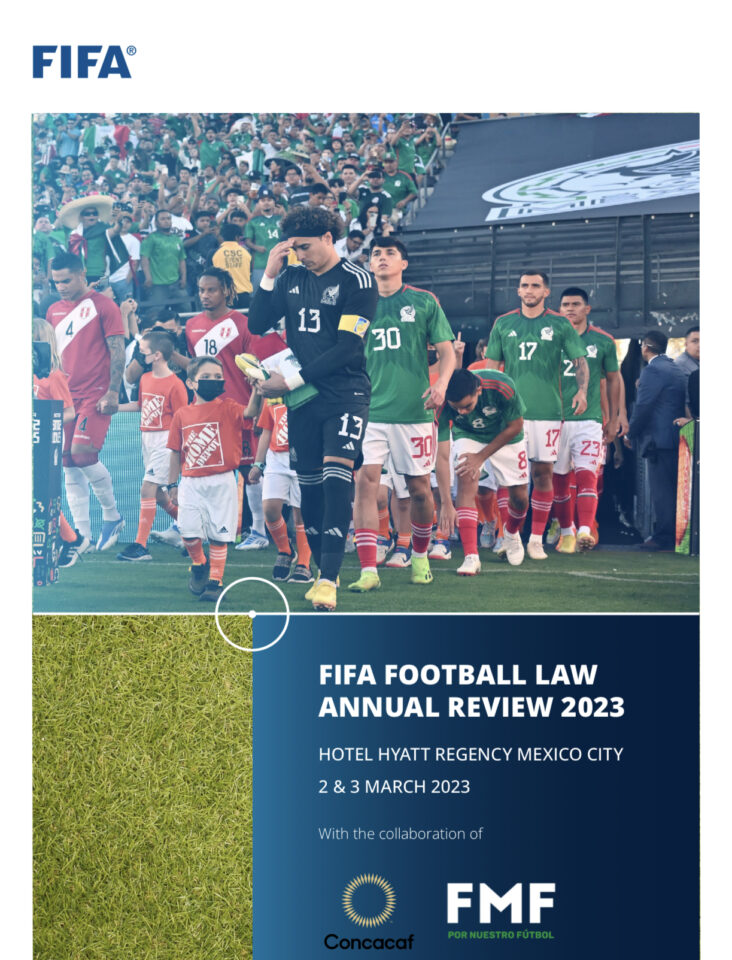
FIFA Football Annual Review 2023 in Mexico City
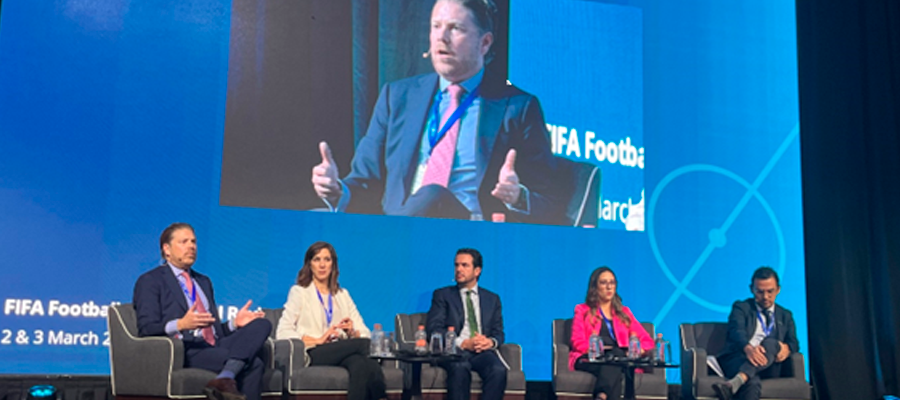
Dr. Despina Mavromati spoke at the FIFA Football Annual Review (FLAR) 2023 that took place in Mexico City on 2-3 March 2023. The 5th edition of the FLAR included several important football-related topics and renowned experts in the field of international football law and sports arbitration. The full agenda of the program (which will also be live-streamed) is available here
International sports dispute resolution from CAS and the SFT in 2022
A summary of selected CAS & Swiss Federal Tribunal judgments rendered in 2022 & major regulatory reforms
2022 marked an exciting year for international sporting events – and ensuing disputes: it started before the Beijing 2022 Winter Olympics and Paralympics in February, which led to a number of qualification and selection cases before the CAS Ad Hoc Division, and particularly the decision to confirm the lifting of the provisional suspension of the 15-year-old prodigy figure skater Kamila Valieva. This case is set to continue in 2023, since WADA filed an appeal to the CAS as RUSADA failed to issue a decision within the time limit set by WADA.
The war in Ukraine also led to the exclusion of the Football Union of Russia from FIFA and UEFA competitions, leading to a dismissed request for provisional measures before the CAS in March 2022 and a final award in July 2022. In essence, the Panel found that the FIFA / UEFA decision to prevent Russian teams and clubs from participating in their competitions were within their power of discretion under the applicable regulations.
The year ended with the FIFA World Cup in Qatar, which did not register any disputes before the CAS Ad Hoc Division that was established for the tournament and had its own CAS Ad Hoc arbitration rules. There was, however, an dispute shortly before the World Cup regarding the eligibility of the Ecuadorian player Byron Castillo to participate in the qualifying matches of the tournament with the Ecuadorian Football Federation (FEF): while the CAS found that this was not an eligibility case under Article 22 FIFA Disciplinary Code (the Player was eligible to participate in the qualifying round under national laws that determine nationality), there was a violation of Article 21 by the FEF since it used falsified information in the Player’s passport (particularly the place of birth, which was in Colombia). The Panel therefore only sanctioned the federation with a 3-point deduction in the next preliminary competition to the FIFA World Cup and a fine.
Doping-related judgments
In February 2022 the SFT issued its final judgment on the motion to set aside the (second) CAS Award in the widely covered Sun Yang judgment. The Chinese swimmer, who destroyed his sample with a hammer during a doping control, was sanctioned with a 4-year and 3 month ineligibility period from the second CAS panel, following the annulment of the first CAS Award in the end of 2020. The second CAS Award was confirmed by the SFT, which dismissed all pleas raised by the athlete and repeated that the guarantees of the European Convention of Human Rights (ECHR) and the Swiss Constitution cannot be invoked directly unless it could establish a violation of the grounds of Art. 190 (2) PILA. Moreover, the SFT confirmed that there was not an obligation for a double degree of jurisdiction in CAS proceedings in view of the full power of review by the CAS panel.
In June 2022, the CAS Antidoping Division (deciding on a request filed by the ITA which acted on delegation from the International Weightlifting Federation (IWF)) issued in June its long-awaited decisions concerning the former IWF President, former IOC Member, former WADA council member) Tamás Aján and former IWF President (and former Vice-President of the IWF Anti-Doping Commission) Nicu Vlad (ROM). The decisions imposed a lifetime ban on both for anti-doping rule violations involving tampering and complicity (for Mr. Ajan), and for complicity (for Mr. Vlad).
The same month, the CAS issued its decision upholding three appeals filed by WADA against the decision of the International Canoe Federation (ICF) and sanctioned three Russian athletes for anti-doping rule violations. The annulled appealed decision, which had accepted an institutionalized doping scheme by the Russian authorities and an effort to cover up doping practices, found insufficient evidence against the particular athletes.
Noteworthy doping-related cases in 2022
Football ethics, disciplinary and qualification disputes
Several decisions related to football ethics were rendered by the CAS and the SFT in 2022: among others, the CAS upheld the appeal of the former African Football Confederation (CAF) PresidentIssa Hayatou against the FIFA Ethics Committee by lifting the one-year ban and accompanying fine, for lack of sufficient proof of the alleged violation of the duty of loyalty towards CAF by entering into an anti-competitive agreement with a sports agency.
As for the SFT, it confirmed the lifetime sanction imposed within the framework of the so-called “FIFA-Gate” on Marco Polo Del Nero(former President of the Brazilian Football Confederation (CBF) and a former member of various FIFA and CONMEBOL committees). In his challenge before the SFT, the former CBF President sought to annul the CAS award confirming the FIFA Ethics Commission decision based on the repeated appointments of the FIFA-appointed arbitrator. In this important judgment, which found that the applicant had failed to request the challenge within the time limits set by the CAS Code, the SFT held that the failure of ongoing disclosures as such does not equal lack of independence unless a deliberate concealment can be established. It also referred to the specificities of CAS arbitrations and the numerous proceedings in which FIFA is a party, while confirming that arbitrators are bound by the ongoing duty of disclosure (also as per the new wording of Art. 179 (6) PILA).
The SFT also confirmed the CAS award in the matter of another former CBF President, namely Ricardo Texeira.The latter had sought to annul the CAS Award rendered in 2021 (which confirmed the life ban imposed by the FIFA Ethics Committee decision), alleging, among others, a violation of public policy for the excessive sanction. Interestingly, the SFT judgment found that this plea was in violation of the principle of good faith, to the extent that the sanction itself was not contested by him in the CAS proceedings (which, in fact, accepted that such sanction would be proportionate if the panel were to accept the violation of the FIFA Code of Ethics provisions). The SFT concluded that such plea was unfounded and reiterated the very narrow scope of substantive public policy violation (and the violation of Art. 27 (2) Swiss Civil Code).
In June, a CAS award found that a decision rendered by the Kenyan Football Federation (FKF) to withdraw its women’s national football team from the first qualifying round of the 2022 Africa Women Cup of Nations (AWCON)was rendered ultra vires and was therefore annulled. Unfortunately, since the appellant-athletes had not appealed against the CAF decision to directly qualify the team of Uganda for the next round of the competition, the CAS could not review such decision and had no power to reinstate the appellants to the tournament.
Election disputes
The CAS also heard the appeal of several European Federations against the election of Johan Eliasch as President of the International Ski Federation (FIS) in December 2022. Eliasch was re-elected unopposed for another four years while the Congress had allegedly agreed to include the option to vote against him; the appellant four federations sought thus the annulment of the decision for violation of Swiss law and the CAS decision will be rendered in 2023.
In weightlifting, the CAS upheld the appeals filed by the Russian Weightlifting Federation and several individuals who were declared ineligible for election by the IWF Eligibility Determination Panel (EDP), finding that the EDP lacked jurisdiction to issue a decision of a disciplinary nature as per the IWF Constitution.
Similarly, in boxing, the CAS upheld the appeals of several individuals against the decision of the Boxing Independent Integrity Unit Interim Nomination Unit (INU) to declare them ineligible for the IBA elections in May 2022, even though the IBA Disciplinary Committee had found them not guilty. The CAS found that the minor breach of regulations (for early campaigning) did not merit a severe sanction and annulled the ineligibility decision.
Other interesting CAS and SFT judgments
Review of the jurisdiction of FIFA tribunals by the Swiss Federal Tribunal
In a football-related contractual dispute between a coach and a national federation, the CAS accepted the jurisdiction of the FIFA PSC – and subsequently its own jurisdiction. In the subsequent motion to set aside the CAS award before the SFT, the applicant federation invoked again the lack of jurisdiction of the FIFA PSC. Interestingly, the SFT judgment found that such challenge does not fall within the “typical” jurisdictional challenge of a CAS award under Art. 190 (2) b PILA and it is only possible to challenge this under the public policy ground of Art. 190 (2) e PILA.
Limited scope of the pacta sunt servanda principle
In a contractual dispute between Sporting Portugal and a football player, the SFT judgment reiterated the extremely limited scope of pacta sunt servanda, stating that such a plea is not admissible if the applicant (in casu the club) only tries to establish that the challenged award is contrary to a norm of Swiss law – and repeated that it is beyond the scope of the motion to the SFT to review the appreciation of the arbitral tribunal.
SFT judgment in a defamation case following a match-fixing judgment
The criminal law court of the SFT rendered this interesting judgment in the follow-up of a match-fixing saga involving the FC Skënderbeu. Following the sanction on the club based on a report drafted by two UEFA Ethics & Disciplinary Inspectors (EDIs) and submitted to the UEFA Control, Ethics and Disciplinary Body (CEDB), based on a Sportradar analysis, the individuals incriminated in the report filed criminal complaints in Switzerland. While the EDI’s were found guilty of defamation in first instance, their sanction was reversed on appeal and such decision was subsequently confirmed by the SFT. In essence, while the SFT held that the EDIs are third parties with respect to the CEDB, the Sportradar analysis was a valid source of information on which the UEFA officers could rely in good faith to purport the accusation.
Transfer of Emiliano Sala
In 2022, the CAS also issued its full decision in the dispute between FC Nantes and Cardiff City FC over the transfer of the late Emiliano Sala, who was killed in a plane crash back in February 2019. In essence, the CAS Panel confirmed the FIFA PSC decision and found that Sala’s transfer from FC Nantes to Cardiff City FC had been completed and therefore FC Nantes’ claim for the first installment of the transfer fee of EUR 6 million was confirmed. However, the rest of the transfer fee (of EUR 17 million) was not due at the time of the procedure and that there could be another procedure (i.e., outside the CAS) for liability of the FC Nantes for the player’s death (in which case the remaining transfer installments should be set off against such tort liability).
Regulatory changes in 2022
In November 2022 the CAS (which inaugurated its new Headquarters at the Palais de Beaulieu in June) amended its CAS Code, by increasing the ICAS members to 22 (in order to ensure a better representation of football stakeholders). Importantly, the ICAS Legal Aid Commission will now manage two legal aid funds, including the newly established Football Legal Aid Fund (FLAF) exclusively for football disputes and financed by the football stakeholders.
Furthermore, the CAS issued its annual Report 2022 in October, including valuable information and statistics on the cases dealt with by the various CAS divisions and the ICAS Financial Statements for 2021. The FLAF Guidelines will be issued in 2023.
In October 2022 the FIFA Clearing House, a centralized entity in charge of processing training and solidarity compensation, became operational following the approval of its FIFA Clearing House Regulations by the FIFA Council. During the FIFA Council in Qatar, FIFA also approved its new FIFA Agents Regulations and amended its FIFA Code of Ethics and Disciplinary Code.
What to expect in 2023
Even though 2023 is not an Olympic year, the 2022 Asian Games were postponed due to the COVID-19 pandemic and will take place in Hangzhou in September-October 2023, featuring 61 disciplines and, for the first time, eSports.
Apart from the Valieva case before the CAS, at the EU level we expect the decision of the Court of Justice of the European Union (CJEU) in the Super League case to be rendered. The Advocate General (AG) has issued his (favorable to UEFA) opinion in December 2022, supporting in essence that the FIFA / UEFA rules according to which new competitions are subject to prior approval are compatible with EU competition law. The CJEU is also expected to render its decision in the ISU case following the AG opinion issued in December, stressing the specific nature of sport and the advantages of CAS arbitration.
Note: this article was first published in LawInSport.
Sports Arbitration class at the University of Geneva (with Prof. Jacques de Werra)
November 18, 2022
Despina Mavromati gave a lecture on sports arbitration during the sports law seminar organised by Prof. Jacques de Werra at the University of Geneva on 18 November 2022 (Mémoire et Séminaire – Droit du sport: aspects de droit privé).
Inaugural UNIL – CAS Sports Arbitration Forum at the CAS in Lausanne
November 9, 2022
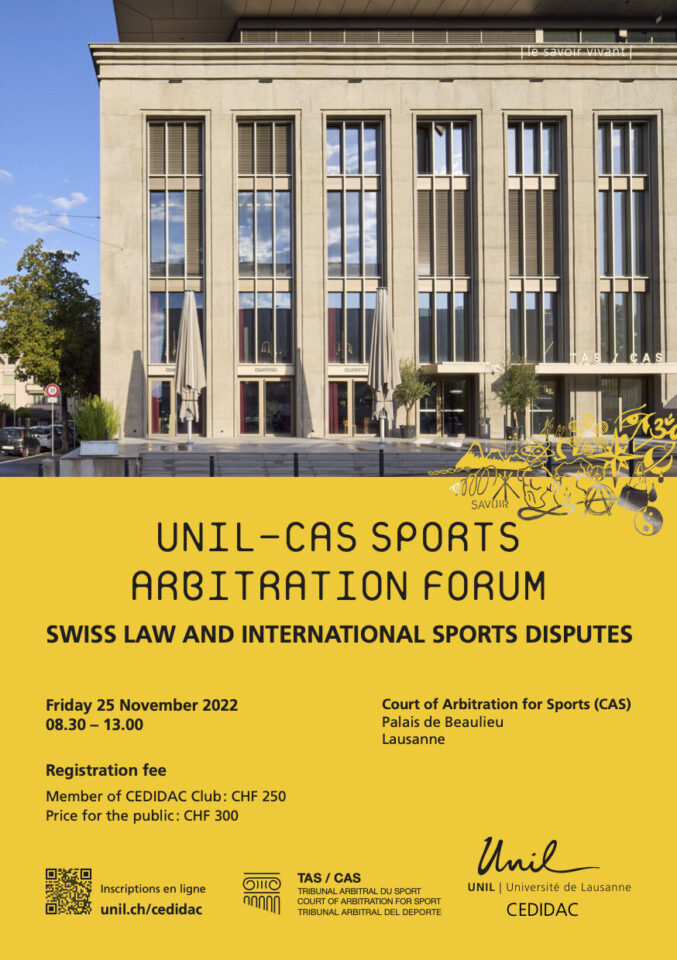
Dr. Despina Mavromati and CAS Director General Matthieu Reeb organised the inaugural UNIL-CAS Sports Arbitration Forum that will take place at the new CAS Headquarters in Lausanne. The conference (part of the CEDIDAC Seminar Series) is entitled “Swiss Law and International Sports Disputes” and features many interesting topics and renowned speakers from Swiss academia and practice. You can find the full program and registration details here.
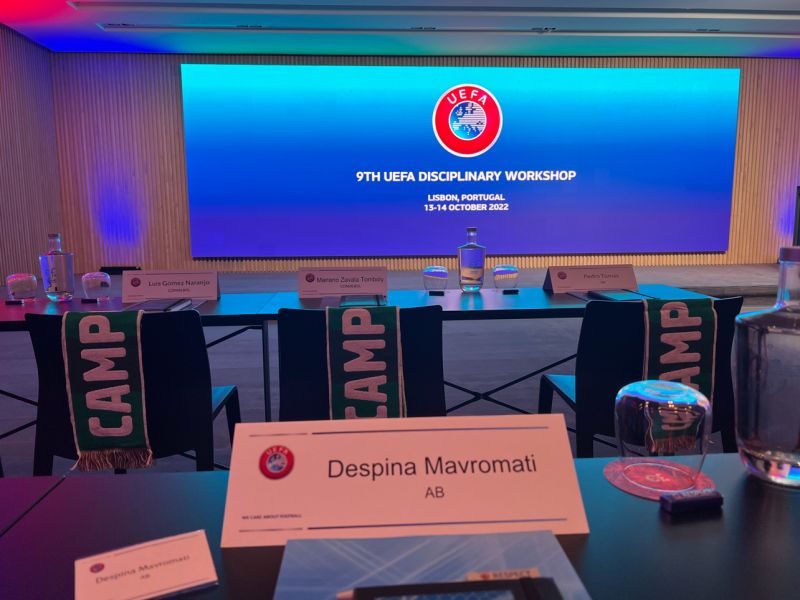
UEFA Appeals Body Member Dr Despina Mavromati participated in the 9th UEFA Disciplinary Workshop that took place in Lisbon, Portugal on 13-14 October 2022. UEFA’s disciplinary bodies – the Control, Ethics and Disciplinary Body (CEDB) and Appeals Body (AB), as well as the Ethics and Disciplinary Inspectors (EDIs) – were briefed about the new provisions contained in the 2022 UEFA Disciplinary Regulations. The new format of the UEFA men’s club competitions from the 2024/25 season was also presented. You can find more information about the workshop here.
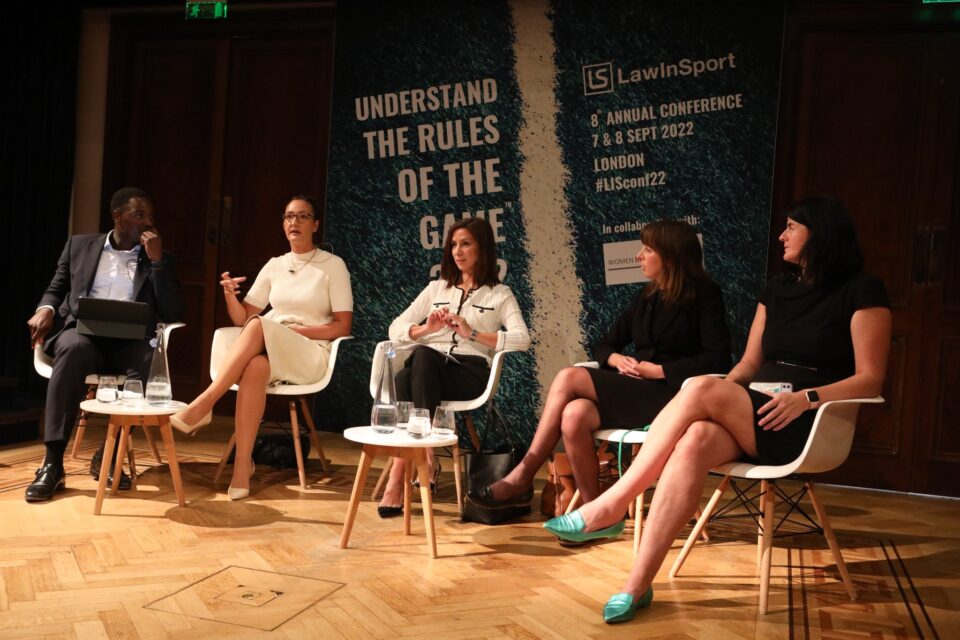
Despina Mavromati was a speaker at the 8th LawInSport Conference that took place at the Royal Institution in London, UK. The prestigious two-day conference – which this year was organised in collaboration with Women In Sports Law – WISLaw – included several gender diverse panels related to contemporary issues in sports law. Despina Mavromati discussed “Sports and Human Rights” and more specifically selected aspects on the right to a fair trial before the Court of Arbitration for Sport (CAS) and other sports tribunals. You can find more information on the conference here.
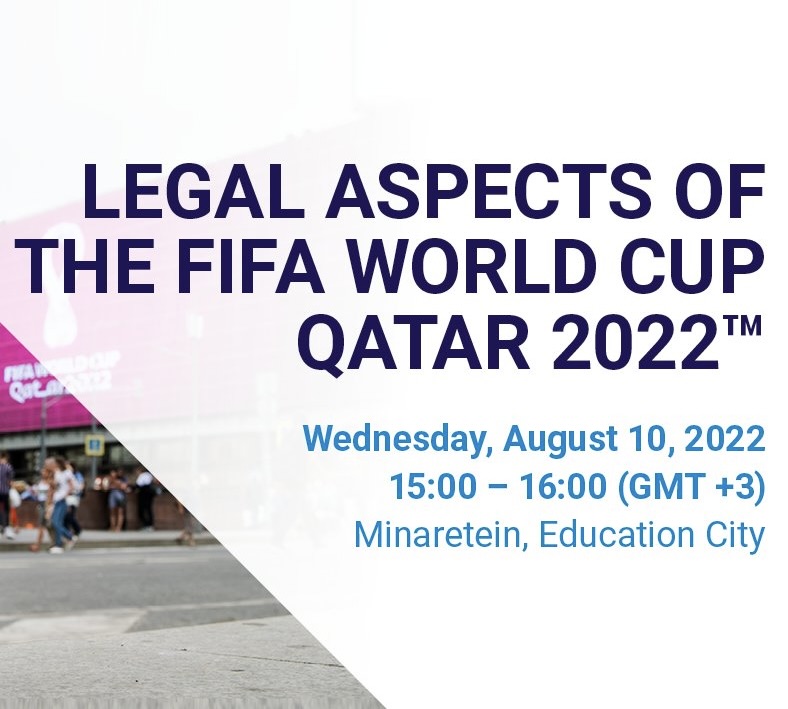
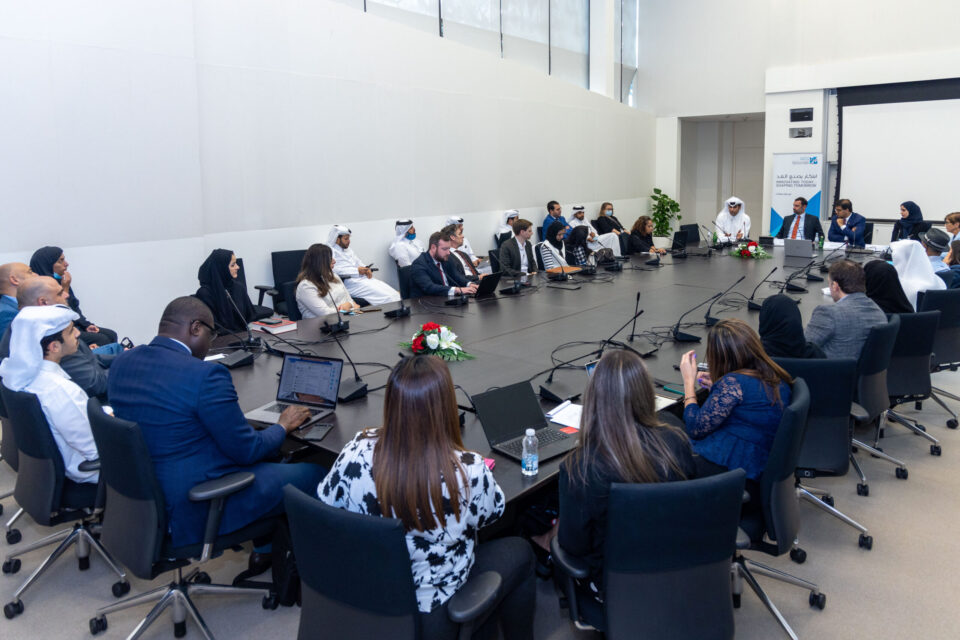
Despina Mavromati participated in an event organised by the Hamad Bin Khalifa University (College of Law) that examined the legal framework underpinning Qatar’s hosting of the FIFA World Cup, including dispute resolution, Qatari laws enacted to support the event, and the legal legacy of 2022. Other Panelists included Aarij S. Wasti (Legal Director, FIFA World Cup Qatar 2022™), Salman Al Ansari & Khadeja Al-Zarraa (Al-Ansari & Associates). You can find more information on this event here.
Handbook on International Sports Law (2nd Edition)- Elgar Publishing
July 25, 2022
Chapter on the European Court of Human Rights & the CAS
The Handbook on International Sports Law (2nd Edition) was published in July 2022. Despina Mavromati was among the contributors of the second edition. In her new chapter, she analysed the major ECtHR and other tribunals’ judgments related to the CAS and discussed their potential impact on the functioning of the CAS. Edited by Prof. James A.R. Nafziger and Ryan Gauthier, the second edition of this comprehensive handbook presents new and significantly revised chapters by leading scholars and practitioners in the field of international sports law. You can order a copy here.
A comparison of Sports Justice Systems – Webinar organised by the Milan Bar Association
June 29, 2022
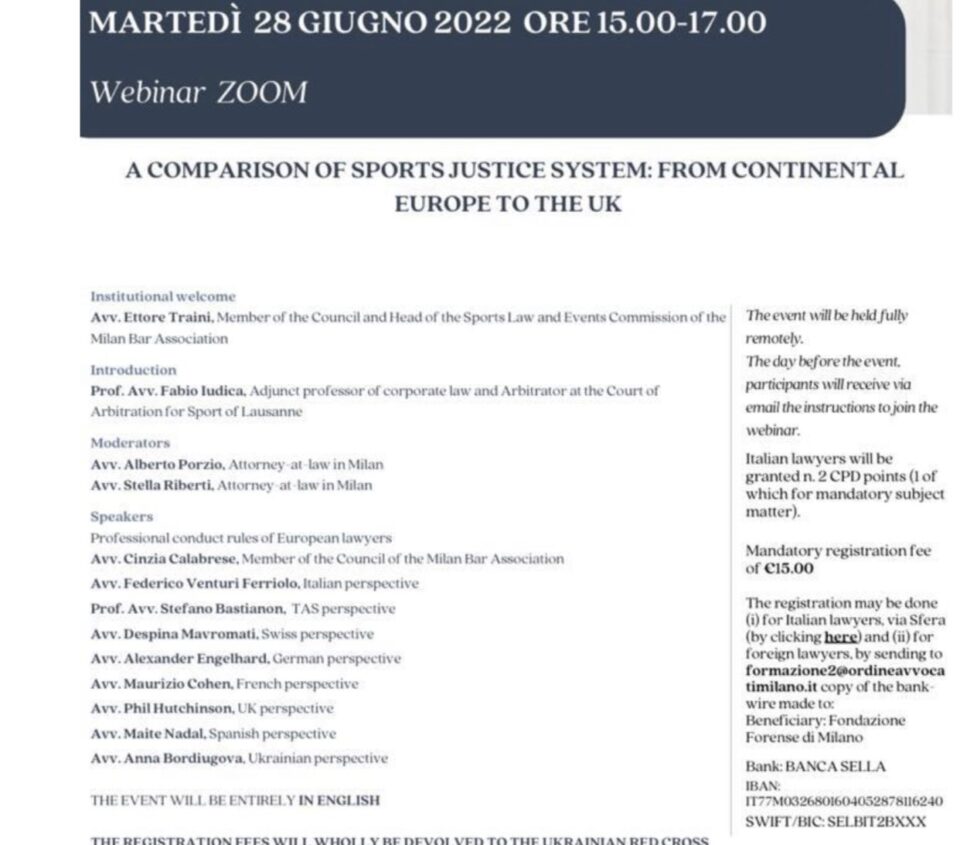
Despina Mavromati discussed selected aspects of the Swiss dispute resolution system related to sports during the webinar organised by the Milan Bar Association that took place on 28 June 2022. In her presentation, she discussed issues related to jurisdiction of state courts and the recognition and enforcement of CAS awards in Switzerland.
NEW BOOK RELEASE
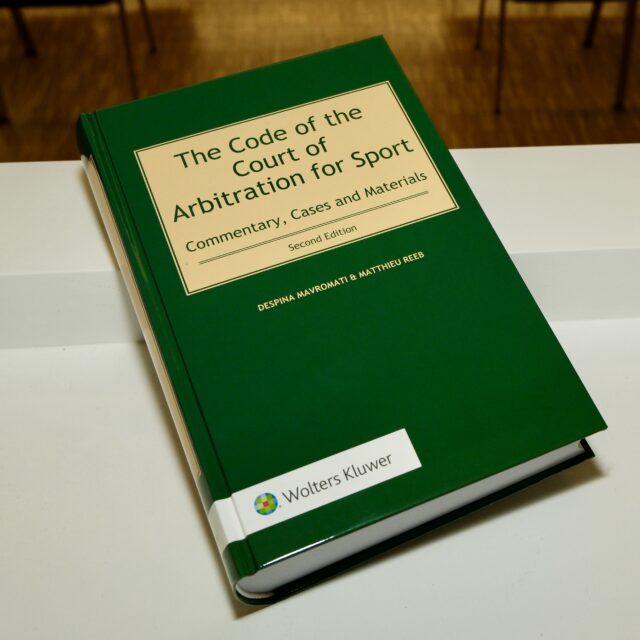
The Code of the Court of Arbitration for Sport – Commentary, Cases and Materials
by Despina Mavromati / Matthieu Reeb, Wolters Kluwer 2025
Ιn its fully revised second edition, The Code of the Court of Arbitration for Sport offers a comprehensive, article-by-article commentary of the CAS Rules. Drawing on leading CAS and Swiss Federal Tribunal case law, CAS practices and international arbitration principles, the book is an indispensable reference for practitioners, arbitrators, and scholars working in sports arbitration.
This second edition introduces significant updates, including new model documents and new chapters on the ICAS, the CAS ad hoc Rules and the CAS Anti-Doping Division Rules during the Olympic Games.
This site uses cookies to improve site functionality - you can manage your preferences. Legal Notice & Privacy Policy
Functional
Always active
The technical storage or access is strictly necessary for the legitimate purpose of enabling the use of a specific service explicitly requested by the subscriber or user, or for the sole purpose of carrying out the transmission of a communication over an electronic communications network.
Preferences
The technical storage or access is necessary for the legitimate purpose of storing preferences that are not requested by the subscriber or user.
Statistics
The technical storage or access that is used exclusively for statistical purposes.The technical storage or access that is used exclusively for anonymous statistical purposes. Without a subpoena, voluntary compliance on the part of your Internet Service Provider, or additional records from a third party, information stored or retrieved for this purpose alone cannot usually be used to identify you.
Marketing
The technical storage or access is required to create user profiles to send advertising, or to track the user on a website or across several websites for similar marketing purposes.