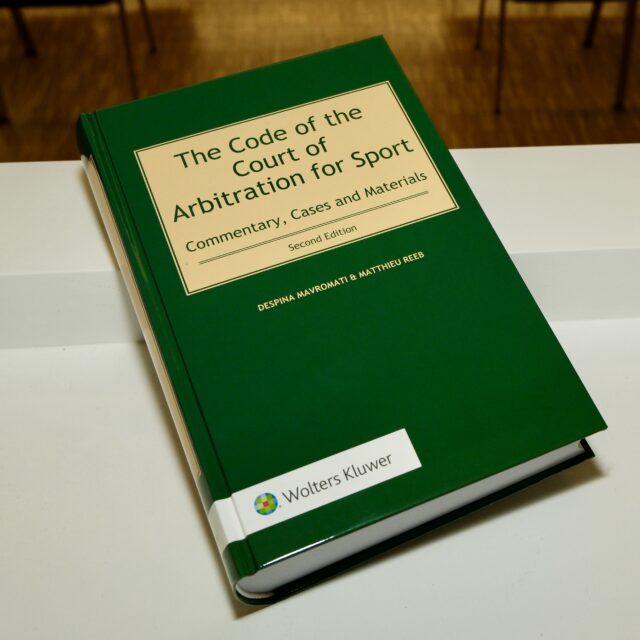
On 25 June 2022, Despina Mavromati attended the 20th Rex Sport General Assembly that took place in Barcelona, Spain. During the academic part of the program, Dr Despina Mavromati and Dr Hansjörg Stutter presented some recent jurisprudence of the Swiss Federal Tribunal regarding the independence and impartiality of CAS arbitrators. You can find Dr Mavromati’s note here.

Despina Mavromati was invited by Prof. Kenneth Jacobsen to give a lecture on sports law to the students of the summer program of the Temple University – Beasley School of Law in Rome on 14 June 2022. You can find additional information about the program here.

Despina Mavromati wrote a chapter for the latest Asser Yearbook on International Sports Arbitration and commented on the well-known Trabzonspor Judgment of the Swiss Federal Tribunal (4A_486/2019, judgment of 17 August 2020). Her paper relates to the legal battle of a Turkish football club, Trabzonspor, to initiate disciplinary proceedings against another Turkish club before the tribunals of national, continental, and international football governing bodies and subsequently to CAS and the SFT. Her paper deals with several interesting legal questions, including the right of a party to the CAS proceedings to request a public hearing, the standing to appeal a decision by a third party indirectly affected by such decision, and the right of the CAS to bifurcate the proceedings without violating the parties’ right to be heard.

Notes
Recurring Appointments of an Arbitrator by FIFA and Specificities of CAS Arbitration


4A_520/2021, judgment of March 4, 2022
A v. FIFA, motion to set aside the CAS Award of 31 August 2021 (CAS 2019/A/6344).
This important judgment of the Swiss Federal Supreme Court (Swiss Federal Tribunal, SFT) deals with the thorny issue of independence and impartiality of CAS arbitrators, examining the so-called “duty of curiosity” of a party’s counsel regarding the appointment of an arbitrator by the other party or by the CAS, the strict admissibility requirements for filing a request for challenge, and the issue of repeated appointments in CAS proceedings where FIFA is a party (see also the recent Newsletter of Hansjörg Stutzer of 20 April 2022).
The case related to the widely known “FIFA-Gate” which revealed, following an investigation by the U.S. authorities, that several individuals were involved in a bribery scheme related to the sale of rights to several football competitions, and charged them with various offences. The Appellant, a former President of the Brazilian Football Confederation Marco Polo Del Nero (also a former member of various FIFA and CONMEBOL committees), was one of the individuals and was also banned for life by the FIFA Ethics Committee and the FIFA Appeals Committee and given a fine of CHF 1,000,000. Ruling in appeal, the CAS reduced his sanction to twenty years and confirmed the fine.
The Appellant filed a motion to set aside the CAS Award for violation of his right to be heard (which was swiftly dismissed by the SFT and will not be further examined below) and for lack of independence and impartiality of the chairman of the panel, who was appointed by the CAS and is a very experienced CAS arbitrator (the Arbitrator). While the latter initially merely disclosed that “FIFA are a party in another case I have on – CAS 2019/A/6229. I am President of that Panel”, following the hearing (which took place almost one year after the panel’s appointment) and at the Appellant’s request for updated declarations related to appointments involving FIFA, the Arbitrator provided the parties with a quite extensive list of ongoing matters involving himself and FIFA. Furthermore, the Arbitrator disclosed that a colleague at his law firm had “(…) recently advised FIFA on an entirely unrelated matter involving GDPR / data protection. For the avoidance of any doubt I was not involved in that matter in any way”. The Arbitrator confirmed his independence and the fact that he provided this disclosure in the interest of “complete transparency”. After an additional request for information of both the Arbitrator and the clerk (who happened to be a lawyer working at the same law firm as the Arbitrator), the Appellant filed a request for challenge before the ICAS Challenge Commission, which was rejected and led, after the final CAS award, to the SFT proceedings examined here.

In its judgment, the SFT first held that the IBA Guidelines on Conflicts of Interest in International Arbitration (“IBA Guidelines”) are a useful tool towards the harmonization of the standards in international arbitration. The pertinent provision in this case was Art. 3.1.3 of the IBA Guidelines, which provides that an arbitrator appointed twice or more by the same party during the last three years falls within the waivable “Orange list”. The SFT also reiterated that, apart from the general declarations of the arbitrators, each party must pursue its own research in order to ascertain the independence and impartiality of the arbitrators (the so-called “duty of curiosity”).
The starting point for the analysis was whether the Appellant’s claim was admissible, to the extent that the parties must raise any such claim as soon as the pertinent fact becomes known, and within the specific time limit of seven days enshrined in Art. R34 (1) of the CAS Code. The SFT considered as decisive the fact that the appellant’s counsel knew of other appointments of the Arbitrator as well as of the FIFA mandate of the Arbitrator’s colleague – through other cases in which it acted before the CAS (at 5.3.1) and failed to raise any objections on time. Referring to previous case law (4A_110/2012 of October 9, 2012 at 2.2.2) the SFT confirmed that the knowledge of the counsel is attributable to his client directly and rejected the appellant’s claim as inadmissible for failing to file the request for challenge on time. Therefore, the SFT concluded that the Appellant was foreclosed from raising the issue of lack of independence and impartiality of the Arbitrator at this late stage.
Even though it held that the claim was inadmissible, the SFT still examined the arguments raised by the Appellant and concluded that the claim would have, in any event, been unfounded: while the Appellant largely based his claim on the failure of the Arbitrator to comply with his duty of disclosure, the SFT reiterated that such duty relates principally to elements which may give rise to legitimate doubts as to the arbitrator’s impartiality and would be insufficient, per se, to justify the challenge of an arbitrator.
The SFT also agreed with the ICAS Challenge Commission, which criticized the Arbitrator’s practice to only disclose pending cases and not to regularly update his declaration of independence but found no evidence of deliberate concealment likely to lead to the recusal of the Arbitrator. On the contrary, the fact that the Arbitrator had already disclosed other appointments in the context of another procedure (in which the Appellant’s counsel was involved) was the decisive element to disprove any intentional concealment. At this point it must be noted that, as per the latest amendment of the LDIP, Art. 179 (5) explicitly provides that the obligation of disclosure “shall persist for the duration of the proceedings”, confirming thus an ongoing duty of disclosure.
Under the strict admissibility requirements of the request for challenge, the arbitrator’s disclosure, even in another case involving the party’s counsel, triggers the time limit of seven days for a potential request for challenge under Art. R34 CAS Code.
With regard to the issue of the repeated appointments of the Arbitrator, the SFT specified the cases prone to play a role in the determination of the arbitrator’s independence: accordingly, only the cases in which the arbitrator was directly appointed by FIFA can count as multiple appointments that could raise doubts as to his impartiality in this case (in the present case the Arbitrator, acting as the Chairman of the Panel, was appointed by the CAS). It also implicitly accepted that consolidated procedures count as one appointment, acknowledging that the three times where the Arbitrator was appointed directly by FIFA in the previous three years may seem problematic at first, under Art. 3.1.3 of the IBA Guidelines. Importantly, however, the SFT referred to the specificities of CAS proceedings and the closed list of the CAS arbitrators in order to justify this number, noting that the arbitrator appointed by the appellant himself was also appointed by FIFA six times in the course of the previous three years!
Apart from the general distinction between commercial and sports arbitration in terms of multiple appointments, the SFT therefore distinguished between an arbitrator appointed by FIFA itself and an arbitrator appointed by the CAS (when acting as a chairman). In any event, the SFT did not specifically address the argument raised by the CAS related to the specific status of FIFA in most CAS proceedings, in which FIFA acts as the body that issued the decision appealed against and does not actively appoint the arbitrator but rather allows the principal respondent to do so. According to the CAS, in these cases FIFA acts as a “passive co-respondent” to the appeal and these cases should not be counted as separate cases under Art. 3.1.3 of the IBA Guidelines (at 5.2.1).
Another aspect not usually discussed in the context of challenge proceedings and Art. 190 (2) (a) LDIP relates to the subsequent disclosure of the Arbitrator and the clerk, relating to a FIFA mandate by the Arbitrator’s law firm colleague: the SFT examined the specific circumstances of the case and concluded that this was an isolated instance, with no connection to the case or the specific arbitrator that brought an insignificant amount to the firm’s turnover. In any event, this fact was also disclosed and made known to the Appellant’s counsel in other proceedings as seen above.
Overall, this case is important for a variety of reasons. On the one hand, it reiterated the high burden of the “duty of curiosity” of the parties’ counsel (which was somewhat narrowed down in the Sun Yang judgment, 4A_318/2020 of December 22, 2020) and the strict admissibility requirements in order to request the challenge of an arbitrator as soon as the ground for challenge becomes known: As such, the arbitrator’s disclosure, even in another case involving the party’s counsel, triggers the time limit for a potential request for challenge. On the other hand, it confirmed that multiple appointments are common in CAS arbitration in view of the closed list of arbitrators and particularly for FIFA which is called to appoint numerous arbitrators every year. In this context, the arbitrator’s failure to duly disclose any appointments with the initial declaration of independence or to regularly update such declaration during the proceedings is not as such sufficient to challenge such arbitrator unless more incriminating elements are present (which, as seen above, were clearly not present in this case). It seems that the burden shifts to the party’s counsel to prove a “deliberate concealment”, which can be extremely difficult at times.
Nonetheless, and as noted by both the ICAS Challenge Commission’s decision and the SFT (at 5.5), it becomes evident that arbitrators must always act in a diligent manner, and not only submit a full declaration (of both past and ongoing cases and appointments by the parties) but also regularly and spontaneously update their declarations during the proceedings.
As noted by both the ICAS Challenge Commission and the SFT, arbitrators should always act in a diligent manner, not only through a full declaration of past and ongoing appointments but also through a regular update of any new nominations

For a fourth consecutive year, Despina Mavromati was ranked as a Thought Leader in Sports by Who’s Who Legal, according to which Despina Mavromati stands out as an “extremely well-known name in the field” “with significant experience representing clubs and athletes in complex disputes”.You can read Despina’s WWL 2021 interview here.d
Notes
Review of the jurisdiction of FIFA tribunals by the Swiss Federal Tribunal

4A_346/2021, Judgment of January 13, 2022, appeal against the CAS Award of May 26, 2021 CAS 2020/A/7203
In this football-related case, a national football association (the Appellant) terminated its contract with the football assistant coach (the Respondent) of its women’s team prematurely; the Respondent filed a claim before the FIFA Player Status Committee (PSC), which was partially admitted. Importantly, the PSC accepted its jurisdiction (which was objected to by the Appellant) based on Art. 22 (c) (in conjunction with Art. 23) of the FIFA Regulations on the Status and Transfer of Players (RSTP), according to which the FIFA PSC is a competent tribunal for international labor disputes between an association and a coach.
The Appellant launched an unsuccessful appeal before the CAS, also invoking FIFA’s lack of jurisdiction, following which it filed a motion to set aside the CAS award before the Swiss Federal Tribunal (SFT) based on Art. 190 (2) (b) of the Swiss Private International Law Act (LDIP). This ground for annulment of a CAS award relates to the erroneous jurisdiction of the arbitral tribunal.
This case is interesting because, unlike other SFT challenges, the Appellant football association did not challenge the jurisdiction of the CAS directly but rather the jurisdiction of the previous instance, namely the FIFA tribunal, to decide on this matter. The SFT reiterated its view that the FIFA tribunals are not arbitral tribunals, and that their decisions are mere expressions of the will of their association and not judiciary acts. Upon exhaustion of the internal instances, these decisions can either be challenged before state courts under Art. 75 Swiss Civil Code or – if there is a valid arbitration agreement – before an independent arbitral tribunal such as the CAS (see also 4A_612/2020 of June 18.2021 para. 4). In the present case, the CAS relied on Art. 57 ff. of the FIFA Statutes (2019) and Art. R47 CAS Code.
An erroneous jurisdictional decision by a FIFA tribunal can only be challenged before the Swiss Federal Tribunal as a violation of public policy, not jurisdiction
Importantly, the SFT held that, to the extent that the Appellant itself appealed the FIFA decision to the CAS and did not attack the aforementioned legal basis, it could no longer challenge the jurisdiction of the CAS itself. The SFT proceeded to a quite restrictive – but logical – view of the jurisdictional ground for annulment of Art. 190 (2) (b) LDIP: so long as the CAS has upheld its jurisdiction in an appeal against a decision rendered by a FIFA tribunal, the jurisdiction of the FIFA tribunal can no longer be challenged before the SFT under Art. 190 (2) (b) LDIP (which only encompasses the jurisdiction of CAS and not the instance prior to that) but only under the limited control of violation of public policy (Art. 190 (2) (e) LDIP).
Note: The case is connected to another one involving the same appellant association against the head coach of the women’s national team (4A_344/2021). Notwithstanding the similarities, the SFT refused to consolidate the two proceedings.
Notes
The CAS Ad Hoc decision on the provisional suspension of Kamilla Valieva
IOC, WADA & ISU v. Kamilla Valieva, ROC & RUSADA (CAS OG 22/08 -OG 22/09 -OG 22/10)
On Monday 7 February 2021, 15-year-old prodigy figure skater Kamila Valieva (the Athlete) participated in the team figure skating event and finished first. One day later, the International Testing Agency imposed on her a provisional suspension: a test taken back in December 2022 of which the results only came on 7 February 2022 showed an Adverse Analytical Finding, and more specifically the existence of the non-specified substance Trimetazidine. This substance is a hormone and metabolic modulator and figures on the WADA Prohibited List.
The widely-known CAS Ad Hoc procedure started after the Russian Anti-Doping Committee Tribunal (ADT) decided to lift the provisional suspension and let the Athlete participate in the other events during the Olympic Games. The IOC, WADA and the International Skating Union (ISU) all decided to appeal this decision before the CAS Ad Hoc Division. In rendering its decision, the ADT referred to clause 9.4.3 of the Russian Anti-doping Rules (ADR) which states that a mandatory provisional suspension may be eliminated if the athlete demonstrates that the violation is likely to have involved a contaminated product.
The appeal filed by the IOC, WADA and the ISU and the CAS Ad Hoc proceedings
The IOC, WADA and the athlete’s federation (International Skating Union, or ISU) filed an appeal against the ADT Decision to lift the provisional suspension, essentially requesting to annul the decision and declare the athlete ineligible to compete. In its submissions, the ISU supported that there should not be a special standard of proof regarding provisional suspensions for “protected persons” (which includes minor athletes) and that the panel should not apply by analogy the three conditions for granting provisional measures as per the CAS Code (i.e., irreparable harm, balance of interests, and likelihood of success) to a case related to the lifting of a provisional suspension. The respondents included the Athlete, her national Olympic Committee (ROC) and RUSADA.
As in all cases heard by the CAS Ad Hoc Division, a panel was swiftly constituted and held an urgent hearing with all parties involved. In her submissions, the Athlete claimed that contamination was the most likely route of ingestion of the substance. On its side, RUSADA questioned the jurisdiction of the CAS Ad Hoc Division for this case, while ROC stated that the anti-doping rule violation (ADRV) should be lifted because the results came out after the 20-day window stipulated in the rules. Upon hearing the parties, the CAS Panel issued its operative part dismissing the claim and allowing the Athlete to compete.
Jurisdiction of the CAS Ad Hoc Panel to decide on the Athlete’s provisional suspension
As a preliminary issue, the Panel upheld its jurisdiction (objected to by RUSADA) because the decision was rendered during the OG, and the dispute was related to the OG (referring to CAS OG 20/06 & CAS OG20/08). More specifically, the legal connection to the OG is established by the fact that the provisional suspension automatically prohibits the athlete from participating in all sports, while the jurisdiction ratione temporis arises from the fact that the decision was rendered during the jurisdictional window of the Ad Hoc Division. As such, the Panel held that the connecting factor for the CAS Ad Hoc jurisdiction was the dispute itself and not the authority that rendered the appealed decision; it was therefore irrelevant that RUSADA did not act as an authority of the OG or was not listed among the sports authorities of Article 1 of the CAS Ad Hoc Rules. It was further irrelevant that the suspension was not specifically aimed at the participation of the Athlete in the OG.
Notwithstanding the fact that several provisions have different standards of evidence and lower sanctions for protected persons, the WADA Code is silent regarding provisional suspensions imposed on these athletes

Decision on the provisional suspension
Special status of “Protected Persons” in the WADA Code but lacuna regarding provisional suspensions
According to the ADR (and the respective provision of the 2021 WADA Code, Article 7.4.1), the provisional suspension (which is “mandatory”) may be eliminated if the violation is likely to have involved a contaminated product and the athlete can establish that the AAF came via the ingestion of such product. The Panel held that “Protected Persons” have a special status in the WADA Code particularly when it comes to assessing fault or negligence and the standard of proof. Notwithstanding the fact that several provisions have different standards of evidence and lower sanctions for these athletes, the Panel acknowledged that the WADA Code is silent regarding provisional suspensions imposed on such Protected Persons.
The Panel went further in its analysis and held that the Athlete (as a Protected Person) would be potentially subject to a minimum possible sanction if she could establish no significant fault or negligence. Even though the WADA Code does not provide for an exemption to the mandatory provisional suspension for a non-specified substance used by a Protected Person (and thus falls within the mandatory provisional suspension), only Protected Persons can potentially receive a reprimand and no period of ineligibility. The Panel held that this different treatment for Protected Persons is “inconsistent with the oft-expressed intent of the Code drafters to make the Code apply more leniently and flexibly to Protected Persons in light of their age and inexperience, and their diminished responsibility for rule violations”.
As a result, the pertinent provisions (Articles 9.4.1 and 9.4.3 of the ADR) should be interpreted by the Panel in line with the rest of the rules: to the extent that the ability to show intention or fault of a minor athlete might be difficult, the sanction is likely to be on the low end of the range and the strict application of the rules related to the provisional suspension would almost certainly lead to a longer provisional suspension period than the one that would eventually be imposed. The Panel therefore filled the lacuna (or “unintended gap”) of the WADA Code and insisted that this is its “interpretation” and not a re-writing of the rules (at 196 and 201). It held that provisional suspensions of protected persons should be evaluated as optional and not mandatory under WADA Code 2021 Article 7.4.2 and its progeny. As an additional argument, the Panel held that the Athlete found herself in this situation without a fault of her own, and she would have been before the CAS Appeals Division (and not the Ad Hoc Division).
Consideration of the criteria for granting provisional measures in the light of Articles R37 CAS Code and 14 Ad Hoc Rules
Coming back to the issue of provisional suspension, the Panel recalled the conditions of Article 37 of the CASCode as well as Article 14 of the CAS Ad Hoc Rules, which apply to the granting of interim relief, notwithstanding the objections raised by the ISU in this regard (at 90). The three criteria that need to be cumulatively met are the risk of irreparable harm, the balance of interest, and chances of success to the merits). Prior to the specific examination of the three criteria, the Panel generally took into account the length of time for the laboratory to submit its report of an AAF involving the Athlete, the relatively low level of the prohibited substance, the fact that she had tested negative in multiple tests before and after the test in question, and the likely low level of sanction she will face if found to have committed an Anti-Doping Rule Violation (ADRV).
With respect to the risk of irreparable harm, the Panel confirmed that such risk was present in this case by referring to relevant CAS case law. More specifically, even though the risk of missing a sporting event or a competition is not per se considered to constitute irreparable harm, a suspension that is subsequently found to be unjustified can cause irreparable harm (at 208). Interestingly, the Panel stressed that the Athlete should not bear the consequences of the delay in the processing and notification of the sample and dismissed WADA’s arguments about the “recommendations” of the International Standard for Laboratories (ISL).
The Panel also determined whether the harm that the Athlete would suffer from the provisional suspension would overweigh the inconvenience of the other parties by lifting the provisional suspension. In an argument similar to the one made in determining the risk of irreparable harm, the Panel concluded that the balance of interests test tipped decisively for the Athlete as a Protected Person, to the extent that her chance to compete in the OG could not be replaced with any other competition.
The Panel concluded that all this would have been avoided had the results been notified according to the recommended time limits of WADA and the ISL; a decision would have been rendered before the starting of the OG, stressing the rather extraordinary character of this particular case. At the same time, the Panel recalled the unique facts and circumstances surrounding the case and its limited mandate that would have no impact on the merits and will be decided by another panel through the regular CAS proceedings.
Concluding remarks
Overall, the Panel rendered a decision on a particular and rather exceptional case, involving a minor athlete (of Russian nationality) and excessive delays in the processing and notification of the sample. Interestingly, the Panel applied by analogy the criteria of provisional measures of Articles R37 CAS Code and 14 Ad Hoc Rules to the issue of provisional suspension of the WADA Code, which is a provision whose conditions are already embedded in the WADA Code and the criteria for its lifting are explicitly provided therein.
It is true that the Panel proceeded to a broad interpretation of the WADA Code in order to confirm the ADT’s decision which reversed the provisional suspension imposed by the ITA. According to WADA, the CAS panel even “decided not to apply the terms of the Code, which does not allow for specific exceptions to be made in relation to mandatory provisional suspensions for ‘protected persons’, including minors”.
However, the Panel’s decision seems to be well justified and considers the specific—and quite extraordinary—circumstances of the case. Most importantly, the wide discretion of the CAS Ad Hoc panels is also enshrined in Article 17 of the Ad Hoc Rules, which explicitly allows the application of general principles of law, making such decision practically impermeable to further challenges. Moreover, the overall spirit of the modifications of the WADA Code is also aimed at granting increased flexibility in the sanctioning of Protected Persons. Finally, one should not lose sight of the fact that the specific decision was limited to the Athlete’s provisional suspension and did not deal with the merits nor with any broader issues arising out of the presence of a prohibited substance in the sample of a minor athlete, such as the investigation of the minor athlete’s entourage and further safeguarding questions.
Notes
Consideration of an argument not raised by the parties and violation of the parties’ right to be heard

4A_62/2020, Judgment of September 30, 2020, A FC v B., Appeal against the CAS award of 11 December 2019 (CAS 2019/A/6286)
This case is of limited interest to sports arbitration practitioners: A typical loan agreement with a purchase option of a football player was brought to the FIFA Dispute Resolution Chamber (DRC), then to the Court of Arbitration for Sport (CAS) and eventually to the Swiss Federal Tribunal (SFT). Both the FIFA DRC and the CAS upheld the Player’s claims for outstanding payments by the Club. Before the SFT, the Club invoked a violation of its right to be heard by the Panel for allegedly failing to examine its argument that the payment of the signing bonus was due only if the player was definitively transferred, which in the Club’s view was not the case. The SFT held that this grievance was nothing more than a disguised effort to review the substance of the case and to question the interpretation of a contractual clause, only reviewable under Art. 190 (2) (e) LDIP.

The SFT also dismissed the argument raised by the Club on the violation of its right to be heard by the Panel for taking into account an argument that the parties did not raise. Specifically, the CAS considered that the employment contract had probably been drawn up by the Club and therefore should be interpreted against it, based on the principle in dubio contra proferentem. Apart from being just one of the elements taken into account by the Panel in order to reach its decision, the SFT considered that the alleged violation of the Club’s right to be heard could not have an influence on the outcome of the dispute, to the extent that the Club had expressly admitted its debt during the DRC proceedings. As such, the real and common intent of the parties was established without the need for recourse of additional interpretational principles such as the one of in dubio contra proferentem.
Notes
Standing of a third party to appeal a FIFA decision before the CAS

4A_486/2019 (SFT 146 III 358), Trabzonspor et al. v. TFF, Fenerbahçe and FIFA, judgment of 17 August 2020
This SFT judgment ended the Turkish football club Trabzonspor’s legal battle to initiate disciplinary proceedings against another Turkish club before the tribunals of national and international football governing bodies, and subsequently before CAS and the SFT. The SFT judgment itself addresses several interesting legal questions for sports arbitration practitioners. The questions include the right of a party to request a public hearing before the CAS under Article 6 para. 1 of the European Convention of Human Rights (ECHR), the conditions for the standing to appeal a decision by a third party indirectly affected by such decision, and the right of the CAS to bifurcate the proceedings without violating the parties’ right to be heard.

In its judgment, the SFT reminded the parties that even though some procedural guarantees of the ECHR may coincide with the principles of public policy, it is not admissible to directly invoke a violation of public policy under Article 6 para. 1 of the ECHR due to the panel’s refusal to hold a public hearing. Even though the SFT considered that Trabzonspor did not fall within the personal scope of Article 6 para. 1 ECHR, it still examined the plea and justified the refusal of the Panel to hold a public hearing in the present case. It thus showed that the case fell within the exceptions of the rule of a public hearing (also incorporated in Article R57 of the CAS Code) and distinguished the case from the famous Pechstein case before the ECtHR (at 4.3).
The SFT equally touched upon the bifurcation of the proceedings before the CAS, thereby confirming the Panel’s decision to limit the procedure to the issues of admissibility, jurisdiction and standing for reasons of procedural economy. Such decision was considered to fall within the discretion of the hearing authority similarly to the proceedings before civil courts.
The decision of the Panel to limit the procedure to the issues of admissibility, jurisdiction and standing for reasons of procedural economy falls within the discretion of the hearing authority, similarly to the proceedings before civil courts
Overall, the arbitral tribunal is not obliged to address all the arguments raised by the parties and could ignore the ones that have been rendered moot following its analysis on other issues. In other words, the right to be heard does not confer a right to an obiter dictum (at 8.3).
The SFT avoided reviewing the well-founded principles of the CAS case law regarding the Club’s standing to appeal the FIFA decision before the CAS (based on the applicable FIFA rules). It only reiterated that the review of a party’s standing is not a jurisdictional question—which can then be freely reviewed by the SFT—but rather one that falls within the appreciation of the arbitral tribunal, which is not reviewable in annulment proceedings before the SFT. Therefore, the SFT endorsed the view of the Panel that third parties (i.e., parties that are not direct addressees of the decision) may file an appeal only if they are “directly” affected by such decision. Accordingly, the status of a mere whistle-blower cannot be equated to an athlete who has a direct interest in the outcome of the case, even more if the disqualification of another person or entity following such decision does not automatically lead to the change of status of the appellant.
Third parties may file an appeal only if they are “directly” affected by such decision. The status of a mere whistle-blower cannot be equated to an athlete who has a direct interest in the outome of the case.
Notes
No “effet de surprise” if a disputed issue was raised during the hearing

4A_384/2020, Judgment of 10 December 2020, A v. B FC, appeal against the CAS Award CAS 2018/A/6044
The dispute arose from the alleged existence of an employment contract between a Norwegian football player and the Kazakh club Astana: the player first lodged an unsuccessful claim with the FIFA Dispute Resolution Chamber and then filed an appeal to the CAS. The CAS panel decided that the question of whether the player had entered into an employment contract with the club could be left undecided, to the extent that, based on its interpretation of Article 18 (5) FIFA Regulations on the Status and Transfer of Players (RSTP), the alleged contract between the parties automatically ended when the player joined another club—shortly before the entry into force of his contract with the club.

In his subsequent motion to set aside the CAS Award, the Player first objected to the admissibility of the reply filed by the CAS Director General (in lieu of the CAS Panel). The SFT immediately dismissed this objection by referring to its previous jurisprudence.
The Player also alleged a violation of his right to be heard (“effet de surprise”) alleging that the panel failed to give him the opportunity to present his arguments on the application of Art. 18 (5) FIFA RSTP and did not draw his attention to the high importance of this provision for the outcome of the case. This argument was also swiftly dismissed by the SFT as clearly unfounded, to the extent that this specific question was explicitly raised during the hearing.
There is no violation of the parties’ right to be heard in the form of the unforeseeable application of an argument by the Panel if the specific issue was explicitly raised during the hearing.
In his second part of the alleged violation of his right to be heard, the Player accused the CAS of not examining several essential questions before reaching its decision, in particular, the intention of the parties with regard to the coexistence of the two contracts and the fact that the contract with the other club was of a temporary nature and aimed at maintaining the Appellant’s level of play. The SFT dismissed this last argument as a criticism of appellatory nature.
Notes
Qualification and selection disputes decided by the CAS Ad Hoc Division during the Olympic Winter Games Beijing 2022

An overview of the disputes decided by the CAS Ad Hoc Division in Beijing (CAS OG 22/01 – OG 22/07)
Introduction
The most common disputes occurring at the beginning of the Olympic Games are selection and qualification disputes. At the CAS Winter Olympic Games in Beijing (OG), the CAS Ad Hoc Division has already (as of February 11) published five qualification decisions. Apart from the decisions on the merits, some decisions raised interesting issues regarding the temporal jurisdiction of the CAS Ad Hoc Tribunal (OG 22/02), the requirement to exhaust prior remedies before seizing said ad hoc court (OG 22/04) or the standing to appeal a decision (OG 22/07) (See also Eligibility Cases from the Beijing Olympic Winter Games, Mike Cook, 9 February 2022).
The first application (OG 22/01) before the CAS Ad Hoc Division in Beijing came from Megan Henry, a US skeleton athlete (the Athlete), and was directed against the International Olympic Committee (IOC) and the International Bobsleigh and Skeleton Federation (IBSF). Her first application was subsequently withdrawn following the IBSF decision that became the object of her subsequent application (OG 22/03) and the CAS only issued a decision in the procedure OG 22/03.
The dispute originated from the final IBSF decision to deny the Athlete’s application to be allocated a competitive slot in the Women’s Skeleton Event. The Athlete also requested the stay of the IBSF decision to allocate the last remaining quota place to an athlete from the United States Virgin Islands, which led to that athlete becoming one of the “interested parties”.
The Athlete submitted that the relevant qualification system was the 2020 Qualification System, under which the IBSF was to reallocate all unused quota places between 20 and 23 January, 2022. By selecting a previously ineligible player for the open quota spot, she argued that the IBSF had not complied with such qualification system, while the amendment of 24 January 2022 (which allowed a previously ineligible athlete to be selected) gave a retrospective effect to its rules and was therefore arbitrary.
The IOC raised the issue of lack of the Athlete’s standing to challenge the IBSF decision, arguing that an athlete cannot bring an action only to deprive another athlete from participating in the Olympic Games, and that in any event she could not benefit from the quota place since the USOPC had already attributed its maximum 2 quotas to its best-ranked athletes. Interestingly, the IOC did not challenge the “temporal jurisdiction” of the Ad Hoc Division in the present matter (the challenged decision was rendered on 25 January 2022), like it did in the Russian mogul skiers case (see CAS OG 22/02, infra).
The Panel left the objections to the Athlete’s standing open to the extent that it eventually dismissed the athlete’s application. In summary, the Panel considered that it had to apply the qualification system as was adopted by the IBSF and should not substitute the IBSF policy judgment in this matter. It also decided not to address other matters raised by the Athlete, either due to lack of supporting evidence or due to the discretion of both the IBSF and IOC to render decisions on the allocation / reallocation criteria of the qualification system (at 8.20). The Panel concluded that the IBSF had the right and duty to establish its rules and qualification criteria according to the Olympic Charter and these rules were approved by the IOC. Since the USOPC had already filled the spots with two other athletes, the Panel dismissed the application and refused to reverse the decision.
The second case (OG 22/02) was filed by two Russian moguls Skiers (the Skiers) and the Russian Olympic Committee (ROC) against the International Skiing Federation (FIS). In this Covid-related case, the Skiers could not take part in the World Cup stages in Canada and the USA because their national vaccine (Sputnik) was not recognized in those countries. Even though the ROC had tried to secure entry visas for the applicants and other athletes, only speedskating athletes were eventually allowed entry. As a result, they could not reach the required quotas for their participation in the OG. The ROC President subsequently wrote to the IOC and to the FIS requesting to allocate additional quotas for the athletes who were unable to participate in the qualifying competitions. The FIS President and Secretary General replied to the ROC President that the FIS would try to ensure that the athletes get fair chances to participate but could not guarantee that. In a subsequent exchange, the FIS reminded the ROC that the quotas allocations were decided by the IOC.
The Skiers requested to use the two unused Olympic Quotas for the ROC in the freestyle discipline. The athletes invoked a violation of the 6th Fundamental Principle of Olympism, to the extent that the immigration §regulation was discriminatory against them and were not granted the opportunity to obtain the points which were required to qualify as the other athletes from other countries.
The FIS responded that it cannot change the number of participants or quotas at an Olympic competition at its own discretion and that unused quota spots for one event cannot be transferred to another event (at 4.12). To the extent that the FIS correctly applied the Qualification System as was approved by the IOC, it was not possible to grant additional quota spots to the athletes. As a result, there was no discrimination by the FIS.
The IOC, acting as an interested party, submitted that the publication of the FIS list (on 17 January 2022) was the latest date that the dispute arose and as such was outside the window of the CAS Ad Hoc Division’s jurisdiction (at 4.18). As for the travel ban, it was not discriminatory and was the result of governmental actions with no evidence that it was directed to anyone of any particular nationality.
The panel recalled the scope of jurisdiction of the Ad Hoc Division, which includes “(…) Any dispute arising on the occasion of, or in connection with, the Olympic Games shall be submitted exclusively to the Court of Arbitration for Sport (CAS), in accordance with the Code of Sports-Related Arbitration.” As for the application of the CAS Arbitration Rules for the Olympic Games, the Panel reminded that the CAS Ad Hoc Division is a tribunal of limited jurisdiction: the parties must have exhausted the internal remedies (on this issue see also OG 22/04 below), the dispute should be covered by Rule 61 of the Olympic Charter, and should either arise during the Olympic Games or ten days preceding the Opening Ceremony of the Olympic Games.
While it was undisputed that the matter fell within Rule 61 of the Olympic Charter, the temporal scope of jurisdiction of the Ad Hoc Division was not found to be met by the panel. By using a literal definition of the word “arise”, the Panel found that the dispute had in fact “arisen” on 17 January 2022 when the FIS published its Allocation List, rejecting the Skiers’ argument that the “final decision” by the FIS only came on 26 January, when the FIS advised the ROC to address these issues with the IOC. The Panel summarily found that the dispute “arose” outside the relevant time period and that the CAS Ad Hoc Panel lacked jurisdiction (at 5.15).
The Skiers’ claims raised some interesting issues so it is a pity that the panel was prevented from reviewing the merits by holding that it lacked (temporal) jurisdiction as was invoked by the IBSF and the IOC. On the other hand, the jurisdictional scope of the Ad Hoc Division must be distinguished from the “ordinary” CAS in Lausanne. In case of doubt, a parallel application before both tribunals could arguably be an alternative.
The fourth application (OG 22/04) related to the interpretation of the qualification rules of the IBSF and was filed by an Israeli Bobsledder (the Athlete) and his national federation (Israeli Bobsleigh & Skeleton Israel, BSI, jointly the Applicants) against the IBSF Executive Committee decision not to allocate two unused quota places to BSI for the 2-man Bobsleigh competition.
Following the publication by the IBSF Ranking list for the 2-man Bobsleigh event at the Beijing Olympic Games, the BSI did not qualify for the event but was in the first position in the NOC list for reallocation candidates. The BSI President wrote to the IBSF suggesting that since not all available quota spots were allocated, the BSI should be granted the unused places. The IBSF responded that unused quota places in an event could not be reallocated to another event. The Athlete wrote back with his own interpretation of the document and supported that the IBSF seek approval for filling the quota spots according to his own interpretation above. On 24 January 2022, the BSI wrote a letter to the President of the IBSF, requesting the Executive Committee render a formal deliberation in relation to the unused quota places for the men’s Bobsleigh event at the OWG Beijing 2022. The IBSF Executive Committee dismissed his application which led the appeal to the CAS Ad Hoc Division, requesting 1) to grant and allocate two unused athletes quota spots to Bobsleigh Skeleton Israel for it to use in the 2-man Bobsleigh competition, and 2) to allow the Athlete to make use of the two unused athletes quota places and to allow him to participate in 2-man Bobsleigh competition at the Olympic Games Beijing 2022.
In its decision, the Panel held that even though the Applicants failed to file an appeal with the IBSF appeals tribunal (and thus failed to exhaust internal remedies), the exception applied due to the time pressure of the Olympic Games under Article 1 of the Ad Hoc Rules (…“unless the time needed to exhaust the internal remedies would make the appeal to the CAS Ad Hoc Division ineffective”).
After examining the pertinent rules, the Panel found that there was indeed a provision in the IBSF Qualification System limiting the number of crews per competition and followed the interpretation given by the IBSF, in that the Ranking List shows that all 19 eligible NOCs had used their full quotas of crews and there was therefore no “unused quota” for another crew.
The fifth application (OG 22/05) was filed by the Irish Bobsleigh and Skeleton Association (the Applicant) and was directed, again, against the IBSF (and also the IOC). Similar to the BSI in the OG 22/04 case above, the Applicant requested inter alia four additional quota places for the Men’s skeleton alleging a discriminatory amendment of the IBSF Qualification System that provided for less quota places NOCs with one eligible male athlete.
Interestingly, the Applicant filed an appeal to the IBSF Appeals Tribunal and shortly afterwards to the CAS Ad Hoc Division in Beijing, before the IBSF Appeals Tribunal could render its final decision. Similar to the OG 22/04 case above, the question of the exhaustion of prior remedies was raised, even though in this particular case due to the fact that there was a still pending IBSF decision (at 5.2 ff.). However, the IOC “exceptionally” accepted during the hearing to waive the exhaustion of prior remedies requirement, despite having previously objected thereto in its submissions (at 5.7).
The Applicant relied on the Fundamental Principles 4 and 6 of the Olympic Charter on the prohibition of discrimination and referred to CAS precedent, whereby the IBSF had permitted moving unused quota places from one IBSF discipline to another (at 7.4). The discrimination plea was swiftly dismissed by the Panel for lack of any evidence in this respect. With respect to the alleged gender inequality through the new regulations, and in the absence of other evidence to the contrary, the Panel repeated (see OG 22/01) that these matters fall within the policy of the IBSF and do not form a basis for a discrimination claim.
Moreover, the Panel held that the Applicant only raised these objections after one of its athletes failed to qualify and two years after the Qualification System was introduced, thus contradicting the principle of good faith and being estopped from raising these claims at this stage (at 7.8). Finally, the Panel held that the last relief requested by the Applicant (request that the IOC and the IBSF should adopt new selection criteria after the 2022 Winter Games) was outside the scope of jurisdiction of the Panel (7.17). The Panel eventually refused to “put itself into a role of policymaking” and dismissed the claim.
The decisions also discussed the temporal jurisdiction of the CAS Ad Hoc Division, the need to exhaust prior remedies and the standing to appeal a decision to the CAS.
The last in the series of qualification disputes decided so far by the CAS Ad Hoc Division was the seventh application OG 22/07, filed by the Jamaican bobsledder pilot Jazmine Fenlator-Victorian (the Applicant) against the IBSF, requesting the reallocation of quota places in bobsleigh/skeleton for the Olympic Winter Games Beijing 2022. Several NOCs and the French athlete who was allocated the 2-woman quota place joined the proceedings as interested parties.
In essence, the IBSF had decided not to reschedule a cancelled event leading to the allocation of a quota spot for the 2-woman bobsleigh competition to the French NOC.
The Applicant submitted that the IBSF had rendered an ultra vires decision and that the IBSF should not have awarded points from a cancelled competition, but instead should have rescheduled the cancelled competition. In her petition, the Applicant requested that the IBSF set aside its decision, recalculate the point rankings for the 2-woman bobsleigh competition, allocate such quota spot to the Jamaican NOC instead of the French NOC and, finally, order the ISBF and IOC to add an additional quota spot for the French NOC (for greater female inclusion in the OG).
The IBSF Appealed Decision had found that the Applicant lacked standing to the extent that such request should have been filed by the Applicant’s NOC and not by her directly (Section B.3 of the IOC/IBSF Qualification System).
In its decision, the Panel reiterated the general conditions for a legal standing referring to CAS case law, namely the legitimate or protectable interest (at 89) and held that third parties have standing only when the regulation explicitly confers it or when an association’s measures affect not only the rights of the addressee but also—and directly—those of a third party (at 95). It therefore concluded that the Applicant only had standing for its two first claims.
The Panel further found that the Applicant’s failure to file an appeal against the IBSF Executive Committee decision before the IBF Appeals Tribunal did not prevent her from filing her application with the CAS Ad Hoc Division, since when the Executive Committee decision was published, she did not yet have a “tangible interest” to appeal the decision. In sum, the Panel found that the application was admissible but eventually dismissed the case on the merits, holding that the Executive Committee Decision on which the Ranking List was based was justified and not arbitrary.
By reaching its decision, the Panel highlighted the IBSF policy with respect to sanctioned events—holding that it is legitimate—and noted that the IBSF Rules grant the IBSF Executive Committee the option (and not a requirement) to replace a cancelled race. The Panel dismissed the pleas of discrimination in view of lack of evidence; with respect to the principle of non-retroactivity, the Panel reiterated CAS case law according to which such principle does not apply to a rule governing the requirements for admission to a competition.
While acknowledging that results would have been different from those achieved in the previous race and that the Executive Committee Decision awarded a fictitious score not based on actual merits, the Panel noted the circumstances and the time constraints surrounding the Executive Committee Decision and concluded that it was neither arbitrary nor unreasonable, thereby refusing to reverse it and dismissing the Applicant’s petition. In sum, the decision raised interesting issues related to the standing, the limited application of the principle of non-retroactivity with respect to requests for admission to a competition and the high burden of an applicant to establish the arbitrariness / unreasonableness of an association’s decision.
In line with CAS case law, the principle of non-retroactivity does not apply to a rule which governs the requirements for being admitted to a competition (cf OG 22/07)
Concluding remarks
Overall, all applications decided so far related to a request for allocation of quota places for participation in the OG; four applications were directed against the IBSF and one against the FIS. One application was dismissed for lack of jurisdiction while all others were dismissed on their merits. The question of standing was left open in a case that was subsequently dismissed. Besides these interesting procedural issues, the disputes also raised noteworthy questions related to the Covid pandemic, including the impossibility to participate in qualifying events due to an invalid covid vaccine in the country of the event or the retroactive application of rules due to force majeure. Generally, however, the cases show the high discretion of an association to draft and amend its rules and the high burden that lies with the athlete or the national federation to establish violation of general principles of the Olympic Chater or the arbitrary / unreasonable application of the international federation’s rules.
Notes
The SFT judgment in the case of Caster Semenya against World Athletics

4A_248/2019, Caster Semenya v. World Athletics & Athletics South Africa (ASA), 4A_398/2019, ASA v World Athletics, judgment of 20 August 2020
In a nutshell, the case related to the adoption by World Athletics, the world-governing body of Athletics based in Monaco, of a set of regulations (the DSD Regulations) that set out the specific conditions regarding eligibility for a specific category of female athletes, namely athletes with “Differences in Sex Development” (DSD), which must be met in order to compete in specific events in the womens’ category of an international competition, or to set a world record in a non-international competition. The conditions involve lowering the blood testosterone level to below 5 nmol/L for an uninterrupted period of at least six months and maintaining such levels low at all times.
Caster Semenya, a South African gold medalist and Olympic Athlete and specialist in middle-distance races (800 to 3’000 meters), fell within the DSD Athlete category and was directly impacted by these regulations. She unsuccessfully challenged the adoption and validity of the DSD Regulations before the CAS. The hearing lasted five days and the panel accepted a very large number of experts, subsequently rendering a 165-page award. In the following motion to set aside the CAS award before the SFT.
In her subsequent motion to set aside the CAS award, the SFT initially granted her request for interim measures, but eventually withdrew such suspensive effect holding that the likelihood of success condition for granting interim measures was not met in the present case.
As a side issue, and since the Athlete’s national federation (ASA) also filed a motion to set aside the CAS award, the SFT discussed the standing of a third party in federal proceedings (interest worthy of protection distinct from the one of the Athlete) and highlighted the difference between this case and the Guerrero motion filed by FIFA in support of the decision rendered by one of its bodies (FIFA Disciplinary Committee). Accordingly, in this case the national federation not only had a direct interest at stake since it would be called to enact the disputed regulations, but had also filed a claim before the CAS (at 4.1.3 f.)
Another interesting issue discussed was the validity of the waiver of the appeal to the SFT enshrined in the DSD Regulations. The SFT swiftly confirmed its Cañas jurisprudence (BGE 133 Ill 235, para. 4) and held that such a waiver is not enforceable against an athlete since it was not the result of a freely expressed consent by the Appellant association and that it is therefore inoperative (at 4.2.3 f.).

At the outset of its analysis, the SFT reiterated its scope of review, which is limited to the legality of the challenged award with respect to the regulations adopted by an international federation with its seat in Monaco (at 5.1.1 f.). The SFT then stressed the finality of the decisions rendered by the CAS and the structural independence of said arbitral institution as confirmed by several landmark judgments, by reiterating the Lazutina judgment and the Pechstein jurisprudence of the European Court of Human Rights (ECHR) (at 5.1.2).
Notwithstanding the highly hierarchical structure of sports federations, the SFT left the question whether the DSD Regulations (as regulations of a private actor) could fall within the scope of the discrimination prohibition open.
Overall, the Athlete unsuccessfully pleaded an undue restriction of the Panel’s power of review under Art. 190 (2) (a) and (d) LDIP and divided her plea of violation of public policy into several parts (at 9). Among other issues, the Athlete submitted that the contested Award was contrary to the principle of prohibition of discrimination and that her fundamental rights had been violated. The SFT reiterated that a party cannot directly invoke the violation of provisions of the ECHR, as it has to show how these violations fall within the scope of public policy under Art. 190 para. 2 (e) LDIP.
Another interesting issue that the SFT touched upon – but eventually left undecided – was the scope of the prohibition of discrimination, traditionally addressed to the State under the Swiss Constitution.
The SFT further confirmed that the CAS Panel had carefully carried out its examination from the point of view of the principle of proportionality (at 9.8.3.1) and concluded that the contested award had not violated the principle of public policy, since it held that the DSD Regulations aimed at ensuring fair sport and this constituted a “perfectly legitimate interest” (at 9.8.3.3). Overall, the SFT examined the various pleas raised, including violation of the Athlete’s personality rights, protection of privacy, and economic freedom, and differentiated from other cases such as the Matuzalem judgment, concluding that the DSD regulations were an appropriate, necessary and proportionate measure to the legitimate aims of sporting fairness.
Caster Semenya’s case is now pending before the ECtHR.
Notes
Applicability of the prohibition of discrimination as part of public policy in relations between individuals – the Blake Leeper case
4A_618/2020, Judgment of 2 June 2021, A v. World Athletics (formerly IAAF), appeal against the CAS Award CAS 2020/A/6807
This SFT judgment of June 2021 relates to an eligibility case involving the US bilateral transtibial amputee sprinter Blake Leeper (the Athlete) and World Athletics. The SFT proceedings were initiated against the first CAS award that was issued in 2020 but the Athlete subsequently filed a second appeal to the CAS, which was also dismissed in June 2021.
Before the CAS, the Athlete challenged the decision rendered by the World Athletics Mechanical Aids Review panel, which did not allow him to use his Running-Specific Prostheses (RSPs) on grounds that the height of the proposed RSPs gave him a competitive advantage over other athletes. The CAS Panel confirmed the Review panel’s decision, concluding that the specific RSPs gave, through extra height, a running-speed advantage, referring among others to the MASH (Maximum Allowable Standing Height) method to assess the maximum “natural” height of double amputee athletes. The Panel dismissed the athlete’s argument that such method was not validated by reference to Black athletes of African descent and concluded that, based on a balance of probabilities, the Athlete’s proposed RSPs gave him a competitive advantage, although a less-intrusive alternative did not exist.
In his subsequent motion to set aside the CAS award, the Athlete invoked among others a violation of the prohibition of discrimination under Art. 14 of the European Convention on Human Rights (ECHR), of pacta sunt servanda and of human dignity.
The SFT reiterated that the provisions of the ECHR are not directly applicable as a ground for setting aside an arbitral award in Switzerland (at 4.1 and 5.2) and recalled the very limited scope of pacta sunt servanda (which was not applicable in the present case). The SFT further dismissed the plea of prohibition of discrimination but aé,gain left unanswered the question of whether the prohibition of discriminatory measures falls within the scope of the restrictive concept of public policy when the discrimination is committed by a private person and occurs in relations between individuals.
The ECHR provisions are not directly applicable as a ground of setting aside an arbitral award in Switzerland
The Athlete also alleged an attack on his human dignity based on the fact that he, as an athlete of African or African-American origin, was forced to be measured according to the MASH rule. However, the SFT held that the CAS Panel had not determined whether the MASH rule was legally permissible or applicable to all athletes but rather concluded—in a manner that bound the SFT—that the sprinter had a competitive advantage as a result of his use of RSPs. In order to do so, the Panel considered that it was necessary to make a comparison between the Athlete’s performance with his prostheses and that which he could have achieved if he had intact biological legs, while stressing that this assessment ultimately and inevitably involved an element of uncertainty.
Notes
No appeal to the CAS for doping-related procedures involving “national-level” athletes

4A_618/2019, Judgment of 17 September 2020
A v. ESKAN (appeal against the CAS award of 29 October 2019 CAS 2018/A/6015)
In this case, the SFT dealt with a case of a “national-level” athlete whose appeal could not be brought to the CAS in line with the relevant regulations of the World Anti-Doping Code (WADC), as it has been transposed in the national regulations.
The dispute between a professional football Player (the Player) and the Greek Antidoping Agency (ESKAN) arose after an antidoping test revealed the presence of a prohibited substance under the WADC. ESKAN rendered a first-instance decision confirming an Anti-Doping Rule Violation (ADRV), appealed by the Player and confirmed by the Disciplinary Committee. The decision was written in Greek and did not contain any indication of the legal remedies. The Player filed an appeal against said decision to the CAS but ESKAN did not file an answer, nor did it participate in the appeal proceedings. The relevant part of the regulations provided that an appeal against the ESKAN decision was only possible to the CAS for “participation in an international event or in cases involving international-level athletes”. At the request of CAS, FIFA confirmed that the Player did not qualify as an “international level player”. While the player acknowledged this, he argued that CAS had still jurisdiction since the existence of the Greek national authority that was foreseen to hear appeals against decisions rendered by the Disciplinary Committee was not established. The CAS still dismissed the appeal for lack of jurisdiction.

In the subsequent motion to set aside the CAS award, the SFT reiterated the “Einlassung” theory, i.e., that any jurisdictional objections must be filed before the submissions to the merits, however, this principle does not apply when the respondent fails to submit an answer as in this case. The SFT also held that an arbitral tribunal may carry out investigative measures in order to determine its jurisdiction. The SFT further confirmed the arbitrator’s position that it is for the person who brings the case before the CAS to show that the domestic legal remedies have been established, or that they do not exist, considering that the Player failed to do so. The Player also invoked a violation of public policy due to the fact that the award did not contain any indication of the legal remedies available. The SFT left the admissibility of the argument from the scope of Art. 190 (2) (e) LDIP open and swiftly dismissed it since it should be for the addressee of the decision to take the necessary steps and seek the necessary information himself, also because the Player was represented by a lawyer during the Disciplinary Committee proceedings.
Notes
Arbitrability of a contractual dispute between a football player and a club in case of insolvency proceedings

4A_200/2021 judgment of 21 July 2021, A v. B & C, motion to set aside the CAS award CAS 2019/A/6404 & 6405
This is a relatively interesting judgment that discusses the arbitrability of disputes linked to insolvency proceedings. The dispute between a Romanian football club (the Club) that fell into bankruptcy in 2016 and two football players (the Players) led to an appeal to the CAS in 2019 against the decisions rendered by the internal bodies of the Romanian Football Federation (RFF). The insolvency proceedings were terminated and the Club resumed its activities in 2020, i.e., before the issuing of the CAS award, which partially upheld the Players’ appeals and led to a motion to set aside the CAS award before the SFT proceeding filed by the Club.
As a side note, the Players filed their request for extension of the deadline for the filing of their reply to the motion by electronic mail only (i.e., not signed by an electronic signature in accordance with the Swiss Federal Tribunal Act) and as such their request was considered invalid, while their reply was filed after the deadline expired and was therefore disregarded by the SFT, as was the reply filed by the CAS (at 3.1-3.2).
Before the SFT, the Club first invoked the lack of the jurisdiction of the CAS, to the extent that insolvency proceedings are of a mandatory nature and therefore not arbitrable under Romanian law. The SFT recalled that arbitrability is a condition for the validity of the arbitration agreement and, under Swiss law, includes all disputes of pecuniary nature. Despite the fact that Swiss enforcement law is a matter of public policy, the case at hand involved two football players with pecuniary claims against their former club, thus falling within Art. 177 Swiss LDIP. The SFT also considered as decisive the fact that the Club had become solvent again prior to the issuance of the arbitral award, rendering thus any questions regarding the exclusive state jurisdiction irrelevant (at 4.4).
The plea of violation of res judicata for alleged disregard of the decision of the insolvency administrator and the subsequent withdrawal of the players’ challenge against such decision was swiftly dismissed because it was formulated within the context of the panel’s lack of jurisdiction (and not as part of an alleged violation of procedural public policy) but also as clearly unsubstantiated (at 4.4 in fine).
In the same judgment, the SFT reminded that the double level of jurisdiction is not a matter of procedural public policy and that there is a difference between violation of public policy and arbitrariness, which is only a ground for annulment of an arbitral award in domestic arbitration under the Swiss Code of Civil Procedure (at 5.2).
Notes
Sporting successors in football and res judicata of disciplinary proceedings before association bodies
4A_476/2020, Judgment of 5 January 2021, A. v. FIFA, B. FC, appeal against the CAS Award CAS/2019/A/6436
Even though the SFT judgment itself does not answer any significant questions, this procedurally complex case arose out of the highly debated issue of “sporting successors” in football: An Australian football Player played several years for a Greek football Club before both parties agreed to terminate the contract in 2012. Following outstanding payments from the Club, the Player filed a claim before the FIFA Dispute Resolution Chamber (DRC), which partially upheld his claim. Shortly afterwards, the FIFA Player Status Committee requested the Club to comply with the decision, failing which the matter would be referred to the FIFA Disciplinary Committee (DC).
However, the Hellenic Football Federation (HFF) informed FIFA that the Club had been dissolved and no longer existed. Therefore, the FIFA Disciplinary Committee concluded that it had no jurisdiction over a club that was no longer affiliated to FIFA. In 2016, the Player wrote back to FIFA and informed them that the Club was again affiliated with the HFF and had been participating in the Greek Super League since 2015. It requested anew the assistance of the FIFA DC in order to enforce the DRC’s decision under the relevant provisions of the FIFA Disciplinary Code to the extent that the Club was the “successor” of the previous club and therefore subject to disciplinary sanctions by FIFA.

Following FIFA’s response that it needed additional evidence, the Player informed FIFA that it had already submitted sufficient evidence and that its answer constituted a denial of justice, which allowed him to bring his case to the CAS. However, shortly afterward FIFA dealt with the case and issued a decision, considering that there was already a decision by the FIFA DC on this issue, and it could not re-open the case. In the meantime, the Player had withdrawn his appeal to the CAS but subsequently filed a new appeal to the CAS, whereby he unsuccessfully claimed a denial of justice by the FIFA DC for not reopening the disciplinary proceedings against the Club.
In his motion to set aside the CAS award, the Player requested the SFT refer the case back to the CAS for a new decision. He alleged a violation of public policy and more specifically the violation of the principle of res judicata. The SFT found the Player’s criticisms to be unsubstantiated and thus avoided dealing with the question of whether res judicata is applicable to disciplinary proceedings before association bodies, repeating that decision making bodies within associations are not arbitral tribunals and therefore their decisions do not constitute judicial acts. In view of the overall approach of the SFT though, the question should be rather answered negatively.
The SFT left the question open whether res judicata is applicable to disciplinary proceedings before association bodies, to the extent that these bodies are not arbitral tribunals and their decisions are not judicial acts
Regarding the allegation of violation of Article 6 (1) of the European Convention of Human Rights (ECHR), the SFT reiterated its view that it is not possible to directly raise a violation of the ECHR, even though its principles can be used to define the guarantees protected under Art. 190 (2) LDIP. For this, the appellant would need to show in what way or ways the alleged violation of the ECHR violates public policy. It also drew the distinction between this case – which relates to “voluntary” arbitration – and “forced” arbitration cases such as the Mutu and Pechstein judgment of the European Court. More specifically, the contractual provision in the termination agreement expressly allowed the Player to seek recourse to the public courts in the event of a dispute. The SFT concluded that the alleged infringement of the principle of a fair hearing was unfounded and dismissed the appeal in its entirety.
Notes
No direct challenge to the Swiss Federal Tribunal following a decision rendered by the CAS Anti-Doping Division acting as a first-instance tribunal
4A_612/2020, judgment of 18 June 2021
A v. International Biathlon Union (IBU), Appeal against CAS 2019/ADD/6
This judgment relates to an interesting doping-related case that was heard by the Anti-Doping Division of the Court of Arbitration for Sport (CAS ADD) acting as the first-instance tribunal, upon the delegation of its doping disciplinary authority by the International Biathlon Union (IBU). Before the CAS ADD, the Athlete objected to the tribunal’s jurisdiction. Following the notification of the CAS ADD award and pending the outcome of his appeal to the CAS, the Athlete filed a motion to set aside the CAS ADD award before the SFT instead of expecting the outcome of the appeal proceedings.
In its judgment, the SFT refrained from determining whether the CAS ADD was a “true court of arbitration”, simply reminding that the internal tribunals of sports federations are not arbitral tribunals, and their decisions are simple acts of management rather than judicial acts. As such, their decisions cannot be brought before the SFT directly but only challenged based on Art. 75 CC (if Swiss law applies). Even if the CAS ADD were to be considered as a “true court of arbitration”, the Athlete would still need to exhaust all previous remedies before filing a motion before the SFT.
The SFT also rejected the Athlete’s claim that the contested decision of the CAS ADD was an preliminary award dealing only with preliminary procedural questions (thus open for a challenge based on Article 190 (3) Swiss Private International Law Act – LDIP) and that the CAS Appeals Division would a fortiori not have jurisdiction to deal with this case. In addition, the SFT drew an interesting distinction between the final nature of the award (as opposed to an interim or a partial award) and that of the final or challengeable decision before the SFT (at 5.1.2).
Difference between the final nature of the award and that of the final and challengeable decision before the SFT
The SFT concluded that the athlete’s motion to the SFT was inadmissible in that the prior available instances had not been exhausted awaiting the outcome of the CAS award, based on the analogous application of Art. 75 and 77 of the LTF. By doing so, it dismissed the Athlete’s argument that the exhaustion of prior remedies was not appropriate in this case, invoking that the appeal to the CAS would be a “meaningless formality” (at 5.3.1) and considered that there were no grounds for granting an exception to the obligation to exhaust prior remedies (at 5.3.2).
4A_416/2020, Judgment of 4 November 2020, A. v. B., Motion to set aside the Termination Order of 15 June 2020 by the CAS Deputy President of the Appeals Division
A dispute between two football clubs was first decided by the Single Judge of the FIFA Players’ Status Committee and was brought to the CAS in appeal, with a request for a sole arbitrator by the Appellant, to which the Respondent objected. The CAS Division President eventually decided to appoint a panel of three arbitrators and invited the Appellant club to appoint its arbitrator, drawing its attention to the fact that, if it did not comply within the deadline, its appeal would be considered withdrawn, pursuant to Art. R36 of the CAS Code. The Appellant appointed its arbitrator one day after the time limit expired, which led the Division president to terminate the procedure through a “Termination Order”.
In its subsequent motion to set aside the Termination Order, the Appellant Club invoked a violation of procedural public policy. First, the Appellant raised an arbitrary application of Article R36 of the CAS Code by the Division President. The SFT swiftly dismissed this argument to the extent that the arbitrary application of the law does not fall within the scope of public policy and is not open to review; the SFT also considered that the aforementioned provision (which deals with the replacement of an arbitrator) is not of fundamental nature such as to ensure procedural fairness, and therefore its potential violation could not entail a breach of public policy.
Second, the Appellant invoked a violation of the principle of excessive formalism to the extent that the Division President failed to grant a short grace period, by analogy to Article R48 of the CAS Code, in order to appoint its arbitrator. The SFT dismissed the arguments linked to the pandemic and to the fact that the Appellant was only represented by its legal department and not by outside counsel. The SFT also dismissed the arguments that the Appellant promptly remedied this procedural irregularity and that such irregularity did not have an impact on the proper conduct of the proceedings, by reminding that procedural forms are necessary for the implementation of legal remedies in line with the principle of equal treatment. It also applied by analogy – and referred to examples drawn by – its previous jurisprudence, such as the failure to pay the advance of costs in time or the sending of the statement of appeal by simple fax.
At the same time, the SFT drew the distinction between the grace period granted under Article R48 CAS Code for the filing of an incomplete statement of appeal and the present case, to the extent that the Appellant was already given a deadline to appoint its arbitrator and it had the possibility to request an extension.
Overall, this judgment is a good reminder of the limited scope of the excessive formalism under Art. 190 (2) (e) LDIP and of the various examples drawn by the SFT jurisprudence in CAS-related procedures. See also the more recent SFT Judgment 4A_324/2021.