Motion to set aside the CAS award of March 1, 2018 (CAS 2017/O/5025).
The dispute: elections within an International Sports Federation based in France
This is an election dispute within the International Federation of American Football (IFAF) based in France related to its former president (Mr. Tommy Wiking, the Appellant). The CAS issued an award confirming that the Appellant resigned already in 2015 and thereafter his actions acting on behalf of IFAF were null and void and confirmed the valid election of another individual as the IFAF president. In his subsequent appeal to the Swiss Federal Tribunal, the Appellant invoked a number of grounds for the annulment of the CAS Award, including the violation of ne ultra / extra petita and the violation of his right to be heard.
Appeal to the Swiss Federal Tribunal: scope and limits of the ne ultra petita plea
On the ultra petita plea, the SFT reiterated its findings that there is no such violation if the panel assessed the claims in part or deviated from the claims, provided that its operative part is covered by the parties’ requests for relief (at 3.1). By the same token, a deviation from the wording of the requests or an interpretation of a legal request taking into account the relevant legal provisions does not violate ultra petita (at 3.3). The panel has therefore a fair amount of leeway in the way it formulates its operative part, particularly when the parties have not narrowed down the requests in such a way as to leave no options to the arbitral tribunal.
Right to be heard: no need for the Panel to address each argument raised by the Parties in an explicit manner
On the violation of the right to be heard, the SFT repeated that the panel does not need to address each argument raised by the parties in an explicit manner (at 4.5). In this respect, there is no violation if the panel failed to specifically mention an argument but implicitly took it into consideration (at 4.2 and 4.4).
Finally, with respect to the “effet de surprise” which forms part of the violation of the parties’ right to be heard, the panel found that there was no such violation to the extent that the Appellant himself filed a post-hearing letter whereby he expressed his objections with respect to the issue at stake (at 5.2).
Dispute Resolution At The Olympics At The Fletcher School Of Law & Diplomacy
March 1, 2016
Despina Mavromati and Mr Michael Lenard (ICAS VP) addressed Dispute Resolution during the Olympic Games at the Fletcher School of Law and Diplomacy (Tufts University) on 7 April 2016.
Decision of the International Tennis Federation – ITF v. I. Nǎstase
The Issue Breach of the ITF Fed Cup Regulations 2017
The Facts
The ITF recently published the full decision rendered by its Internal Adjudication Panel in the matter of ITF v. Ilie Nǎstase.1 The Internal Adjudication Panel is a standing committee of the Board of Directors (the Board) of ITF empowered, among others, to determine whether the ITF Fed Cup Regulations 2017 (including Appendix I – Fed Cup Welfare Policy) has been breached.2
The claim was filed by the ITF, an International Federation (IF) against Ilie Nǎstase, a former elite-level tennis player and currently the Captain of the Romanian Fed Cup team. The claim was filed following a number of incidents occurred during the tie match at the Fed Cup World Group II Playoffs between Romania and Great Britain from April 20 to April 23, for which Mr Ilie Nǎstase was charged by the ITF for breach of the Welfare Policy (the “Charges”).
In summary, the Charges included the following:
– A comment about Serena William’s unborn child that could be interpreted as racist (Articles a.ii. a and a.v.b of the Welfare Policy) (Serena Williams charge);3
– Advances of sexual nature towards Anne Keothavong, the Captain of the GB team (Articles a.ii.a) ( Keothavong charge);
– Entrance without authorization into the GB team lounge (Article a.ii.a) (GB lounge charge)4
– Making insulting comments to a member of the accredited press (Articles a.ii.b and a.v.b) (press charge)5
– Making abusive and offensive comments to the match officials and to members of the GB team (Articles a.ii.a, a.iii.a, a.iii.b and a.v.b) (on-court charge)6
– Ilie Nǎstase’s overall conduct, in breach of the Introduction to the Welfare Policy (as per the ITF’s charge). When taken together, all individual breaches of the Welfare Policy increase the severity of Mr. Nǎstase’s conduct: (overall conduct charge).7
In essence, Mr Nǎstase did not deny the facts8 but denied breaching Articles a.ii.a., a.iii.a, a.iv.c of the Welfare Policy: his choice of words was unfortunate, but these were meant as a joke and made on the spur of the moment.9 The same goes for the requests to Ms. Keothavong, which were made in public (in order to display friendliness towards the GB Team) for which Mr. Nǎstase apologized to her in a private letter.10 As to the comments to the Press, Mr. Nǎstase admitted that they were inappropriate, but they were made in frustration in response to an exaggerated media coverage that he was more interested in non-tennis events. Furthermore, he sent a private apology letter to the journalist concerned, who accepted the mitigating circumstances and had invited the Panel to do the same.11 With respect to the on-court charge, he accepted having lost his temper and making inappropriate remarks to the Chair Umpire, but stated that his comments were precipitated by unequal treatment of the two teams.12 Finally, with respect to his overall conduct, Mr. Nǎstase highlighted that his numerous attempts to apologize -both publicly and privately to the persons concerned – should be considered as mitigating factors.13
The Panel’s decision
First, the Panel found that Mr. Nǎstase falls within the scope of the Welfare Policy (“covered person”). Second, Mr. Nǎstase did not deny any act forming the basis of the charges but only contextualized them. Therefore, the Panel limited its determination to whether those acts breached the Welfare Policy and to the appropriate sanction to be imposed.
Specifically, the Panel imposed a 3-year suspension from acting in an official capacity in all Official ITF Competitions and Circuits (until 31 December 2020) along with a fine of $ 10,000.14
The charges: “total disrespect to officials”, “sexual innuendo”, “racially insensitive” comments and “harassment of a member of the media”
The Panel did not qualify Mr. Nǎstase as racist with respect to the “racially insensitive” comment about Serera William’s baby (the Serena Williams charge).15 However his behavior was found to fall within the general introductory provisions of the Welfare Policy which requires a professional conduct “at all times” and the comment was found to reflect unfavourably on the Fed Cup, the ITF and tennis in breach of Article a.v.b of the Welfare Policy (“Other matters”, “conduct in general”).
With regard to the advances of sexual nature to the GB Team’s Captain (the A. Keothavong charge), the Panel unequivocally found that Mr. Nǎstase engaged in a form of sexual harassment. As lack of intent was not relevant, the Panel confirmed the violation of Article a.iv.c of the Welfare Policy (“sexual harassment”).16
The insults to members of the press were found to constitute a serious violation of Article a.iii.b of the Welfare Policy, particularly in view of the longstanding exposure of Mr. Nǎstase to the media (“abusive conduct, physical or verbal, or threatening conduct”).17
Furthermore, Mr. Nǎstase’s uncontrolled behavior on court, i.e. verbal abuses and threats to the officials and refusing to exit the court (on-court charge) was found to be unjustified and as such constituted a serious violation of Articles a.ii.a, a.iii.a, a.iii.b and a.v.b of the Welfare Policy (“unethical conduct”, “abuse of control”, “abusive conduct”, “conduct in general”).18
Finally, with respect to the overall conduct charge brought by the ITF, the Panel considered that it should rather be an aggravating factor on the penalty imposed than a separate charge.
Extensive authority of the ITF Internal Adjudication Panel to calculate the sanctions based on fairness and proportionality “in all of the circumstances of the case”
The Takeaway
It must generally be noted that the ITF Internal Adjudication Panel has extensive authority to calculate the sanctions based on what it considers “just and proportionate in all of the circumstances of the case”, based on the charges brought by the ITF and according to Article 5.2.6
and Article b.ii of the Appendix I to the ITF Fed Cup Regulations 2017.
More specifically, in this particular case the Panel considered factors such as the severity of the violations, any useful precedents, mitigating or aggravating factors and the principle of proportionality.19
When calculating the applicable sanction, the Panel denied to use other cases as precedent and found this case to be unique due to the number of incidents and the sequence of events.20 In their majority, cases related to sexual harassment, discriminatory behavior or verbal abuse are assessed in separate procedures.21 Therefore, the violation of multiple provisions of the Welfare Policy could count as an aggravating factor.
Another point showing the increased flexibility of the Panel in both asserting a violation and calculating the sanction under the ITF Regulations is that an act that could not fall within a specific category of breach (e.g., the Serena Williams charge could not fall within the discriminatory acts under Article a.ii.a) was nevertheless admitted as breach under the general obligation of professional conduct “at all times” in the introductory comments of the Welfare Policy or the “Conduct in general” of Article a.v.ii.22
The Panel repeatedly stressed the respondent’s increasing responsibility arising from the “fifty-year experience” and his role as the captain of the Romanian Fed Cup team.23
When it comes to the mitigating factors pleaded, the Panel only partially accepted Mr. Nǎstase’s initial apologies as timely and genuine and having a minimal mitigating effect.24 However, the apology to the GB team was not considered by the Panel as a mitigating factor because it lacked the reasons for – and the addressees of – his apologies, but also because in a later interview, Mr. Nǎstase said that he did not “regret it”. As to the later personal apologies to practically all persons directly affected, the Panel did not consider them as they were sent after he was notified of the charges that led to the ITF proceedings.25 Again, the Panel made use of its increased flexibility to consider the mitigating value of Mr. Nǎstase’s apologies and it is open to consideration whether another Panel would follow the same strict approach.
Overall, the Panel found that contextualization of facts and lack of intent could not be relevant for such a high level of unprofessional conduct (“total disrespect to officials”, “sexual innuendo”, “racially insensitive” comments and “harassment of a member of the media”).26
Finally, an interesting point to retain is that ITF does not have jurisdiction over Grand Slam tournaments. Therefore Mr. Nǎstase’s sanction does not include ATP / WTA tournaments. It is for the organizers of those tournaments to determine whether to admit a person suspended by the ITF.
It must be noted that an appeal against this decision is possible as per Article 6 of the Procedural Rules of an Internal Adjudication Panel. Accordingly, both parties have the right to file an appeal before the ITF Independent Tribunal within 21 days from the notification of the full decision (i.e. 20 July 2017).27 Under Article 9.3 of the Procedural Rules of the ITF Independent Tribunal, appeals do not have a suspensive effect, whereas the decision of the Independent Tribunal is the last instance since no possibility for an appeal to the Court of Arbitration for Sport (CAS) in Lausanne is provided for in the Procedural Rules of the Independent Tribunal.28
Despina Mavromati spoke at the FIFA Football Annual Review 2023 in Mexico City
January 11, 2023
FIFA Football Annual Review 2023 in Mexico City
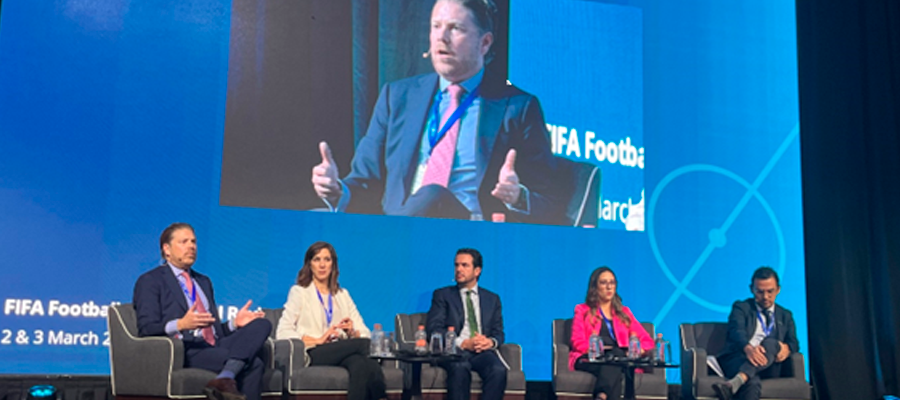
Dr. Despina Mavromati spoke at the FIFA Football Annual Review (FLAR) 2023 that took place in Mexico City on 2-3 March 2023. The 5th edition of the FLAR included several important football-related topics and renowned experts in the field of international football law and sports arbitration. The full agenda of the program (which will also be live-streamed) is available here
Despina Mavromati appointed as Chair of the Disciplinary & Ethics Commission of the International Weightlifting Federation (IWF)
November 11, 2020
The International Weightlifting Federation (IWF) announced the independent and highly-qualified members of its Disciplinary and Ethics Commission, marking the latest significant step in the federation’s ongoing process of governance reform.
The Commission comprises five independent members, from five continents. The members are:
Chair: Dr. Despina Mavromati – Greece and Switzerland
Attorney-at-law and arbitrator, UEFA Appeals Body Member and former CAS Managing Counsel.
Vice Chair: Andrew Minogue – Australia
CEO of Pacific Games Council with experience working within multi-sport Games
Secretary: Prof. Dr. Dr. Moni Wekesa – Kenya
Member of the World Athletics Disciplinary Tribunal, lawyer and sports medicine specialist
Member: Yoshihiro Takatori – Japan
Attorney-at-law, arbitrator (F.C.I.Arb.) and mediator, Executive Director of the Japan Association of Arbitrators
Member: Beatriz Merino – Peru
First female Prime Minister of Peru and Latin America, Former Senator and Congresswoman, Head of Peru IRS & Customs, National Ombudsman.
CAS Award 2018/A/5808, AC Milan v. UEFA, full award with grounds of October 1, 2018
Introduction
In the midst of turbulence from the recent Football Leaks indirectly affecting – among other issues – the Club Licensing and Financial Fair Play Regulations (CL&FFP Regulations) in European football, the CAS published the full award in the case AC Milan v. UEFA. 29 The case relates to a sanction that was imposed by the UEFA Club Financial Control Body (UEFA CFCB). According to the first-instance decision, the Adjudicatory Chamber of the UEFA CFCB initially determined that AC Milan failed to fulfil the break-even requirement of Articles 58 through 63 of the UEFA CL&FFP Regulations, and excluded AC Milan from participating in the next UEFA club competition for which it would otherwise qualify in the next 2 seasons (i.e., in 2018/19 and 2019/20).
Following an appeal to the CAS by AC Milan, the CAS Panel partially upheld AC Milan’s appeal and reverted the case back to Adjudicatory Chamber of the UEFA CFCB for a « proportionate disciplinary measure ».
In the Panel’s view, “certain important elements had not been properly assessed by UEFA’s Adjudicatory Chamber, or could not be properly assessed” when the UEFA Decision was rendered in June 2018 and that AC Milan’s financial position was better following the recent change in ownership. 30
Other than in previous cases related to the UEFA CL&FPP Regulations like the Galatasaray case, where the club challenged the UEFA CL&FFP Regulations (for a second violation of the regulations) and more specifically their compatibility with EU law, AC Milan directly challenged the proportionality of the sanction imposed by the UEFA CFCB. 31 In the Galatasaray case, the Panel had highlighted the existence of mitigating factors in the UEFA CL&FFP Regulations that could be taken into account by the UEFA hearing panel in order to render a proportionate decision under the individual circumstances of each case. 32
In view of the latest developments in European and international football, the CAS Award (which was published on November 8, 2018) is very interesting and worth a closer look because it raises more general questions as to the scope and limits of the UEFA CL&FFP Regulations. More crucially, it brings to the forefront questions of procedural nature before the CAS, such as the scope of the Panel’s full power of review under Art. R57 of the CAS Code, 33 and more particularly the control of proportionality of the sanction and the production of new (factual) evidence before the CAS. Additionally, it addresses the important procedural issue of the admissibility of the appeal (or a portion of it) when a particular part of the decision was not supposed to be subject to appeal.
A summary of the background facts
The UEFA CL&FFP Regulations
The UEFA had been closely following AC Milan’s financial situation for the last years. Such financial control forms part of the obligation imposed on European clubs participating in UEFA competitions to comply with the break-even requirements of the UEFA CL&FFP Regulations. The latter aim, among other things, to « promote and continuously improve the standard of all aspects of football in Europe (…)», « to ensure that clubs have an adequate level of management and organisation »,d) to protect the integrity and smooth running of the UEFA club competitions » ; « to allow the development of benchmarking for clubs in financial, sporting, legal, personnel, administrative and infrastructure-related criteria (…) ».
Regarding financial stability, the CL&FFP Regulations aim to « achieve financial fair play in UEFA club competitions » by improving the economic and financial capability of the clubs, by protecting creditors and by introducing rationality in club football finances and responsible spending for the long-term benefit of football. 34
According to the break-even requirement enshrined in Art. 58-64 of the CL&FFP Regulations, clubs should have a break-even surplus in the monitoring period. The monitoring period is defined as the assessment year and the two previous years. 35 A surplus is defined as the excess of relevant income over relevant expenses. 36 In case of deficit, a deviation of €5 million is tolerated – or an excess of €30 million if a shareholder contribution covers the excess.
AC Milan’s financial situation and the UEFA CFCB Decision of June 2018
Back in 2017, Fininvest S.p.A. sold 99.93% of the shares held in AC Milan to Rossoneri Sport Investment Lux (hereinafter “HoldCo”) for EUR 740 million. The latter was then controlled by a Chinese investor, Mr. Li. 37 HoldCo concluded a loan agreement with the company Redblack Sàrl for EUR 202 million with a maturity date of 15 October 2018. Redblack, a private limited liability company founded under the laws of Luxemburg, is advised by Elliott Advisors (UK) Limited (“Elliott”), which is indirectly controlled by Elliott Management, an American fund manager. The loan provided by Redblack to HoldCo was secured against the shares of AC Milan and Holdco.
The Shareholders’ meeting in May 2018 decided, among others, to increase the share capital of AC Milan up to EUR 49,920,000. However, after HoldCo failed to make a EUR 32 million capital contribution in June 2018, Redblack injected this amount instead of HoldCo, which in turn failed to pay the amount back to Redblack and such default entitled Redblack to enforce the relevant pledge agreement and become the new controlling shareholder of Milan.
AC Milan’s financial situation was assessed by UEFA, which refused to conclude a voluntary assessment 38 with the Club back in December 2017.
The CFCB Investigatory Chamber further announced its decision to refer the case to the CFCB Adjudicatory Chamber (hereinafter referred to as the “Referral Decision”) and, thus, not to enter into a settlement agreement on May 22, 2018. 39 The UEFA CFCB decision was issued on June 27, 2018 (the UEFA Decision).
The CAS Award and the importance of the procedural « details »
As seen above, AC Milan challenged the UEFA Decision on the grounds of proportionality, a principle warranted under both EU competition law and Art. 28 Swiss Civil Code that protects personality rights. 40 It submitted that, instead of imposing a sanction on the Appellant, the CFCB should have concluded a settlement agreement with the Club, an “obviously” less severe measure that was available. It also submitted that the UEFA Decision was based on wrong facts or that the facts were not correctly assessed.
The expedited procedure, the production of documents and the submission of new evidence by AC Milan
Following the parties’ settlement agreement, the procedure was conducted on an expedited basis (according to Art. R52(4) of the CAS Code) with an expedited calendar 41 and the Panel issued the operative part of the award already on July 20, 2018. 42 As per the Swiss Federal Tribunal, the parties who agree on an expedited procedure are presumed to have accepted the limitations that the very tight procedural calendar entails with respect to the conduct of the proceedings and the production of evidence. 43 In this particular case, the Panel accepted (following AC Milan’s request) to order the production of the audio file of the hearing of the CFCB Adjudicatory Chamber on June 19, 2018, based on two things: first, the broad meaning given to the word “documents” in Art. R44.3 CAS Code and second, in view of the expedited proceedings, because it could not exclude the relevance of such evidence. 44 Within the context of (and thanks to) the expedited proceedings, the CAS Panel also ordered the production of the unredacted settlement agreements for Paris Saint-German, FC Internazionale Milano and Manchester City Football Club that were in the custody of the UEFA. 45 The CAS Panel however dismissed the request for production of further evidence 46 as not being specific enough and relating to highly sensitive and confidential information. 47 Interestingly, the CAS Panel accepted the (late) submission of a new document by AC Milan (on July 19, 2018) in the form of an updated profit and loss comparison forecast for the season 2017/2018 notwithstanding an objection by the UEFA. The CAS Panel based its decision on Article R56 CAS Code and considered as “exceptional circumstances” the fact that the proceedings were conducted on an expedited basis and that AC Milan could not have produced such document at an earlier stage of the proceedings. 48 It must be noted that the (late) submission of a document and its acceptance by the Panel based on “exceptional circumstances” 49 can be decisive for the outcome of the case. Finally, the CAS Panel considered that the fact that the parties agreed to an expedited procedure weighed in favor of reverting the case to the previous instance (as per Art. R57 CAS Code) since the Panel was “not in a position to fully investigate and assess the factual basis of the case”. 50 This brings to the forefront the more general question of suitability of expedited procedures in similar – factually and evidentiary – complex cases. Indeed, the advantages of an expedited procedure (linked to the need for an urgent and final resolution of the case) could be “diluted” in cases where the Panel opts to revert the case back to the previous instance. According to Art. R52.4 CAS Code, it is at the Panel’s discretion to accept or refuse to proceed in an expedited manner (“The Panel may…”). 51 The solution undertaken is also questionable since the Panel acknowledged that it was not in a position to fully investigate and assess the factual basis of the case: at the same time, however, it found that the appealed decision «has not assessed the relevant facts correctly …”) and concluded that it was not proportionate, a control that entails – or rather presupposes – an assessment to the merits and therefore also of the factual basis of the case. 52
Is the Referral Decision of the CFCB Investigatory Chamber an “appealable decision” according to Article R47 of the CAS Code?
In this case the Panel proceeded to the determination of whether the UEFA’s Referral Decision (e.g., a decision not to conclude a settlement agreement) was an “appealable decision” according to Art. R47 of the CAS Code. In the UEFA’s view, the appeal to the CAS was “partially inadmissible”: In its view, the Referral Decision of the CFCB Investigatory Chamber, i.e., to refer the case to the CFCB Adjudicatory Chamber and not to conclude a settlement agreement had become final and binding, since it had been issued on May 22, 2018 and was not appealed by the Appellant within the deadline of Article 62(3) UEFA Statutes. 53 In line with established CAS case law, the Panel held that whether or not a decision of a sports federation is appealable is a matter of substance and not of form, in the same way that a letter (which never contains an “operative part”) can also be an “appealable decision”. 54 Furthermore, it is necessary to determine whether the decision affects the legal position of the addressee, independently of the rules of the federation and in line with the jurisprudence of the Swiss Federal Tribunal and the general principle of access to justice. The CAS Panel proceeded to an interpretation of the UEFA Procedural Rules Governing the CFCB (in particular Article 34 thereof) and held that the latter do not provide for a separate appeal against the Referral Decision, a finding that was further confirmed by the UEFA’s practice. 55 Interestingly, the Panel found that the decision of the CFCB Investigatory Chamber not to conclude a settlement agreement with AC Milan would not affect the latter’s rights, since it did not predetermine the outcome of the case. 56 Therefore, to the extent that the Referral Decision was not a separately appealable decision, AC Milan’s appeal to the CAS was considered as admissible in its entirety.
The extent of the panel’s full power of review and the “decisive reference date”
In our view, the most important issue – and the one that proved to be decisive in the case at hand – was the extent of the Panel’s review based on Article R57 CAS Code. Even though it was uncontested that Article R57 CAS Code applied, the parties could not reach an agreement as to the level of review of the case by the CAS Panel. 57 The latter provides in its first paragraph that “The Panel has full power to review the facts and the law. It may issue a new decision which replaces the decision challenged or annul the decision and refer the case back to the previous instance.”
With respect to the “decisive reference date”, the Panel stressed the importance of the relevant reference date for the assessment of the case. While the UEFA referred to a “photo finish” for the facts assessed by the previous instance in its decision (and which could not called into question at the later stage), AC Milan set the decisive reference date as the date of the CAS hearing, since the financial situation of a club is an “ongoing process” and that it would be “wrong to ignore today’s reality”. 58 Even though the analysis made by the CAS Panel is based on the broad discretion of Article R57 CAS Code, one may question how an appealed decision can be found to be disproportionate if it was logically based on facts that were available at the time the decision was rendered, and not on evidence that did not previously exist. The Panel itself seemed to acknowledge this problem linked to the de novo hearing and lack of legal certainty in para. 132 of the Award. It noted, however, that the UEFA Procedural Rules Governing the CFCB lack a specific reference in this respect in order to delimit the point in time where the correctness of a decision must be assessed. This, in our view, indirectly calls for an addition/ precision of the relevant rules in order to enhance legal certainty with respect to the relevant reference date. On the “depth of scrutiny” The other important aspect of Article R57 of the CAS Code is the “depth of scrutiny.” 59 While AC Milan supported that the full power of review should lead the Panel to “re-hear the matter afresh, as if it had not been previously heard or decided”, UEFA seemed to favor another jurisprudential approach whereby “[t]he measure of the sanction imposed by a disciplinary body in the exercise of the discretion allowed by the relevant rule can be reviewed only when the sanction is evidently and grossly disproportionate to the offence.”60 The Panel left the question open as to whether there are reasons to limit the scope of review in disciplinary sanctions (apart from the field of play cases, where review is limited). 61 It held, however, that the approach to limit the review by the hearing authority does not apply to questions of law, such as whether and to what extent a federation is bound by the principle of proportionality or the principle of equal treatment when imposing a disciplinary sanction. 62 The Panel further found that the distinction between “simple” and “gross” disproportionality appears to be “arbitrary”, even though one could argue that such difference is depicted in CAS 2010/A/2283 (cited by the CAS Panel in the AC Milan case), whereby a CAS panel “would not easily ‘tinker’ with a well-reasoned sanction, i.e. to substitute a sanction of 17 or 19 months’ suspension for one of 18. It would naturally […] pay respect to a fully reasoned and well-evidenced decision of such a Tribunal in pursuit of a legitimate and explicit policy. However, the fact that it might not lightly interfere with such a Tribunal’s decision, would not mean that there is in principle any inhibition on its power to do so”. 63 The Panel concluded that its power of review is neither excluded nor limited. 64 The fact remains that Article R57 CAS Code gives vast power to the CAS Panel to decide on the length / scope of the review – and the CAS case law has shown different approaches, which, even though they do not favor legal certainty, fall within the broad discretion of the Panel according to the CAS Code. As such, CAS Panels have limited their review of disciplinary sanctions imposed by the previous instance to “grossly disproportionate sanctions”, while others, like the CAS Panel in the AC Milan case, have opted for a full and fresh re-hearing of the matter, « as it had not been previously heard or decided ». 65
The Merits of the Case – a Detail?
In a relatively short section the Panel proceeded to analyze the merits of the case. In assessing the legality of the settlement agreement – challenged by AC Milan through an expert report in EU law – the Panel found that the settlement is, like the disciplinary sanction, a legal instrument for the regulation of a certain matter, “issued on a similar factual basis and with interchangeable contents”. 66 Furthermore, the Panel held that the choice of offering a settlement agreement or not is within the discretion of the CFCB Chief Investigator according to Article 15(1) of the Procedural Rules Governing the CFCB. The question of acting in a discriminatory way by offering said solution to other licensees but not the Appellant also appeared questionable for the Panel, based on the specific circumstances surrounding the case, leaving the possibility of unequal treatment open had AC Milan adduced additional evidence in this respect. In any event, this would not invalidate the decision to the extent that the choice of the legal instrument is at the discretion of the UEFA Investigatory Chamber. 67 The most important part of the merits lies, in our view, with the control of the factual assessment by the CFCB Adjudicatory Chamber. 68 While the breach of the break-even requirement was uncontested (EUR 121 million in excess of the maximum acceptable deviation) and confirmed in the operative part of the CAS Award, the fact that the CFCB Adjudicatory Chamber approved the factual findings at the time of the Referral Decision was not in line with the mandate of the CFCB Adjudicatory Chamber. In the Panel’s view, the Adjudicatory Chamber should have determined the relevant facts at the time of its hearing on June 19, 2018, since the situation had significantly changed. 69 As the new controlling shareholder of AC Milan, Elliott is a well-known robust company that manages two multi-strategy funds and in both its letter dated June 19, 2018 and the press release on July 10, 2018 held that it supported AC Milan’s business plan and its strategy. Again, this brings us back to the importance of fixing a point in time where the factual assessment must be made as seen above under the Panel’s full power of review.
Concluding Remarks
We should not forget that, within the context of international arbitration and notwithstanding the influence of lex sportiva, the findings of this CAS Panel do not have an absolute precedential value, but relate to the specific and sui generis legal framework of the UEFA CL&FPP Regulations and the even more specific circumstances surrounding the particular case. Notwithstanding the above, the CAS Award in the case AC Milan v. UEFA is a very important ruling not necessarily because the factual issues raised are of utmost timeliness, but mostly because it raised important and decisive procedural matters including the depth of review by the CAS Panel and the point in time where factual and legal evidence can be adduced before CAS. In our view, and in order to enhance legal certainty as to the point in time where the factual assessment should take place, a regulatory amendment of the UEFA Procedural Regulations might be advisable. The CAS Panel concluded in its operative part that the CFCB Adjudicatory Chamber is called to issue a “a proportionate disciplinary measure”. What the outcome will be, and whether the current developments and revelations surrounding other clubs will influence the decision-making process in this case, remains to be seen.
4A_456/2023, judgment of 11 December 2023, FC A. v. B, motion to set aside the CAS Award of 25 July 2023 (CAS 2022/A/8754)
A football employment-related dispute between a football club (the Club) and a football player (the Player) was brought before the CAS: the employment contract provided for a salary of USD 4’000 and a signing on fee of USD 50’000, whereas the parties also agreed on a USD 2’000’000 compensation in case of unilateral contractual breach. The Club unilaterally terminated the contract with the Player in February 2021 and the Player filed a successful claim before the FIFA DRC; following an appeal to the CAS by the Club, the Panel partially upheld the appeal and reduced the awarded compensation (from USD 2’000’000 to UDS 500’000).
The Club subsequently filed a motion to the SFT invoking, primarily, a violation of its right to be heard (Article 190 para. 2 d PILA). More specifically, the Club held that the CAS had not justified its assessment of the compensation nor had it substantiated how it reached its decision. The CAS Panel had found that the compensation foreseen in the contract was a contractual penalty that was validly negotiated between the parties. As such, the Panel went on to reduce it amount to the extent that this was found to be excessive (under Article 163 para. 1 SCO), also considering the Player’s salary.
In its judgment, the SFT was not convinced that there was a procedural irregularity to the extent that the Panel had considered the arguments raised. The SFT reiterated that the arbitral tribunal is not obliged to answer explicitly to every and single argument raised in the appeal.
The Club’s argument, that the CAS should have reduced the contractual penalty to the equivalent of six salaries (i.e. USD 24’000) was swiftly dismissed by the SFT, rightly considering that this was an inadmissible plea of appellatory nature. In its conclusion that shows the (high) threshold of a procedural violation under Article 190 para. 2 d PILA, the SFT referred to well-established federal case law according to which the right to be heard does not entitle the parties to a materially correct decision but rather safeguards their right to participate in the decision-making process.
SFT Judgment 4A_232/2024 of 3 October 2024, motion to set aside CAS 2022/A/9157
In this case, a dispute arose between a professional footall club (Club A), a football player (the Player) and another football club (Club C) over the validity of a contract between Club A and the Player and the authenticity of the Player’s signature. The case involved various claims to the FIFA Tribunal and then to the CAS. The main contentious point related to the validity of the contract, which was annuled by FIFA and the CAS and the graphological expertise (handwriting analysis) of the signatures on the contract, which the CAS ultimately dismissed as insufficient.
Club A filed a motion to challenge the award alleging a violation of its right to be heard but this was immediately dismissed by the SFT based on the elements of the award. Club A also alleged that the Player and Club C had acted in bad faith by opposing the graphological analysis and adopted a contradictory conduct regarding the appeal, however the respondents’ conduct could not amount to bad faith, all the more based on the wide powers granted to the CAS Panel based on Article R57 of the CAS Code. The SFT also confirmed the assesment of the evidence made by the CAS, which found that the signatures in the disputed contract were not authentic.
The SFT reiterated the large authority of CAS Panels in reviewing facts and applying the law in CAS appeal proceedings
This case emphasizes the importance of thorough evidence assessment in sports arbitration, especially regarding contract validity and the authentication of signatures. The SFT also reaffirmed the large autonomy of the CAS in reviewing facts and applying legal principles, such as those related to the burden of proof and the scope of review under the CAS Code.
4A_62/2020, Judgment of September 30, 2020, A FC v B., Appeal against the CAS award of 11 December 2019 (CAS 2019/A/6286)
This case is of limited interest to sports arbitration practitioners: A typical loan agreement with a purchase option of a football player was brought to the FIFA Dispute Resolution Chamber (DRC), then to the Court of Arbitration for Sport (CAS) and eventually to the Swiss Federal Tribunal (SFT). Both the FIFA DRC and the CAS upheld the Player’s claims for outstanding payments by the Club. Before the SFT, the Club invoked a violation of its right to be heard by the Panel for allegedly failing to examine its argument that the payment of the signing bonus was due only if the player was definitively transferred, which in the Club’s view was not the case. The SFT held that this grievance was nothing more than a disguised effort to review the substance of the case and to question the interpretation of a contractual clause, only reviewable under Art. 190 (2) (e) LDIP.
The SFT also dismissed the argument raised by the Club on the violation of its right to be heard by the Panel for taking into account an argument that the parties did not raise. Specifically, the CAS considered that the employment contract had probably been drawn up by the Club and therefore should be interpreted against it, based on the principle in dubio contra proferentem. Apart from being just one of the elements taken into account by the Panel in order to reach its decision, the SFT considered that the alleged violation of the Club’s right to be heard could not have an influence on the outcome of the dispute, to the extent that the Club had expressly admitted its debt during the DRC proceedings. As such, the real and common intent of the parties was established without the need for recourse of additional interpretational principles such as the one of in dubio contra proferentem.
SFT Judgment 4A_504/2023 of 22 February 2024, motion to set aside CAS 2022/A/9297
This case involved Paolo Barelli (Barelli or the Applicant), the President of the Italian Swimming Federation, former President of European Aquatics (LEN) from 2012 to 2022, and World Aquatics (formerly FINA) Vice-President from 2017 to 2021. In March 2021, while serving as LEN President, Barelli signed a contract with his home country for the European Aquatics Championships in 2022. Under this contract, his country was required to pay EUR 3,000.000 to host the event. However, in May 2021, an addendum to the contract was signed, reducing the payment to between EUR 500,000 and EUR 1.5 million, depending on COVID-19 restrictions in Italy. The commercialization rights for Italy were also increased from 50% to 60%.
Both LEN and FINA became aware of this arrangement, and FINA initiated proceedings against Barelli for conflicts of interest, resulting in a one-year sanction. The Court of Arbitration for Sport (CAS) upheld this sanction on appeal.
In his challenge before the SFT, the Applicant argued that FINA’s actions were contradictory and violated substantive public policy, to the extent that FINA had allowed him to simultaneously lead both LEN and Country B for nearly a decade. Despite the conflict of interest, he argued that this tacit approval gave him the right to sign the addendum with Italy.
The SFT emphasised that in sports disciplinary cases, it only reviews the panel’s decisions if they are manifestly unjust.
The SFT rejected this argument, noting that while FINA had allowed him to hold both positions, this did not grant him carte blanche to act in the interests of Italy. The SFT found that by signing the addendum on behalf of LEN, he had primarily served the interests of Italy, securing significant financial reductions for them and concluded that he should have refrained from signing the contract or at least sought guidance before proceeding.
The SFT also dismissed the argument on the violation of personality rights, emphasizing that in sports disciplinary cases, it only reviews arbitrators’ decisions if they are manifestly unjust. Citing the Platini case (which reached a similar result from the scope of arbitrariness, wider than the narrow scope of public policy), the SFT affirmed that it would only intervene if it found a clear violation or excessively severe sanction, which were clearly not met in this case.
A Summary of the key Swiss Federal Supreme Court judgments published in 2024
In 2024, the Swiss Federal Supreme Court (SFT) issued, once again, numerous judgments in motions against awards rendered by the Court of Arbitration for Sport (CAS). As occurs each year, most of the pleas involved grievances of due process and violations of a parties’ right to be heard, but also quite common this year were violations of public policy.
The SFT did not uphold any of the challenges in 2024, reiterating the high admissibility threshold, in particular, casesrelated to the ‘effet de surprise’ (see also my note on 4A_112/2024). Generally, the SFT confirmed its view that CAS Panels generally enjoy broad powers in the assessment of the evidence under Art. R44.1 (see my note on 4A_598/2023) as well as their power of review under Art. R57 CAS Code (see my note on 4A_232/2024). Moreover, pleas of appellatory nature are generally inadmissible (see my notes on 4A_264/2024 and 4_456/2023) and the parties must raise any procedural irregularities / violations of the right to be heard in an explicit manner as soon as they arise, all the more after the 2021 modification of Art. 182 paragraph 2 of the Swiss Private International Law Act, PILA (see my note on 4A_598/2023). Importantly, the right to be heard does not include as such a right to cross-examine a witness who filed written statements (see my note on 4A_600/2023). Alleged violations of the equality of the parties must relate to the CAS proceedings and not challenges under e.g. the WADA rules (see my note on 4A_442/2023).
Furthermore, the SFT re-confirmed its very strict view of violation of public policy but also the notion of ‘abuse of rights’ in employment claims based on mandatory labour law in football (see my note on 4A_134/2024). There is, in principle, no violation of public policy in case of the filing of the statement of appeal by email only (see my note on 4A_346/2024) or in case of delays to issue the CAS Award (to the extent that they can be justified by the complexity of the proceedings and the parties’ requests) (see my note on 4A_442/2023). CAS Panels generally enjoy a wide discretion in assessing and dermining the amount of a contractual penalty if the latter is found to be excessive (see my note on 4A_456/2023) but also in reviewing disciplinary sanctions in sports proceedings (see my note on 4A_ 504/2023). What is more, requests for joinder and intervention under the CAS Code are not ‘essential rules’ falling within the scope of public policy (see my note on 4A_154/2023).
The SFT also confirmed its view that violations of the European Convention of Human Rights (the Convention) cannot be directly invoked pending the Caster Semenya case before the ECHR Grand Chamber (see also my note on 4A_448/2023). Moreover, there is no public policy violation if a panel imposes doping sanction on a minor athlete, to the extent that a different treatment depending on age would endanger the fight against doping (see my notes on 4A_564/2023 and the Valieva case 4A_136/2024).
In terms of jurisdiction, the SFT reiterated that CAS jurisdiction and arbitrability cannot be invoked in bad faith, e.g., if said jurisdiction was accepted in other proceedings, see my note on the Valieva case 4A_136/2024). What is more, the SFT clarified the interpretation principles of jurisdiction clauses in international football disputes, especially where FIFA’s regulations allow parties to opt out of FIFA and CAS jurisdiction for labor law issues (see my note on 4A_430/2023).
Decision to reduce a contractual penalty in a football-related dispute and right to be heard
This SFT judgment dealt with a legal dispute between a football club (the Club) and a football player (the Player) over a contractual penalty, after the Club unilaterally terminated the player’s contract in February 2021. The employment contract included a salary of USD 4,000, a signing fee of USD 50,000, and a penalty of USD 2,000,000 in the event of a breach. The Player successfully claimed compensation before the FIFA DRC, and the CAS reduced the penalty to USD 500,000 on appeal by the Club.
The CAS had argued that the penalty was valid but excessive, reducing it based on the Player’s salary and Swiss law (Article 163 para. 1 SCO). The Club then filed a motion to the Swiss Federal Tribunal (SFT), arguing a violation of its right to be heard (Article 190 para. 2 d PILA). Specifically, the Club claimed that the CAS had not justified its decision to reduce the penalty or explained how it reached its conclusion.
The SFT rejected the Club’s claims, ruling that the CAS had considered the arguments raised and that it was not required to respond to every point in detail. The SFT also dismissed the Club’s argument that the penalty should be reduced to six months’ salary (USD 24,000), stating it was an inadmissible criticism of appellatory nature. Ultimately, the SFT reinforced the principle that the right to be heard ensures participation in the decision-making process, but not necessarily a correct decision.
Pleas of inequality of the parties and delay to issue the CAS Award in a doping-related case
In this doping case involving a Russian wrestler, the athlete’s sample initially tested negative in 2015 but was re-examined in 2020 at WADA’s request, showing traces of a prohibited anabolic steroid. The Russian Anti-Doping Agency (RUSADA) but the CAS suspended the Athlete for four years in appeal.
In the subsequent SFT judgment, the SFT scrutinized the time limits for CAS awards, generally set at three months under the CAS Code. In this case, the CAS took nine months to issue the award after receiving the case file, including multiple extensions. The SFT noted that delays could violate procedural public policy under certain conditions but concluded that the overall circumstances of the case—including the complexity of consolidating proceedings and the Athlete’s own requests for extensions—meant that the delay was not excessive.
The SFT also addressed the athlete’s claim of inequality of the parties due to difficulties in finding a scientific expert. Interestingly, this was deemed outside the scope of the appeal as the Athlete did not criticize the CAS proceedings as such but rather his challenges under WADA rules. The SFT dismissed this claim, noting that the athlete eventually found experts.
In conclusion, while not a landmark case, the decision highlights the SFT’s scrutiny of time limits for CAS awards and emphasizes that the reasonableness of delays must be assessed in the context of the overall case, not just the duration of proceedings.
European Convention of Human Rights invoked directly before the Swiss Federal Tribunal after the Semenya judgment
In this doping-related case, a Russian female triathlete was disciplined by her international federation for failing to report the use a banned substance found in her samples from 2014 and 2015. After a four-year suspension imposed by the CAS Anti-Doping Division in 2022, the athlete sought to overturn the decision, citing human rights violations and invoking Article 13 of the European Convention on Human Rights (ECHR).
In this post-Semenya judgment, the Swiss Federal Tribunal (SFT) ruled that the Semenya judgment was not binding on the SFT because the case was still pending before the ECHR Grand Chamber, therefore declining to modify its established case law. The SFT also dismissed the Athlete’s plea that CAS lacked institutional independence, reaffirming its support for the CAS based on previous rulings, including the Mutu & Pechstein case.
Furthermore, the Athlete argued a violation of her right to be heard for not being able to access or test three contested urine samples from 2014 and 2015, which had been destroyed. This was dismissed to the extent that, following the destruction of the samples, it was naturally impossible to provide evidence in the arbitration proceedings. What is more, the argument that WADA unlawfully prevented the Athlete from obtaining the evidence was deemed inadmissible to the extent that it was directed against one of the opposing parties and not the panel. Finally, the SFT found no violation of public policy, concluding that the Athlete’s claims did not demonstrate a breach of fundamental procedural principles.
This judgment is significant as the first post-Semenya case in which the SFT addressed Article 13 ECHR directly, reinforcing that it was not yet ready to integrate such arguments into its case law pending the ECHR Grand Chamber’s final decision. The SFT also emphasized the narrow scope of Article 190(2)(d) PILA, which does not address factual disputes or appeals.
Proportionality of a doping sanction imposed on a minor athlete and violation of public policy
SFT Judgment 4A_564/2023 of 26 January 2024, motion to set aside TAS 2023/A/9466 and TAS 2023/A/9625
In this case, a taekwondo athlete – a minor at the time of the violation – tested positive for furosemide, a banned masking agent, during an in-competition test. Following a two-year first-instance decision, the athlete was subsequently banned for four years by the CAS.
In his motion to the SFT, the athlete argued that the four-year sanction was disproportionate, particularly because he was only 17 years old at the time of the violation, and discriminatory as he should not be sanctioned in the same way as an adult athlete, given his inexperience with doping controls.
The SFT clarified that it could only intervene in cases where a decision violated public policy as to its result and further noted the sanction should be manifestly unjust or shockingly inequitable. In this case, the SFT upheld the CAS decision, which found that the athlete had intentionally ingested the substance to aid weight loss for competition, ignoring that it was prohibited. As such, the athlete’s young age and inexperience did not excuse him from verifying the substances he ingested, particularly given his prior international competition experience.
The SFT also dismissed the discrimination argument, stating that anti-doping rules apply equally to all athletes, regardless of age, and there was no compelling reason to treat the minor athlete differently from adults. The SFT concluded that the athlete’s criticisms were not sufficient to overturn the decision, and the four-year sanction was neither disproportionate nor discriminatory.
Non-timely filing of the statement of appeal due to non-established technical problems and excessive formalism
In 4A_254/2023 of 12 June 2023, a doping-related sanction was issued by the disciplinary body of the International Fencing Federation (FIE) on 31 January 2023. The athlete’s counsel filed the statement of appeal within the 21-day time limit by email only, requesting at the same time the “Case Registration Form” in order to upload the statement via the CAS e-filing platform. On the last day of the time limit, the counsel uploaded the submission on the e-filing platform, noticing that the platform was particularly slow but without receiving an error notification from the system. Several days later, the CAS informed the athlete that the statement of appeal was filed late. In the subsequent challenge proceedings, the SFT confirmed that the parties uploading their statement of appeal on the e-filing platform bear the burden to establish the valid filing of their submissions, whereas the inadmissibility for non-timely filing cannot amount to excessive formalism (cf also my note on 4A_692/2016).
Conflict of interests in sports administration and the (high) threshold to establish violation of public policy in sports disciplinary sanctions
SFT Judgment 4A_504/2023 of 22 February 2024, motion to set aside CAS 2022/A/9297
This case involved Paolo Barelli, the President of the Italian Swimming Federation, former President of European Aquatics (LEN) from 2012 to 2022, and former Vice-President of World Aquatics (formerly FINA) from 2017 to 2021. In March 2021, while serving as LEN President, Barelli signed a contract with Italy to host the 2022 European Aquatics Championships, requiring Italy to pay EUR 3 Mio. However, in May 2021, an addendum to the contract was signed, reducing the payment due to Covid-19 restrictions, and increasing Italy’s commercialization rights from 50% to 60%.
Both LEN and FINA became aware of this arrangement, and FINA launched proceedings against Barelli for conflicts of interest, imposing a one-year sanction. The Court of Arbitration for Sport (CAS) upheld this sanction on appeal.
Barelli then challenged the decision before the Swiss Federal Tribunal (SFT), arguing that FINA’s actions were contradictory and violated public policy, as FIFA had allowed him to hold these roles for nearly a decade and had given him a tacit approval to sign the addendum with Italy.
The SFT rejected this argument, noting that while FINA had permitted him to hold both positions, it did not give him the right to act in Italy’s interests. The SFT also dismissed a claim regarding a violation of personality rights, emphasizing that, as found in the Platini judgment, it only reviews decisions in sports disciplinary cases if the sanction is manifestly unjust.
Football-related labour law disputes of ‘international dimension’ and jurisdiction of state courts
SFT Judgment 4A_430/2023 of 23 February 2024, motion to set aside CAS 2022/A/8571
In August 2020, a Hungarian football club (the “Club”) signed a contract with a Russian football player (the “Player”), which included an arbitration clause specifying that disputes could be resolved through negotiation, and if those failed, by either the Hungarian state courts or FIFA’s authority for labor disputes, or through the Sports Standing Arbitration Court for other disputes under Hungarian Sports Law.
When a dispute arose regarding unpaid wages, the Player terminated his contract and filed a claim before FIFA’s Dispute Resolution Chamber (DRC). The FIFA DRC partially upheld the Player’s claim, ordering the Club to pay various amounts. On appeal to the CAS, the Sole Arbitrator ruled that the CAS did not have jurisdiction over the matter, and that the dispute should have been brought before Hungarian state courts.
The SFT Court confirmed the interpretation of the arbitration clause by the CAS, as the clause clearly distinguished between labor law disputes (which should go to state courts) and other disputes (which could be resolved through FIFA and then CAS). The SFT rejected the Player’s argument that the clause allowed for “alternative jurisdiction” between state courts and FIFA DRC, affirming that this interpretation was not supported by the CAS award.
This case is notable for clarifying the interpretation of jurisdiction clauses in international disputes, especially where FIFA’s regulations allow parties to opt out of FIFA and CAS jurisdiction for labor law issues. The SFT emphasized that the parties’ intent to exclude state courts from jurisdiction must be clear and referenced a similar case (4A_2/2023), where the SFT confirmed the jurisdiction of Hungarian state courts over labor law disputes in a similar context.
Importance of clear evidence in arbitration proceedings and limited scope of review of alleged procedural violations by the SFT
SFT Judgment 4A_16/2024 of 26 June 2024, motion to set aside CAS 2023/A/9876
This case involved a dispute between a Turkish football club (the “Club”) and a Lithuanian player (the “Player”) regarding disciplinary sanctions imposed by FIFA on the Club that was confirmed by the CAS.
In the SFT challenge, the Club raised a violation of its right to be heard and a violation of public policy, alleging that the CAS award had falsely accused it of producing a forged document. Both arguments were swiftly dismissed by the SFT based on the elements of the file.
This judgment highlights the importance of clear evidence in arbitration proceedings and the limited scope for challenging arbitration awards based on alleged procedural violations or public policy concerns.
Requests for joinder and intervention under the CAS Code are not ‘essential rules’ falling within the scope of public policy
SFT Judgment 4A_154/2024 of 10 June 2024, motion to set aside the CAS Award TAS 2023/A/10194
The case involved four Peruvian football clubs: Club C, which competed in the first division, and Clubs A, B, and D, which were relegated to the second division. Following investigation, the PFF imposed a financial penalty and a four-point deduction for the 2023 season on Club C for failing to meet its financial obligations. Club C appealed the decision, as did Clubs A and D; the latter Clubs arguing that the sanction should apply to the 2022 season, which would have kept them in the first division. PFF upheld the sanction, but adjusted it to apply to the 2022 season, prompting appeals to CAS from Club C and Club B. Club A requested to intervene in the CAS proceedings, but the Sole Arbitrator dismissed this request.
Club A then sought to annul the CAS decision refusing its intervention request before the SFT. The SFT confirmed that a decision on intervention is not just a procedural order, but a challengeable decision, citing previous jurisprudence (cf. SFT 4A_416/2020). Moreover, the SFT held that the decision on intervention did not fall within the jurisdictional scope of Art. 190(2)(b) of PILA, but rather public policy under Art. 190(2)(e) PILA. Most importantly, however, the SFT referenced another recent judgment whereby it found that Art. 41.4 was not an essential rule that would lead to the violation of public policy (4A_340/2023, at 6.4).
The SFT further dismissed Club A’s argument that its right to be heard had been violated as being largely appellatory and confirmed the CAS’ finding that the appellant should have filed a proper appeal and not an intervention request. Finally, the SFT held that the coherence of the CAS reasoning was beyond the SFT scope of review. (NB: see also the linked cases 4A_156/2024, 4A_180/2024 and 4A_182/2024 of 10 June 2024).
On the limited scope of the ‘effet de surprise’ – the case of the former President of the European Weightlifting Federation Hasan Akkus
SFT Judgment 4A_112/2024 of 3 July 2024, motion to set aside CAS 2023/A/9398 and CAS 2023/A/9493
This judgment relates to the former President of the European Weightlifting Federation (EWF) Hasan Akkus (A), who was initially sanctioned for anti-doping violations by the CAS Anti-Doping Division (ADD) and subsequently cleared by the CAS in appeal. A was accused by the IWF of backdating a document from January 2013 to November 2012 to avoid sanctions for doping violations of approximately 20 Turkish weightlifters and the Turkish Weightlifting Federation (TWF).
The IWF then sought to have the CAS award set aside by the Swiss Federal Tribunal (SFT), claiming a violation of its right to be heard. The SFT quickly dismissed the appeal and ruled that a new piece of evidence submitted for the first time before the SFT was inadmissible under Article 99(1) of the Swiss Federal Tribunal Act (LTF).
Regarding A’s resignation as EWF president, the SFT found that the exact date of his resignation was not crucial. It also ruled that the falsification of the document was immaterial, as it occurred after A had left his position with the EWF.
The SFT further rejected the IWF’s argument of “effet de surprise” concerning the scope of the anti-doping regulations, stating that the issue of whether the regulations applied after A’s resignation was a central point in the case, and the CAS was justified in thoroughly examining it. Lastly, the SFT concluded that the CAS’s reference to Article 7.7 of the IWF Anti-Doping Regulations was not the foundation of its decision, but merely supported the conclusion that the regulations did not apply to former officials like A.
Very restrictive notion of ‘abuse of rights’ in employment claims based on mandatory labour law in football
SFT Judgment 4A_134/2024 of 28 June 2024, motion to set aside CAS 2023/A/9574
In this case, a dispute arose from an agreement between a Turkish Club and a Brasilian Player to terminate their employment contract prematurely in order to facilitate the Player’s transfer to another club. The Club initially obtained a favorable decision from the FIFA DRC but lost in appeal to the CAS, as the Sole Arbitrator essentially found that the Club had not proven damages.
More specifically, the Sole Arbitrator awarded the Player’s counterclaims on the grounds that the termination agreement was null and void due to a breach of mandatory law (Art. 341 para. 1 CO), as it did not provide for balanced mutual concessions and lacked reciprocity. At the same time, the Sole Arbitrator rejected the Club’s objection that the Player had acted in abuse of rights by subsequently invoking the nullity of the agreement despite his concessions and the payment of instalments. Accordingly, it was decided that the Club should pay outstanding wages due to the nullity of the cancellation agreement and repay the partial payments to the Player for unjust enrichment.
In the subsequent motion to set aside the CAS Award, the Club alleged that the Sole Arbitrator had not recognized the player’s conduct as an abuse of rights (venire contra factum proprium), amounting to a violation of public policy.
The SFT reiterated the very restrictive notion of abuse of rights falling within the scope of public policy, which is possible for an employer only if special circumstances exist (BGE 131 III 439 E. 5.1 with references), in view of the very limited view of labor law claims based on mandatory law, the SFT could not establish – on the basis of the binding findings in the award – that the Sole Arbitrator granted legal protection to abusive conduct by the Player and therefore could not annul the award for violation of public policy.
Proportionality of a doping sanction imposed on a minor athlete – the SFT Judgment in the case of Kamila Valieva
SFT Judgment 4A_136/2024 of 5 September 2024, motion to set aside CAS 2023/A/9451, CAS 2023/A/9455 and CAS 2023/A/9456
The Swiss Federal Tribunal (SFT) reviewed the case of Russian figure skater Kamilla Valieva, who was disqualified from the 2022 Beijing Olympics after testing positive for the banned substance trimetazidine. The CAS had earlier imposed a four-year ineligibility period starting from December 25, 2021, and disqualified all results since that date. The CAS found that Valieva could not prove, on the balance of probabilities, that the violation was unintentional or explain the source of the banned substance, dismissing her claims of sabotage, contamination, or ingestion via a dessert. Despite her status as a minor, the CAS applied the same standards for intentional anti-doping rule violations and noted that further protection for young athletes would require changes to the WADA Code.
The SFT addressed Valieva’s challenges to the CAS’s jurisdiction and the arbitrability of the case. It rejected her claims, noting that the CAS had jurisdiction based on applicable regulations for international-level athletes and she had already accepted such jurisdiction in CAS Ad Hoc proceedings that dealt with her provisional suspension (see my note here). The SFT also held that the dispute remained arbitrable even though Russian law incorporated WADA’s rules, emphasizing the importance of maintaining a unified anti-doping framework.
Valieva argued that her young age warranted a less severe sanction under public policy. The SFT dismissed this, stating that lowering sanctions solely due to age would undermine anti-doping efforts. Additionally, the SFT found no merit in her grievance about excessive media coverage by the CAS, as the publicity complied with WADA rules given the high-profile nature of the case during the Olympics.
No excessive formalism in case of filing the statement of appeal at the CAS only by email
SFT Judgment 4A_346/2024 of 2 September 2024, motion to set aside CAS Decision of 15 May 2024
Following a FIFA DRC decision ordering a Turkish professional football Club to pay unpaid salaries to a player on 4 April 2024, the Club filed a statement of appeal to the CAS by email on 3 May 2024. Several days later, the CAS Court Office acknowledged receipt of the email and called attention to Art. R31 of the CAS Code. The Club confirmed that it had sent its statement of appeal by post on 6 May 2024, the date on which it had allegedly delivered its submission in person to a company called C.
However, CAS determined the decisive dispatch date to be May 13, 2024, based on DHL’s shipment tracking. This fell outside the deadline set by Art. R31 of the CAS Code. Consequently, CAS declined to hear the case due to the late filing of the appeal.
Before the SFT, the Club argued that CAS had committed excessive formalism, claiming Art. R31 para. 3 only required the appeal to be sent “by post” without specifying the need for a traceable system. The SFT dismissed this argument and noted that failing to meet formal requirements for filing appeals does not constitute a formal denial of justice (Art. 190(2) c PILA). The SFT emphasized that compliance with Art. R31 para. 3 is an admissibility condition, not a mere procedural formality and as such the CAS did not commit excessive formalism by not accepting the appeal.
Evidence submitted late pursuant to Art. R44.1 of the CAS Code and right to be heard
SFT Judgment 4A_598/2023, of 2 September 2024, motion against the CAS Award CAS 2021/O/7669
A Colombian football Club signed an exclusive representation agreement with an Agency in Brasil for the transfer of a football Player, and signed a contract providing for the payment of a sum depending on the transfer fee of the player.
The Agency subsequently filed a request for arbitration with the CAS requesting the payment of the agreed amount. The Sole Arbitrator considered that it was not necessary to hold a hearing but ordered a new round of submissions and requested the Agency to provide documents showing the role played in the negotiations. The Agency provided its written statements of the Player, while the Club contested the admissibility of such written statement. The Sole Arbitrator upheld the claim and ordered the Club to pay the agreed amount plus interest, considering that the agency had indeed assisted the Club in the negotiations.
In its challenge before the SFT, the Club alleged a violation of its right to be heard, holding that the CAS had not offered the possibility to cross-examine the player and failed to decide on the requested nullity of the witness statement that was provided late (cf. also 4A_600/2023). However, the SFT swiftly dismissed this argument as the challenged award confirmed that such evidence was validly submitted under Art. R44.1 of the CAS Code.
Right to be heard does not include a right to cross-examine a witnesses who provided written statement
SFT Judgment 4A_600/2023 of 2 September 2024, motion to set aside CAS 2021/O/7670
In this case, an Agency sought a commission for assisting a football Club in its negotiations for the transfer of a football Player to another football club. In the CAS proceedings, the Sole Arbitrator decided not to hold a hearing but to have a second round of submission, then invited the Agency to submit the documents that would establish the role played in the negotiations for the transfer. The Agency filed its second submissions and a written statement of the Player, which was contested by the Club as inadmissible. The Sole Arbitrator upheld the claim and the Club brought a challenge before the SFT for violation of its right to be heard, for not allowing it to cross-examine the Player.
The SFT discarded this argument, confirming that the Club had the possibility to express itself on the content of the witness statement. It could also have filed its written submissions with a list of additional questions for the Player during the second round of submissions, but only requested the inadmissibility of the witness statement. Other elements that were considered included the fact that the Club explicitly requested the CAS not to hold a hearing in the end of the second round of submissions, and signed the Order of Procedure without reservations. Most importantly, the SFT reiterated that Art. 182 paragraph 3 PILA does not grand the right to ask questions to the witnesses who provide written statements (4A_199/2014 at 6.2.3).
De novo review and wide powers in the assesment of the evidence by the CAS in appeal.
SFT Judgment 4A_232/2024 of 3 October 2024, motion to set aside CAS 2022/A/9157
This case involved a dispute between a football club (Club A), a player, and another club (Club C) regarding the validity of a contract and the authenticity of the player’s signature. The FIFA Tribunal and the CAS annulled the contract after finding the signature invalid, dismissing the graphological evidence presented as being insufficient.
Club A challenged the CAS award before the SFT, claiming a violation of its right to be heard and alleging bad faith by the player and Club C in opposing the graphological analysis. The SFT dismissed these claims, noting that the respondents’ conduct did not constitute bad faith and affirmed the broad authority of the CAS under Article R57 of the CAS Code. The SFT also upheld the Panel’s evaluation of evidence, including its conclusion that the disputed signatures were not authentic.
The case underscores the significance of robust evidence evaluation in sports arbitration, particularly in contractual disputes, and reaffirms the wide autonomy of the CAS panels in fact-finding and applying legal principles.
Inadmissible criticisms of appellatory nature – the challenge of the IOC Decision to withdraw its recognition of the International Boxing Association.
SFT Judgment 4A_264/2024 of 12 September 2024, motion to set aside CAS 2023/A/9757
This is the SFT judgment in the motion to set aside the CAS Award that confirmed IOC decision to withdraw its recognition of the International Boxing Association (IBA) as an Olympic federation and to ban IBA from the next version of the Olympic Games (in Los Angeles, 2028) but to keep boxing as a discipline during the Paris Olympics 2024 in order to protect the athletes’ interests. The IBA, previously recognized by the IOC as the governing body for international boxing, faced allegations of corruption and governance issues, particularly after the 2016 Rio Olympics. Investigations revealed serious governance, financial, and ethical concerns and, despite attempts to address these, the IOC suspended its recognition in June 2023.
Before the SFT, the IBA invoked procedural errors, including the violation of its right to be heard. In essence, the SFT dismissed the grievances as being largely inadmissible criticisms of appellatory nature but also holding that the IBA’s arguments were duly considered and implicitly – if not explicitly – discarded by the CAS Panel.
The only interesting remark in this case was that the parties had signed the Order of Procedure opting for the 12th Chapter of the PILA (governing international arbitration and providing for a more limited review of the arbitral award), even though the arbitration was domestic (as both parties were based in Switzerland.
2024 was a year rich in major sporting events, including the Summer Olympic and Paralympic Games in Paris (from 26 July 2024 to 11 August 2024, “Paris 2024 Olympics”). The Paris 2024 Olympics generated numerous interesting disputes that were decided by the CAS Ad Hoc Division present on-site, including the well-publicized Jordan Chiles dispute that is still pending before the Swiss Federal Tribunal (SFT) in Switzerland.
In a nutshell, the CAS ad hoc Panels dismissed four applications for being filed outside of the 10-day jurisdictional window in which the CAS ad hoc Division has jurisdiction over a dispute related to the Olympics. In four other cases, the CAS ad hoc Panels considered that the disputes fell within the “field of play doctrine”, which would only allow them to review the case for very limited grounds. In most cases, the Panels examined the proportionality, the reasonableness or the well-founded of the challenged decision, and upheld four applications after interpretation of the applicable regulations (you can also see my overview of all cases heard by the CAS ad hoc Division during the Paris 2024 Olympics here).
In the first case of the ad hoc Division CAS 24/01, the CAS panel dismissed the application filed by Jamaican athlete Nayoka Clunis. Notwithstanding the fact that the omission to include her name in the pre-entry list submitted to World Athletics (WA) was due to an administrative error by the Jamaican Athletics Association, World Athletics had already reallocated the slot to another athlete. The Panel found that it lacked jurisdiction as the dispute had arisen prior to the 10-day jurisdictional window leading to the Paris 2024 Olympics.
In CAS OG 24/02, the ad hoc Division the Cook Islands Aquatics Federation and NOC filed an application against World Aquatics against the decision not to allocate a ‘Universality Place’ under the World Aquatics rules for the Paris 2024 Olympics to Wesley Tikiairki Roberts for the swimming competition. The Sole Arbitrator found that the relevant provisions were reasonable and consistent, limiting the Universality Places to athletes who have not competed in more than two prior Olympic Games or are under 30 years old in order to encourage new athlete participation. In this case, the Sole Arbitrator accepted her jurisdiction holding that World Aquatics did not have a formal internal appeal process that would need to be exhausted prior to the application to the CAS.
The third case of the ad hoc Division CAS OG 24/03 dealt with an application of a Saudi weightlifter Mahmoud Al Hamid seeking an exceptional entry to the Paris 2024 Olympics because he was not able to participate in qualifying competitions due to a provisional suspension following a positive anti-doping test (A sample), that was however not confirmed by the test of the B sample. Similar to the first ad hoc case, the Sole Arbitrator found that the CAS lacked jurisdiction as the dispute arose in May 2024, largely beyond the 10-day jurisdictional window leading to the Paris 2024 Olympics within which the CAS ad hoc Division has jurisdiction.
In this interesting fourth case of the ad hoc Division CAS OG 24/04 related to eligibility, the Israeli Football Association and player Roy Revivo sought permission to participate in the Israeli football team’s first Olympic match and any subsequent matches. The player was suspended for two matches by UEFA and FIFA subsequently decided that the suspension should apply to the Paris 2024 Olympics based on the UEFA Disciplinary Regulations. The Panel dismissed the application finding that FIFA had the power to enforce sanctions imposed in confederation competitions that have not been served in the competition in which they are imposed, in its own tournaments, notwithstanding the wording of the decision that it would apply to “UEFA representative team competition matches”.
In the fifth, sixth and seventh cases, the CAS ad hoc Division upheld the challenges of three Brazilian athletes, Livia Avancini, Max Batista, and Hygor Bezerra, who challenged their disqualification due to failure to meet additional anti-doping testing requirements. The issue stemmed from the misinterpretation of World Athletics rules by Brazil’s anti-doping body, which resulted in incomplete testing for the applicants. The panel found that such misinterpretation amounted to “truly exceptional circumstances” under the applicable rules and set aside the challenged decisions, allowing them to compete in the Paris 2024 Olympics.
Outdoor floodlit stadium full of spectators under evening sky and rain. Image made in 3D.
In CAS OG 24/08, Czech cyclist Jitka Čábelická challenged her non-selection for the Paris 2024 Olympics, arguing that the nomination criteria were unfairly altered to favor another athlete. The panel found however that the national federation had acted within its discretion and allowed for a “comprehensive assessment process”, which favoured domestic race performance over international rankings, and dismissed allegations of bias, bad faith or procedural violations.
The ninth case (CAS OG 24/09) heard by the ad hoc Division was the appeal filed by the Canadian Olympic Committee and Canada Soccer against the decision issued by the FIFA Disciplinary Committee to issue a six-point deduction on the Canadian women’s soccer team for the football tournament at the Paris 2024 Olympics due to the use of flying drones over training sites of other competing teams. In this very interesting case, the panel dismissed arguments raised by the applicants and found that the sanction for the violations of the FIFA Disciplinary Code (against the principles of fair play, security and safety and reputation) was not “grossly disproportionate” nor did it fail to consider mitigating factors.
In CAS OG 24/10, the panel dismissed the application by French wrestler Tatiana Debien against the IOC decision rejecting the additional quota place for France in her weight category, finding that the dispute arose beyond the 10-day jurisdictional window, namely, when the quota places were published.
The CAS OG 24/11 related to the application of athlete Adrien Coulibaly against the decision rendered by the French NOC not to register him for the 4×400 m relay event at the Paris 2024 Olympics. In this case the Sole Arbitrator found that the dispute fell outside the 10-day jurisdictional window provided for in the CAS AHD Rules and had therefore no jurisdiction.
In the twelfth case, CAS OG 24/12, the panel dismissed the application of the Spanish weightlifter David Sánchez López against the decision of the IWF Independent Member Federation Sanctioning Panel (Sanctioning Panel), which had imposed a financial sanction on the Turkish Weightlifting Federation after three of its athletes were found guilty of anti-doping rule violations. The athlete considered that the offences should have led to all athletes being sanctioned and banned from the Paris 2024 Olympics, which would in turn lead to his own qualification and participation in the Games. As was expected, the Sole Arbitator dismissed the application, considering that the applicant lacked standing to challenge the decisionand, in any case, the IWF Sanctioning Panel could, pursuant to the applicable regulations, impose sanctions or exclude athletes at its own discretion.
In CAS OG 24/13, Swiss athlete Dany Brand challenged his exclusion from the men’s 400m hurdles event at the Paris 2024 Olympics, requesting to be declared eligible to compete further to the withdrawal of a French competitor due to injury. The Sole Arbitrator dismissed the appeal after considering that World Athletics did not have the authority to declare the athlete eligible and that the French NOC had not acted arbitrarily by failing to reallocate the quota place to another athlete.
In the CAS OG 24/14, the CAS ad hoc Division heard a challenge filed by Brasilian football player Marta against a sanction she received by the FIFA Disciplinary Committee for serious foul play. Even though the athlete acknowledged that the decision made by the referee in the field of play was final, and hence non reviewable by the panel, she disputed the qualification of the sanction as a “serious foul play” rather than an “unsporting behaviour”. The Sole Arbitrator dismissed the application holding that the athlete had not adduced evidence to establish bad faith or bias in order to overturn the field of play decision.
The applications of two Romanian gymnasts, Ana Maria Bărbosu and Sabrina Maneca-Voinea and the Jordan Chiles case
In the fifteenth and sixteenth cases, the CAS ad hoc Division heard the application filed by the Romanian Gymnastics Federation and two Romanian gymnasts, Ana Maria Bărbosu and Sabrina Maneca-Voinea, who challenged the Women’s Floor Exercise Final results at the Paris 2024 Olympics. The challenge sought to conclude that the 0.1 penalty assessed to Sabrina Maneca-Voinea was given without legal basis and requested to increase her score. At the same time, they challenged the timeliness of the inquiry by the coach of US Gymnast Jordan Chiles, which resulted in an increased score for Chiles, moving her to third place and awarding her the bronze medal.
As it was expected, the Panel confirmed the field of play doctrine for the 0.1 penalty in the case of Sabrina Maneca-Voinea, which could not be reviewed as such. However, and most interestingly, the same Panel ruled that challenge of the inquiry for violation of the one-minute rule contained in the applicable regulations did not fall within the field of play doctrine – and even if it did – the same result would be reached as the case would fall under one of its exceptions. As such, the Panel decided that, based on the evidence heard during the proceedings, Jordan Chiles’ inquiry was filed beyond the one-minute rule foreseen in the applicable regulations and should not have been considered, reinstating Ana Maria Bărbosu’s original score that brought her to the third place, Sabrina Voinea to the fourth place and Jordan Chiles to the fifth place. At the same time, the Panel dismissed the request to award multiple bronze medals, as falling outside its jurisdiction. As will be seen below, these cases are currently pending before the SFT.
In CAS OG 24/17, the CAS ad hoc Division heard the application of Indian wrestler Vinesh Phogat who challenged the United World Wrestling decision to replace her because of her failed second weigh-in (exceeding the weight limit by 100 grams) during the second-day weigh-in before the gold medal match that was due to start in the evening of the application day. The Sole Arbitrator dismissed her application, considering that the applicable rules were clear and did not provide room for interpretation, so that failing the weigh-in should lead to elimination from the entire competition and not only the final round.
In CAS OG 24/18, the Italian Swimming Federation filed a protest after the exclusion of Italian water polo player Francesco Condemni during the quarterfinal for a “violent action” found by referees to breach competition rules. The referees imposed a four-minute penalty against Italy, who ultimately lost the game. As expected, the Sole Arbitrator considered that this decision falls within the field of play doctrine and that the referees acted within their discretion, dismissing the application.
In the last case registered by the ad hoc Division (CAS OG 24/19), the Sole Arbitrator head the challenge of Slovenian canoeist Benjamin Savšek and the Slovenian Olympic Committee regarding a 50-second penalty imposed by the Chief Judge during the Men’s Canoe Slalom C1 final at the Paris 2024 Olympics, which dropped Savšek’s rank from third to eleventh. They argued the penalty was arbitrary, violating due process and fairness. Again, the Sole Arbitrator considered that the case fell within the field of play doctrine and the decision was in line with competition rules, with no evidence of improper conduct or unfairness.
A summary of selected Swiss Federal Tribunal judgments in motions to set aside CAS awards published in 2023
In 2023, the Swiss Federal Supreme Court (SFT) issued several noteworthy judgments in motions against awards rendered by the Court of Arbitration for Sport (CAS). In most of them, it reiterated the high admissibility threshold. Accordingly, pleas of appellatory nature are generally inadmissible, but also the parties have an obligation to raise any procedural irregularities / violations of the right to be heard in an explicit and unequivocal manner as soon as they arise.
With respect to the irregular constitution of the arbitral tribunal, the SFT reiterated that there is no analogy between barristers belonging to the same Chambers (who are all independent and thus not partners) and Swiss lawyers belonging to the same law firm. Therefore, in the absence of additional criteria, such connection cannot on its own establish bias or lack of independence of arbitrators. Inversely, the SFT reinforced its view on the parties’ and the parties’ counsel duty of curiosity, which is clearly violated when they fail to examine notorious facts related to the appointed arbitrators in a timely manner; at the same time, the appointed arbitrators are not obliged to disclose publicly available -and easily discoverable- information.
Determination of the nature of the CAS Anti-Doping Division proceedings by the SFT
The judgment 4A_232/2022 of 22 December 2022 examined for the first time the nature of the CAS Anti-Doping Tribunal (ADD) proceedings when the latter acts as a first instance body. A first challenge was dismissed back in 2021 (see my note on 4A_612/2020). A former biathlete’s doping-related case was heard by the CAS ADD acting as the first-instance tribunal, and then by the CAS Appeals Division. In a nutshell, the SFT found that the CAS ADD merely acted through delegation of the disciplinary power over anti-doping matters by an international federation and therefore did not qualify as a “true” arbitral tribunal (see my note on 4A_346/2021). The SFT therefore dismissed the jurisdictional grievance as inadmissible but would have in any case been unfounded based on the de novo review by an independent arbitral tribunal which is the CAS Appeals Division. The SFT also held that the coexistence of two instances within the same tribunal is not unusual (cf. the International Criminal Court, the ECtHR etc.). Overall, the SFT largely accepted the legitimacy of the CAS ADD, to the extent that such instance replaces the internal disciplinary instance of sports federations and is sufficiently independent from the CAS Appeals Division.
FIFA PSC Jurisdiction to hear Set-off Claims for Damages Against Contractual Claims in Football Transfer Disputes
In March 2023, the SFT issued a very interesting 4A_420/2022 of 30 March 2023 related to the Emiliano Sala transfer fee owed by Cardiff to FC Nantes following his tragic plane crash shortly after the transfer. The judgment essentially relates to the scope of the arbitration clause between the parties to a transfer agreement but also the scope of disputes decided by the FIFA dispute resolution bodies and, subsequently, by the CAS. In essence, the SFT confirmed that CAS jurisdiction could not go beyond the jurisdiction of the FIFA PSC and that there were no reasons to justify the concurrent ruling on claims based on the transfer agreement and on (the unrelated) set-off against a tort claim. The SFT equally interpreted the pertinent parts of the FIFA Regulations and confirmed the limited material scope of the FIFA PSC jurisdiction, which does not extend to ruling on civil disputes of football stakeholders that are unrelated to football. This was a thorough judgment that highlights the specificities of sports arbitration with respect to the jurisdictional scope of the FIFA decision-making bodies, which draw the limits of the subsequent jurisdiction of the CAS.
Ne bis in idem in disciplinary proceedings initiated at both the national- and the international level
In April 2024, the SFT issued two factually very similar judgments related to match-fixing in tennis. Both judgments 4A_484/2022 and 4A_486/2022 of 26 April 2023 primarily dealt with the principle of ne bis in idem as part of public policywhen disciplinary proceedings are opened for allegations of match-fixing by both the national federation (NF) and the international federation (IF). In a case where the athlete was acquitted by the NF but convicted by the IF, the SFT held that there was no violation of the principle ne bis in idem and that the material and temporal link between both proceedings constitute “two sides of a unique system”, which would be jeopardized if not triggered in parallel. Consequently, concurrent or subsequent national and international disciplinary proceedings do not infringe Swiss public policy / ne bis in idem, at least as long as national proceedings do not have an automatic international effect.
In addition to the aforementioned plea of ne bis in idem, the decision 4A_484/2022 of 26 April 2023 dealt with the independence and impartiality of an arbitrator belonging to a barristers’ Chamber: The panel chair Mr. Michael J. Beloff KC was challenged by the athlete as two out of the four Anti-Corruption Commissioners worked in the same Chambers. The SFT disregarded the argument that such arbitrator would be inclined to “defend” the decision rendered by his colleagues in order to protect their reputation. After seriously questioning the admissibility of the grievance to the extent that the player had not raised any objection during the hearing, the SFT dismissed the plea as unfounded, confirming that there is no analogy between barristers belonging to the same Chambers and lawyers belonging to the same law firm. Therefore, in the absence of additional criteria, such connection cannot on its own establish bias under Art. 190 (2) a PILA.
Impact of several extensions to issue the CAS award in a match-fixing case on the arbitration agreement and the principle of celerity
In 4A_22/2023 of 16 May 2023, the SFT addressed the questions of numerous extensions to issue the CAS award in a complex match-fixing case related to tennis and its impact on the validity of the arbitration agreement / the celerity of the proceedings. A professional tennis player suspended for eight years for violations appealed his sanction to the CAS in December 2020; a hearing was held one year later and the CAS issued its award in November 2022, after eight extensions of the time limit under the CAS Code. In the subsequent challenge proceedings, the SFT held that the player could not rely on procedural rules that entered into force after his filing of the appeal and that the arbitrators were authorized to render the award as long as their mandate had not been revoked. The SFT equally held that there was no violation of the principle of procedural celerity, finding the procedural length reasonable in view of the complexity of a case related to match-fixing.
Right of a complainant to obtain the full decision in sports disciplinary proceedings
In 4A_184/2023 of 5 June 2023, the SFT addressed the right of a complainant to obtain the full decision in sports disciplinary proceedings. In 2020, a French female semi-professional cyclist had filed a complaint against her team’s manager for sexual harassment before the UCI Ethics Commission. Her request to participate in the proceedings was denied, according to the applicable rules at the time, and she only received a three-page summary of the final decision. In her subsequent motion to the SFT, the latter considered that there was no violation of imperative Swiss law and no violation of public policy because the summary of the decision was sufficient to inform the cyclist on the outcome of the procedure. Similarly, the SFT found that the non-transmission of a disciplinary decision rendered by an association’s organs to the person that filed a complaint does not violate human dignity.
This was a rather unsurprising judgment of the SFT which confirmed its strict approach regarding the limited review of procedural rules of sports federations but also the inadmissibility of arguments of appellatory nature in the federal proceedings.
Non-timely filing of a statement of appeal due to non-established technical problems and excessive formalism
Non-timely filing of the statement of appeal due to non-established technical problems and excessive formalism
In 4A_254/2023 of 12 June 2023, a doping-related sanction was issued by the disciplinary body of the International Fencing Federation (FIE) on 31 January 2023. The athlete’s counsel filed the statement of appeal within the 21-day time limit by email only, requesting at the same time the “Case Registration Form” in order to upload the statement via the CAS e-filing platform. On the last day of the time limit, the counsel uploaded the submission on the e-filing platform, noticing that the platform was particularly slow but without receiving an error notification from the system. Several days later, the CAS informed the athlete that the statement of appeal was filed late. In the subsequent challenge proceedings, the SFT confirmed that the parties uploading their statement of appeal on the e-filing platform bear the burden to establish the valid filing of their submissions, whereas the inadmissibility for non-timely filing cannot amount to excessive formalism (cf also my note on 4A_692/2016).
Publicly available information and duty of curiosity of the parties in a CAS procedure
Publicly available information and duty of curiosity of the parties in a CAS procedure
In June 2023 the SFT rendered several judgments, starting with the unusual 4A_100/2023 of 22 June 2023, which annulled a CAS award, for the first time due to the erroneous challenge of an arbitrator by the ICAS Challenge Commission. In a contractual dispute between an Austrian coach and a Croatian club, a Croatian Arbitrator appointed by the Club signed his declaration without mentioning that he was also an arbitrator at the Croatian Football Tribunal, only disclosing this during the deliberations. Following such disclosure, FIFA challenged his appointment and the ICAS replaced the arbitrator. In this case, the SFT narrowed down the arbitrators’ ongoing duty of disclosure as it does not apply to notorious facts that can be easily discovered (see also my note on 4A_520/2021). Inversely, it highlighted the importance of the parties’ duty to investigate as the starting point for the admissibility of the challenge.
SFT Judgment in the motion to set aside the CAS award in the Yves-Jean Bart judgment
The judgment 4A_170/2023 of 23 June 2023 put an end to the disciplinary proceedings initiated by FIFA against the Haitian Football Federation President Yves-Jean Bart (Respondent) for allegations of sexual abuse vis-à-vis several female players of the national technical center. Following a decision by the FIFA Ethics Committee sanctioning him for several violations of the FIFA Code of Ethics, the CAS annulled the FIFA decision holding that there was insufficient evidence and a lack of coherence or credibility in the witness testimony by the alleged victims during the hearing. In a rather unusual procedural move, FIFA filed a motion to set aside the CAS award in March 2023, invoking a violation of its right to be heard by the CAS panel for refusing to hear one of the victims online by means of a voice distortion mechanism. Interestingly, the SFT considered that FIFA had not validly and explicitly raised an objection to the modalities of the hearing. In any event, such plea was unfounded to the extent that the panel simply suggested an alternative hearing mode of such witnesses. The SFT also held that there is (currently) no statutory obligation to hear witnesses through video conference. In any event, the efficient protection of the identity of witnesses in similar cases remains a very sensitive issue that could be crucial for the outcome of the proceedings. In this respect, it must be noted that the CAS has just published its “Guidelines for the hearing of vulnerable witnesses and testifying parties in CAS Procedures (December 2023)”.
No violation of res judicata in case of an action filed before the national courts and a subsequent FIFA disciplinary procedure.
The judgment 4A_256/2023 related to the FIFA World Cup 2022 and a disciplinary sanction imposed by the CAS on the Equatorian Football Federation (the Federation) for violation of the FIFA Disciplinary Code regarding forgery and falsification of documents of one of its football players. In the subsequent motion to the SFT, the FEF first invoked a violation of ultra petita which was immediately dismissed by the SFT, holding that the parties’ requests for relief included the Federation’s exclusion from the 2026 edition of the World Cup. The SFT also clarified that the parties’ legal interest falls obviously outside the scope of the plea of ultra / infra petita of Art. 190 (2) c PILA.
In a very interesting part of the judgment, the SFT dealt with the Federation’s grievance of violation of procedural public policy (res judicata). The Federation supported that the question of nationality of one of its players had already been examined and decided by the Ecuadorian courts. However, the SFT confirmed that FIFA had enacted its own regulations regarding falsification of documents and could exercise its disciplinary power over its members irrespective of any national rules combatting falsified identity documents. In other words, the two bodies of rules are considered to be autonomous and can coexist. The SFT concluded that there was no identity of the parties and that the subject matter of the proceedings brought before the Ecuadorian judicial authorities and the FIFA disciplinary proceedings was different.
Overall, the judgment seems to confirm previous SFT case law and the restrictive approach regarding res judicata, which is not violated in parallel proceedings enacted upon different sets of rules (e.g. national statutory rules vs. international disciplinary regulations).
Note: a comprehensive compilation of the 2023 SFT judgments has been published on LawInSport
Comparing approaches in dispute resolution in football
June 5, 2020
On 5 June 2020, Despina Mavromati chaired a panel that compared approaches in dispute resolution in football. Panelists included the FIFA Head of Player Status Erika Montemor, Roberto Barracco, Murray Rosen QC, Takuya Yamazaki and Farai Razano.
Despina Mavromati spoke to the Colorado Bar Association (USA) about the role of the Court of Arbitration for Sport and its latest case law on May 18, 2017.
Judgment 4A_318/2020 of 22 December 2020, Request for revision of the award CAS 2019/A/6148
Chinese elite swimmer Sun Yang (“Athlete”) has managed to occupy the headlines of international sports arbitration in recent years: after a CAS public hearing and several motions filed with the Swiss Federal Tribunal during the CAS proceedings, this important judgment constitutes the first in the CAS history where the SFT annulled a CAS award for bias of its Panel Chair, Mr. Franco Fratini. The CAS Award had imposed an eight-year ban on the Chinese swimmer Sun Yang due to an anti-doping rule violation.
Request for revision and the new Article 190(2)(a) PILA After the CAS award, the Athlete filed a motion to set aside the CAS award but also a request for revision of the latter. While the SFT normally starts its analysis from the motion to set aside the arbitral award, it departed from this rule and dealt with the request for revision first, for reasons of procedural economy: By annulling the CAS award and reverting the case back to the CAS for a new award in a different panel composition, the SFT did not need to deal with all the other grounds for annulment filed along with the main motion, which became moot. In view of the fairly recent modification of Art. 190(a) PILA allowing for revisions of arbitral awards, the SFT filled the gap by admitting the possibility to request the revision of the award after the expiry of the time limit to raise such challenges, provided that the requesting party was unable to discover the reason for the challenge during the arbitral proceedings by exercising due diligence. In essence, the Athlete’s counsel claimed that an online article published after the issuance of the final award revealed problematic statements expressed by the Panel Chair through his twitter account. The arbitrator criticized a Chinese practice of dog slaughter that raised questions as to the arbitrator’s independence and impartiality (“This yellow face chinese monster smiling while torturing a small dog,deserves the worst of the hell!!!!”. The other tweets of the arbitrator can be found in para. 5.1 of the SFT judgment).
A limitation of the duty of curiosity for social media? The SFT then examined whether the Athlete’s Counsel could or should have discovered the grounds for challenge earlier. Discarding WADA’s argument that the request was based on new evidence for old facts (i.e. the article published after the issuance of the CAS award), the SFT confirmed that the disputed elements were the tweets of the arbitrator and not the press article itself. Most importantly, the SFT held that the Athlete’s counsel had indeed complied with their “duty of curiosity” by undertaking online search on the arbitrator, since the initial google search did not show anything suspicious. By referring to the rather evasive notion of the “duty of curiosity”, the SFT seemed to lower its requirements when it comes to the social media search: while the parties must actively search the websites of the main arbitration institutions, the parties, their counsel and their law firms, a party’s counsel should not be expected to systematically scrutinize all the online sources relating to a given arbitrator. This is also due to the ever-evolving number of social networks, even though the arbitrator’s twitter account was accessible to everyone and the twitter account appeared in the first entries of a Google search.
Challenge of an arbitrator: the standard of a reasonable third-party under the IBA Guidelines
The opinions of an arbitrator on the social media should be expressed with a certain restraint, irrespective of whether the particular declarations are made in his capacity as an arbitrator.
At a final stage, the SFT examined whether the statements of the panel chair could indeed justify his challenge as alleged by the Athlete. According to its settled jurisprudence, the SFT focused on the objective circumstances that give rise to the appearance of partiality. With references to the Pechstein judgment but also to the IBA Guidelines (at 7.4), it reiterated the principle (in section 2 (c) of the Guidelines) of the reasonable third-party standard. While agreeing that an arbitrator is free to defend his convictions on social media, the SFT found that the choice of words used was very problematic. The SFT discarded arguments raised by WADA that the arbitrator’s tweets should be interpreted in the context in which they were made, i.e. on a social network where he did not express himself in his capacity as an arbitrator, reacting to images of violence towards animals. It held that an arbitrator must still express any opinions with a certain restraint – irrespective of whether the particular declarations are made in his capacity as an arbitrator. Furthermore, expressions referring to the skin color (“yellow face”) of certain Chinese individuals – even if they are used in a particular context – have nothing to do with the acts of cruelty of certain Chinese nationals and are inadmissible irrespective of the context. An additional element taken into account was that the arbitrator made these remarks on more than one occasions and even after his appointment on the panel of the specific case.
Overall, the SFT seemed to depart from its previous jurisprudence (see Paulissen) and lower the burden of the parties’ counsel specifically for the social media search of any grounds for challenge within the applicable time limits; it still remains to be seen whether this approach will continue and, if so, whether it will lead to an ever-increasing number of requests for challenge / revision. The burden should still remain high as to whether such grounds were discoverable within the applicable time limits and the “due care” standard should also be measured by the due care shown by the party’s counsel in other aspects of the case. One obvious lesson to retain is that arbitrators, irrespective of whether they are acting in such capacity on social media, should always show a certain restraint in any declarations publicly made.
4A_442/2023, judgment of 11 January 2024, A. v. WADA) & RUSADA, motion to set aside the CAS Award 2021/A/8263 & 8381
In this doping-related case, the sample of a Russian wrestler (the Athlete) had been first tested negative by the Moscow Laboratory (accredited by WADA) in 2015. Following WADA’s request, the sample was re-examined in April 2020 and showed the presence of a prohibited anabolic steroid. This led to the issuance of a notice of charge in May 2020 and the subsequent acquittal of the Athlete by the RUSADA Disciplinary Commission.
This decision was subsequently challenged by both RUSADA and WADA before the Court of Arbitration for Sport (CAS). The Sole Arbitrator appointed ordered the consolidation of both proceedings, held a hearing and issued its decision, admitting both appeals. The Sole Arbitrator found that the Athlete had violated the RUSADA anti-doping rules and issued a four-year suspension from the notification of the decision (after deducting any provisional period served by the Athlete) and disqualified his competitive results from 2015 until 2020.
In his subsequent motion to the Swiss Federal Tribunal, the Athlete filed a request for a stay of the appealed decision that was rejected.
Determination of the “reasonable time limit” to render a CAS award
The SFT also examined the issue of the time limits to render a CAS award within scope of public policy: pursuant to the time limit enshrined in Article R59 para. 5 of the CAS Code, the Panel has 3 months from the transfer of the file. In the case at hand, the Sole Arbitrator had received the files in May 2022 and issued the award in July 2023, 9 months after the hearing and 8 extensions of the time limit. What is more, the CAS never informed the Athlete of the reasons that the extensions were granted notwithstanding his request to this effect.
The SFT held that the delay of the proceedings can, under conditions, violate procedural public policy and referred to previous case law in which it found that the conditions were not met (4A_22/2023 of 16 May 2023, at 7.3.2; 4A_668/2020 of 17 May 2021, at 4.2). In determining whether the case was decided within a “reasonable time limit”, it is necessary to consider the totality of circumstances, the legal and factual complexity of the matter, the nature of the procedure and the stakes for the parties, as well as their conduct during the proceedings. The case at hand presented a certain level of complexity including the consolidation of the proceedings and the hearing of several experts. What is more, the Athlete had himself contributed to the delay of the procedure requesting several extensions and never complaining about the extensions, reason why the duration of the proceedings in this case could not be considered as excessive and thus leading to a violation of procedural public policy as per Article 190 (2) e Swiss Private International Law Act (PILA).
Difficulty in finding an expert in doping-related proceedings and alleged violation of the equality of the parties
The SFT also examined the plea of violation of equality of the parties, as the Appellant invoked difficulties in finding a scientific expert to comment on the sample analysis conducted by the Lausanne Anti-Doping Laboratory. This argument was found to fall outside the scope of Article 190 (2) d PILA, as it did not criticize how the Sole Arbitrator conducted the proceedings but rather deplored the Athlete’s difficulties in finding an expert based on the applicable rules (the WADA Code). In any event, this argument was dismissed also because the Athlete, notwithstanding his difficulties, had eventually managed to find experts in the CAS proceedings.
Concluding remarks
Even though this judgment is not a groundbreaking one, it still shows that the time limit to issue an award in a sports-related matter is a sensitive issue that is subject to the scrutiny of the Swiss Federal Tribunal (SFT) through the prism of procedural public policy. The judgment reiterated several of the considerations of a previous, relatively recent SFT judgment that also related to a CAS award (see my note here) and confirmed that the “reasonable delay” must be assessed by taking into account the totality of circumstances rather than the actual length of the proceedings or the extensions to the time limit to issue the decision.
NEW BOOK RELEASE
The Code of the Court of Arbitration for Sport – Commentary, Cases and Materials
by Despina Mavromati / Matthieu Reeb, Wolters Kluwer 2025
Ιn its fully revised second edition, The Code of the Court of Arbitration for Sport offers a comprehensive, article-by-article commentary of the CAS Rules. Drawing on leading CAS and Swiss Federal Tribunal case law, CAS practices and international arbitration principles, the book is an indispensable reference for practitioners, arbitrators, and scholars working in sports arbitration.
This second edition introduces significant updates, including new model documents and new chapters on the ICAS, the CAS ad hoc Rules and the CAS Anti-Doping Division Rules during the Olympic Games.
This site uses cookies to improve site functionality - you can manage your preferences. Legal Notice & Privacy Policy
Functional
Always active
The technical storage or access is strictly necessary for the legitimate purpose of enabling the use of a specific service explicitly requested by the subscriber or user, or for the sole purpose of carrying out the transmission of a communication over an electronic communications network.
Preferences
The technical storage or access is necessary for the legitimate purpose of storing preferences that are not requested by the subscriber or user.
Statistics
The technical storage or access that is used exclusively for statistical purposes.The technical storage or access that is used exclusively for anonymous statistical purposes. Without a subpoena, voluntary compliance on the part of your Internet Service Provider, or additional records from a third party, information stored or retrieved for this purpose alone cannot usually be used to identify you.
Marketing
The technical storage or access is required to create user profiles to send advertising, or to track the user on a website or across several websites for similar marketing purposes.