
Despina Mavromati gave an interview after the 1st CAS Conference on Mediation held at the Olympic Museum on May 16, 2014. See her interview in the first issue of Football Legal.

Despina Mavromati gave an interview after the 1st CAS Conference on Mediation held at the Olympic Museum on May 16, 2014. See her interview in the first issue of Football Legal.

Motion to set aside CAS Awards CAS 2016/O/4469 and CAS 2017/A/4949
1. The Background Facts
The case involved a Russian international-level track-and-field athlete (the Athlete, the Appellant) who was suspected for anti-doping rule violations with two parallel procedures opened against her, one for the presence of a prohibited anabolic steroid, that led to a decision by her national federation (All-Russia Athletic Federation, or “ARAF”) and which was subsequently appealed before the CAS by the IAAF, and a second procedure based on her biological passport and the indirect detection of doping based on a variety of her blood samples over several years.
The particularity of the case is that it fell within the period of time in which the Athlete’s national federation (ARAF) was suspended from IAAF membership.
According to the relevant provision of the IAAF Competition Rules (Article 38 thereof), the IAAF considered that the suspension of the Athlete’s national federation entailed the application of a rule submitting her case to a Sole Arbitrator at the CAS since the federation would not be in a position to conduct a hearing in a timely manner.
The case was then brought before a Sole Arbitrator of the CAS, where the Athlete merely contested the tribunal’s jurisdiction and, in appeal, before a three-member Panel of the CAS.
2. The Appeal to the Federal Tribunal
Interpretation of Article 38 IAAF Competition Rules
In appeal to the Swiss Federal Tribunal, the Athlete challenged both the first-and the second CAS Awards, considering that the CAS wrongly accepted its jurisdiction to hear the case.
The Athlete considered that the Sole Arbitrator lacked jurisdiction since the IAAF Rules provided for the first instance proceedings by the national federation and the jurisdiction of the Sole Arbitrator was reserved to cases where the national instance “failed to complete” its obligations. Since the federation was suspended, the national tribunal was not even given the opportunity to deal with the case and therefore no such failure could be established.
Principle of subsidiarity and appeal against (only) the final decision
The Federal Tribunal swiftly rejected the appeal that was directed at the (first-instance) award of the Sole Arbitrator as inadmissible, since the principle of subsidiarity imposes an appeal only against the final decision, and the Sole Arbitration decision was subsequently brought before the CAS in appeal (at 2.5).
Interpretation of Article 38 IAAF Competition Rules according to the principle of trust
After repeating the well-established jurisprudence on the interpretation of arbitration clauses according to the principles of statutory interpretation (with references, among others, to the Platini Judgment), the Federal Tribunal considered that, since the Athlete did not contest the formal validity of the arbitration agreement, the principle of utility had to be applied and give the arbitration agreement a scope in accordance with the will of the parties.
The pertinent provision, namely Article 38.3 of the IAAF Competition Rules, aims to provide the affected Athlete with a request for a hearing before a national federation, and then a timely internal decision, which can subsequently be appealed against to the CAS. For this purpose, the provision foresees a two-month period for the performance of the requested hearing (“If the Member fails to complete a hearing in two months […]”) and then the timely issuance of a decision within a reasonable time limit (“[…] or, if having completed a hearing, fails […]”, whereby the IAAF can set time limits, if necessary (“[…] the IAAF may impose a deadline for such event.”). The transfer of the case to the Sole Arbitrator of the CAS is provided in case these time limits are not met.
The Federal Tribunal endorsed the Arbitral Tribunal’s focus on ARAF’s suspension in its conclusion that the ARAF would be incapable to carry out a timely disciplinary procedure against the Athlete. In this respect, it would be unnecessary to grant a deadline to ARAF and therefore the Respondent had the right to bring the dispute directly to the CAS.
Furthermore, the Federal Tribunal considered that the Athlete failed to show in which respect an internal procedure by the IAAF would have been preferable compared to the Sole Arbitrator of the CAS, by repeating that the judicial instances of a federation are not “true arbitral tribunals” and their decisions are mere expressions of will of the associations involved.
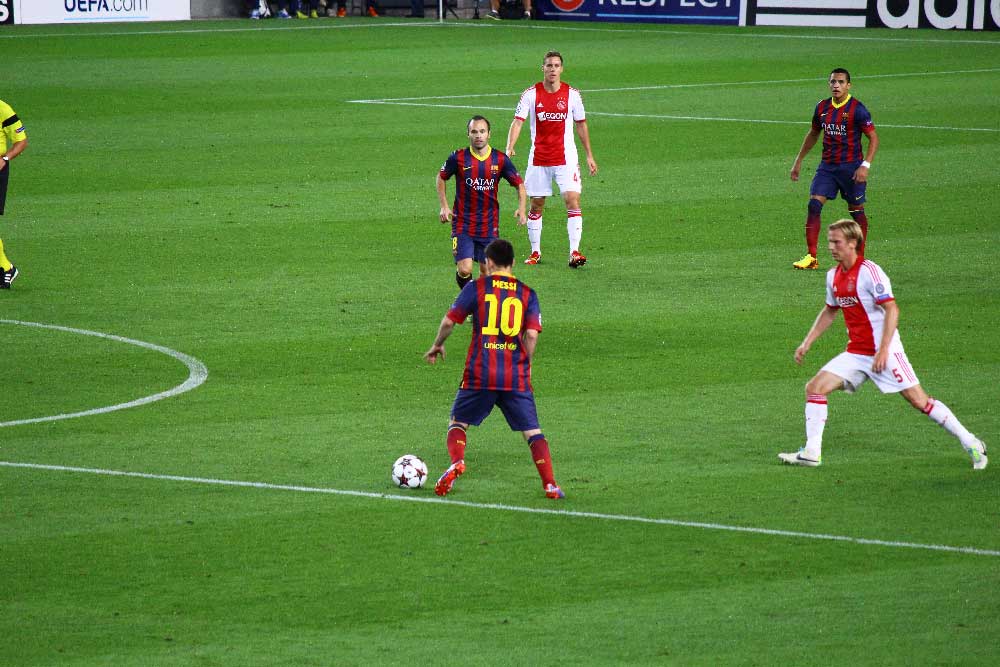
Following the Barcelona, Real Madrid and Atletico Madrid cases, Chelsea Football Club (Chelsea) were the latest high-profile club to be sanctioned by FIFA for alleged violations relating to Article 19 of the FIFA Regulations on the Status and Transfer of Players (FIFA RSTP) and the international transfers of minor players.
Inspired from the CAS procedure in the Chelsea case involving the transfer of minor football players, this paper addresses questions such as the appeal of a decision without grounds or the request provisional measures prior to the filing of the appeal brief

As every year, I prepared my 2025 compilation of notable international sports-related cases. This year included a number of major sporting events, such as the FIFA Club World Cup in the United States and the UEFA Women’s Euro 2025 in Switzerland, but these events did not give rise to many notable disputes decided by the Court of Arbitration for Sport (CAS). The year was nevertheless marked by several landmark rulings – primarily from the European Court of Human Rights (ECtHR) and the Court of Justice of the European Union (CJEU), as well as from the CAS and the Swiss Federal Supreme Court (SFT) – which are briefly presented below.
This year was rich in SFT findings regarding CAS’ jurisdiction. In two important judgments, the SFT clarified and reconfirmed the scope of the arbitration agreement in favour of the FIFA tribunal vis-à-vis state courts. Accordingly, FIFA’s jurisdiction under Art. 22 para. 1 (b) RSTP is default for international-dimension disputes but not exclusive, and the parties may validly opt-out or seize national courts for the specific category of labour-law disputes (see my notes on 4A_64/2025 and 4A_92/2025). The SFT also clafiried the admissibility threshold for review of the FIFA jurisdiction by the SFT, which must be raised during the CAS proceedings, even though it is not necessary to explicitly object at the outset of the FIFA proceedings (see my note on 4A_92/2025).
In another judgment, the SFT held that it is immaterial for the validity of the arbitration agreement that an agent lacked the required Swiss licence under the national laws: so long as the foreign seat of the agent is established, alleged breaches of Swiss employment-placement licensing rules cannot retroactively alter the international character of the relationship or invalidate an otherwise autonomous arbitration clause governed by Art. 178 PILA, nor render the dispute non-arbitrable under Art. 177 para. 1) PILA (see my note on 4A_616/2024).
In an interesting dispute related to the extension of the arbitration agreement to non-signatories due to alleged sporting succession, the SFT held that sporting succession is not recognized as a Swiss legal institution (see my note on 4A_188/2025): The fact that the SFT has found sporting succession to be in line with international public policy does not render it part of the Swiss legal order for jurisdictional purposes, limiting thus the effect of sporting succession – or other concepts of lex sportiva – when it comes to the interpretation of arbitration agreements under Art. 178 PILA. In another dispute, the SFT clarified the consequences of the distinction between admissibility and jurisdiction in multi-tier (FIFA & CAS) dispute resolution clauses: accordingly, when a case is rejected by FIFA as being time-bared, the parties cannot bring the claim to CAS and thus circumvent an agreed jurisdiction hierarchy by allowing time limits to lapse (see my note on 4A_230/2025).
With respect to the violation of public policy, the SFT reiterated on numerous occasions that it must be the outcome of the award – and not the panel’s reasoning – that violates public policy, showing the high admissibility threshold for such grievance (see e.g. my notes on 4A_616/2024, 4A_608/2024, and 4A_28/2025). In 2025, and prior to the ECHR Grand Chamber judgment in Semenya v. Switzerland issued in July 2025, the SFT still denied to apply directly the ECHR provisions and repeated that these guarantees fall within the restrictive scope of Art. 190 para. 2 (e) PILA (see my notes on 4A_682/2024 and 4A_544/2024). It is equally found inadmissible to reiterate due process grounds separately invoking Art. 6 ECHR (4A_474/2024). It is now settled federal case law that criminal law principles are not directly applicable in disciplinary proceedings (see my notes on 4A_682/2024 and 4A_544/2024; 4A_474/2024). Furthermore, the disregard of a contractual provision regarding liquidated damages is not violating public policy /pacta sunt servanda when the arbitral tribunal considers said provision as void (see my note on SFT 4A_638/2024).
Moreover, 2025 marked numerous alleged violations of the parties’ right to be heard, which were all dismissed by the SFT: accordingly, there is no such violation when the panel (only) implicitly considers and rejects raised arguments (see my notes on 4A_608/2024 and 4A_168/2025; on arguments regarding the reliability and authenticity of the LIMS evidence, see my note on4A_544/2024); objections to the weighing of testimony typically amount to inadmissible appellate criticism (see my note on 4A_28/2025). The CAS is further not obliged to highlight specific elements of the file relied upon so long as they were on record and discussed at the hearing (see my note on 4A_474/2024).
Finally, the SFT issued two interesting cases regarding requests for revision of CAS Awards under Art. 190a PILA: the first was filed by Russian figure skater Kamila Valieva and relied on an undisclosed expert report allegedly withheld by RUSADA and WADA during the CAS proceedings: the SFT dismissed the request considering that there was no procedural fraud and not a basis to reopen the CAS Award (see my note on 4A_654/2024). In the second, published in December 2025, the SFT admitted the request for revision in view of a final state court decision establishing forgery of a document linked to the outcome of the CAS award (see my note on 4A_268/2025).

The landmark judgment issued by the ECtHR Grand Chamber in Semenya v. Switzerland (see my note here) originates from the exclusion of Caster Semenya (the Athlete) from international women’s competitions under World Athletics’ DSD Regulations, upheld by the CAS in 2019 and by the SFT in 2020 (see also my earlier note on the CAS and SFT proceedings). In its final judgment, the Grand Chamber significantly narrowed the case’s scope, declining jurisdiction over the alleged substantive violations of Articles 8, 13 and 14 ECHR, but finding a violation of Article 6 ECHR, holding that the Athlete had been deprived of her right to a fair hearing due to insufficient judicial review by the SFT.
In essence, the Grand Chamber’s parallels, at a human-rights level, developments seen in Seraing one month later, though based on Article 6 ECHR rather than EU law. While reaffirming the legitimacy and systemic advantages of CAS arbitration, the ECtHR stressed that compulsory arbitration fundamentally alters the standard of judicial review where core human rights are at stake. In this context, the Grand Chamber held that the SFT should not have confined itself to its traditional, extremely narrow public-policy review under Article 190 para. 2 (e) PILA, but should instead have conducted a “particularly rigorous examination” of the CAS award.
Overall, the judgment left unresolved both the substantive legality of the DSD Regulations and the exact contours of such “particularly rigorous” standard imposed on the SFT, confining its intervention strictly to procedural guarantees. The ambiguity remains however critical: it seems highly doubtful that the SFT’s enhanced scrutiny will resemble an expanded arbitrariness test; what seems more likely is that such standard will be akin to a proportionality review of fundamental rights. Unlike Seraing, the judgment does not risk systemic fragmentation through parallel national proceedings, but it nonetheless calls the SFT to raise the bar of review of CAS awards in the specific category of compulsory, human-rights-sensitive cases. With the time limit to request a revision of the CAS Award having now elapsed, the SFT will not deal with the same case again but new challenges remain open, in particular following the reform, by World Athletics, of its eligibility framework imposing a genetic test for all its athletes as of September 2025. It will therefore be for the SFT to establish the contours of this “particularly rigorous examination”.
RFC Seraing SA v. FIFA, C-600/23, Judgment of 1 August 2025, ECLI:EU:C:2025:617 (Seraing Judgment)
The landmark ruling of RFC Seraing SA v. FIFA started with the FIFA’s 2015 ban on Third-Party Ownership (TPO). Following the sanction imposed on Belgian football club RFC Seraing (the Club) by the FIFA Disciplinary Committee, partially upheld by the CAS after an in-depth EU-law compatibility analysis, the case was confirmed by the SFT. Meanwhile, parallel proceedings before the Belgian courts led the Belgian highest instance (Cour de cassation) to refer questions to the CJEU on the extent of national-court review of CAS awards (see also my previous notes on the procedural history of the Seraing saga, the SFT judgment, and the AG Ćapeta Opinion).
In essence, the CJEU found that – consistently with its own case law and the ECHR – compulsory CAS arbitration is not per se incompatible with EU law, provided that effective judicial protection is ensured. Departing from the broader approach suggested in AG Ćapeta’s Opinion (see my note here), the CJEU limited mandatory national-court review to the hard core of EU public policy, namely EU competition law and fundamental freedoms, rather than all EU-law rights. Notwithstanding the numerous advantages of centralized sports arbitration, where such arbitration is imposed as a condition of participation in economic activity within the EU, national courts must be able to review CAS awards effectively, grant interim relief if necessary, and ensure compliance with Articles 19 para. 1 TEU and 47 of the Charter.
The CJEU’s stance regarding its authoritative interpretation of EU law is not new, nor is the existence of EU-public-policy review (already available via the NYC 1958). The novelty here lies rather in its depth and remedial consequences: EU courts may review the interpretation, legal classification, and consequences of EU-public-policy norms applied by CAS, albeit without reopening factual findings (i.e. not a de novo review). Interestingly, the CAS panel in the Seraing CAS Award (composed of three eminent EU-qualified CAS arbitrators) dedicated a large part of its analysis to the compatibility of the TPO ban with EU competition law and the fundamental freedoms and included several factual findings that will eventually bind the Belgian court (c.f. §106 of the Seraing CAS Award). Therefore, it seems that the parties’ choice of arbitrators with deep EU law knowledge (from among the CAS list of arbitrators), will be key in order to ensure that awards are resistant to subsequent national court review.
All in all, national rules conferring res judicata or probative effects on CAS awards must be set aside insofar as they undermine effective judicial protection under EU law. As explained in my note on the CJEU judgment, this produces a calibrated but real tension with arbitration finality, with limited practical reach but tangible risks of delay and fragmentation in the category of compulsory, EU-law-sensitive sports disputes.
In his Opinion issued just before Christmas (see my full note here), AG Spielmann considers that the principle of effective judicial protection under EU law requires that national courts be able to annul unlawful sporting sanctions and, where appropriate, grant interim relief. While EU law does not, as such, preclude disciplinary sanctions imposed by sports federations – provided they pursue legitimate objectives such as the integrity of competitions and comply with the requirements of transparency, objectivity, non-discrimination and proportionality – the absence of review powers at national level may infringe the right to effective judicial review.
Crucially, however, the AG’s conclusions depend on whether the judicial bodies established under Italian sports law qualify as a “court or tribunal” within the meaning of EU law. If that qualification were met, national legislation excluding further judicial review would not necessarily be incompatible with EU law. It is interesting to note that the assessment of that qualification (which is left to the referring court, § 72-113) draws heavily on the criteria developed under Article 6 para. 1 ECtHR in the Ali Riza v. Turkey EctHR Judgment (see also my note on the Ali Riza v. Turkey ECtHR Judgment here).

From the disciplinary cases issued in 2025, a notable case is the one of the former President of the Royal Spanish Football Federation Luis Rubiales, who appealed the FIFA disciplinary sanctions imposed for breaches of the FIFA Disciplinary Code and Code of Ethics arising from conduct at the 2023 FIFA Women’s World Cup medal ceremony. The CAS upheld FIFA’s assessment that the conduct constituted a serious violation of ethical principles and personal integrity, rejecting arguments based on consent, proportionality, and procedural irregularities. (CAS 2024/A/10384 – Luis Rubiales v. FIFA).
Another interesting CAS Award is the one of Laureano González against the sanction imposed by FIFA on the basis of his ethical responsibility as a federation president for financial governance failures and suspicious transactions. Here again, the CAS confirmed the FIFA decision and the accountability of presidents of member associations for financial conduct occurring during their mandate under the FIFA Code of Ethics, regardless of delegation to internal bodies (TAS 2023/A/9362 Laureano González v. FIFA).
The CAS heard and decided several noteworthy doping-related cases in 2025.
In weightlifting, the CAS Anti-Doping Division (CAS ADD) partially upheld the request by the International Weightlifting Federation (IWF) against Chinese weightlifter Lyu Xiaojun, whose out-of-competition test revealed recombinant erythropoietin (rEPO). The CAS ADD confirmed an ADRV under Art. 2.1 IWF ADR and imposed a four-year ineligibility period, backdating to the date of sample collection due to procedural delays not attributable to the athlete.
In wrestling, the CAS issued its award in the appeal of WADA and the International Wrestling Federation against the Georgian Anti-Doping Agency (GADA) & four Georgian athletes, finding that the sabotage theory retained by the appealed decision was unsupported, due to lack of factual investigation and contradicted by scientific evidence, imposing thus a four-year sanction for intentional use on the athletes (CAS 2024/A/10960, IWF v. G. Giorbelidze & GADA).
In football, the CAS issued its award in the appeal filed by Paul Pogba against a four-year ban imposed for an ADRV following a positive test for DHEA (a prohibited non-specified substance). CAS partially upheld the appeal and reduced the sanction to 18 months for non-intentional ingestion, finding no performance-enhancing evidence and inadvertent consumption (CAS 2024/A/10443, Paul Pogba v. NADO Italia).
In cycling, Miguel Ángel López appealed his four-year sanction due to possession and use of prohibited substance menotropin to the CAS. The appealed decision was fully confirmed by the CAS which concluded that the athlete possessed and used Menotropin during the relevant period, with the ineligibility running from 25 July 2023.
In tennis, the CAS issued its award in the appeal of International Tennis Integrity Agency (ITIA) against a decision finding that Tara Moore had no fault or negligence after she tested positive for prohibited substances boldenone and nandrolone at the 2022 Bogotá tournament, where she argued meat contamination in Colombia. The CAS upheld ITIA’s appeal and imposed a four-year period of ineligibility finding that she had failed to prove the nandrolone concentration was consistent with contaminated meat ingestion and therefore did not establish that the ADRV was not intentional. Moore’s cross-appeal was declared inadmissible.
Finally, the biggest doping-related case of the year did not result – as many would expect – in a CAS award: Tennis player Jannik Sinner, after testing positive for the banned steroid clostebol and being cleared of fault and negligence by an independent tribunal, had this decision appealed by WADA to the CAS, ultimately resulting in a negotiated three-month suspension agreed in early 2025.

2025 also marked several eligibility cases, not least due to geopolitical tensions but also due to genetic testing: With respect to the Russian – and Belarussian athletes’ exclusion from international competitions, the CAS issued its award (operative part only) in the appeal of the Russian Luge Federation together with 6 athletes against the international Luge Federation (FIL), challenging their refusal to implement a programme allowing Russians to compete as Individual Neutral Athletes (AIN), impacting OWG Milano/Cortina 2026 qualification. CAS held the blanket prohibition on AIN participation was disproportionate to the stated safety aim and therefore set aside that prohibition, but maintained the exclusion of RLF athletes from FIL competitions; the athletes’ request for immediate participation was dismissed.
Moreover, the Russian Ski Association (RSF) and 12 Russian athletes and para-athletes together with the Russian Paralympic Committee appealed against the FIS Council resolution “not to facilitate” Russian/Belarusian participation as AINs in FIS qualification events for OWG/Paralympics 2026: CAS partially upheld both appeals (operative part only), ruling the resolution amounted to a blanket exclusion by nationality inconsistent with FIS Statutes (including political neutrality/non-discrimination protections), so athletes meeting IOC AIN criteria must be allowed into FIS qualification events. What is more, Russian para-athletes were allowed to participate under the same conditions as other para-athletes absent an IPC AIN framework, while broader requests were dismissed as within FIS remit.
On the other side, speed skater Daria Kachanova unsuccessfully appealed against the ISU’s refusal to include her on the list of AIN-eligible athletes for OWG 2026 qualifiers, reportedly based on affiliation with CSKA Moscow (linked to the Russian Ministry of Defence).
In October 2025, CAS rejected urgent requests by the Israel Gymnastics Federation (and, in a parallel appeal, six qualified gymnasts) seeking provisional measures to secure Israeli participation in the 2025 World Artistic Gymnastics Championships after Indonesia denied visas. The CAS held that the conditions for interim relief were not met. One appeal was also terminated for lack of jurisdiction, while the other remained pending on the merits (most likely expected in 2026).
Another eligibility decision that is still pending and is expected in 2026 is the one of Olympic champion Imane Khelif, who appealed to CAS against World Boxing’s decision conditioning her eligibility on mandatory genetic sex testing. She sought provisional measures to compete without undergoing the test, but CAS denied the request, leaving the rule in force pending the arbitration proceedings.
The CAS also decided several cases relating to multi-club ownership. In FK DAC 1904 v. UEFA, CAS dismissed FK DAC 1904’s appeal against its removal from the 2025/26 UEFA Conference League, holding that UEFA lawfully amended the assessment date and that DAC breached the multi-club ownership rules because the same individual exercised decisive influence through senior management roles at both clubs.
An important case that was heard this summer on an expedited basis by the CAS was the appeal filed by Crystal Palace FC against the decision rendered by UEFA, excluding the club from the 2025/26 UEFA Europa League. CAS dismissed the appeal, ruling that the club was non-compliant with UEFA’s multi-club ownership rules at the fixed assessment date and that UEFA had no discretion to accept governance changes implemented after the regulatory deadline.
Another interesting case arose from the Club World Cup 2025 multi-club ownership rules (Art. 10.1). The CAS, after an expedited procedure and a hearing in May 2025, dismissed consolidated appeals by Club León and CF Pachuca against FIFA’s decision, confirming that governance and trust arrangements were insufficient to remove common control and upholding León’s exclusion while Pachuca remained qualified. CAS also rejected Liga Deportiva Alajuelense’s separate appeal seeking admission in their place (operative decisions with reasons to follow).

In September 2025, World Athletics enacted its reforms on the DSD and Female Eligibility regulations, replacing old eligibility rules with a unified framework, requiring athletes wishing to compete in the female category to undergo a one-time SRY gene test to confirm biological sex and establishes eligibility criteria (e.g., restrictions on testosterone exposure after male gender-affirming treatment). In 2026, the federation will enforce these new eligibility rules across its major competitions through an expanded testing schedule (i.e. World Athletics Series, Diamond League, and other leading events). This will likely generate new disputes and challenges concerning privacy, discrimination and proportionality of the regulatory measures.
Also, and while the IOC 2021 framework on Fairness, Inclusion and Non-Discrimination remains in force, the IOC aims to come up with a new policy on eligibility in female sports in early 2026.
Furthermore, in 2025 FIFA continued its FIFA RSTP revision process following the Diarra CJEU judgment following extensive consultation with various stakeholders. In 2026, FIFA will continue and likely proceed to regulatory amendments, softening the effects of joint and several liability and narrowing sporting sanctions for unilateral contractual termination without just cause. Overall, these regulatory developments will further unfold in 2026 and show that international federations are moving towards smoother sanctions and eligibility rules, embedded proportionality tests, in anticipation of review by EU but also national courts and the CAS. With the Milano-Cortina Winter Olympic Games 2026, the FIFA World Cup and the Glasgow Commonwealth Games on the horizon, 2026 is set to be a busy year for sports governance, eligibility and selection – and, inevitably, for sports disputes.

2024 was a year rich in major sporting events, including the Summer Olympic and Paralympic Games in Paris (from 26 July 2024 to 11 August 2024, “Paris 2024 Olympics”). The Paris 2024 Olympics generated numerous interesting disputes that were decided by the CAS Ad Hoc Division present on-site, including the well-publicized Jordan Chiles dispute that is still pending before the Swiss Federal Tribunal (SFT) in Switzerland.
Paris 2024 Olympics
In a nutshell, the CAS ad hoc Panels dismissed four applications for being filed outside of the 10-day jurisdictional window in which the CAS ad hoc Division has jurisdiction over a dispute related to the Olympics. In four other cases, the CAS ad hoc Panels considered that the disputes fell within the “field of play doctrine”, which would only allow them to review the case for very limited grounds. In most cases, the Panels examined the proportionality, the reasonableness or the well-founded of the challenged decision, and upheld four applications after interpretation of the applicable regulations (you can also see my overview of all cases heard by the CAS ad hoc Division during the Paris 2024 Olympics here).
UEFA Euro 2024
Another major event in 2024 was the UEFA Euro 2024 in Germany (from 14 June to 14 July 2024), which engendered some disciplinary cases for the UEFA CEDB, the UEFA Appeals Body (and for the first time before the CAS ad hoc Division for UEFA Euro 2024). Apart from the sanction of the Turkish Player Merih Demiral for two matches, Spanish Players Rodrigo Hernández Cascante and Álvaro Morata were also suspended for the conduct that occurred during the public presentation of the 2024 UEFA European Championship trophy in Madrid on 15 July 2024, all of them for violating the basic rules of decent conduct and bringing the sport into disrepute. Moreover, Jude Bellingham was fined with EUR 30,000 and suspended for one match (on a probationary period of one year) for violating the basic rules of decent conduct under the UEFA Disciplinary Regulations.
Doping-related CAS awards published in 2024
Many of the mediatized CAS awards of 2024 related to doping (or re-ranking of results following disqualification).
In January 2024 the CAS issued its award in the well-known case of Kamila Valieva that started during the Winter Olympic Games Beijing 2022 (with an unsuccessful request for provisional suspension, see my note here) and continued with this appeal by RUSADA, the ISU and WADA, in February 2023. The Panel decided that Ms. Valieva could not meet her burden to establish that the origin of the banned substance found in her sample (Trimetazidine), concluding that violation of the anti-doping rule violation was intentional by the athlete and imposed a four-year sanction, with a backdating of the starting point of the ineligibility period to the date of the positive doping test. The Panel decided that her status as a “Protected Person” (a minor) under the current WADA Code could not justify a different treatment compared to other athletes and as such, the CAS Award was unsuccessfully challenged by the athlete before the SFT (see my note here).
In the aftermath of Kamila Valieva’s disqualification of results since December 2021, the results of the Team Event in figure skating at the Olympic Winter Games Beijing 2022 were also disqualified by an ISU decision in February 2024. This resulted, in July 2024, in an unsuccessful appeal that was filed by the ROC, the Figure Skating Federation of Russia and Russian skaters. At the same time, the Canadian team and NOC also sought to adjust the results in order to be ranked third and awarded the Bronze medal following the re-ranking by the ISU. This case was equally dismissedin August 2024, as the Panel held that it did not have the possibility under the ISU Rules to re-allocate points in favour of the Canadian team following the retroactive disqualification of Kamila Valieva.
In March 2024, the CAS issued the operative part of its decision (here is the full award) in the highly publicized case of Romanian tennis player Simona Halep, who was sanctioned for two separate charges related to anti-doping rule violations by the International Tennis Integrity Agency. While the ITF Independent Tribunal had initially imposed a four-year ineligibility period on the athlete, the CAS reduced the sanction in appeal to nine months. In the view of the Panel, the prohibited substance found in the athlete’s sample (Roxadustat) was the result of a contaminated supplement and such violation was unintentional, and she bore no significant fault or negligence. With respect to the second charge (violation of the Athlete’s Biological Passport), the Panel considered, based on its full power of review and the applicable standard of proof, that the ITIA could not establish an anti-doping rule violation.
In June 2024, the CAS confirmed the first-instance decisions rendered by the World Athletics Disciplinary Tribunal clearing athlete Norah Jeruto (from alleged abnormalities in her Athlete Biological Passport, ABP) and Nigerian athlete Tobi Amusan, finding that he had not violated the applicable anti-doping regulations for alleged whereabouts failures within a 12-month period.
Shortly afterwards, again in athletics, the CAS imposed a two-year period of ineligibility on Romanian athlete Florentina Iusco, reversing the decision of the Romanian Anti-Doping Agency that had initially imposed a reprimand on the athlete for the presence of specified substance furosemide in her sample. The CAS found that the athlete had failed to exercise her duty of care that would otherwise justify a lower sanction.
In July 2024, the CAS reversed the ITF Independent Tribunal decision on tennis player Mikael Ymer and imposed a18-month ineligibility period for three whereabouts failures within a 12-month period.
In August 2024, after a mediatized public hearing, the CAS imposed a four-year ban on Croatian football player Mario Vušković, increasing the initial two-year sanction imposed by the first-instance decision of the German Football Association for the presence of the prohibited, non-specified substance recombinant erythropoietin (rEPO) in an out-of-competition doping control.
In September 2024, Russian athlete Tatyana Tomashova was sanctioned by CAS (which acted as a first-instance tribunal in this case in lieu of the suspended Russian Athletics Federation) for anti-doping rule violations, following re-tests of various doping controls form 2012 that revealed the presence of prohibited anabolic steroids in her sample. To the extent that this was the athlete’s second violation, the Sole Arbitrator imposed a ten-year ineligibility periodstarting from the date of the issuance of the award.
In October 2024, the CAS issued an operative part of its award reducing the initial four-year sanction imposed on football player Paul Pogba to 18 months. The player was initially sanctioned for the presence of DHEA, a “non-endogenous testosterone metabolite” under the WADA Rules. According to the CAS press release, the Panel considered the player’s ingestion of DHEA as non-intentional due to a supplement prescribed by a medical doctor in Florida.
Membership and eligibility-related issues
Beyond the doping-related cases, the CAS has issued some interesting decisions in membership and eligibility-related issues.
In February 2024, the CAS issued its award in the appeal filed by the Russian Olympic Committee against the IOC Executive Board decision to suspend its membership, due to the ROC decision to include as members regional sports organisations that are currently under the authority of the NOC of Ukraine. In its award, the Panel concluded that the appealed decision did not apply double standards, nor did it breach the principles of legality, equality, predictability or proportionality. In particular, the Panel found the length of the suspension (“until further notice”) to be a less intrusive measure than until the dispute between Russia and Ukraine is terminated, as the suspension could be lifted prior to that, if this was justified by future circumstances.
In April 2024, the CAS dismissed the appeal filed by the International Boxing Association (IBA) against the IOC Executive Board Decision to withdraw its recognition due to the IBA’s failure to address concerns related to its governance and financial stability, keeping however
In June 2024, the CAS issued the award dismissing the request of the US transgender Swimmer Lia Thomas that was initiated in January 2024. Lia Thomas had challenged certain parts of the World Aquatics’ Policy on the Eligibility for the Men’s and Women’s Competition Categories of 24 March 2023 and its associated Operational Requirements, considering them as invalid and unlawful as they go against the Olympic Charter, World Aquatics Constitution, and Swiss law including the European Convention on Human Rights and the Convention on the Elimination of All Forms of Discrimination against Women. The Panel dismissed the athlete’s request not after review of the legality of the disputed regulations but after bifurcation of the procedure, accepting the preliminary objection by World Aquatics. The Panel concluded that the athlete lacked standing to challenge the regulations under Swiss Law, as she was not registered to take part in World Aquatics international competitions.
Alongside the aforementioned doping-related cases and the football-related awards issued in 2024 in labour law and transfer-related disputes (see also the review of football cases challenged before the SFT below), the CAS has also dealt with the UEFA Club Licensing & Financial Fairplay Regulations (UEFA CL & FFP). In September 2024, the CAS issued an award confirming the UEFA CFCB Decision to sanction FC Barcelona with a fine of EUR 500’000 for breach of its reporting requirements under the UEFA CL & FFP for the 2022/23 season. The club was found to have wrongly reported, in the financial year 2022, profits on disposal of intangible assets as “relevant income”.
Selected Swiss Federal Supreme Court Judgments from 2024
In 2024, the Swiss Federal Supreme Court (SFT) issued, once again, numerous judgments in motions against awards rendered by the Court of Arbitration for Sport (CAS). As occurs each year, most of the pleas involve grievances of due process and violation of the parties’ right to be heard, but also violation of public policy.
The SFT did not uphold any of the challenges in 2024, reiterating the high admissibility threshold, in particular related to the ‘effet de surprise’ (see my note on the former President of the European Weightlifting Federation Hasan Akkus in 4A_112/2024). Generally, the SFT confirmed its view that CAS Panels generally enjoy broad powers in the assessment of the evidence under Art. R44.1 (see my note on 4A_598/2023) and their power of review under Art. R57 CAS Code (see my note on 4A_232/2024). Moreover, pleas of appellatory nature are generally inadmissible (see e.g. my note onthe challenge of the International Boxing Association against the IOC Decision to withdraw its recognition, 4A_264/2024).Importantly, the parties have an obligation to raise any procedural irregularities / violations of the right to be heard in an explicit and unequivocal manner as soon as they arise, all the more after the 2021 modification of Art. 182 paragraph 2 of the Swiss Private International Law Act (see my note on 4A_598/2023). Interestingly, the SFT held that the right to be heard does not include as such a right to cross-examine a witness who filed written statements (see my note on 4A_600/2023).
Furthermore, the SFT re-confirmed its very strict view of violation of public policy but also the notion of ‘abuse of rights’ in employment claims based on mandatory labour law in football (see my note on 4A_134/2024). There is, in principle, no violation of public policy in case of the filing of the statement of appeal by email only (see my note on 4A_346/2024) or in case of delays to issue the CAS Award, to the extent that they can be justified by the complexity of the proceedings and the parties’ requests (see my note on a case involving a Russian wrester 4A_442/2023). CAS Panels generally enjoy wide discretion in assessing and determining the amount of a contractual penalty if the latter is found to be excessive (see my note on 4A_456/2023), but also in reviewing disciplinary sanctions in sports proceedings as found in the Hasan Akkus judgment (see my note on 4A_ 504/2023). What is more, requests for joinder and intervention under the CAS Code are not ‘essential rules’ falling within the scope of public policy (see e.g., my note on the request of a Peruvian football club to join disciplinary proceedings before the CAS in 4A_154/2023).
The SFT also confirmed its view that violations of the European Convention of Human Rights (the Convention) cannot be directly invoked pending the Caster Semenya case before the ECHR Grand Chamber (see my note on 4A_448/2023). Moreover, there is no public policy violation if a panel imposes doping sanction on a minor athlete, to the extent that a different treatment depending on age would endanger the fight against doping (see the analysis in 4A_564/2023 but also in the widely known Valieva judgment 4A_136/2024).
In terms of jurisdiction, the SFT emphasized that CAS jurisdiction and arbitrability cannot be invoked in bad faith, notably, if said jurisdiction was accepted in previous proceedings (see in particular the Valieva judgment 4A_136/2024and my note on the proceedings before the CAS Ad Hoc Division). Finally, the SFT clarified the interpretation principles of jurisdiction clauses in international football disputes, especially where FIFA’s regulations allow parties to opt out of FIFA and CAS jurisdiction for labor law issues (see my note on 4A_430/2023).

Regulatory developments and what to expect in 2025
In 2024, the most important case that shook the football regulatory world was the Decision issued by the Court of Justice of the European Union (ECJ) on the Diarra case. The judgment ruled on FIFA’s transfer rules founding some aspects related to financial compensation and sporting sanctions to be incompatible with EU law, in particular Articles 45 (freedom of movement) and 101 (competition law) of the Treaty on the Functioning of the European Union (TFEU). According to the ECJ, rules on joint liability of players and new clubs for compensation along with automatic sporting sanctions are disproportionate and have a dissuading effect on clubs from recruiting players across Member States, restricting cross-border competition. Even though the protection of interclub football competitions is a legitimate objective and notwithstanding the specificities of football, the mechanisms used should be proportionate and with respect to the EU law principles.
The case will further unfold in 2025, as FIFA swiftly reacted to the ECJ judgment by opening “global dialogue on article 17 of the FIFA Regulations on the Status and Transfer of Players” with a view to amending Article 17 FIFA RSTP; most importantly, through an official letter sent by the FIFA Secretary General, FIFA informed all national associations that it would suspend, with immediate effect, all pending disciplinary cases against players, coaches and clubs related to the enforcement of financial entitlements based, in particular, on Article 17 FIFA RSTP. This suspension at the FIFA level will likely impact proceedings related to the aforementioned issues that are currently pending before the CAS in appeal against decisions already rendered by the FIFA Tribunal and the FIFA Disciplinary Committee. On 22 December 2024, FIFA adopted an interim regulatory framework (along with detailed explanatory notes), pending the conclusion of the new RSTP.
In 2025, the Grand Chamber of the European Court of Human Rights (ECHR) is expected to issue its final judgment following the hearing in the case of Semenya v. Switzerland that took place in Strasbourg on 15 May 2024. South African Athlete Caster Semenya had unsuccessfully challenged (before CAS and the SFT) the World Athletics Eligibility Regulations that required her to decrease her natural testosterone levels in order to be eligible to participate in international competitions in the female category. However, in 2023 the ECHR held, by majority, that there had been a violation of Articles 14, 8 and 13 of the Convention and the case was referred to the ECHR Grand Chamber, upon request of the Swiss Government and with the participation of several third parties.
In 2025, the CAS will also issue its decision in the appeal filed by the ITIA against the ITIA Independent Tribunal first-instance decision to clear Italian tennis player Jannik Sinner following the presence of prohibited and non-specified substance steroid Clostebol in his sample. The decision under appeal before the CAS found that the prohibited substance had been found by way of cross-contamination during a physiotherapy session and that the player had exercised “utmost caution” to avoid a positive test result.
Finally, the SFT is also expected to issue its decision in the requests for revision / to set aside the CAS award issued by the CAS ad hoc Division in the cases of US gymnast Jordan Chiles and Romanian gymnast Sabrina Maneca-Voinea. Ms. Chiles (who was an interested party and not a respondent in these proceedings) was initially awarded the Olympic bronze medal in the women’s gymnastics floor exercise final at the Paris 2024 Olympics after her coach’s inquiry led to an increase of her final score. However, as seen above, the CAS ad hoc Panel determined that the inquiry was submitted four seconds after the one-minute time limit, rendering it invalid, and reinstated the results. In her application, Jordan Chiles asserted a violation of her right to be heard due to the Panel’s disregard of evidence that the inquiry was made within the applicable time limit. Jordan Chiles also contends that the Panel was improperly constituted because the Panel Chair had a conflict of interest due to his ongoing legal relationship with Romania, which was not disclosed to Ms. Chiles during the entire CAS proceedings. The case is expected to rule on a number of interesting procedural and substantive questions, including the obligation of interested parties to be informed on disclosures regarding conflicts of interests in the same way as ‘formal’ parties.

Several major sporting events took place in 2023, including the Womens World Cup in Australia in the summer of 2023, that ended with a widely publicised case of the “Rubiales kiss” and a FIFA Disciplinary Committee decision suspending the President of the Spanish Football Federation for three years (the decision is currently under appeal). The Asian Games also took place in September 2023 in China but did not generate any disputes for the CAS Ad Hoc Division present on site during the games. July was the busiest month in terms of important international sports law judgments rendered, with the most important being the European Court of Human Rights (ECtHR) judgment in the application of the South African athlete Caster Semenya against Switzerland. December was an equally crucial month for European sports law, as the CJEU rendered its judgment in the Super League case, in the International Skating Union (ISU) case and the Antwerp case on the “home-grown players rule”.
Swiss Federal Tribunal judgments in motions against CAS Awards
In 2023, the Swiss Federal Supreme Court (SFT) issued several noteworthy judgments in motions against awards rendered by the Court of Arbitration for Sport (CAS). In most of them, it reiterated the high admissibility threshold. Accordingly, pleas of appellatory nature are generally inadmissible, but also the parties have an obligation to raise any procedural irregularities / violations of the right to be heard in an explicit and unequivocal manner as soon as they arise.
Furthermore, the SFT re-confirmed its very strict view of violation of public policy. There is, in principle, no violation of public policy in case of the late uploading of a statement of appeal on the e-filing platform, the lack of online hearing of (protected) witnesses, several extensions of the time limit to issue the arbitral award, the non-transmission of the full decision to a complainant in sports disciplinary proceedings, or in case of disciplinary sanctions imposed parallelly at the national – and the international level. The SFT also reiterated its view that violations of the European Convention of Human Rights (the Convention) cannot be directly invoked but only through the limited scope of public policy and the Swiss Constitution; it will be interesting to see how this view will evolve after the ECHR landmark judgment in Caster Semenya (this case is still pending before the ECHR Grand Chamber).
In terms of jurisdiction, the SFT held that CAS jurisdiction could not go beyond the jurisdiction of the previous instance, that the FIFA tribunal (like the CAS Anti-Doping Division) is not a “true arbitral tribunal” and as such is not bound by the pertinent provisions of the Swiss Code on Civil Procedure and that the FIFA Player Status Committee (PSC) ruling on atransfer agreement is not bound to decide on (the unrelated) set-off against a tort claim. The SFT further held that the question of the parties’ legal interest falls outside the scope of ne ultra /infra petita.
With respect to the irregular constitution of the arbitral tribunal, the SFT reiterated that there is no analogy between barristers belonging to the same Chambers (who are all independent and thus not partners) and Swiss lawyers belonging to the same law firm. Therefore, in the absence of additional criteria, such connection cannot on its own establish bias or lack of independence of arbitrators. Inversely, the SFT reinforced its view on the parties’ and the parties’ counsel duty of curiosity, which is clearly violated when they fail to examine notorious facts related to the appointed arbitrators in a timely manner; at the same time, the appointed arbitrators are not obliged to disclose publicly available -and easily discoverable- information.

Selected CAS Awards rendered in 2023
In February 2023, the CAS issued its decision in the appeal filed by the Haitian Football Federation (HFF) President Yves-Jean Bart against a decision of the FIFA Ethics Commission sanctioning him for several violations of the FIFA Code of Ethics for allegations of sexual abuse of members of the female technical team of the HFF. The CAS annulled the FIFA decision holding that there was insufficient evidence and a lack of coherence or credibility in the witness testimony by the alleged victims during the hearing. The decision was unsuccessfully appealed to the SFT.
In March, however, another CAS panel confirmed the life ban imposed by FIFA on the former Haitian Vice-President of the HFF Rosnick Grant for violations of the FIFA Ethics Code, including acts of abuse, sexual abuse, acts of threat and coercion of female arbitrators. Unlike the previous case, the panel in this case found the testimony of a victim credible, precise and coherent. In both cases, the hearing of protected witnesses was a crucial one and led to the CAS recently publishing its “Guidelines for the hearing of vulnerable witnesses and testifying parties in CAS Procedures (December 2023)”.
In March 2023, the CAS partially upheld the appeal of the Ukrainian gymnast Oleg Verniaiev against a decision issued by GEF Disciplinary Commission and reduced the four-year suspension for the presence of Meldonium in his sample to two years. In July 2023, the CAS issued its award in the case of the Swedish tennis player Mikael Ymer, in an appeal filed by the ITF against the decision of the ITF Independent Tribunal that had exonerated the player for whereabouts failures. In appeal, the CAS imposed an 18-month ineligibility period on the player for three whereabouts failures within a 12-month period. Following the CAS award, the player decided to retire from professional tennis.
In July 2023, the CAS issued an award CAS 2023/O/9370 on the legality of FIFA’s Agents Regulations (FFAR), notwithstanding -or rather amid – the pending challenges before state courts in several European countries but also the expected preliminary ruling by the Court of Justice of the European Union (CJEU). In the arbitration proceedings between the Professional Football Agents Association (PROFAA) and FIFA, the CAS Panel confirmed the legality of FFAR and dismissed all claims filed by PROFAA. In essence, the Panel found that Article 15 FFAR (imposing a cap on agents’ fees) does not contravene EU competition law in the sense of Articles 101- 102 of the Treaty on the Functioning of the European Union (TFEU). In the Panel’s opinion, FIFA is authorized to regulate football agents to the extent that the latter directly engage in the core aspects of the football system. It held that whether imposing a service cap leads to FIFA acting as an “association of undertakings” must be assessed under the Wouters / Meca-Medina test.
Interestingly, the CAS found that there was insufficient evidence filed by the claimant to establish abuse of a dominant position and concluded that Article 15 (2) FFAR pursues several legitimate objectives (e.g. fighting contractual instability, conflicts of interest etc.) and any restrictive effects are proportionate to achieve the legitimate objectives sought. The views of the CAS panel have however not been endorsed by other courts: for example, the Madrid Commercial Court, the Dortmund Regional Court or the Mainz Regional Court which referred several questions to the CJEU. The UK FA Rule K Tribunal has already rendered an award on 30 November 2023 finding that an implementation of the fee cap and other rules would infringe the Competition Act 1998.
In July 2023 the CAS also rendered another noteworthy decision in the football transfer of the Senegalese player Pape Alassane Gueye to the French football club Olympique de Marseille from Watford Association FC Ltd. The CAS confirmed the FIFA DRC decision that the player had breached his employment contract with Watford FC and the amount of compensation for breach but annulled the four-month ban of ineligibility on the player and the two registration periods ban on Olympique de Marseille.
One of the most important cases of 2023 was undeniably the ECtHR judgment in the matter of South-African, 3-time Olympic champion Caster Semenya. The athlete initially contested the validity of the World Athletics regulations regarding the participation in competitions of Athletes with Differences of Sex Development (DSD Regulations) before the CAS in 2019, which confirmed the validity of said regulations. The SFT subsequently confirmed the CAS award, repeating its long-standing position, whereby a party cannot directly invoke violations of the Convention but only through the very limited scope of public policy and the Swiss Constitution.
However, Semenya filed an application before the ECtHR which essentially found that Switzerland had violated Article 14 in conjunction with Article 8 of the Convention (prohibition of discrimination and respect of private life) but also Article 13 (right to an effective remedy). The ECtHR held that Switzerland failed to provide sufficient institutional and procedural safeguards to protect the athlete from discrimination and exceeded its margin of appreciation (which is narrow for aspects linked to the identity of the individual concerned). In summary, any justification for the discriminatory character of the DSD Regulations on grounds of sex and sexual characteristics required “very weighty reasons” which were not given in the present case.
Interestingly, the Court admitted jurisdiction irrespective of the fact that the athlete was South African and World Athletics is based in Monaco, as long as the review of the CAS award was made by the SFT. As the judgment included a strong dissent (four to three dissenting judges), the request for referral to the Grand Chamber was admitted and the case is still pending.
Beyond the practical effect of the judgment on federations’ future rulemaking and sanctions , it will be particularly interesting to see if the Grand Chamber will confirm the expanded duty of review of CAS awards by the SFT. If confirmed, the SFT would find itself obliged not only to control the compatibility of CAS awards with ordre public but also review the assessment made by the CAS in similar cases. This could have far-reaching consequences for both the CAS and the SFT review and lead to a shift of the long-standing SFT jurisprudence.
Regulatory changes in 2023

In February 2023, the ICAS enacted new guidelines on legal aid for football-related matters, the Football Legal Aid Fund (FLAF), which is financed directly by FIFA and is available to both natural persons and, exceptionally also to football clubs in a difficult financial situation (excluding those under judicial administration due to insolvency or bankruptcy). Such legal aid fund exists in parallel with the ICAS legal aid fund for all other Olympic sports.
In July 2023, the ICAS published its Annual Report and Financial Statements for 2022, which contains important information on the ICAS and the various CAS divisions but also statistics on the procedures. In December 2023, the ICAS published its “Guidelines for the hearing of vulnerable witnesses and testifying parties in CAS Procedures (December 2023)”.
Furthermore, FIFA enacted the FIFA Agents Regulations (FFAR) in October 2023 but temporarily suspended numerous important provisions on 30 December 2023 following the preliminary injunction by the District Court of Dortmund in Germany in the procedure LG Dortmund, 8 O 1/23 (Kart).
What to expect in 2024
2024 will be a year rich in major sporting events, including the Summer Olympic and Paralympic Games in Paris (from 26 July 2024 to 11 August 2024) and the UEFA Euro 2024 in Germany (from 14 June to 14 July 2024). Both events will likely generate sports-related disputes prior, during and after their termination.
In terms of IOC governance, in June 2023, the CAS dismissed the urgent request for a stay filed by the International Boxing Association (IBA) of the decision rendered by the Executive Board of the International Olympic Committee (IOC), which withdrew the IOC’s recognition of IBA according to Rule 3.7 of the Olympic Charter. The IBA has also filed an appeal to the CAS seeking to annul the decision to recommend the withdrawal of the IOC and a decision should be expected in the coming year.
Another important decision expected in 2024 relates to the appeal of the Russian Olympic Committee (ROC) against the decision of the IOC EB to suspend the former following breaches of the Olympic Charter (namely ROC’s decision to include as its members regional sports organizations which are attached to the NOC of Ukraine).
In terms of doping-related cases, the Romanian tennis player and multiple ATP champion Simona Halep has appealed to the CAS her four-year ineligibility period imposed by the ITF Independent Panel, whereas the award in the case of the Russian figure skater Kamila Valieva is also expected in 2024.
There are also other important proceedings pending before the CAS related to compliance with the WADA Code, involving the Russian Anti-Doping Agency (RUSADA) and the South African Institute for Drug-Free Sport (SAIDS): following a decision by the WADA Executive Committee in September 2023 to declare RUSADA and SAIDS non-compliant with the WADA Code, both agencies have disputed their non-compliance and the matters were submitted to the CAS Ordinary Arbitration Division for a binding decision.
Last but not least, shortly before 2023 came to a close, the CJEU Super League judgment found that certain FIFA and UEFA rules requiring prior approval of new interclub football projects and giving them exclusive control over the commercial exploitation of rights were incompatible with the EU rules on competition and free movement of services. As this was only a preliminary ruling by the CJEU, the Madrid commercial court will be the ultimate arbiter of determining whether the rules are justified, among others by benefitting different stakeholders in football through a solidarity redistribution of the profits generated by media rights. Similarly, following the CJEU judgment on the “home-grown players” rules, it will be for the First Instance Brussels Court to determine whether the Belgian football federation’s rules pursue a legitimate objective by encouraging the recruitment and training of young professional players and are proportionate and necessary for the purpose sought. Finally, as seen above, the FIFA FFAR have triggered numerous legal challenges across several European countries, which are still pending.
Note: this compilation was first published in LawInSport. For a more detailed review of the SFT judgments rendered in 2023, you can see my “Compilation of Swiss Federal Tribunal judgments in motions against CAS Awards rendered in 2023” and my notes available on www.sportlegis.com and www.lawinsport.com.

2022 marked an exciting year for international sporting events – and ensuing disputes: it started before the Beijing 2022 Winter Olympics and Paralympics in February, which led to a number of qualification and selection cases before the CAS Ad Hoc Division, and particularly the decision to confirm the lifting of the provisional suspension of the 15-year-old prodigy figure skater Kamila Valieva. This case is set to continue in 2023, since WADA filed an appeal to the CAS as RUSADA failed to issue a decision within the time limit set by WADA.
The war in Ukraine also led to the exclusion of the Football Union of Russia from FIFA and UEFA competitions, leading to a dismissed request for provisional measures before the CAS in March 2022 and a final award in July 2022. In essence, the Panel found that the FIFA / UEFA decision to prevent Russian teams and clubs from participating in their competitions were within their power of discretion under the applicable regulations.
The year ended with the FIFA World Cup in Qatar, which did not register any disputes before the CAS Ad Hoc Division that was established for the tournament and had its own CAS Ad Hoc arbitration rules. There was, however, an dispute shortly before the World Cup regarding the eligibility of the Ecuadorian player Byron Castillo to participate in the qualifying matches of the tournament with the Ecuadorian Football Federation (FEF): while the CAS found that this was not an eligibility case under Article 22 FIFA Disciplinary Code (the Player was eligible to participate in the qualifying round under national laws that determine nationality), there was a violation of Article 21 by the FEF since it used falsified information in the Player’s passport (particularly the place of birth, which was in Colombia). The Panel therefore only sanctioned the federation with a 3-point deduction in the next preliminary competition to the FIFA World Cup and a fine.
Doping-related judgments
In February 2022 the SFT issued its final judgment on the motion to set aside the (second) CAS Award in the widely covered Sun Yang judgment. The Chinese swimmer, who destroyed his sample with a hammer during a doping control, was sanctioned with a 4-year and 3 month ineligibility period from the second CAS panel, following the annulment of the first CAS Award in the end of 2020. The second CAS Award was confirmed by the SFT, which dismissed all pleas raised by the athlete and repeated that the guarantees of the European Convention of Human Rights (ECHR) and the Swiss Constitution cannot be invoked directly unless it could establish a violation of the grounds of Art. 190 (2) PILA. Moreover, the SFT confirmed that there was not an obligation for a double degree of jurisdiction in CAS proceedings in view of the full power of review by the CAS panel.
In June 2022, the CAS Antidoping Division (deciding on a request filed by the ITA which acted on delegation from the International Weightlifting Federation (IWF)) issued in June its long-awaited decisions concerning the former IWF President, former IOC Member, former WADA council member) Tamás Aján and former IWF President (and former Vice-President of the IWF Anti-Doping Commission) Nicu Vlad (ROM). The decisions imposed a lifetime ban on both for anti-doping rule violations involving tampering and complicity (for Mr. Ajan), and for complicity (for Mr. Vlad).
The same month, the CAS issued its decision upholding three appeals filed by WADA against the decision of the International Canoe Federation (ICF) and sanctioned three Russian athletes for anti-doping rule violations. The annulled appealed decision, which had accepted an institutionalized doping scheme by the Russian authorities and an effort to cover up doping practices, found insufficient evidence against the particular athletes.
Football ethics, disciplinary and qualification disputes
Several decisions related to football ethics were rendered by the CAS and the SFT in 2022: among others, the CAS upheld the appeal of the former African Football Confederation (CAF) President Issa Hayatou against the FIFA Ethics Committee by lifting the one-year ban and accompanying fine, for lack of sufficient proof of the alleged violation of the duty of loyalty towards CAF by entering into an anti-competitive agreement with a sports agency.
As for the SFT, it confirmed the lifetime sanction imposed within the framework of the so-called “FIFA-Gate” on Marco Polo Del Nero (former President of the Brazilian Football Confederation (CBF) and a former member of various FIFA and CONMEBOL committees). In his challenge before the SFT, the former CBF President sought to annul the CAS award confirming the FIFA Ethics Commission decision based on the repeated appointments of the FIFA-appointed arbitrator. In this important judgment, which found that the applicant had failed to request the challenge within the time limits set by the CAS Code, the SFT held that the failure of ongoing disclosures as such does not equal lack of independence unless a deliberate concealment can be established. It also referred to the specificities of CAS arbitrations and the numerous proceedings in which FIFA is a party, while confirming that arbitrators are bound by the ongoing duty of disclosure (also as per the new wording of Art. 179 (6) PILA).
The SFT also confirmed the CAS award in the matter of another former CBF President, namely Ricardo Texeira.The latter had sought to annul the CAS Award rendered in 2021 (which confirmed the life ban imposed by the FIFA Ethics Committee decision), alleging, among others, a violation of public policy for the excessive sanction. Interestingly, the SFT judgment found that this plea was in violation of the principle of good faith, to the extent that the sanction itself was not contested by him in the CAS proceedings (which, in fact, accepted that such sanction would be proportionate if the panel were to accept the violation of the FIFA Code of Ethics provisions). The SFT concluded that such plea was unfounded and reiterated the very narrow scope of substantive public policy violation (and the violation of Art. 27 (2) Swiss Civil Code).
In June, a CAS award found that a decision rendered by the Kenyan Football Federation (FKF) to withdraw its women’s national football team from the first qualifying round of the 2022 Africa Women Cup of Nations (AWCON)was rendered ultra vires and was therefore annulled. Unfortunately, since the appellant-athletes had not appealed against the CAF decision to directly qualify the team of Uganda for the next round of the competition, the CAS could not review such decision and had no power to reinstate the appellants to the tournament.
Election disputes
The CAS also heard the appeal of several European Federations against the election of Johan Eliasch as President of the International Ski Federation (FIS) in December 2022. Eliasch was re-elected unopposed for another four years while the Congress had allegedly agreed to include the option to vote against him; the appellant four federations sought thus the annulment of the decision for violation of Swiss law and the CAS decision will be rendered in 2023.
In weightlifting, the CAS upheld the appeals filed by the Russian Weightlifting Federation and several individuals who were declared ineligible for election by the IWF Eligibility Determination Panel (EDP), finding that the EDP lacked jurisdiction to issue a decision of a disciplinary nature as per the IWF Constitution.
Similarly, in boxing, the CAS upheld the appeals of several individuals against the decision of the Boxing Independent Integrity Unit Interim Nomination Unit (INU) to declare them ineligible for the IBA elections in May 2022, even though the IBA Disciplinary Committee had found them not guilty. The CAS found that the minor breach of regulations (for early campaigning) did not merit a severe sanction and annulled the ineligibility decision.

Review of the jurisdiction of FIFA tribunals by the Swiss Federal Tribunal
In a football-related contractual dispute between a coach and a national federation, the CAS accepted the jurisdiction of the FIFA PSC – and subsequently its own jurisdiction. In the subsequent motion to set aside the CAS award before the SFT, the applicant federation invoked again the lack of jurisdiction of the FIFA PSC. Interestingly, the SFT judgment found that such challenge does not fall within the “typical” jurisdictional challenge of a CAS award under Art. 190 (2) b PILA and it is only possible to challenge this under the public policy ground of Art. 190 (2) e PILA.
Limited scope of the pacta sunt servanda principle
In a contractual dispute between Sporting Portugal and a football player, the SFT judgment reiterated the extremely limited scope of pacta sunt servanda, stating that such a plea is not admissible if the applicant (in casu the club) only tries to establish that the challenged award is contrary to a norm of Swiss law – and repeated that it is beyond the scope of the motion to the SFT to review the appreciation of the arbitral tribunal.
SFT judgment in a defamation case following a match-fixing judgment
The criminal law court of the SFT rendered this interesting judgment in the follow-up of a match-fixing saga involving the FC Skënderbeu. Following the sanction on the club based on a report drafted by two UEFA Ethics & Disciplinary Inspectors (EDIs) and submitted to the UEFA Control, Ethics and Disciplinary Body (CEDB), based on a Sportradar analysis, the individuals incriminated in the report filed criminal complaints in Switzerland. While the EDI’s were found guilty of defamation in first instance, their sanction was reversed on appeal and such decision was subsequently confirmed by the SFT. In essence, while the SFT held that the EDIs are third parties with respect to the CEDB, the Sportradar analysis was a valid source of information on which the UEFA officers could rely in good faith to purport the accusation.
Transfer of Emiliano Sala
In 2022, the CAS also issued its full decision in the dispute between FC Nantes and Cardiff City FC over the transfer of the late Emiliano Sala, who was killed in a plane crash back in February 2019. In essence, the CAS Panel confirmed the FIFA PSC decision and found that Sala’s transfer from FC Nantes to Cardiff City FC had been completed and therefore FC Nantes’ claim for the first installment of the transfer fee of EUR 6 million was confirmed. However, the rest of the transfer fee (of EUR 17 million) was not due at the time of the procedure and that there could be another procedure (i.e., outside the CAS) for liability of the FC Nantes for the player’s death (in which case the remaining transfer installments should be set off against such tort liability).
In November 2022 the CAS (which inaugurated its new Headquarters at the Palais de Beaulieu in June) amended its CAS Code, by increasing the ICAS members to 22 (in order to ensure a better representation of football stakeholders). Importantly, the ICAS Legal Aid Commission will now manage two legal aid funds, including the newly established Football Legal Aid Fund (FLAF) exclusively for football disputes and financed by the football stakeholders.
Furthermore, the CAS issued its annual Report 2022 in October, including valuable information and statistics on the cases dealt with by the various CAS divisions and the ICAS Financial Statements for 2021. The FLAF Guidelines will be issued in 2023.
In October 2022 the FIFA Clearing House, a centralized entity in charge of processing training and solidarity compensation, became operational following the approval of its FIFA Clearing House Regulations by the FIFA Council. During the FIFA Council in Qatar, FIFA also approved its new FIFA Agents Regulations and amended its FIFA Code of Ethics and Disciplinary Code.
What to expect in 2023
Even though 2023 is not an Olympic year, the 2022 Asian Games were postponed due to the COVID-19 pandemic and will take place in Hangzhou in September-October 2023, featuring 61 disciplines and, for the first time, eSports.
Apart from the Valieva case before the CAS, at the EU level we expect the decision of the Court of Justice of the European Union (CJEU) in the Super League case to be rendered. The Advocate General (AG) has issued his (favorable to UEFA) opinion in December 2022, supporting in essence that the FIFA / UEFA rules according to which new competitions are subject to prior approval are compatible with EU competition law. The CJEU is also expected to render its decision in the ISU case following the AG opinion issued in December, stressing the specific nature of sport and the advantages of CAS arbitration.
Note: this article was first published in LawInSport.
The Covid-19 pandemic affected dispute resolution in sports, albeit in a different way than it affected sports in general. While sporting activity and competitions – with or without fans in the stadium – largely stopped for several months and for the vast majority of sports, dispute resolution in sports swiftly adapted to the new situation and disputes were resolved, in most cases, online through hearings held by video conference.
With respect to the cases decided by the Court of Arbitration for Sport (CAS) in 2020, we can select a few: the year started – and ended with the case of the Chinese swimmer Sun Yang (after the famous public hearing that took place in Montreux in November 2019). In February 2020, the CAS Panel upheld WADA’s appeal, finding that the athlete committed an anti-doping rule violation (ADRV) and imposed an 8-year ineligibility period for a second ADRV. Sun Yang’s case is set to continue in 2021 since his motion to set aside the CAS award is still pending before the Swiss Federal Tribunal (SFT), while his request for revision of the CAS Award was accepted by the SFT for reasons of partiality of one of the arbitrators and the case will be reheard by the CAS with a new panel composition.
In 2020, the CAS also confirmed a FIFA Ethics Committee decision that imposed the lifetime ban and a fine of CHF 1 million on Karim Keramuddin, former President of the Afghanistan Football Federation (AFF) after several complaints were filed by female Afghan football players accusing him of sexual and physical abuse.
Furthermore, CAS ruled on the Manchester City FC appeal against a UEFA decision that found the English club to have contravened UEFA’s Club Licensing and Financial Fair Play Regulations. The CAS panel held that Manchester City FC had not disguised equity funding as sponsorship contributions, but it did fail to cooperate with the UEFA authorities. Most charges were either not established before the CAS or were found to be time-barred. It therefore lifted the UEFA-imposed exclusion from participation in UEFA club competitions, and maintained the fine after reducing it to EUR 10 million.
The CAS also issued its decision on the well-known of Blake Leeper, a US bilateral transtibial amputee sprinter who appealed against a decision rendered by World Athletics (WA). The WA decision had denied Blake Leeper’s application to wear his prostheses in competition in order to qualify for the 2020 Olympic Games, in accordance with the IAAF Rules. On appeal, the CAS Panel found that the contested rule was partially unlawful (placing the burden of proof upon the athlete) but concluded that WA had a legitimate objective in pursuing the contested rule, namely, to prevent disabled athletes from competing against able-bodied athletes with mechanical aids that do more than compensate for the effect of their disability. Blake Leeper’s case will also continue in 2021, since the athlete filed a motion to set aside the CAS award before the SFT for being “racially discriminatory.”
In 2020, the SFT also issued another important judgment in the case of Caster Semenya v World Athletics, rejecting the motion to set aside the CAS award that had confirmed the validity of the World Athletics eligibility rules for Athletes with Differences of Sex Development (DSD Regulations). Caster Semenya has reportedly taken her case to the European Court of Human Rights (ECtHR).
The last highly-publicized CAS case of the year was rendered in December 2020 in the appeal filed by Russian Anti-Doping Agency (RUSADA) against the four-year ban imposed by WADA for non-compliance with the WADA Code (CAS 2020/O/6689). In a very complex dispute that involved 50 intervening parties, the CAS Panel confirmed that RUSADA was non-compliant with the WADA Code for failing to deliver the authentic Laboratory Information Management System (LIMS) and other analytical data from the former Moscow Laboratory to WADA. The CAS has only published part of the conclusions and the operative part of the Award, which show that the CAS Panel reduced the originally imposed sanction of four years to two years and the possibility during this period for any athlete / athlete support personnel from Russia to participate in—or attend—the Olympic and Paralympic Games and other world championships if they have not been subject to a suspension and so far as they do not use the flag of the Russian Federation or the national anthem. The decision, whose operative part includes plenty of caveats further reducing the effect of the sanction, faced criticism by the media and athletes’ unions.
Covid-19 cases brought before the CAS
The CAS also registered and decided on a couple of Covid-19-related matters, such as the case of Slovan Bratislava against UEFA (CAS 2020/A/7356): this case will likely serve as a precedent for analogous cases in other football tournaments (such as the 2020 FIFA WC qualifiers) as it dealt with the responsibility for a match that cannot be played due to Covid-19 reasons, including testing and mandatory quarantine of players on arrival at the match venue.
The “Ghoddos” case (CAS 2019/A/6463 & 6464) related to the unilateral termination of an employment contract but touched upon a procedural Covid-19-related issue, namely the possibility of the CAS Panel to hold an online hearing notwithstanding the appellant’s objections. The Panel confirmed that such a hearing – in line with the CAS Covid-19 Emergency Guidelines—does not violate the parties’ right to be heard.
Another case registered by the CAS in December 2020 (but which will be decided in 2021) relates to the appeal filed by the Ukranian Football Association (UFA) against a UEFA decision which declared a match against Switzerland forfeited. Here, the match that could not take place after the Swiss authorities placed the entire UFA delegation into mandatory quarantine.
Back in March 2020, the CAS issued its “CAS Emergency Guidelines” in order to cope with the Covid-19 pandemic and offer for more flexibility with respect to deadlines fixed in the CAS Code and the electronic filing of submissions, without the consent of both parties. The CAS Code was further modified in July 2020 and Spanish was added as the third official working language of the institution.
In April 2020 and after consultation with different stakeholders, FIFA issued the FIFA “Covid-19 Football Regulatory Issues” guidelines that addressed some key practical issues arising from the pandemic, mostly with respect to player contracts and the transfer system generally. In June 2020, and after several workshops with member federations, FIFA proposed further temporary amendments to the FIFA RSTP and its procedural rules.
The Gymnastics Ethics Foundation (GEF), which was established in 2019 in response to the USA Gymnastics sexual abuse scandal, continued its operations in 2020, adopting changes to its rules and regulations and appointing a new independent disciplinary tribunal as of January 2021.
From a Swiss arbitration law perspective, the 12th Chapter of the Swiss Private International Law Act (LDIP or PILA) has been amended and the amendments will come into force in January 2021. The major amendments that can impact on CAS-related disputes include the possibility to file submissions to the Swiss Federal Tribunal in English and the removal of the admissibility condition of a minimum disputed amount. The amended provisions bring also some clarifications with respect to the application of PILA, the statutory arbitration clauses and the forms of communication that allow the arbitration agreement to be evidenced by text.
Several International Federations are currently reviewing their rules or statutes for 2021, including the International Weightlifting Federation (IWF) which undertook a series of major institutional reforms following the incidents uncovered by the ARD Documentary in January 2020 and largely confirmed by the McLaren investigation in June 2020. In 2021, the IWF will also launch an independent Ethics and Disciplinary Tribunal (EDC), a platform to file complaints related to potential violations of the IWF rules, and a separate and independent investigatory chamber.
Apart from the new WADA Code that will enter into force in January 2021, the new version of the FIFA Rules on the Status and Transfer of Players (RSTP) will also come into force in 2021 and includes a series of important amendments, such as a new general regulatory framework for coaches, new labour conditions for professional female players (including a minimum period of maternity leave), the enforcement of monetary decisions by FIFA and other rules in preparation of the FIFA clearing house.
With the EURO 2020 and the Tokyo 2020 Olympic Games coming up in the summer of 2021, we expect several disciplinary, qualification, eligibility and selection disputes to be filed both before the CAS in Lausanne but also before the CAS Ad Hoc Division at the Olympic Games. The EURO 2020 will also have a number of members of its UEFA Appeals Body present in situ, with an immediate appeal possible before the CAS Ad Hoc Division for the EURO 2020.
Note: This selection was compiled for LawInSport’s “Key sports law cases and developments in 2020” , which features key sports law issues from all over the world.

Indirect methods of detection of violation of an anti-doping rule (ADR) differ from direct methods of detection in many respects. The Athlete Biological Passport (ABP) programme is a new indirect method employed by certain International Federations (IFs) for the detection of ADR violations, based on the longitudinal profiling of an athlete’s biological markers.

Dr. Despina Mavromati and CAS Director General Matthieu Reeb organised the inaugural UNIL-CAS Sports Arbitration Forum that will take place at the new CAS Headquarters in Lausanne. The conference (part of the CEDIDAC Seminar Series) is entitled “Swiss Law and International Sports Disputes” and features many interesting topics and renowned speakers from Swiss academia and practice. You can find the full program and registration details here.
This is the SFT judgment in the motion to set aside the CAS Award that confirmed IOC decision to withdraw its recognition of the International Boxing Association (IBA) as an Olympic federation and to ban IBA from the next version of the Olympic Games (in Los Angeles) but to keep boxing as a discipline during the Paris Olympics 2024 in order to protect the athletes’ interests. The IBA, previously recognized by the IOC as the governing body for international boxing, faced allegations of corruption and governance issues, particularly after the 2016 Rio Olympics. Investigations revealed serious governance, financial, and ethical concerns and, despite attempts to address these, the IOC suspended its recognition in June 2023.
Before the SFT, the IBA invoked procedural errors, including the violation of its right to be heard. In essence, the SFT dismissed the grievances as being largely inadmissible criticisms of appellatory nature but also holding that the IBA’s arguments were duly considered and implicitly – if not explicitly – discarded by the CAS Panel.
The only relatively interesting remark in this case was that the parties had signed the Order of Procedure opting for the 12th Chapter of the PILA (governing international arbitration and providing for a more limited review of the arbitral award), even though the arbitration was domestic (as both parties were based in Switzerland).

This SFT judgment ended the Turkish football club Trabzonspor’s legal battle to initiate disciplinary proceedings against another Turkish club before the tribunals of national and international football governing bodies, and subsequently before CAS and the SFT. The SFT judgment itself addresses several interesting legal questions for sports arbitration practitioners. The questions include the right of a party to request a public hearing before the CAS under Article 6 para. 1 of the European Convention of Human Rights (ECHR), the conditions for the standing to appeal a decision by a third party indirectly affected by such decision, and the right of the CAS to bifurcate the proceedings without violating the parties’ right to be heard.

In its judgment, the SFT reminded the parties that even though some procedural guarantees of the ECHR may coincide with the principles of public policy, it is not admissible to directly invoke a violation of public policy under Article 6 para. 1 of the ECHR due to the panel’s refusal to hold a public hearing. Even though the SFT considered that Trabzonspor did not fall within the personal scope of Article 6 para. 1 ECHR, it still examined the plea and justified the refusal of the Panel to hold a public hearing in the present case. It thus showed that the case fell within the exceptions of the rule of a public hearing (also incorporated in Article R57 of the CAS Code) and distinguished the case from the famous Pechstein case before the ECtHR (at 4.3).
The SFT equally touched upon the bifurcation of the proceedings before the CAS, thereby confirming the Panel’s decision to limit the procedure to the issues of admissibility, jurisdiction and standing for reasons of procedural economy. Such decision was considered to fall within the discretion of the hearing authority similarly to the proceedings before civil courts.
The decision of the Panel to limit the procedure to the issues of admissibility, jurisdiction and standing for reasons of procedural economy falls within the discretion of the hearing authority, similarly to the proceedings before civil courts
Overall, the arbitral tribunal is not obliged to address all the arguments raised by the parties and could ignore the ones that have been rendered moot following its analysis on other issues. In other words, the right to be heard does not confer a right to an obiter dictum (at 8.3).
The SFT avoided reviewing the well-founded principles of the CAS case law regarding the Club’s standing to appeal the FIFA decision before the CAS (based on the applicable FIFA rules). It only reiterated that the review of a party’s standing is not a jurisdictional question—which can then be freely reviewed by the SFT—but rather one that falls within the appreciation of the arbitral tribunal, which is not reviewable in annulment proceedings before the SFT. Therefore, the SFT endorsed the view of the Panel that third parties (i.e., parties that are not direct addressees of the decision) may file an appeal only if they are “directly” affected by such decision. Accordingly, the status of a mere whistle-blower cannot be equated to an athlete who has a direct interest in the outcome of the case, even more if the disqualification of another person or entity following such decision does not automatically lead to the change of status of the appellant.
Third parties may file an appeal only if they are “directly” affected by such decision. The status of a mere whistle-blower cannot be equated to an athlete who has a direct interest in the outome of the case.

With this co-authored, extended editorial, the Editorial Board of the International Sports Law Journal seeks to take stock of what has happened thus far and to address the consequences in both the short-term and the long-term impact of Covid-19 on sports.
Members of the Editorial Board: Borja Garcia, Mark James, Dionne Koller, Johan Lindholm, Despina Mavromati, Richard Parrish, Ryan Rodenberg
Read the editorial

It is fairly common to have a penalty clause inserted in a football-related contract (e.g. a player-transfer contract) for the event of non-compliance with its terms. Due to the fact that contractual penalties are not explicitly regulated in the FIFA Regulations on the Status and Transfer of Players (RSTP), Swiss law applies in the majority of the contracts (with an international dimension) and defines / interprets the modalities of such penalty clauses.

Despina Mavromati and Paul Greene discussed the challenges when drafting sports regulations (including doping and gender classification rules) at the Harvard Law School in Cambridge (MA) on October 16, 2018.

Despina Mavromati and Paul Greene discussed international sports arbitration and athletes’ rights at a Harvard Law School lunch talk in Cambridge, Massachusetts, on November 8, 2017.

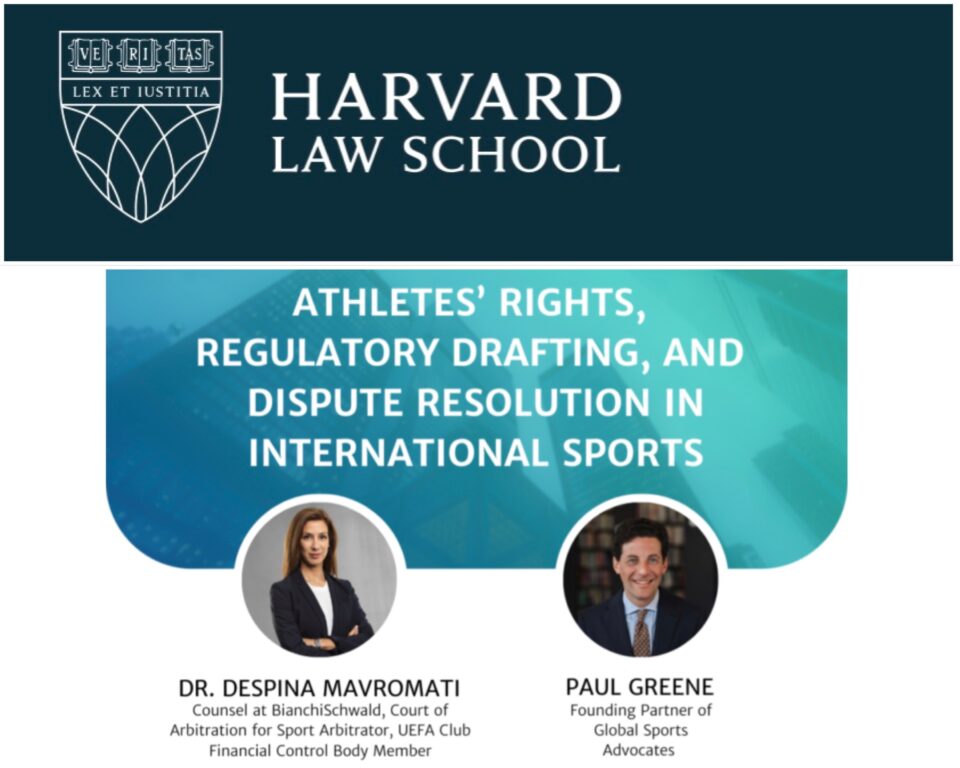
Despina Mavromati spoke at the Harvard Law School on 2 November 2023. Together with Paul Greene, they discussed the Semenya judgment rendered by the European Court of Human Rights and its potential implications on athletes’ rights, regulatory drafting and dispute resolution in international sports. More information can be found here.

The Handbook on International Sports Law (2nd Edition) was published in July 2022. Despina Mavromati was among the contributors of the second edition. In her new chapter, she analysed the major ECtHR and other tribunals’ judgments related to the CAS and discussed their potential impact on the functioning of the CAS. Edited by Prof. James A.R. Nafziger and Ryan Gauthier, the second edition of this comprehensive handbook presents new and significantly revised chapters by leading scholars and practitioners in the field of international sports law. You can order a copy here.
NEW BOOK RELEASE
by Despina Mavromati / Matthieu Reeb, Wolters Kluwer 2025
Ιn its fully revised second edition, The Code of the Court of Arbitration for Sport offers a comprehensive, article-by-article commentary of the CAS Rules. Drawing on leading CAS and Swiss Federal Tribunal case law, CAS practices and international arbitration principles, the book is an indispensable reference for practitioners, arbitrators, and scholars working in sports arbitration.
This second edition introduces significant updates, including new model documents and new chapters on the ICAS, the CAS ad hoc Rules and the CAS Anti-Doping Division Rules during the Olympic Games.


