
Despina Mavromati gave a lecture on “Good Governance and the Rule of Law in Sports” at the Fletcher School of Law and Diplomacy (Tufts University) on March 3, 2016.
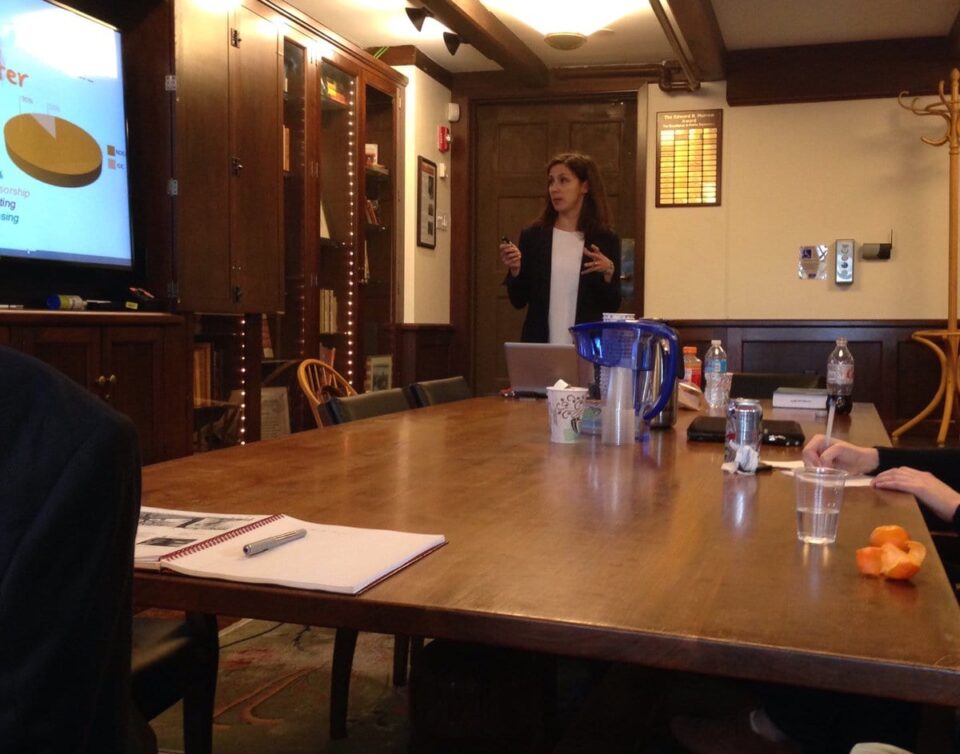

Despina Mavromati gave a lecture on “Good Governance and the Rule of Law in Sports” at the Fletcher School of Law and Diplomacy (Tufts University) on March 3, 2016.

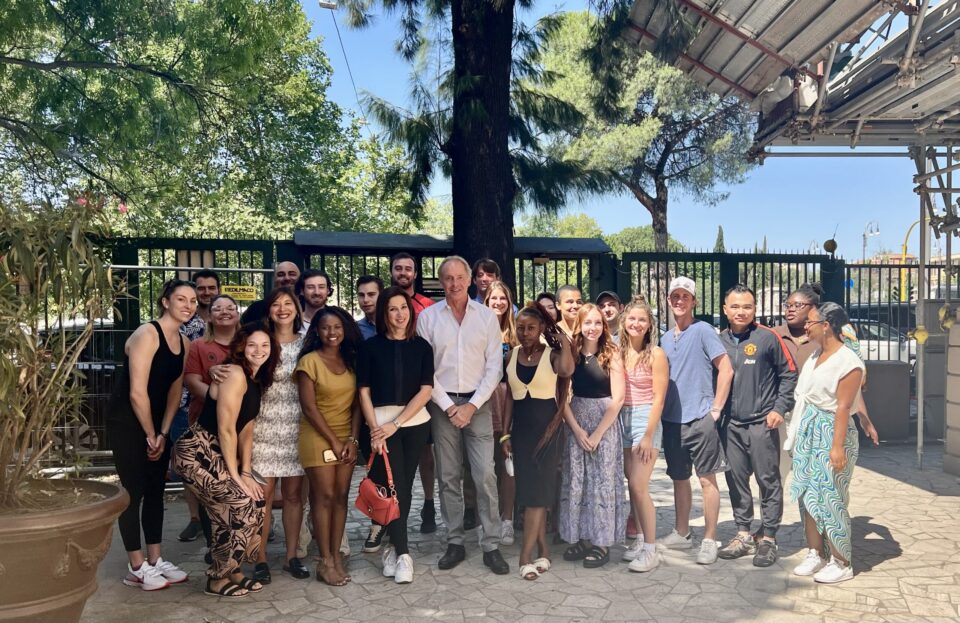
Despina Mavromati was invited by Prof. Kenneth Jacobsen to give a lecture on sports law to the students of the summer program of the Temple University – Beasley School of Law in Rome on 14 June 2022. You can find additional information about the program here.
Despina Mavromati presented some leading CAS cases in disciplinary and governance matters at the SLA Annual Conference in Los Angeles on May 13, 2016

Despina Mavromati attended the 10th LawInSport Global Summit that was hosted by A&O Shearman in London. The two-day conference included a series of interactive panel discussions on sports-law topics and the latest developments in international sports law and regulations. You can find the full program of the conference here.


Despina Mavromati was a speaker at the Law In Sport Annual Conference that took place in London on September 7-8, 2017. She participated in a panel discussing best practices in sports arbitration. See the agenda of the conference here

On 9 September 2025, the Court of Arbitration for Sport (CAS) hosted an event to launch the second edition of The Code of The Court of Arbitration for Sport – Commentary, Cases and Materials by Despina Mavromati & Matthieu Reeb (Wolters Kluwer 2025).
This book is a follow up to the first edition published in 2015 and includes comprehensive commentary on updated jurisprudence, CAS rules, landmark rulings and the latest evolutions in sports arbitration. It also serves as an indispensable guide to CAS proceedings for practitioners, arbitrators and scholars of sports law.
During the event, CAS arbitrator Prof. Luigi Fumagalli and ICAS representative Corinne Schmidhauser OLY spoke alongside the co-authors.
The book is available to purchase via Wolters Kluwer.



A doping-related sanction was issued by the disciplinary body of the International Fencing Federation (FIE) on 31 January 2023. According to the applicable rules, the athlete had 21 days to file an appeal to the CAS. The athlete’s counsel filed the statement of appeal by email only, requesting at the same time the “Case Registration Form” in order to upload the statement via the CAS e-filing platform. On the last day of the time limit, the counsel uploaded the submission on the e-filing platform, noticing that the platform was particularly slow but without receiving an error notification from the system. Several days later, the CAS sent a letter noting that the statement of appeal was filed late.
In the subsequent challenge proceedings, the SFT did not consider that the CAS committed excessive formalism by not admitting the late filed statement of appeal, to the extent that the athlete’s counsel could not adduce any documents showing the inability to upload such submission. It also highlighted that the athlete’s counsel should have verified that the submission was successfully uploaded with the CAS Court Office if he had any doubts to this effect, all the more as such counsel was experienced in the filing of submissions with the CAS. It thus reiterating the importance of the respect of procedural rules (cf also my note on 4A_692/2016).

Ultimately, the SFT considered that there was no violation of the principle of good faith in the proceedings due to the CAS’ letter that the time limit to file the appeal brief was not suspended : in the SFT’s view, such letter does not infringe the principle of good faith as it is without prejudice to the question of the timely filing of the statement of appeal.
All in all, this was a confirmation that the parties uploading the statement of appeal on the e-filing platform bear the burden to establish the valid and timely filing of their submissions, whereas inadmissibility for non-timely filing can in principle not amount to excessive formalism on behalf of the CAS.
Article R29 of the CAS Code reads as follows:
“The CAS working languages are French and English. In the absence of agreement between the parties, the President of the panel or, if he has not yet been appointed, the President of the relevant Division, shall select one of these two languages as the language of the arbitration at the outset of the procedure, taking into account all pertinent circumstances. Thereafter, the procedure is conducted exclusively in the language selected, unless the parties and the panel agree otherwise.

This dispute was between 28 Russian Paralympic Athletes (Appellants) and the International Paralympic Committee (IPC), an association under German law with its seat in Bonn. Following the suspension of the Russian Paralympic Committee due to allegations and reports on a sophisticated doping plan in Russia in 2016, including disabled Russian athletes, the IPC received numerous individual applications requesting their participation in the Rio 2016 Games as “neutral” athletes. The IPC sent a reasoned letter to the 28 Appellants refusing their admission in the Rio Games but did not agree to a further appeal to the CAS.
The Athletes filed an appeal to the CAS against this decision and the CAS denied its jurisdiction, finding that there was no arbitration agreement allowing the Appellants to seize the CAS.
In the subsequent motion to set aside the CAS award, filed long after the Paralympic Games had taken place, the SFT examined – and dismissed – the appeal due to the lack of a “present” legal interest worthy of protection in the annulment of the contested decision. The legal interest is determined based on the requests that were submitted by the parties in the CAS proceedings: In this case, the requests were exclusively focused on the Athletes’ participation in the Rio 2016 Games, which ended long before they filed their civil law appeal to the SFT.
The SFT further differentiated the legal interest in attacking a decision of a direct member of an association and the athletes, who were merely indirect members of the IPC. Unlike the RPC that was a direct member of the IPC and its suspension would remain in place even after the Rio 2016 Games, the Athletes’ suspension related exclusively to the Rio 2016 Games.
Interestingly, a potential claim for damages against the IPC was not found to be a sufficient ground to establish legal interest.
Finally, the SFT confirmed that the standard for the derogation from the requirement of a current interest is very high: To the extent that the admission criteria are constantly changing, this case could not qualify as “a question of principle” that the SFT would be required to examine as it would likely occur in similar circumstances in the future.

Legal interest of FIFA to appeal a CAS award to the Swiss Federal Tribunal in a disciplinary (doping-related) case
This case involves the well-known (at least to all football aficionados) Peruvian football Player Paolo Guerrero who was sanctioned for an anti-doping rule violation of 14 months by the CAS, under the rather unusual circumstances of consuming tea with coca leaves. The CAS award was rendered in appeal against a decision of the FIFA Appeals Committee that initially suspended the Player for six months (see also CAS 2018/A/5571).
Apart from the appeal to the Swiss Federal Tribunal filed by the Player (4A_318/2018), FIFA filed a separate appeal invoking mainly the arbitrariness of the CAS award but also a violation of public policy and of the parties’ right to be heard (the appeal in 4A_318/A/2018 was dismissed as unfounded on March 4, 2019).
In a very short judgment which dismissed FIFA’s appeal as inadmissible, the Federal Tribunal repeated the essential condition of legal interest for the admissibility of an appeal under Articles 76 and 77 of the LTF. Accordingly, anyone who has taken part in the proceedings before the previous instance or has been deprived of the opportunity to do so is entitled to appeal in civil matters, provided that he or she is particularly affected by the contested decision and has an interest worthy of protection for its annulment or amendment. It is for the appellant to demonstrate such interest (at 2.1).
The interest “worthy of protection” also needs to be “personal” (Art. 76 (1) b LTF)
The Federal Tribunal analyzed in particular the notion of an interest “worthy of protection” that needs to be “personal” (Art. 76 para. 1 let b LTF). Accordingly, it is in principle not allowed to take legal action by pleading for someone else’s interest.
The Federal Tribunal also distinguished between Article 75 para. 3 (1) of the FIFA Anti-Doping Rules, which gives the right to FIFA to appeal to the CAS for international-level athletes, and the legal standing of FIFA to file a motion to set aside a CAS award under Article 76 LTF. It found that the grievances brought forward by FIFA were not sufficient to justify a “personal” legal interest.
The role of FIFA in the CAS Proceedings: A Court of First Instance?
Interestingly, the Federal Tribunal clarified the role of FIFA in the CAS proceedings, which is a role similar to a court of first instance whose judgment is subject to an appeal.
In this respect, such court of first instance could not validly file a motion to set aside the appeal decision on the sole ground that the appeal instance modified the operative part of its judgment! In other words, it questioned the legal interest of FIFA (and other federations whose judicial instances act in a similar capacity) and indirectly stressed the need for those federations to be (and stay) independent in case of an appeal to the CAS, since they do not have a valid legal interest at stake.
“Questions de principe” and Article 76 (1) b LTF
Finally, the Federal Tribunal held that FIFA’s “wish” to obtain an answer to legal questions, as fundamental as FIFA considers they might be, cannot confer legal standing to an entity that lacked a personal legal interest in filing such appeal under the meaning of the Art. 76 para. 1 let. b LTF.

This compilation reflects a selection of the SFT judgments in sports arbitration rendered in 2025, focusing on jurisdiction, due process, public policy, and the revision of CAS awards.
2025 was rich in SFT findings regarding the jurisdiction of the Court of Arbitration for Sport (CAS). In two important judgments, the SFT clarified and reconfirmed the scope of the arbitration agreement in favour of the FIFA tribunal vis-à-vis state courts. Accordingly, FIFA’s jurisdiction under Art. 22 para. 1 (b) RSTP is default for international-dimension disputes but not exclusive, and the parties may validly opt-out or seize national courts for the specific category of labour-law disputes (see my notes on 4A_64/2025 and 4A_92/2025). The SFT also clafiried the admissibility threshold for review of the FIFA jurisdiction by the SFT (see my note on 4A_12/2025), which must be raised during the CAS proceedings, even though it is not necessary to explicitly object at the outset of the FIFA proceedings (see my note on 4A_92/2025).
In another judgment, the SFT held that it is immaterial for the validity of the arbitration agreement that an agent lacked the required Swiss licence under the national laws: so long as the foreign seat of the agent is established, alleged breaches of Swiss employment-placement licensing rules cannot retroactively alter the international character of the relationship or invalidate an otherwise autonomous arbitration clause governed by Art. 178 PILA, nor render the dispute non-arbitrable under Art. 177 para. 1) PILA (see my note on 4A_616/2024).
In an interesting dispute related to the extension of the arbitration agreement to non-signatories due to alleged sporting succession, the SFT held that sporting succession is not recognized as a Swiss legal institution (see my note on 4A_188/2025): The fact that the SFT has found sporting succession to be in line with international public policy does not render it part of the Swiss legal order for jurisdictional purposes, limiting thus the effect of sporting succession – or other concepts of lex sportiva – when it comes to the interpretation of arbitration agreements under Art. 178 PILA. In another dispute, the SFT clarified the consequences of the distinction between admissibility and jurisdiction in multi-tier (FIFA & CAS) dispute resolution clauses: accordingly, when a case is rejected by FIFA as being time-bared, the parties cannot bring the claim to CAS and thus circumvent an agreed jurisdiction hierarchy by allowing time limits to lapse (see my note on 4A_230/2025).
With respect to the violation of public policy, the SFT reiterated on numerous occasions that it must be the outcome of the award – and not the panel’s reasoning – that violates public policy, showing the high admissibility threshold for such grievance (see e.g. my notes on 4A_616/2024, 4A_608/2024, and 4A_28/2025). In 2025, and prior to the ECHR Grand Chamber judgment in Semenya v. Switzerland issued in July 2025, the SFT still denied to apply directly the ECHR provisions and repeated that these guarantees fall within the restrictive scope of Art. 190 para. 2 (e) PILA (see my notes on 4A_682/2024 and 4A_544/2024). It is equally found inadmissible to reiterate due process grounds separately invoking Art. 6 ECHR (4A_474/2024). It is now settled federal case law that criminal law principles are not directly applicable in disciplinary proceedings (see my notes on 4A_682/2024 and 4A_544/2024;4A_474/2024). Furthermore, the disregard of a contractual provision regarding liquidated damages is not violating public policy /pacta sunt servanda when the arbitral tribunal considers said provision as void (see my note on SFT 4A_638/2024).
Moreover, 2025 marked numerous alleged violations of the parties’ right to be heard, which were all dismissed by the SFT: accordingly, there is no such violation when the panel (only) implicitly considers and rejects raised arguments (see my notes on 4A_608/2024 and 4A_168/2025; on arguments regarding the reliability and authenticity of the LIMS evidence, see my note on 4A_544/2024); objections to the weighing of testimony typically amount to inadmissible appellate criticism (see my note on 4A_28/2025). The CAS is further not obliged to highlight specific elements of the file relied upon so long as they were on record and discussed at the hearing (see my note on 4A_474/2024).
Finally, the SFT issued two interesting cases regarding requests for revision of CAS Awards under Art. 190a PILA: the first was filed by Russian figure skater Kamila Valieva and relied on an undisclosed expert report allegedly withheld by RUSADA and WADA during the CAS proceedings: the SFT dismissed the request considering that there was no procedural fraud and not a basis to reopen the CAS Award (see my note on 4A_654/2024). In the second, published in December 2025, the SFT admitted the request for revision in view of a final state court decision establishing forgery of a document linked to the outcome of the CAS award (see my note on 4A_268/2025).

A football employment dispute arising from the unilateral termination of a Hungarian player’s contract governed by the widely debated “Clause 49”. While the FIFA tribunal accepted its jurisdiction, the CAS found that it lacked jurisdiction and said award was later confirmed by the SFT. In essence, the SFT held that CAS, as an appellate body, could not extend its jurisdiction beyond that of the FIFA DRC; moreover, FIFA jurisdiction under Art. 22 para. 1 (b) RSTP is not absolute nor exclusive but subject to the parties’ contractual choice of forum, including state courts. The SFT further upheld the CAS’s interpretation of Clause 49 as conferring jurisdiction on the Hungarian Administrative and Labour Court for labour-law disputes and on a sports arbitration body only for other types of disputes, stressing that a literal and contextual reading of the clause, the player’s experience, and the absence of structural imbalance supported the conclusion that the parties validly opted for state court jurisdiction. This was an opportunity for the SFT to reiterate its restrictive approach to waivers of state court jurisdiction, holding that the decisive element was the clear reference to state courts irrespective of any imprecision in their designation. Moreover, FIFA’s alternative jurisdiction under Art. 22 RSTP does not prevail over a valid contractual choice of state courts.
This is an important football employment dispute arising from the termination of a Hungarian player’s contract governed by the widely litigated “Clause 49”, which provides for the jurisdiction of Hungarian state courts for labour-law disputes. In this judgment, the SFT set aside the CAS award, holding that the CAS had wrongly assumed jurisdiction in breach of Art. 190 para. 2 (b) PILA: the SFT reiterated that CAS appellate jurisdiction cannot exceed the jurisdiction of the FIFA body appealed from and depends on the existence of a valid arbitration agreement; as such, FIFA’s competence under Art. 22 para. 1 (b) RSTP is default but not absolute, and subject to the parties’ contractual choice of forum.
After interpreting Clause 49 restrictively, in line with its settled case law, the SFT held that the clause grants exclusive jurisdiction to the competent Hungarian labour courts for employment disputes, notwithstanding its imprecise wording, the use of the term “may,” the standardised nature of the clause, or the international character of the employment relationship. Therefore, the CAS had erred in treating the state-court jurisdiction as merely alternative or non-exclusive. The SFT further clarified that the distinction between voluntary and compulsory arbitration is irrelevant where the clause preserves state-court jurisdiction and that parties do not tacitly waive jurisdictional objections by silence during the FIFA proceedings, so long as these objections were validly raised at the outset of the CAS proceedings. Having found a lack of CAS jurisdiction, the SFT did not examine the subsidiary res judicata argument under Art. 190 para. 2 (e) PILA. Overall, it is now settled federal case law that now “famous” Clause 49 excludes FIFA and CAS jurisdiction in favour of Hungarian labour courts for both domestic and international employment disputes.
The case related to a football employment dispute involving a Chinese club (the Club) and an Ecuadorian player and arose from the termination of an employment contract containing an optional FIFA/CAS jurisdiction clause and parallel claims under an image rights agreement providing for exclusive CAS arbitration. Both FIFA and subsequently CAS upheld jurisdiction; the SFT dismissed the Club’s motion for erroneous findings on jurisdiction as inadmissible: it reiterated that, in principle, it may review only CAS jurisdiction – and therefore not that of the prior instance (here the FIFA DRC) – save for exceptional cases where both bodies decline jurisdiction; it also emphasised that any objection to FIFA DRC jurisdiction must be raised during the CAS proceedings; since the Club itself had appealed to CAS and had failed to challenge FIFA’s jurisdiction before the arbitral tribunal, it was precluded from doing so for the first time before the SFT, thereby reaffirming the strict procedural preclusion rules governing jurisdictional challenges in FIFA–CAS dispute resolution.
The case related to a football employment dispute involving a Chinese club (the Club) and an Ecuadorian player and arose from the termination of an employment contract containing an optional FIFA/CAS jurisdiction clause and parallel claims under an image rights agreement providing for exclusive CAS arbitration. Both FIFA and subsequently CAS upheld jurisdiction; the SFT dismissed the Club’s motion for erroneous findings on jurisdiction as inadmissible: it reiterated that, in principle, it may review only CAS jurisdiction – and therefore not that of the prior instance (here the FIFA DRC) – save for exceptional cases where both bodies decline jurisdiction; it also emphasised that any objection to FIFA DRC jurisdiction must be raised during the CAS proceedings; since the Club itself had appealed to CAS and had failed to challenge FIFA’s jurisdiction before the arbitral tribunal, it was precluded from doing so for the first time before the SFT, thereby reaffirming the strict procedural preclusion rules governing jurisdictional challenges in FIFA–CAS dispute resolution.
A cooperation agreement between two football clubs provided for FIFA as the primary forum and CAS arbitration only on a subsidiary basis if FIFA lacked jurisdiction. After FIFA declined to hear the claim as time-barred under Article 23 para. 3 FIFA RSTP, the claimant sought to seize CAS, arguing that FIFA’s refusal triggered CAS jurisdiction. Both the CAS and the SFT rejected this view, holding that FIFA’s decision was based on inadmissibility, not lack of jurisdiction, since FIFA remained competent in principle but was procedurally barred from examining the case. The SFT confirmed that a procedural time bar cannot activate CAS’s subsidiary jurisdiction and reaffirmed the distinction between jurisdiction and admissibility: Parties cannot circumvent an agreed jurisdictional hierarchy in multi-tier dispute resolution clauses by allowing time limits to lapse.
In a football-related contractual dispute between a Swiss professional player (the Player) and his intermediaries (the Agents) arising from the early termination of exclusive player-agent agreements providing for CAS arbitration and a 10% commission on employment contracts, the SFT rejected the motion to set aside the CAS award, holding that none of the grounds invoked under Art. 190 para. 2 PILA were established: the Player challenged CAS jurisdiction (Art. 190 para. 2 (b) PILA) contending that the Agents lacked the required Swiss licence under the Arbeitsvermittlungsgesetz (AVG, LSE) and only structured their contract as “international” in order to circumvent Swiss mandatory law, rendering the arbitration clause invalid. The SFT held that it was bound by the facts as established by the CAS, in particular the Agents’ foreign seat, and alleged breaches of Swiss employment-placement licensing rules could not retroactively alter the international character of the relationship or invalidate an otherwise autonomous arbitration clause governed by Art. 178 PILA, nor render the dispute non-arbitrable under Art. 177 para. 1) PILA.
The alleged violation of procedural and substantive public policy (Art. 190 para. 2 (e) PILA), based on claims that the award enforced a void contract, disregarded employee-protection norms, or imposed a sanction akin to bribery, was likewise rejected, as the outcome – ordering payment of damages for premature termination – did not contradict fundamental principles such as pacta sunt servanda or procedural fairness, thereby reaffirming the SFT’s settled jurisprudence on the autonomy of arbitration agreements, the extremely narrow scope of ordre public review, and the prohibition on factual re-assessment at the annulment stage.

A football employment dispute arose after the early termination of a Portuguese coach (the Coach) by his club (the Club), with a contract including a contractual liquidated-damages clause. The SFT held that the alleged violation of public policy under Art. 190 para. 2 (e) PILA based on pacta sunt servanda was not established: the SFT reiterated that public policy review is strictly limited to whether the result of the award, and not its reasoning, contradicts fundamental legal principles. It also found that the CAS had acted consistently in holding the Club liable for termination without just cause while refusing to apply the contractual compensation clause because it conflicted with mandatory Swiss employment law (notably Art. 337c para. 1 CO in conjunction with Arts. 341 para. 1 and 362 CO). To the extent that an employee cannot validly waive rights arising from mandatory provisions during the employment relationship or shortly thereafter, the CAS was entitled to disregard Article 5 of the contract as null and void and to award a higher compensation. The SFT found no inconsistency or violation of pacta sundt servanda in the Panel’s reasoning: although the Panel initially acknowledged that the contractual clause could potentially be valid, it correctly held that, under Art. 341 para. 1 and Art. 362 CO, an employee cannot waive rights arising from mandatory legal provisions during the employment relationship or within one month after its end, and that Art. 337c CO is one such mandatory rule.
In a football-related dispute (training compensation) arising from a player transfer processed through FIFA’s TMS and EPP system, a Latvian club (the Club) unsuccessfully sought to rely on a late-submitted waiver from the training club and saw its CAS appeal dismissed for failure to join the training club as a necessary party. The SFT subsequently rejected the motion to set aside the CAS award based on the alleged violation of the right to be heard (Art. 190 para. 2 (d) PILA), to the extent that the Club merely criticized CAS’s assessment of the facts and law and the arbitrator had implicitly but clearly addressed and rejected all arguments: as such, submissions concerning regulatory inconsistencies, the absence of a time limit for waivers and the allegedly disciplinary nature of the procedure. Importantly, criticisms of the arbitrator’s expertise were found to be irrelevant. With respect to the alleged violation of public policy (Art. 190 para. 2 (e) PILA), the SFT rejected grievances based on contractual freedom, personal freedom, pacta sunt servanda and the burden of proof, as misapplication of FIFA regulations or erroneous factual findings cannot amount to a breach of ordre public. the outcome of the award – requiring the joinder of the training club as a necessary party and disregarding a waiver filed after the final EPP – was neither arbitrary nor incompatible with fundamental Swiss legal values (see also the almost identical judgments involving other players SFT 4A_612/2024 & SFT 4A_614/2024 of 22 January 2025).
In a FIFA ethics case arising from allegations of systemic sexual abuse within the Haitian Football Federation, a federation vice-president (the Official) was sanctioned with a lifetime ban and fine later upheld by CAS on the basis of protected victim testimony and corroborating evidence. The SFT dismissed the Official’s motion to set aside the CAS award, finding no violation of the right to be heard (Art. 190 para. 2 (d) PILA). More specifically, the CAS had sufficiently reasoned its decision not to hear additional alleged victims, had lawfully relied on anonymous witness testimony subject to adequate procedural safeguards, and had afforded the official an effective opportunity to participate in – and challenge – the examination of evidence, while objections to the weighing of testimony amounted to inadmissible appellate criticism. The alleged violation of procedural and substantive public policy (Art. 190 para. 2 (e) PILA) was equally dismissed, as neither claims of arbitrariness nor disagreement with the evidentiary assessment meet the stringent ordre public threshold, and the outcome – confirming a lifetime ban for serious sexual-abuse misconduct – was not incompatible with fundamental Swiss legal values, thereby reaffirming the SFT’s consistent deference to CAS fact-finding and its restrictive review of ethics-related sanctions.

4A_474/2024 – CAS Discretion in rEPO Analysis in Doping-Related Proceedings – SFT Judgment of 6 February 2025, A. v. NADA, WADA & DFB, Motion to set aside CAS Award CAS 2023/A/9550, CAS 2023/A/9586 & CAS 2023/A/9607 of 27 August 2024
Croatian football Player Mario Vušković (the Athlete) was sanctioned for an anti-doping rule violation following an out-of-competition test revealing rEPO in November 2022 following a CAS award that increased the first-instance sanction from two to four years. The SFT rejected the alleged violation of the Player’s right to be heard (Art. 190 para. 2 (d) PILA) as he should have expected a full review of the evidentiary record; moreover, the CAS was under no duty to highlight specific elements of the file relied upon if they were on record and discussed at the hearing. The Athlete also invoked a violation of public policy (Art. 190 para. 2 (e) PILA), based on the excessive commitments provision under Art. 27 para. 2 CC, the use of the SAR-PAGE method, the CAS panel’s reliance on technical images (without the expertise to do so), and the purported impossibility of producing exculpatory evidence due to WADA’s regulatory framework. All the pleas were rejected in line with the SFT’s settled case law recognising the CAS’s broad discretion in doping matters and the compatibility of strict liability and anti-doping evidentiary rules with ordre public; arguments relying on in dubio pro reo and lex mitior were also dismissed as inapplicable to disciplinary sanctions imposed by private sports federations and, in any event, they were not shown to be violated. The Athlete’s reliance on Art. 6 ECHR was found inadmissible to the extent that it reiterated previously rejected grounds without satisfying the strict threshold required to establish a breach of public policy.
A former elite Russian bi-athlete was sanctioned by the IBU for an anti-doping rule violation relating to the use of prohibited substance ostarine in 2013, later discovered through the LIMS data from the Moscow laboratory; his CAS appeal was dismissed and the SFT rejected the motion to set aside the CAS award: the alleged violation of the right to be heard (Art. 190 para. 2 (d) PILA) was dismissed because the CAS had comprehensively examined the evidentiary record, including the statistical arguments relied upon by the athlete, and had implicitly but clearly rejected arguments regarding the reliability and authenticity of the LIMS evidence; the alleged violation of public policy (Art. 190 para. 2 (e) PILA), based on the presumption of innocence and the principle of in dubio pro reo, was equally rejected in line with the SFT’s settled case law that criminal-law guarantees under Art. 6 ECHR do not directly apply to disciplinary proceedings conducted by private sports federations; moreover, the SFT reconfirmed the non-application of criminal law principles in disciplinary sanctions and the limitation of public policy review to the outcome – rather than the reasoning – of the CAS award, showing the limits of the SFT control in anti-doping cases relying on LIMS evidence.
In a long-term doping dispute relating to the Athlete Biological Passport (ABP) of a former Russian biathlete and Olympic medallist, the CAS ultimately confirmed an anti-doping rule violation covering the period 2010–2014 and imposed a four-year suspension with disqualification of results. The subsequent motion to the SFT for violation of public policy was also dismissed: similar to other judgments, and since the Semenya ECHR judgment was still pending before the Grand Chamber (see my note here), the SFT reiterated that Art. 6 ECHR cannot be invoked directly in challenges against international arbitration awards. Also, criminal-law principles such as the presumption of innocence and in dubio pro reo do not apply to disciplinary proceedings of private sports bodies; it further found that the CAS had not reversed the burden of proof, had assessed the ABP and genetic evidence without harbouring any reasonable doubt, and was entitled to rely on circumstantial indicators in reaching its “comfortable satisfaction”; finally, the allegation of a breach of legal certainty was dismissed, as the Athlete had been notified of the investigation well within the applicable ten-year limitation period, confirming once again the exceptionally high threshold for establishing a violation of Swiss ordre public in complex, long-running anti-doping cases.
In an anti-doping dispute involving an American elite swimmer sanctioned on the basis of abnormal ABP findings, the SFT dismissed the motion to set aside the CAS award for alleged violation of the right to be heard under Art. 190 para. 2 (d) PILA. In essence, the SFT found that the CAS panel had sufficiently considered the athlete’s key defence that the hematological abnormalities could be explained by “detraining” following a reduction in training load and a Covid-19 infection, even though it did not address this argument in detail, noting that the panel implicitly rejected the explanation by reasoning that such detraining could equally support the blood-doping hypothesis. Reiterating its settled case law, the SFT confirmed that an arbitral tribunal is not required to respond expressly to every argument, that implicit reasoning suffices where the issue has been addressed, and that Art. 190 para. 2 (d) PILA cannot be used to challenge the assessment of scientific evidence or the persuasiveness of expert testimony.
This judgment concerns Russian figure skater Kamila Valieva’s (the Athlete) request for revision of the CAS award of 29 January 2024, imposing a four-year ineligibility for trimetazidine. The SFT dismissed the request, holding that the stringent requirements of Art. 190a PILA were not met. The Athlete had claimed that an allegedly undisclosed expert report constituted new, outcome-determinative evidence or established procedural fraud by RUSADA or WADA. The SFT rejected these arguments, noting that the report’s existence was unproven (could not constitute a pre-existing fact under Art. 190a para. 1 (a) PILA) and, in any event not conclusive as it stated that the contamination scenario was theoretically possible. In any event, the CAS had rejected the contamination defence for lack of factual proof rather than scientific uncertainty. Emphasising that revision is exceptional and cannot function as a disguised appeal or a second attempt to relitigate the merits, the SFT reaffirmed the finality of CAS awards and the high threshold for reopening international sports arbitration decisions.
In 2025, the SFT exceptionally admitted a request for revision of a CAS award pursuant to Article 190a para. 1 (b) PILA, holding that the 2019 decision had been decisively influenced by criminal conduct. The case arose from a dispute between a professional footballer and his agent, in which the CAS had ordered the payment of a commission on the basis of representation contracts and an email later proven to be forged. Final Swiss criminal judgments established that the agent had fabricated the contracts and falsified the email to mislead the arbitral tribunal and obtain an undue payment. The Federal Supreme Court found a clear causal link between these criminal acts and the outcome of the arbitral award, annulled the CAS decision in its entirety, and remitted the case to CAS for a new decision. The judgment stands out as a rare but important illustration of the revision mechanism operating as an exceptional corrective measure, where the finality of arbitral awards is disregarded due to proven fraud affecting both jurisdiction and the merits.

Published in M. Bernasconi (ed.), Arbitrating Disputes in a Modern Sports World, 5th Conference CAS & FSA / SAV Lausanne 2014, Weblaw 2015
On 5 and 6 September 2014, the 5th edition of the Sports Law Conference organized every two years by the Swiss Bar association and the Court of Arbitration for Sport took place in Lausanne. Despina Mavromati contributed to the book with her article on the jurisprudence of the Swiss Tribunal Federal concerning sports arbitral awards. The book includes several articles and a review of numerous CAS cases in football and in «non-football» matters.

Jurisprudence of the SFT in Appeals Against CAS Awards – Issues related to jurisdiction, ISLR, Issue 2/2011, Sweet & Maxwell, pp. 37-48

On 17 December, one day after the EU General Court published its highly-publicized judgment in the action brought by the International Skating Union (ISU) (the ISU judgment), I was invited to discuss the judgment together with Benoit Keane during the event “Bosman at 25: Contemporary issues in sports law” hosted by the Edge Hill University and my dear colleague Prof. Richard Parrish.
The EU General Court rendered its long-awaited decision three years after the EU Commission had issued its first decision in December 2017 (Commission Decision of 7 December 2017, AT.40208). The ISU judgment generally confirmed the Commission decision from December 2017: accordingly, the ISU’s “Eligibility Rules” were found to infringe upon EU competition rules (Article 101 TFEU), to the extent that their goal was to prevent professional speed skaters from taking part in international events organized by third parties; in turn, such third parties were deprived of the athletes’ participation necessary to organize those competitions. The ISU also Eligibility Rules included arbitration rules that provided for the exclusive jurisdiction of the CAS, which were found by the Commission to “reinforce” such infringement. The EU Commission subsequently ordered the ISU (subject to a periodic penalty payment) to put an end to the infringement through the amendment of its Eligibility Rules, which included the arbitration rules. While generally upholding the Commission decision, the ISU judgment annulled its part relating to the ISU arbitration rules in favor of the CAS.
In my intervention during the “Bosman at 25” event, I focused on the specific issue of the ISU arbitration rules while my colleague Benoit Keane extensively discussed the ISU eligibility rules and their compatibility with EU competition rules as confirmed by the ISU judgment. On this particular aspect, I limited myself in noting that the ISU judgment shows an increasing tendency of the EU adjudication instances to determine the compatibility of the rules of Sports Governing Bodies (SGBs) with EU competition rules by scrutinizing their regulatory drafting and, subsequently, their overall governance structure (cf. the Motoe Judgment of the ECJ of 1 July 2008).
The EU Commission decision on the ISU arbitration rules
Like all international federations recognized by the International Olympic Committee (IOC), the ISU has the exclusive right to manage and administer its sport, which includes both figure- and speed skating. Alongside its regulatory activity the ISU also carries out a commercial activity by organizing speed skating events for the most important international competitions. As per its ISU Eligibility Rules (in their previous version), the ISU only authorized specific events, according to which the participation of skaters in unauthorized competitions exposed them to a penalty or a lifetime ban from ISU competitions.
Following a complaint filed by two Dutch professional speed skaters, the Commission decision essentially held that the ISU Eligibility Rules infringed the EU competition rules and the CAS arbitration rules included therein “reinforced” such infringement.
The Commission decision noted the exclusive jurisdiction of the Court of Arbitration for Sport (CAS) in the ISU arbitration rules, and the limited review of the CAS awards through a motion to set aside CAS awards before the Swiss Federal Tribunal. These statutory clauses conferring exclusive jurisdiction on the CAS are common among the vast majority of the rules of international SGBs. Therefore, the Commission decision could have had important repercussions on the overall dispute resolution system in Olympic sports through the CAS more generally if the ISU judgment confirmed its findings. The Commission decision also considered the limited remedies granted under the New York Convention of 1958 on the Recognition and Enforcement of Arbitral Awards (NYC58), in view of the self-enforcement mechanism of CAS awards in sports disputes, the general difficulty to obtain such remedies, but also due to the fact that courts can interpret public policy under the NYC58 differently and in accordance with their own jurisdiction.
It is important to note that the Commission decision did not find that the ISU arbitration rules as such infringed the EU competition rules, rather, they simply “reinforced” the restriction that was already established by the ISU Eligibility Rules. It was further not held by the Commission decision that the arbitration rules breached the athletes’ right to a fair hearing more generally. Therefore, the finding as to the arbitration rules was more a finding “for the sake of completeness,” to quote the exact term used by the Commission (para. 132 of the ISU judgment).
The ISU judgment largely confirmed the Commission decision, finding that the classification of a restriction of competition by object in respect of the eligibility rules was well founded, but partially annulled the Commission decision with respect to the corrective measures imposed on the ISU relating to the amendment of its arbitration rules. Some key takeaways from the ISU judgment with respect to the arbitration rules are set out below. Again, it is important to recall that the Commission decision did not find that the arbitration rules constituted a separate infringement of EU competition law (i.e. a stand-alone infringement), but only that they reinforced the previously established restrictions of competition.
Notwithstanding the fact that the arbitration rules were not found by the Commission decision to constitute a stand-alone infringement, the ISU was ordered under Art. 2 of such decision to bring an end to the infringement also by amending its arbitration rules in order to approve the legality of the eligibility rules.
The ISU judgment held that only unlawful conduct or circumstances can render the infringement more harmful and constitute “aggravating circumstances” as submitted by the Commission. Arbitration rules conferring exclusive jurisdiction on the CAS were not “unlawful,” all the more since the Commission itself acknowledged that arbitration was an accepted method of dispute resolution and an arbitration clause as such does not restrict competition (para. 35 of the ISU judgment).
The ISU judgment equally referred to the “forced” character of sports arbitration and (as was expected) endorsed the Mutu and Pechstein judgment and the benefits of a centralized venue for adjudicating sports-related disputes in order to promote procedural uniformity and legal certainty (at 156 of the ISU judgment).
After an extensive analysis, the Court found that the arbitration rules did not interfere with the effectiveness of judicial protection under EU law.
Importantly, neither the ISU judgment – nor the Commission decision – considered that the arbitration rules violated the athletes’ right to a fair hearing nor challenged the legality or independence of the CAS as an arbitral institution (as was the case in the ECtHR Pechstein / Mutu decision).
At the same time, the ISU judgment addressed the control of EU competition law conducted by CAS: notwithstanding the binding character of an arbitration agreement conferring exclusive jurisdiction on the CAS, the athletes – or even third affected parties – may initiate proceedings before a national court and claim compensation for the harm suffered where there is a causal link between that harm and an agreement prohibited under Article 101 TFEU (para. 157 of the ISU judgment and references).
The ISU judgment held that, while it is not possible under the arbitration rules to bring an action before a national court for annulment of an ineligibility decision, the skaters – or third parties – could still bring an action for damages before a national court (para. 159 of the ISU judgment).
As a result, the ISU judgment confirmed that the national courts and competition authorities are not bound by any assessment made by CAS Panels with respect to the application of EU competition law. Additionally, national courts may also submit a request for a preliminary ruling to the Court of Justice (para. 160 of the ISU judgment).
The ISU judgment also highlighted the difference between the jurisdiction of the CAS in this case and the Achmea judgment (C-284/16). In the latter judgment, EU member states agreed to reduce the jurisdiction of their courts and the EU courts in favour of arbitral tribunals (e.g., ICSID or other). However, in the case at issue, the establishment of the CAS does not affect the national and EU courts’ right to apply and interpret EU competition law.
Thus, the Court found that the arbitration rules granting exclusive jurisdiction to the CAS in order to review the legality of ineligibility decisions do not constitute “unlawful circumstances” that make the infringement more harmful.
To the extent that the ISU arbitration rules were not a – direct or indirect – part of the infringement (nor an aggravating circumstance, since they were not “unlawful”), the ISU judgment also annulled the imposition of periodic penalty payments that were ordered in the event of a failure to amend the arbitration rules.
Concluding Thoughts
Overall, the ISU judgment confirmed the compatibility of exclusive arbitration clauses in favor of the CAS with EU competition law, to the extent that they do not prevent the parties from effective judicial protection against potentially anticompetitive decisions under EU competition rules. At the same time, and even though the parties cannot directly request to overturn a decision on ineligibility from state courts (which would technically fall within the exclusive jurisdiction of the CAS), it is still possible to claim damages before the national courts or national competition authorities. However, in assessing such a claim, these judicial instances will necessarily engage in an incidental control of the conformity of the eligibility rules under EU (competition) law. In that respect, any previous CAS assessment on EU competition law is not binding on such courts (to the extent that only the operative part of the CAS Award on the ineligibility of the athlete is vested with res judicata). The ISU judgment therefore confirmed the autonomy of EU law and, more specifically, EU competition law.
Furthermore, the ISU judgment endorsed the finding of the ECtHR decision in the case of Pechstein / Mutu with respect to the legitimate objectives pursued through the binding nature of arbitration in sports disputes. However, neither the ISU judgment nor the Commission decision have conducted an autonomous analysis of the independence of the CAS (unlike the Pechstein / Mutu decision) or the compatibility of the arbitration rules with the athletes’ right to a fair hearing. The ISU judgment (which is still subject to appeal before the Court of Justice of the EU) will have repercussions on other Olympic SGBs, which include similar exclusive arbitration clauses in favor of the CAS. Setting aside the existence of such exclusive arbitration clauses, however, the most serious repercussions for SGBs may derive from the finding of the ISU judgment that eligibility / authorization rules are not shielded from scrutiny from EU or national courts, which will seek to safeguard the autonomy – and ensure the effectiveness – of EU (competition) law.

The dispute arose following an agreement between two clubs for the transfer of a football player. As per the transfer agreement, Club B had to pay additional compensation amounting to half of the transfer sum in the event of the player being transferred to a third club.
Following a transfer agreement to a third club, Club A alleged that Club B had negotiated for more than twice the disclosed transfer amount and requested the production of all the agreements in order to determine the true value of the transfer.
The dispute went to the CAS, which dismissed the claim, finding no evidence that the transfer compensation was in fact higher and that the other contracts had been simulated.
A couple of years later, Club A filed a revision request before the SFT, by citing five media articles from 2018 and an email of 2014. A revision is possible if the requesting party subsequently learns significant facts or finds decisive evidence which it was not able to produce in the previous proceedings, excluding facts and evidence which only arose after the decision.
The SFT judgment is interesting for the rather exceptional character of the requests for revision among the sports arbitration cases. In case a request for revision is upheld, the matter will be reverted back to the previous instance.
Moreover, the SFT repeated that the newly presented facts must be substantial, i.e. they must be suitable to change the factual basis of the decision requested for appeal and, if the legal assessment is correct, to lead to a different decision. New evidence must serve either to prove new substantial facts justifying the appeal or to prove facts which were known in the previous proceedings but remained unproven to the detriment of the Claimant.
Importantly, the SFT held that the determination of whether there are reasons for revision is a question related to the well-founded of the judgment.
The claimant (Club A) supported that the facts and evidence were discovered after the issuance of the arbitral award, revealed almost two years afterwards in the French and Spanish press, and had they been known earlier, they likely would have influenced the ruling. However, the SFT considered that Club A failed to establish how these new facts would be prone to lead to a different decision. Furthermore, the Club had failed to prove the authenticity of the document produced, a necessary condition if such authenticity is disputed by the other party.

This Federal Tribunal judgment is very interesting since it deals, among other issues, with the distinction between domestic and international arbitration and the exact conditions for opting out of the award-review mechanism under the Swiss Code of Civil Procedure (CPC) for the more restrictive appeal conditions foreseen in Article 190 (2) of the Swiss Private International Law Act (PILA).
The Facts
The case related to a disciplinary sanction issued by FIFA upon the former FIFA Secretary General Jérôme Valcke (the Appellant) over various breaches of the FIFA Code of Ethics.
More specifically, the Appellant was implicated in a scheme related to the resale of World Cup tickets and acted against FIFA’s best interests by taking private flights for sightseeing trips with his family at the organization’s expense. The Appellant was also involved in the sale of television rights for below market value and was accused of deliberately trying to obstruct the proceedings against him by attempting to delete files and folders relevant to the investigation.
The Adjudicatory Chamber of FIFA issued its final award on February 10, 2016, prohibiting the Appellant from engaging in any activity related to football for 12 years and imposing a fine of CHF 100’000 for violations of Articles 13, 15, 19, 20 and 41 of the FIFA Code of Ethics (CEF). The FIFA Appeal Committee subsequently reduced the duration of suspension to 10 years, sanction that was subsequently confirmed by the CAS.
The CAS Award and the Appeal to the Swiss Federal Tribunal
Opting out of the domestic arbitration regulation (Art. 393 CPC) from unequivocally signing the order of procedure providing for the 12th chapter of PILA
The Appellant filed a motion to set aside the CAS award before the Swiss Federal Tribunal. He considered the matter to be one of domestic arbitration subject to the provisions of the Swiss CPC (as opposed to the 12th chapter of PILA) and invoked arbitrariness for disregarding the mandatory provisions of Swiss labor law. Arbitrariness is a ground of appeal applicable only in domestic arbitrations regulated under the Swiss CPC.
The Swiss Federal Tribunal repeated some of its considerations on the distinction between international and domestic arbitration from the Platini judgment (4A_260/2016, at 1.1). It reiterated the practical consequences that this distinction entails, particularly with respect to the more thorough review under the CPC, since “arbitrariness” is only a ground for appeal in domestic arbitrations and does not appear in the exhaustively enumerated grounds for appeal under Article 190 (2) PILA.
According to the CPC, however, the parties have the right to opt out of the CPC and agree for a (more limited) review of the arbitral award under the PILA: said agreement would constitute a “choice of law” under Article 176 (2) PILA) and even though the opting-out does not necessarily include questions of arbitrability, which continue to be regulated under Article 354 CPC (ATF 144 III 235 at 2.3.3).
In the present case, the CAS Court Office circulated the (more or less) standard order of procedure which provided for the application of the CAS Code and the provisions of “Chapter 12 of the Swiss Private International Law Statute”, “to the exclusion of any other procedural law”. Said order was unequivocally signed by the parties.
The Federal Tribunal considered the signing of the order of procedure as a valid “choice of law” and dismissed arguments that the mention of the 12th chapter of PILA was a “clerical error”, particularly since said order was signed by the Appellant’s counsel. The fact that such document was a “standard” document did therefore not exempt the parties from carefully reading the provisions which the tribunal suggests should govern the procedure (at 1.5).
The Federal Tribunal also found that, even though the form of opting out (in the order of procedure) did not correspond with other cases related to opting out brought before the Swiss Federal Tribunal, it still qualified as such (1.6.1.1). After comparing the conditions of the waiver of any appeal under Article 192 PILA to the opting out of the CPC, it found that the former has the effect of depriving the appellant of all grounds of appeal, while the latter simply replaces the grounds of appeal in Art. 393 CPC by the more restrictive ones of Article 190 PILA (1.6.1.2).
Violation of the right to be heard by not rendering a decision on the domestic or international character of the dispute
The Appellant invoked a violation of his right to be heard because the CAS Panel did not rule on the (international or domestic) character of the arbitral proceedings (and subsequently ruling on the legal remedies available against the award). Interestingly, the Federal Tribunal held that an arbitral tribunal is not required to indicate the legal remedies against the award (unlike a cantonal authority whose decision cannot be directly appealed to the Swiss Federal Tribunal). It reminded, however, that any similar decision on this issue by the CAS Panel would not have prevented the Swiss Federal Tribunal from reviewing the issue of whether the arbitration in question was domestic or international in nature.
Violation of procedural—and substantive—public policy
In his third ground, the Appellant invoked a violation of Article 6 (1) ECHR and Article 14 of the International Covenant on Civil and Political Rights (ICCPR), making the award incompatible with procedural public policy. More specifically, the Appellant held that the disciplinary sanction was imposed on him while criminal proceedings relating to the same facts were ongoing constituting thus a violation of his right to a fair trial.
Without entering into the issue of the scope of the principle nemo tenetur se ipsum accusare in a disciplinary procedure within a private law association while criminal proceedings are pending, the federal Tribunal simply found that the CAS Panel had not established the scope of these investigations, which constituted a finding that bound the Federal Tribunal and made such a grievance inadmissible (at 3.2).
Finally, the Appellant invoked a violation of substantive public policy due to the excessive nature of the sanction. The Federal Tribunal swiftly dismissed said argument (nothing excessive in view of a serious breach by the Appellant in his capacity as a senior officer of a sports association) and clearly distinguished such case from the case of the Brazilian football player Francelino da Silva Matuzalem, who was subject to an unlimited prohibition to practice his profession failing to pay an indemnity of more than 11 million euros at short notice (ATF 128 III 322).

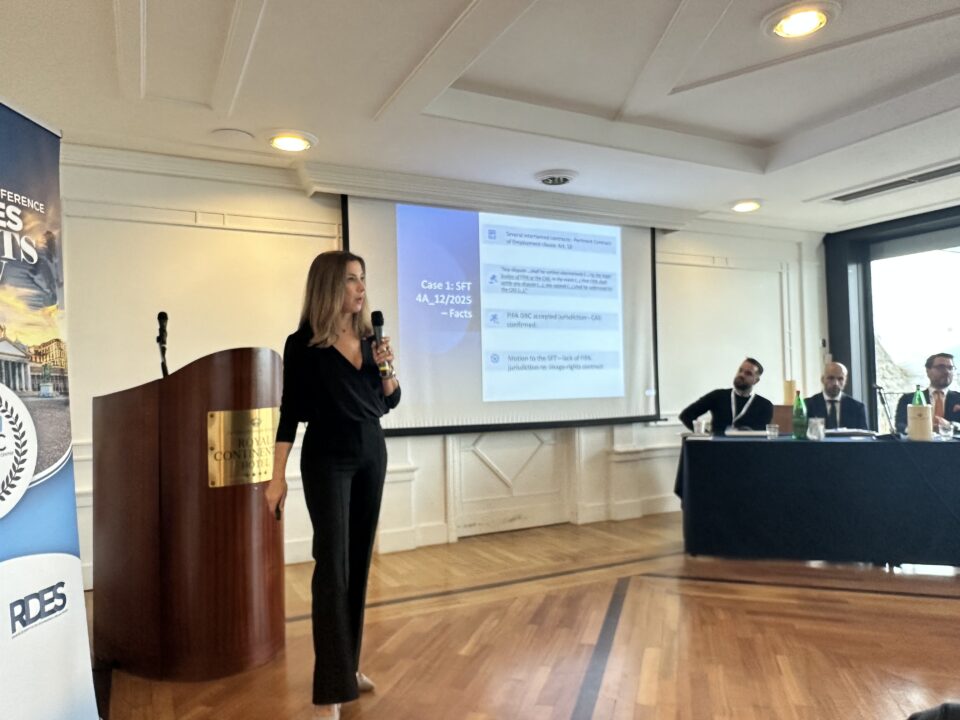
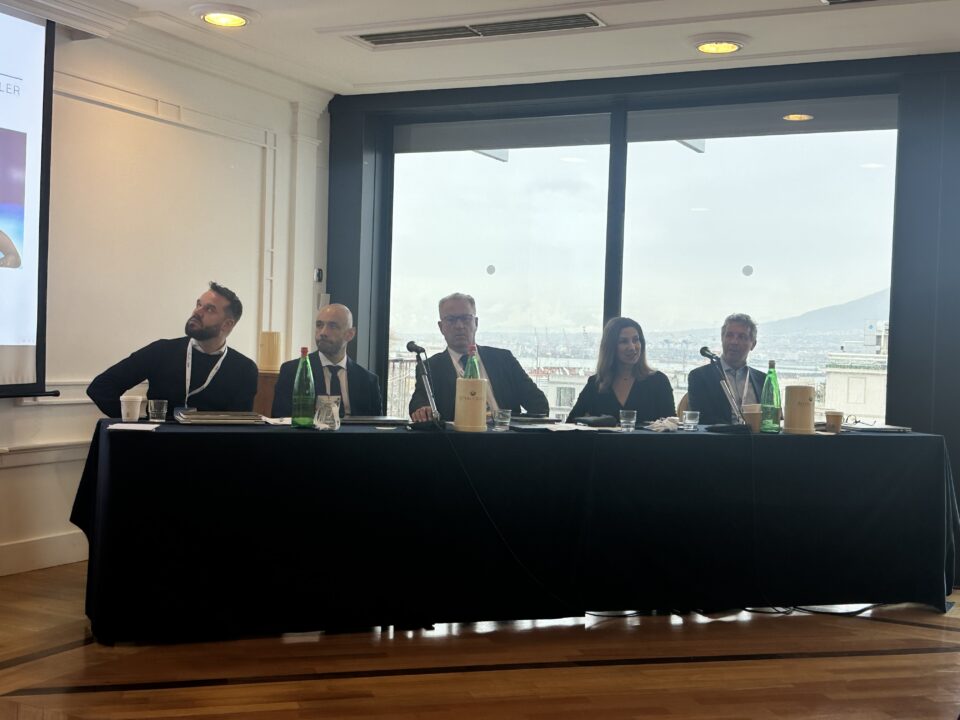
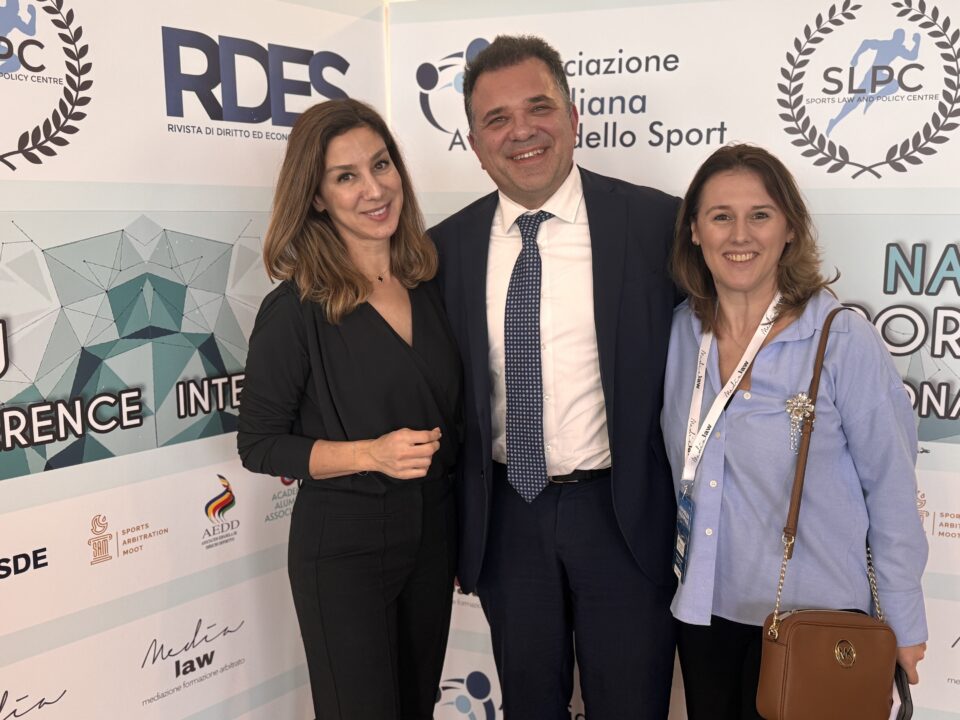
Dr Despina Mavromati participated as a speaker at the Annual Conference of the Italian Sports Lawyers Association, held in Napoli on 20–21 November 2025. During the conference, Dr Mavromati delivered a presentation on the latest jurisprudence of the Swiss Federal Tribunal (SFT) concerning jurisdictional issues between FIFA and state courts.
Her presentation focused on recent developments in international football disputes, with particular emphasis on the interaction between sports arbitration mechanisms and national judicial systems. Dr Mavromati participated in a panel discussion alongside Roy Vermeer, Giovanni Maria Fares, Michele Bernasconi, Giulio Palermo and Antonio Rigozzi.

Even though the SFT judgment itself does not answer any significant questions, this procedurally complex case arose out of the highly debated issue of “sporting successors” in football: An Australian football Player played several years for a Greek football Club before both parties agreed to terminate the contract in 2012. Following outstanding payments from the Club, the Player filed a claim before the FIFA Dispute Resolution Chamber (DRC), which partially upheld his claim. Shortly afterwards, the FIFA Player Status Committee requested the Club to comply with the decision, failing which the matter would be referred to the FIFA Disciplinary Committee (DC).
However, the Hellenic Football Federation (HFF) informed FIFA that the Club had been dissolved and no longer existed. Therefore, the FIFA Disciplinary Committee concluded that it had no jurisdiction over a club that was no longer affiliated to FIFA. In 2016, the Player wrote back to FIFA and informed them that the Club was again affiliated with the HFF and had been participating in the Greek Super League since 2015. It requested anew the assistance of the FIFA DC in order to enforce the DRC’s decision under the relevant provisions of the FIFA Disciplinary Code to the extent that the Club was the “successor” of the previous club and therefore subject to disciplinary sanctions by FIFA.

Following FIFA’s response that it needed additional evidence, the Player informed FIFA that it had already submitted sufficient evidence and that its answer constituted a denial of justice, which allowed him to bring his case to the CAS. However, shortly afterward FIFA dealt with the case and issued a decision, considering that there was already a decision by the FIFA DC on this issue, and it could not re-open the case. In the meantime, the Player had withdrawn his appeal to the CAS but subsequently filed a new appeal to the CAS, whereby he unsuccessfully claimed a denial of justice by the FIFA DC for not reopening the disciplinary proceedings against the Club.
In his motion to set aside the CAS award, the Player requested the SFT refer the case back to the CAS for a new decision. He alleged a violation of public policy and more specifically the violation of the principle of res judicata. The SFT found the Player’s criticisms to be unsubstantiated and thus avoided dealing with the question of whether res judicata is applicable to disciplinary proceedings before association bodies, repeating that decision making bodies within associations are not arbitral tribunals and therefore their decisions do not constitute judicial acts. In view of the overall approach of the SFT though, the question should be rather answered negatively.
The SFT left the question open whether res judicata is applicable to disciplinary proceedings before association bodies, to the extent that these bodies are not arbitral tribunals and their decisions are not judicial acts
Regarding the allegation of violation of Article 6 (1) of the European Convention of Human Rights (ECHR), the SFT reiterated its view that it is not possible to directly raise a violation of the ECHR, even though its principles can be used to define the guarantees protected under Art. 190 (2) LDIP. For this, the appellant would need to show in what way or ways the alleged violation of the ECHR violates public policy. It also drew the distinction between this case – which relates to “voluntary” arbitration – and “forced” arbitration cases such as the Mutu and Pechstein judgment of the European Court. More specifically, the contractual provision in the termination agreement expressly allowed the Player to seek recourse to the public courts in the event of a dispute. The SFT concluded that the alleged infringement of the principle of a fair hearing was unfounded and dismissed the appeal in its entirety.
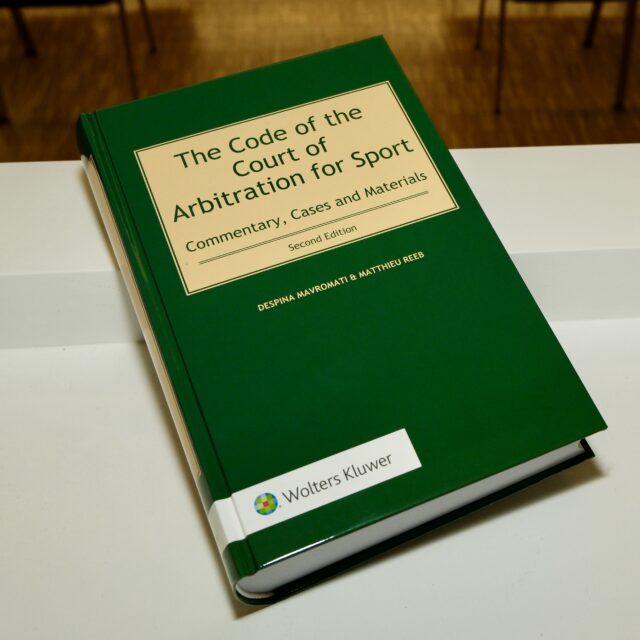
NEW BOOK RELEASE
by Despina Mavromati / Matthieu Reeb, Wolters Kluwer 2025
Ιn its fully revised second edition, The Code of the Court of Arbitration for Sport offers a comprehensive, article-by-article commentary of the CAS Rules. Drawing on leading CAS and Swiss Federal Tribunal case law, CAS practices and international arbitration principles, the book is an indispensable reference for practitioners, arbitrators, and scholars working in sports arbitration.
This second edition introduces significant updates, including new model documents and new chapters on the ICAS, the CAS ad hoc Rules and the CAS Anti-Doping Division Rules during the Olympic Games.

