
Sportlegis ×
Notes

No « forced » arbitration in a horizontal dispute between two football clubs

June 16, 2021 | 3-min read

No « forced » arbitration in a horizontal dispute between two football clubs - www.sportlegis.com

4A_600/2020, Judgment of January 27, 2021, Appeal against the CAS Award 2019/A/6380 of October 16, 2020

This is an interesting judgment raising an issue of principle in sports arbitration, and more specifically the forced character of arbitration in sports-related disputes. The dispute involved two football clubs, A and C (both UEFA members), and their right to use the name and colors of a historical football club (the Club) that was dissolved.  After several civil and criminal proceedings related to the use of the name, trademarks and identity of the Club, Club C filed a request before the Executive Committee of the national federation in order to be allowed to participate in the competitions under a specific trademark. Club A opposed to such request. The Executive Committee granted the request to Club C, without prejudice to a potential subsequent court decision that would cancel the registration of such trademark. In the subsequent appeal to the CAS, the Appellant primarily argued that only the state courts had jurisdiction and subsidiarily requested the annulment of the appealed decision.

After summarizing both the Mutu and the Pechstein decisions, the Federal Supreme Court concluded that forced arbitration is not prohibited but the arbitral tribunal must offer the guarantees provided for in Art. 6 para. 1 ECHR. As such, the CAS was found by the same judgment to be a tribunal established by law that is independent and impartial. In any event, the Supreme Court seriously questioned the “forced” character of the arbitration in the case at hand, which was not between an athlete and a sports federation, but between two football clubs, and decided to leave this question open. Therefore, it rejected the jurisdictional objection raised by the Appellant that the arbitration clause by reference was not freely accepted in this case, and for this reason the CAS should have declined jurisdiction.

This is an interesting judgment drawing a line between “forced” arbitration in disciplinary cases and “voluntary” arbitration in contractual cases brought before the CAS

With respect to the violation of its right to be heard, the Appellant claimed that it had produced video recordings to the Panel but the latter decided to show only certain parts, thus violating its right to be heard. The Supreme Court dismissed this argument by simply adhering to the wording of the award (as fact-binding the Court), showing that it was the Appellant who refused to show the recordings in question.

In the final plea of violation of public policy, the Federal Supreme Court again rejected some arguments as inadmissible to the extent that they departed from the text of the award, thus binding the Court (at 7.2). With respect to the alleged violation of the “principles of legality and the rule of law”, the Supreme Court held that these are not “undoubtedly part” of public policy but left the question open to the extent that the Appellant failed to substantiate its pleas. In any event, the Supreme court concluded that there was no violation of substantive public policy only because the Appellant could win a case in another procedure before the judicial authorities.

Overall this is an interesting – though expected – judgment that drew a line between “forced” arbitration (in disciplinary cases) and “voluntary” arbitration (in contractual cases) brought before the CAS.


Notes

No excessive formalism in case of filing the statement of appeal at the CAS only by email

November 12, 2024 | 3-min read

No excessive formalism in case of filing the statement of appeal at the CAS only by email - www.sportlegis.com

SFT Judgment 4A_346/2024 of 2 September 2024, motion to set aside CAS Decision of 15 May 2024

Following a FIFA DRC decision ordering a Turkish professional football Club to pay unpaid salaries to a player on 4 April 2024, the Club filed a statement of appeal to the CAS by email on 3 May 2024. Several days later, the CAS Court Office acknowledged receipt of the email and drew the appellant’s attention to Art. R31 of the CAS Code. The Club confirmed that it had sent its statement of appeal by post on 6 May 2024, the date on which it had allegedly delivered its submission in person to a company called C.

On 15 May 2024, the CAS acknowledged receipt of the original statement of appeal sent by post. Pointing out that the DHL shipment mentioned 13 May 2024 as the date of dispatch – which, incidentally, corresponded to the date on which the Appellant had sent various documents to the CAS electronically purporting to show that the statement of appeal had been delivered to C. The CAS Court Office considered that only the dispatch date of 13 May 2024, as evidenced by DHL’s electronic shipment tracking system, was decisive and informed the Club that it would not hear the case for non-compliance with Art. R31 of the CAS Code and due to the clearly late filing of the statement of appeal.

In a single plea alleging excessive formalism, the Club supported that Art. R31 para. 3 of the CAS Code requires the statement of appeal to be sent ‘by post’, without providing any further details, and considered that the appellant could choose the carrier of its choice, without it being necessary for the carrier to use a system that allows the consignments to be traced.

The SFT dismissed these arguments referring to numerous prior SFT judgments where it had left open whether excessive formalism could fall within Art. 190 (2) e PILA (public policy) but excluded that such plea could fall within Art. 190 (2) c PILA (ne infra petita). More specifically, the SFT held that when the CAS considered that it would not proceed with the case because the appeal was not validly submitted it did not commit a formal denial of justice that would fall within Art. 190 (2) c PILA.

The SFT confirmed that the filing conditions enshrined in Art. R31 of the CAS Code are not mere administrative formalities but an admissibility condition

In conclusion, the SFT confirmed that there is no excessive formalism in case of formal defect in sending a statement of appeal by fax or e-mail (4A_54/2019 at 4.2.2): While Art. R31 para. 3 of the CAS Code does indeed allow a statement of appeal to be filed in advance by fax or e-mail, the validity of this filing is subject to the condition that the appeal is also sent by post or uploaded onto the online filing platform on the first working day following the expiry of the applicable deadline. This is not a mere procedural formality but an admissibility condition (4A_54/2019, at 4.2.2).

Notes

No “effet de surprise” if a disputed issue was raised during the hearing

February 14, 2022 | 2-min read

No “effet de surprise” if a disputed issue was raised during the hearing - www.sportlegis.com

4A_384/2020, Judgment of 10 December 2020, A v. B FC, appeal against the CAS Award CAS 2018/A/6044

The dispute arose from the alleged existence of an employment contract between a Norwegian football player and the Kazakh club Astana: the player first lodged an unsuccessful claim with the FIFA Dispute Resolution Chamber and then filed an appeal to the CAS. The CAS panel decided that the question of whether the player had entered into an employment contract with the club could be left undecided, to the extent that, based on its interpretation of Article 18 (5) FIFA Regulations on the Status and Transfer of Players (RSTP), the alleged contract between the parties automatically ended when the player joined another club—shortly before the entry into force of his contract with the club.

In his subsequent motion to set aside the CAS Award, the Player first objected to the admissibility of the reply filed by the CAS Director General (in lieu of the CAS Panel). The SFT immediately dismissed this objection by referring to its previous jurisprudence.

The Player also alleged a violation of his right to be heard (“effet de surprise”) alleging that the panel failed to give him the opportunity to present his arguments on the application of Art. 18 (5) FIFA RSTP and did not draw his attention to the high importance of this provision for the outcome of the case. This argument was also swiftly dismissed by the SFT as clearly unfounded, to the extent that this specific question was explicitly raised during the hearing.

There is no violation of the parties’ right to be heard in the form of the unforeseeable application of an argument by the Panel if the specific issue was explicitly raised during the hearing.

In his second part of the alleged violation of his right to be heard, the Player accused the CAS of not examining several essential questions before reaching its decision, in particular, the intention of the parties with regard to the coexistence of the two contracts and the fact that the contract with the other club was of a temporary nature and aimed at maintaining the Appellant’s level of play. The SFT dismissed this last argument as a criticism of appellatory nature.

Notes

No direct challenge to the Swiss Federal Tribunal following a decision rendered by the CAS Anti-Doping Division acting as a first-instance tribunal

January 24, 2022 | 3-min read

No direct challenge to the Swiss Federal Tribunal following a decision rendered by the CAS Anti-Doping Division acting as a first-instance tribunal - www.sportlegis.com

4A_612/2020, judgment of 18 June 2021
A v. International Biathlon Union (IBU), Appeal against CAS 2019/ADD/6

This judgment relates to an interesting doping-related case that was heard by the Anti-Doping Division of the Court of Arbitration for Sport (CAS ADD) acting as the first-instance tribunal, upon the delegation of its doping disciplinary authority by the International Biathlon Union (IBU). Before the CAS ADD, the Athlete objected to the tribunal’s jurisdiction. Following the notification of the CAS ADD award and pending the outcome of his appeal to the CAS, the Athlete filed a motion to set aside the CAS ADD award before the SFT instead of expecting the outcome of the appeal proceedings.

In its judgment, the SFT refrained from determining whether the CAS ADD was a “true court of arbitration”, simply reminding that the internal tribunals of sports federations are not arbitral tribunals, and their decisions are simple acts of management rather than judicial acts. As such, their decisions cannot be brought before the SFT directly but only challenged based on Art. 75 CC (if Swiss law applies). Even if the CAS ADD were to be considered as a “true court of arbitration”, the Athlete would still need to exhaust all previous remedies before filing a motion before the SFT.

The SFT also rejected the Athlete’s claim that the contested decision of the CAS ADD was an preliminary award dealing only with preliminary procedural questions (thus open for a challenge based on Article 190 (3) Swiss Private International Law Act – LDIP) and that the CAS Appeals Division would a fortiori not have jurisdiction to deal with this case. In addition, the SFT drew an interesting distinction between the final nature of the award (as opposed to an interim or a partial award) and that of the final or challengeable decision before the SFT (at 5.1.2).

Difference between the final nature of the award and that of the final and challengeable decision before the SFT

The SFT concluded that the athlete’s motion to the SFT was inadmissible in that the prior available instances had not been exhausted awaiting the outcome of the CAS award, based on the analogous application of Art. 75 and 77 of the LTF. By doing so, it dismissed the Athlete’s argument that the exhaustion of prior remedies was not appropriate in this case, invoking that the appeal to the CAS would be a “meaningless formality” (at 5.3.1) and considered that there were no grounds for granting an exception to the obligation to exhaust prior remedies  (at 5.3.2).

Notes

Right of a party to request a public hearing before the CAS

January 13, 2022 | 3-min read

Right of a party to request a public hearing before the CAS - www.sportlegis.com

4A_486/2019 (SFT 146 III 358), Trabzonspor Sportif A.S. (Trabzonspor) et al. v. Turkish Football Federation (TFF), Fenerbahçe Futbol A.S. (Fenerbahçe) and FIFA, judgment of 17 August 2020

This SFT judgment ended the Turkish football club Trabzonspor’s legal battle to initiate disciplinary proceedings against another Turkish club before the tribunals of national and international football governing bodies, and subsequently before CAS and the SFT. The SFT judgment itself addresses several interesting legal questions for sports arbitration practitioners. The questions include the right of a party to request a public hearing before the CAS under Article 6 para. 1 of the European Convention of Human Rights (ECHR), the conditions for the standing to appeal a decision by a third party indirectly affected by such decision, and the right of the CAS to bifurcate the proceedings without violating the parties’ right to be heard.

In its judgment, the SFT reminded the parties that even though some procedural guarantees of the ECHR may coincide with the principles of public policy, it is not admissible to directly invoke a violation of public policy under Article 6 para. 1 of the ECHR due to the panel’s refusal to hold a public hearing. Even though the SFT considered that Trabzonspor did not fall within the personal scope of Article 6 para. 1 ECHR, it still examined the plea and justified the refusal of the Panel to hold a public hearing in the present case. It thus showed that the case fell within the exceptions of the rule of a public hearing (also incorporated in Article R57 of the CAS Code) and distinguished the case from the famous Pechstein case before the ECtHR (at 4.3).

The SFT equally touched upon the bifurcation of the proceedings before the CAS, thereby confirming the Panel’s decision to limit the procedure to the issues of admissibility, jurisdiction and standing for reasons of procedural economy. Such decision was considered to fall within the discretion of the hearing authority similarly to the proceedings before civil courts.

Overall, the arbitral tribunal is not obliged to address all the arguments raised by the parties and could ignore the ones that have been rendered moot following its analysis on other issues. In other words, the right to be heard does not confer a right to an obiter dictum (at 8.3).

The SFT avoided reviewing the well-founded principles of the CAS case law regarding the Club’s standing to appeal the FIFA decision before the CAS (based on the applicable FIFA rules). It only reiterated that the review of a party’s standing is not a jurisdictional question—which can then be freely reviewed by the SFT—but rather one that falls within the appreciation of the arbitral tribunal, which is not reviewable in annulment proceedings before the SFT. Therefore, the SFT endorsed the view of the Panel that third parties (i.e., parties that are not direct addressees of the decision) may file an appeal only if they are “directly” affected by such decision. Accordingly, the status of a mere whistle-blower cannot be equated to an athlete who has a direct interest in the outcome of the case, even more if the disqualification of another person or entity following such decision does not automatically lead to the change of status of the appellant.

Notes

No appeal to the CAS for doping-related procedures involving “national-level” athletes

February 3, 2022 | 3-min read

No appeal to the CAS for doping-related procedures involving “national-level” athletes - www.sportlegis.com

4A_618/2019, Judgment of 17 September 2020

A v. ESKAN (appeal against the CAS award of 29 October 2019 CAS 2018/A/6015)

In this case, the SFT dealt with a case of a “national-level” athlete whose appeal could not be brought to the CAS in line with the relevant regulations of the World Anti-Doping Code (WADC), as it has been transposed in the national regulations.

The dispute between a professional football Player (the Player) and the Greek Antidoping Agency (ESKAN) arose after an antidoping test revealed the presence of a prohibited substance under the WADC. ESKAN rendered a first-instance decision confirming an Anti-Doping Rule Violation (ADRV), appealed by the Player and confirmed by the Disciplinary Committee. The decision was written in Greek and did not contain any indication of the legal remedies. The Player filed an appeal against said decision to the CAS but ESKAN did not file an answer, nor did it participate in the appeal proceedings. The relevant part of the regulations provided that an appeal against the ESKAN decision was only possible to the CAS for “participation in an international event or in cases involving international-level athletes”. At the request of CAS, FIFA confirmed that the Player did not qualify as an “international level player”. While the player acknowledged this, he argued that CAS had still jurisdiction since the existence of the Greek national authority that was foreseen to hear appeals against decisions rendered by the Disciplinary Committee was not established. The CAS still dismissed the appeal for lack of jurisdiction.

In the subsequent motion to set aside the CAS award, the SFT reiterated the “Einlassung” theory, i.e., that any jurisdictional objections must be filed before the submissions to the merits, however, this principle does not apply when the respondent fails to submit an answer as in this case. The SFT also held that an arbitral tribunal may carry out investigative measures in order to determine its jurisdiction. The SFT further confirmed the arbitrator’s position that it is for the person who brings the case before the CAS to show that the domestic legal remedies have been established, or that they do not exist, considering that the Player failed to do so. The Player also invoked a violation of public policy due to the fact that the award did not contain any indication of the legal remedies available. The SFT left the admissibility of the argument from the scope of Art. 190 (2) (e) LDIP open and swiftly dismissed it since it should be for the addressee of the decision to take the necessary steps and seek the necessary information himself, also because the Player was represented by a lawyer during the Disciplinary Committee proceedings.

Notes

Ne bis in idem in disciplinary proceedings initiated at both the national- and the international level

September 6, 2023 | 2-min read

Ne bis in idem in disciplinary proceedings initiated at both the national- and the international level - www.sportlegis.com

SFT Judgments 4A_484/2022 and 4A_486/2022 of 26 April 2023

The disciplinary proceedings at national – and international level constitute “two sides of a unique system” that would be jeopardised if not triggered in parallel.

These two factually very similar judgments related to match-fixing in tennis. Both judgments 4A_484/2022 and 4A_486/2022 of 26 April 2023 primarily dealt with the principle of ne bis in idem as part of public policywhen disciplinary proceedings are opened for allegations of match-fixing by both the national federation (NF) and the international federation (IF). In a case where the athlete was acquitted by the NF but convicted by the IF, the SFT held that there was no violation of the principle ne bis in idem and that the material and temporal link between both proceedings constitute “two sides of a unique system”, which would be jeopardized if not triggered in parallel. Consequently, concurrent or subsequent national and international disciplinary proceedings do not infringe Swiss public policy / ne bis in idem, at least as long as national proceedings do not have an automatic international effect.

In addition to the aforementioned plea of ne bis in idem, the decision 4A_484/2022 of 26 April 2023 dealt with theindependence and impartiality of an arbitrator belonging to a barristers’ Chamber: The panel chair Mr. Michael J. Beloff KC was challenged by the athlete as two out of the four Anti-Corruption Commissioners worked in the same Chambers. The SFT disregarded the argument that such arbitrator would be inclined to “defend” the decision rendered by his colleagues in order to protect their reputation. After seriously questioning the admissibility of the grievance to the extent that the player had not raised any objection during the hearing, the SFT dismissed the plea as unfounded, confirming that there is no analogy between barristers belonging to the same Chambers and lawyers belonging to the same law firm. Therefore, in the absence of additional criteria, such connection cannot on its own establish bias under Art. 190 (2) a PILA.

In the absence of additional criteria, the fact that an arbitrator belongs to the same chambers as one of the members of the previous instance body cannot establish bias under Article 190 (2) a PILA.

News

National disputes before CAS, in M. Bernasconi (ed), International Sports Law and Jurisprudence of the CAS

September 20, 2014

National disputes before CAS, in M. Bernasconi (ed), International Sports Law and Jurisprudence of the CAS - www.sportlegis.com

In M. Bernasconi (ed), International Sports Law and Jurisprudence of the CAS, 4th CAS & SAV/FSA Conference Lausanne 2012, Weblaw 2014

This publication is part of a book that includes the presentations made by some of the most experienced specialists in the field of sports and arbitration law at the 4th Lausanne Converence of the Swiss Bar Association (FSA/SAV) and the Court of Arbitration for Sport / Tribunal Arbitral du Sport (CAS/TAS), held on 7 and 8 September, 2012.


Read article

News

Mediation of sports-related disputes: facts, statistics and prospects for CAS mediation procedures

December 14, 2015

Mediation of sports-related disputes: facts, statistics and prospects for CAS mediation procedures - www.sportlegis.com

Sporting disputes – and in particular football- related disputes – bear numerous particularities compared to other commercial or personal disputes. The same applies to the mode of resolution for sports-related disputes, which are typically resolved through arbitration: in this respect, the Court of Arbitration for Sport (CAS) is widely-known for its sports arbitration mechanism, developed upon the initiative of the former IOC President J. A. Samaranch. 


Read article

Notes

Limits in the FIFA PSC Jurisdiction to hear Set-off Claims for Damages Against Contractual Claims in Football Transfer Disputes

May 24, 2023 | 6-min read

Limits in the FIFA PSC Jurisdiction to hear Set-off Claims for Damages Against Contractual Claims in Football Transfer Disputes - www.sportlegis.com

Swiss Federal Supreme Court (SFT) Judgment 4A_420/2022 of March 30, 2023,
Cardiff City FC v. SASP FC de Nantes

Motion to set aside the CAS Award CAS 2019/A/6594 of August 26, 2022

This case relates to the internaDonal transfer of the ArgenDnean football player Emiliano Sala
to FC Cardiff (“Appellant”) from FC Nantes (“Respondent”, jointly referred to as the “Par5es”)
in January 2019 and his tragic plane crash which occurred shortly aQerwards. The SFT
judgment essenDally relates to the scope of the arbitraDon clause between the parDes to a
transfer agreement but also to the interpretaDon of the scope of disputes that can be decided
by the FIFA dispute resoluDon bodies and, subsequently, by the CAS.
The ParDes had agreed on a transfer price of EUR 17,000,000, to be paid in three installments,
with the first installment of EUR 6,000,000 payable within five days aQer the registraDon of
the player with FC Nantes. Hours aQer the finalizaDon of the transfer agreement with the FIFA
Transfer Matching System (“TMS”), the player tragically died in a plane crash over the English
Channel.
FC Nantes filed a claim before the FIFA Players Status Chamber (“PSC”) requesDng payment of
the first instalment, but FC Cardiff argued that FC Nantes was liable for the circumstances that
led to the player’s death, thusit intended to claim set-off for damages against the claims raised
by FC Nantes. The FIFA PSC upheld FC Nantes’ claim and held that it had no jurisdicDon to hear
the claim for damages.
FC Cardiff appealed against the FIFA PSC decision to the CAS which dismissed the appeal. The
CAS panel bifurcated the procedure and decided, as preliminary ma_ers, the validity of the
transfer contract, the PSC and CAS had jurisdicDon to hear the claim for damages, and the
possibility to exDnguish a contractual claim by a set-off tort claim. AQer declaring that the
transfer had already taken place before the player’s accident, the panel held that neither the
FIFA PSC nor the CAS had jurisdicDon to rule on a claim of extra-contractual nature (i.e., the
claim that FC Nantes was responsible for the player’s death).
In the subsequent appeal to the SFT, the Appellant invoked a violation of Art. 190 (2) (b) of the
Federal Act on Private InternaDonal Law (“PILA”) considering that the CAS panel had
erroneously interpreted the arbitraDon agreement enshrined both in the contract and in the
FIFA regulaDons. In a very interesDng analysis, the SFT reiterated the various principles of
statutory interpretaDon applying to the regulaDons of large sports federaDons, such as FIFA.
This note discusses the key findings in the SFT judgement.

Interpretation of the contractual agreement by the CAS and the SFT

The SFT confirmed the CAS panel’s view that its own jurisdicion could not go beyond the
jurisdiction of the FIFA PSC. Even though Art. 377 para. 1 Swiss Code of Civil Procedure (“CPC”)
provides for the right of the panel to deal with a counterclaim for damages, there were no
reasons that justified the concurrent ruling on claims based on the transfer agreement and on
(the unrelated) set-off against a tort claim (at 5.3). Notwithstanding the broad formulation of
the arbitration agreement in the transfer contract (“Any dispute arising out of or in connec:on
with this transfer agreement…”), the contract did not extend to the clearly distinct set-off
claim for damages based on the plane crash (at 5.4.3).
Interpretation of the FIFA Regulations
Refraining from rendering a general judgment, and while acknowledging that it is in principle
possible to invoke a claim for a set-off in international arbitration for indirectly related claims
(cf. 4A_482/2010), the SFT then dismissed the Appellant’s arguments on the interpretation of
the arbitration agreement based on the FIFA Regulations. In fact, and even though the latter
reserve the possibility to file a counterclaim (asserting a set-off claim), the FIFA dispute
resolution bodies are not “true” arbitral tribunals and, as such, they are not bound by the
arbitration provisions enshrined in the Swiss Code on Civil Procedure (at 5.5.4).
Accordingly, the jurisdiction of the CAS panel in appeal could not be broader than that of the
association’s tribunal that had first ruled on the ma_er (in this case, the FIFA PSC). After
analyzing the pertinent FIFA regulations, the CAS – and the SFT – confirmed that the possibility
to file a counterclaim before the FIFA PSC could not bind the latter to rule on any claim for
damages raised in this context (at 5.5.5).
Employing various instruments of statutory interpretation, the SFT further confirmed the
limited material scope of the FIFA PSC jurisdiction, which does not extend to ruling on civil
disputes of football stakeholders that are unrelated to football. The limits for the
rendering of the FIFA decisions along with a cap on the procedural costs were also considered
in order to conclude that FIFA did not intend to include the hearing of complex and unrelated
set-off claims by its dispute resoluDon bodies and, subsequently, by the CAS (at 5.5.5.4).

Other grievances: violation of the parties’ right to be heard and of material public
policy

FC Cardiff further raised the issue of a violaDon by the CAS panel of the principle of equality
of the parties for refusing to adjourn the hearing of its expert witness. Such plea was swiftly
dismissed by the SFT to the extent that the panel had included the expert report in the file
and that such report was found to have no influence on the outcome of the proceedings. The
SFT equally dismissed all other pleas on violation of the Appellant’s right to be heard, holding
that the panel had rejected – at least implicitly – the various arguments raised by the
Appellant (at 7).
Finally, the SFT thoroughly dismissed the Appellant’s claim for violation of public policy
alleging the Panel’s refusal “to examine (or even inves:gate) acts of corruption” (at 8.2.2).
After reiterating the very restrictive scope of substantive public policy, the SFT held that such
violation could only be admitted if the corruption had been established but the Panel stll
refused to take it into account, which was clearly not the case (judgment 4A_532/2014 of
January 29, 2015, at 5.1).

Conclusion
Overall, this is an interesting and thorough judgment rendered by the SFT that highlights the
specificities of sports arbitration with respect to the scope of the arbitration agreement but
also delves into the jurisdictional scope of the FIFA decision-making bodies, which draw the
limits of the subsequent jurisdiction of the CAS.

News

Lifetime ineligibility according to the WADA Code, CAS Bulletin, 1/2010, pp. 41-50

August 30, 2010

Lifetime ineligibility according to the WADA Code, CAS Bulletin, 1/2010, pp. 41-50 - www.sportlegis.com

Lifetime ineligibility according to the WADA Code

Published in CAS Bulletin 1/2010, p. 41-50

The 2009 World Anti-Doping Code (2009 WADC) foresees the sanction of ineligibility for life in various provisions and for various violations of the anti-doping rules. In most cases, a life ban is not a so-called “standard” sanction, but the adjudicating instance enjoys a certain degree of flexibility. In this respect, according to Article 10.3.2, for trafficking or attempted trafficking, administration or attempted administration of prohibited substance or prohibited method, the period of ineligibility is a minimum of four years up to lifetime ineligibility, unless the conditions for establishing a reduced sanction are met. 


Read article

News

Les délais dans le Code de l’Arbitrage en matière de sport, CAS Bulletin, 1/2013, pp. 2-12

April 10, 2013

Les délais dans le Code de l’Arbitrage en matière de sport, CAS Bulletin, 1/2013, pp. 2-12 - www.sportlegis.com

The paper deals with the time limits according to Article R32 of the CAS Code. It shows how time limits are calculated and describes the consequences in case these are not respected by the parties. The paper further illustrates the conditions for the extension and the suspension of time limits as they have been developed through the CAS case law.


Read article

News

Legal Aspects of the FIFA World Cup Qatar 2022™

August 11, 2022

Legal Aspects of the FIFA World Cup Qatar 2022™ - www.sportlegis.com

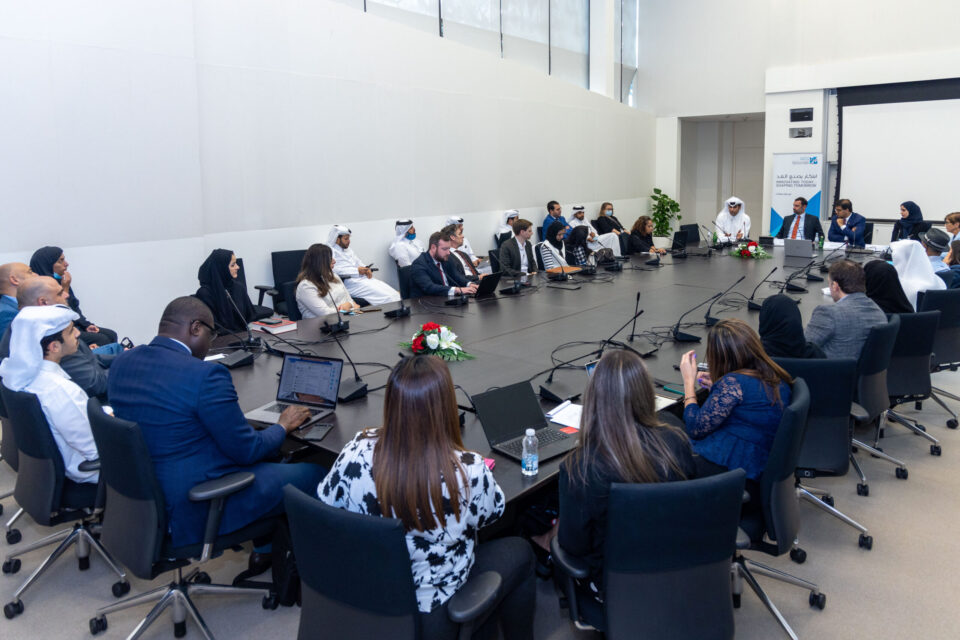
Despina Mavromati participated in an event organised by the Hamad Bin Khalifa University (College of Law) that examined the legal framework underpinning Qatar’s hosting of the FIFA World Cup, including dispute resolution, Qatari laws enacted to support the event, and the legal legacy of 2022. Other Panelists included Aarij S. Wasti (Legal Director, FIFA World Cup Qatar 2022™), Salman Al Ansari & Khadeja Al-Zarraa (Al-Ansari & Associates). You can find more information on this event here.

News

Lecture to the Students of the FIFA Master’s Program at the University of Neuchâtel

May 18, 2018

Lecture to the Students of the FIFA Master’s Program at the University of Neuchâtel - www.sportlegis.com

Despina Mavromati taught a full-morning class on sports arbitration and dispute resolution in sports at the FIFA Master of the University of Neuchâtel (Switzerland) on May 14, 2018.

News

Lecture to the Students of the FIFA Master Program Of CIES – 2018 International Sports Arbitration

May 18, 2018

Lecture to the Students of the FIFA Master Program Of CIES – 2018 International Sports Arbitration - www.sportlegis.com

Despina Mavromati gave a four-hour lecture on the Court of Arbitration for Sport & Alternative Dispute Resolution Mechanisms in Sport to the students of the FIFA Master Program of the CIES – University of Neuchâtel.

News

Lecture on The `Consensual` Nature of CAS Arbitration at the Harvard Law School

March 18, 2016

Lecture on The `Consensual` Nature of CAS Arbitration at the Harvard Law School - www.sportlegis.com

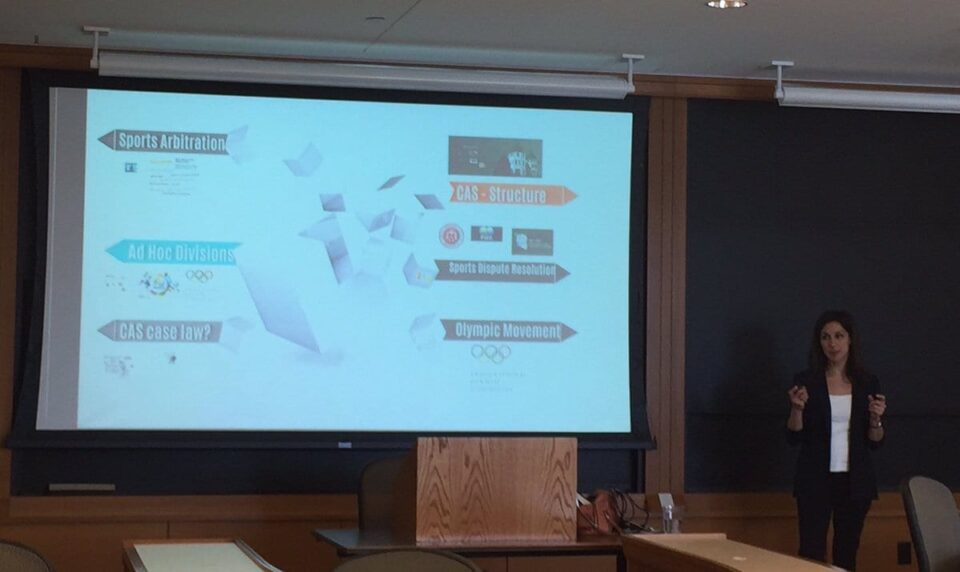
Despina Mavromati gave a lecture on the “consensual” nature of CAS arbitration at the arbitration group lunch talk series of the Harvard Law School on 6 April 2016: “The ‘Consensual Nature’ of Arbitration in International Sports Disputes: Perspectives and Challenges in an Ever-Changing Sports World” 

Book Promotion - www.sportlegis.com

NEW BOOK RELEASE

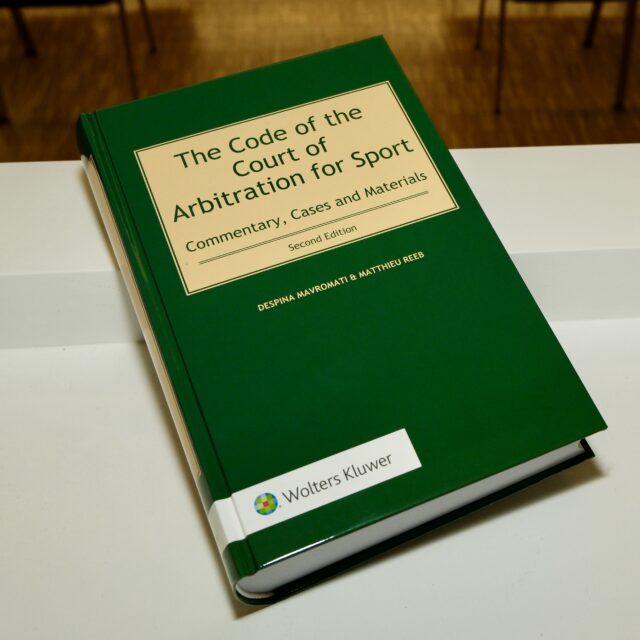
The Code of the Court of Arbitration for Sport – Commentary, Cases and Materials

by Despina Mavromati / Matthieu Reeb, Wolters Kluwer 2025

Ιn its fully revised second edition, The Code of the Court of Arbitration for Sport offers a comprehensive, article-by-article commentary of the CAS Rules. Drawing on leading CAS and Swiss Federal Tribunal case law, CAS practices and international arbitration principles, the book is an indispensable reference for practitioners, arbitrators, and scholars working in sports arbitration.

This second edition introduces significant updates, including new model documents and new chapters on the ICAS, the CAS ad hoc Rules and the CAS Anti-Doping Division Rules during the Olympic Games.

Order Here