Sportlegis ×
News

Trinidad and Tobago Football Association v. FIFA – the validity of normalisation committees and exclusive jurisdiction of CAS

October 24, 2020

Trinidad and Tobago Football Association v. FIFA – the validity of normalisation committees and exclusive jurisdiction of CAS - www.sportlegis.com

Published in LawInSport, 23 October 2020

On 13 October 2020, the High Court of Justice in Trinidad and Tobago issued their decision on a claim filed by the TTFA against FIFA. It ruled, in essence, that the FIFA’s decision to remove the TTFA’s executive board from office and to appoint a normalisation committee to run its affairs was null and void as it was made in bad faith and “for an improper and illegal motive”. This decision was eventually overturned by the Court of Appeal on 23 October 2020. In this decision, the Court of Appeal confirmed that the filings of these proceedings were ultra vires, null and void, confirming the exclusive jurisdiction of the CAS. This note reviews the case and analyses its potential repercussions for sports arbitration more generally.

News

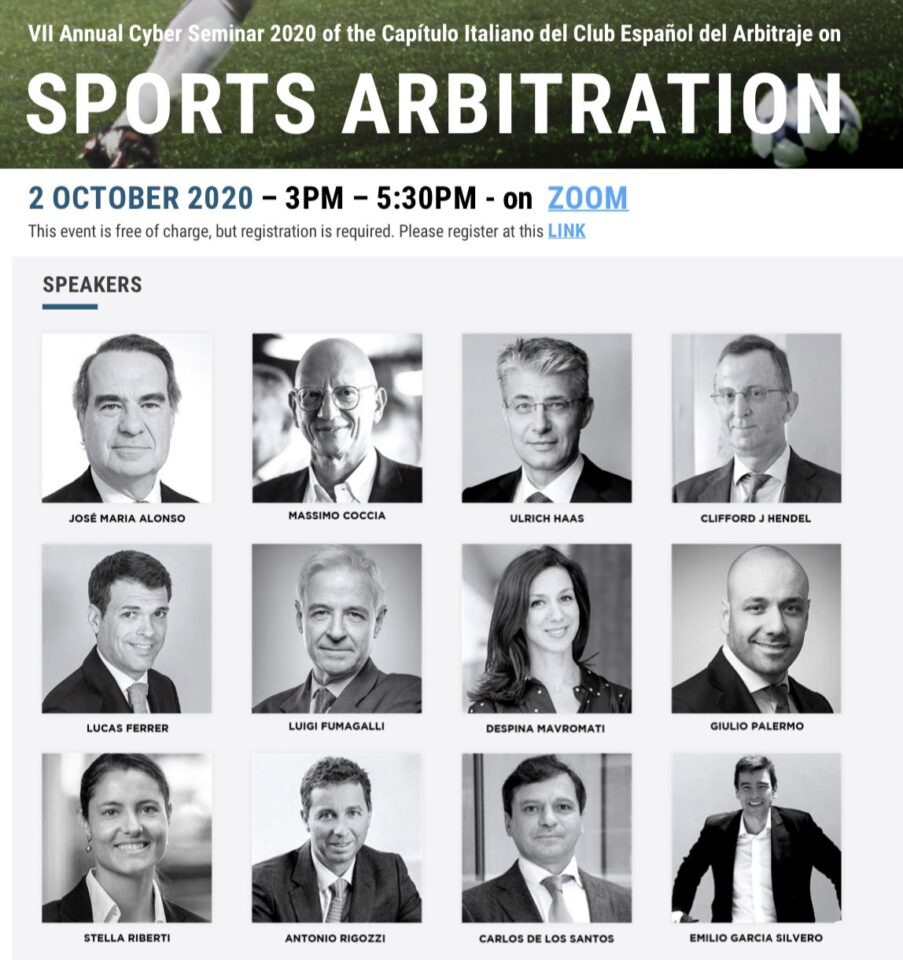
VII Annual Seminar on Sports Arbitration of the Spanish Arbitration Association

October 2, 2020

VII Annual Seminar on Sports Arbitration of the Spanish Arbitration Association - www.sportlegis.com

On 2 October 2020, the Italian Chapter of the Spanish Arbitration Association held its VII Annual Cyber Seminar for 2020. Despina Mavromati was a panelist at the roundtable on sports arbitration, alongside some of the foremost experts in the field: Prof. Massimo Coccia, Prof Ulrich Haas, Prof Luigi Fumagalli, Mr Clifford Hendel, Mr Lucas Ferrer, Mr. Giulio Palermo and FIFA Chief Legal Officer, Dr Emilio Garcia Silvero. More information about the Spanish Arbitration Association (CEA) can be found here.

News

Selected procedural issues –and questions– arising out the Caster Semenya Judgment of the Swiss Federal Tribunal

September 27, 2020

Selected procedural issues –and questions– arising out the Caster Semenya Judgment of the Swiss Federal Tribunal - www.sportlegis.com

Published in the Asser International Sports Law Blog, 11 September 2020

This note deals with selected procedural issues and questions arising out of the very lengthy Semenya Judgment. In a nutshell, the SFT dismissed Semenya’s appeal to set aside the CAS Award, which had denied the request of Caster Semenya (Semenya, the Athlete) to declare unlawful the Differences of Sex Development (DSD) Regulations of World Athletics (formerly IAAF).


Read note

Notes

Lack of legal interest worthy of protection in case of a sporting competition that already took place

September 16, 2020 | 3-min read

Lack of legal interest worthy of protection in case of a sporting competition that already took place - www.sportlegis.com

Federal Tribunal Judgment 4A_56/2018 of 30 January 2019, Russian Paralympic Athletes v. IPC
Motion to set aside the CAS Award of 20 October 20 2017 (CAS 2016/A/4770)

This dispute was between 28 Russian Paralympic Athletes (Appellants) and the International Paralympic Committee (IPC), an association under German law with its seat in Bonn. Following the suspension of the Russian Paralympic Committee due to allegations and reports on a sophisticated doping plan in Russia in 2016, including disabled Russian athletes, the IPC received numerous individual applications requesting their participation in the Rio 2016 Games as “neutral” athletes. The IPC sent a reasoned letter to the 28 Appellants refusing their admission in the Rio Games but did not agree to a further appeal to the CAS. 

The Athletes filed an appeal to the CAS against this decision and the CAS denied its jurisdiction, finding that there was no arbitration agreement allowing the Appellants to seize the CAS.

The legal interest before the Swiss Federal Tribunal is determined based on the requests that were submitted by the parties in the CAS proceedings

In the subsequent motion to set aside the CAS award, filed long after the Paralympic Games had taken place, the SFT examined – and dismissed – the appeal due to the lack of a “present” legal interest worthy of protection in the annulment of the contested decision. The legal interest is determined based on the requests that were submitted by the parties in the CAS proceedings: In this case, the requests were exclusively focused on the Athletes’ participation in the Rio 2016 Games, which ended long before they filed their civil law appeal to the SFT.

The SFT further differentiated the legal interest in attacking a decision of a direct member of an association and the athletes, who were merely indirect members of the IPC. Unlike the RPC that was a direct member of the IPC and its suspension would remain in place even after the Rio 2016 Games, the Athletes’ suspension related exclusively to the Rio 2016 Games. 

Interestingly, a potential claim for damages against the IPC was not found to be a sufficient ground to establish legal interest.  

Finally, the SFT confirmed that the standard for the derogation from the requirement of a current interest is very high: To the extent that the admission criteria are constantly changing, this case could not qualify as “a question of principle” that the SFT would be required to examine as it would likely occur in similar circumstances in the future. 

Notes

A letter of appointment of a sole arbitrator is not a decision appealable to the Swiss Federal Tribunal

September 16, 2020 | 2-min read

A letter of appointment of a sole arbitrator is not a decision appealable to the Swiss Federal Tribunal - www.sportlegis.com

Federal Tribunal Judgment 4A_146/2019 of June 6, 2019, A. v. WADA & B.

Appeal against the letter of the CAS of 25 February 2019 (CAS 2018/A/5990)

The case involves a professional boxer (the Athlete), WADA and the Athlete’s national antidoping agency. WADA filed an appeal to the CAS against the federation’s tribunal decision and requested a three-member panel, reserving however its right to request a sole arbitrator if the Athlete failed to pay its share on the advance of costs. The Athlete did not pay his share of the advance of costs and the CAS decided to appoint a sole arbitrator, notwithstanding the wish of the Athlete to have a three-member panel.  

The appointment of an arbitrator by an administrative body (in casu the CAS Court Office) is not a challengeable decision to the Swiss Federal Tribunal

Following the Athlete’s request of the reasons for the appointment of a sole arbitrator, the CAS answered that this decision was based on Art. R50 para. 1 and R54 of the CAS Code, according to which the CAS takes several factors into account, including the fact of whether the respondent has not paid its share of the advance of costs and within the granted time limit. 

The letter to appoint a sole arbitrator was brought before the SFT alleging an incorrect constitution of the panel (Art. 190 (2) a PILA). The SFT repeated its jurisprudence on the decisions related to the challenge of an arbitrator, which cannot be appealed directly to the SFT but can only be attacked along with the final award (at 2.2). Even though there was a previous SFT judgment that had considered the issue of the number of arbitrators not as a mere procedural order but as a final decision (to the extent that it definitively settles the issue of composition of the tribunal), the SFT decided to clarify its jurisprudence and held that the appointment of a sole arbitrator by an administrative body does not constitute a challengeable decision to the SFT since it does not emanate from an arbitral tribunal. 

Notes

Questions of standing to be sued and alleged violation of procedural public policy

September 9, 2020 | 2-min read

Questions of standing to be sued and alleged violation of procedural public policy - www.sportlegis.com

SFT 4A_548/2019 & 4A_550/2019, Judgment of April 29, 2020,
A, B, C v. CAF

Appeal against the CAS Award CAS 2019/A/6348 & 2019/A/6351

This dispute arose between a national football federation, two players (Appellants) and the African Football Confederation (CAF, Respondent) over the African Cup of Nations U17 (CAN U17), an African football tournament organized at the continental level for players under 17, whose first and second teams qualify for the FIFA U-17 World Cup.

The team that finished second, as revealed following a subsequent investigation, included two players not eligible to play because of their age. Following CAF disciplinary decisions that cancelled the disputed match and issued disciplinary sanctions against the team, the third-place team was then ranked as second and thus qualified for the FIFA U17 World Cup in 2019. The decision was confirmed by the CAS in appeal.

In particular, the CAS held that the Appellants should have directed their appeals not only against the Confederation but also against the federation that was qualified in their place. In the subsequent motion to set aside the CAS Award, the SFT considered the admissibility question of legal interest worthy of protection on behalf of the appellants, to the extent that the tournaments had already taken place. The SFT avoided dealing with the question insofar as it eventually dismissed the appeals on the merits.

This is an interesting case showing the conundrum of procedural requirements in disciplinary proceedings involving sports federations. While – normally– a party seeking the annulment of a disciplinary decision of a sports federation will only call the latter as a party (as the only party having “standing to be sued”), the situation is different when the decision affects the rights of a third party. In these cases, the appeal should also imperatively be directed against this third party as co-respondent alongside the sports federation from which the decision emanates, so that the arbitral tribunal can ensure that its right to be heard is respected.

The Appellant attacked the panel’s finding on the “consorité passive necessaire” from the angle of procedural public policy, to the extent that such principle was not based on any applicable procedural rules. The SFT dismissed the plea since, even if the Panel’s decision were to be considered contradictory, it could still not qualify as violating procedural public policy under Article 190 (2) (e) PILA.

Notes

Partial annulment of a CAS Award for violation of the athlete’s right to be heard

September 9, 2020 | 3-min read

Partial annulment of a CAS Award for violation of the athlete’s right to be heard - www.sportlegis.com

4A_478/2017, Judgment of 2 May 2018, X. v. WADA and Belarussian Taekwondo Federation


Appeal against the CAS award of 20 July 2017 (CAS 2017/A/4954)

This is one of the rare cases in which the Swiss Federal Tribunal admitted a violation of the parties’ right to be heard and partially annulled the CAS Award. An Athlete found positive to a prohibited substance (Meldonium) was subsequently cleared by the disciplinary committee of his federation and WADA filed a statement of appeal with the CAS requesting a four-year period of ineligibility. During the CAS proceedings, the Athlete and his federation changed counsel and the new counsel submitted to CAS a 22-page submission entitled “Amendment to answer to the appeal”, invoking “exceptional circumstances” within the meaning of Art. R56 of the CAS Code (the Code); they requested authorization to disassociate the position of the Athlete from that of his federation and to modify the requests for relief filed with the answer brief. 

The CAS Sole Arbitrator upheld WADA’s appeal and imposed a suspension of four years on the Athlete from the effective date of the award with a deduction of the period of provisional suspension already served. The award further invalidated all the results obtained by the Athlete from July 13 to August 11, 2016. The Arbitrator ruled that the sanction should be a suspension for a period of four years from the effective date of the CAS award because the Athlete failed to establish the unintentional nature of the anti-doping rule violation (thereby deducting the 159 days of the provisional suspension already served). 

The Athlete based his appeal to the SFT uniquely on the violation of his right to be heard (Art. 190 (2) (d) PILA), claiming that the Sole Arbitrator had failed to consider various arguments raised during the proceedings.

While dismissing most of the Athlete’s arguments (including the disregard of his arguments relating to the absence of a doping effect of the substance detected), the SFT considered that there was a particular issue (the starting point of the ineligibility period) on which the Sole Arbitrator had made further reference and was not possible to infer a conscious rejection. The SFT could further not detect from the reading of the award an acceptance of WADA’s arguments, which would result in an implicit rejection of the Athlete’s arguments in this respect. 

The SFT considered that the Arbitrator failed to mention the elements which the Appellant had regularly put forward in support of one of his subsidiary submissions, without any reference to the fact that the Appellant’s submissions were implicitly discarded. The SFT also acknowledged that the disregarded elements were prone to affect the outcome of the dispute, a criterion that is not easily complied with in similar cases. 

The SFT partially admitted the appeal and annulled the operative part of the award that determined the beginning of the four-year suspension period on the date of the award, remanding the case back to the Sole Arbitrator for re-assessment of this particular issue. 

Notes

Violation of the right to be heard and influence on the outcome of the case

September 4, 2020 | 2-min read

Violation of the right to be heard and influence on the outcome of the case - www.sportlegis.com

4A_422/2019 Judgment of April 21, 2020 A v. RUSADA, WADA & FISA

Appeal against the arbitral award of the CAS of June 26, 2019 (2018/O/5754)

The parties to this doping-related dispute included a former Russian rower (the Athlete), his international federation, his national antidoping organization, and WADA. Following a CAS award that imposed a four-year suspension on the Athlete, the latter filed a motion to set aside the CAS award for alleged violation of his right to be heard.

This judgment brings nothing new: the CAS Panel had allegedly failed to consider two elements prone to affect the outcome of the dispute, namely the argument that the Athlete and his expert left the laboratory on the basis of false information given by the representatives of the laboratory, and the numerous arguments aimed at demonstrating that any violation committed by the Athlete could only have been unintentional.

On the first argument, the SFT found that the Athlete could not establish how this allegedly false information given to the Athlete could have influenced the reasoning and decision of the arbitral tribunal, since the arbitral tribunal explicitly acknowledged that the Athlete and the expert left the laboratory with the knowledge that the analytical process would be initiated in their absence and without having objected to it.

The SFT equally dismissed the second element of the plea relating to numerous arguments on the unintentional antidoping rule violation, to the extent that the panel had expressly addressed -and rejected- the argument that the substance in dispute was due to the consumption of contaminated dietary supplements.

Notes

No violation of ne bis in idem in a two-phase procedure initiated according to the UEFA Regulations

September 1, 2020 | 3-min read

No violation of ne bis in idem in a two-phase procedure initiated according to the UEFA Regulations - www.sportlegis.com

4A_462/2019, Judgment of July 29, 2020, KS Skënderbeu v. UEFA

Motion to set aside the CAS award of July 12, 2019 (CAS 2018/A/5734)

The dispute arose between the European confederation of football (UEFA) and one of its members, the Albanian professional football club Skenderbeu (the Club). Based on UEFA’s betting fraud detection system, UEFA had initially denied the Club’s admission to the 2016/2017 edition of the Champions League. In a CAS Award rendered in 2016 (CAS 2016/A/4650), the Panel upheld the decision of the UEFA Appeals Body. 

Following the CAS Award, UEFA inspectors opened new proceedings and, based on reports from the betting detection system, UEFA issued a disciplinary sanction on the Club, suspending the latter from all European competitions for the next ten seasons and imposing a fine of EUR 1’000’000. The CAS upheld the appeal and the Club filed a motion to set aside the CAS award before the SFT.

The principal plea raised by the Club before the SFT related to the violation of the principle of ne bis in idem, which prohibits the prosecution of the same person twice for the same criminal act. The SFT reiterated its skepticism as to the application of a criminal law principle to disciplinary proceedings but left the question open, since the CAS itself had applied the principle in its arbitral proceedings. In view of the SFT’s repeated skepticism on this issue, CAS panels should set stricter standards as to the applicability of this principle in disciplinary proceedings, reserving thus its application to harsh sanctions that may be assimilated to criminal santions.

In any event, the SFT confirmed the CAS’ view that the two-phase procedure provided for in the UEFA Regulations does not contravene the ne bis in idem principle. In the SFT’s view, the first phase is of an administrative nature, while the second phase is of a disciplinary procedure, which is expressly stated in UEFA’s Regulations. The two proceedings are different from each other in that the first merely exclude the club from a sporting competition in order to preserve the integrity of sport, while the second – disciplinary – proceedings aim at sanctioning the same club for its conduct.

The various pleas of violation of the right to be heard were equally dismissed by the SFT. In particular, the Club’s allegation that the Panel proceeded to an “unforeseeable analogy” between the betting detection system and the tax detection software was a simple comparison in order to clarify the functioning of the betting detection system and, as such, did not even fall within the scope of the « effet de surprise », which relates to the unforeseeable application of a legal standard or a consideration whose relevance could not have been guessed by the parties. 

Another interesting argument raised by the Club related to the plea of violation of the criminal law principle of nulla poena sine lege as alleged part of the substantive public policy of Art. 190 (2) (e) PILA. Similar to the principle ne bis in idem, the SFT repeated its skepticism as to the application of these criminal law principles to disciplinary sanctions imposed by private law associations and eventually dismissed the argument as unfounded: the interpretation of the relevant disciplinary regulations by the CAS Panel was in accordance with the principle, to the extent that sports bodies do not have the same means of investigation as state authorities to shed full light on the clubs’ conduct. The Panel’s assessment that the « errors » committed by the Club’s players were also correctly linked to the Club, which should be held responsible in accordance with the disciplinary regulations..

Notes

Judgment 4A_662/2018 of May 14, 2019 FC A. v. FC B. Request for revision of the CAS Award 2015/O/4052

August 31, 2020 | 3-min read

Judgment 4A_662/2018 of May 14, 2019  FC A. v. FC B. Request for revision of the CAS Award 2015/O/4052 - www.sportlegis.com

The request for revision must show how the newly found evidence could influence the outcome of the decision

The dispute arose following an agreement between two clubs for the transfer of a football player. As per the transfer agreement, Club B had to pay additional compensation amounting to half of the transfer sum in the event of the player being transferred to a third club. 

Following a transfer agreement to a third club, Club A alleged that Club B had negotiated for more than twice the disclosed transfer amount and requested the production of all the agreements in order to determine the true value of the transfer. 

The dispute went to the CAS, which dismissed the claim, finding no evidence that the transfer compensation was in fact higher and that the other contracts had been simulated. 

A couple of years later, Club A filed a revision request before the SFT, by citing five media articles from 2018 and an email of 2014. A revision is possible if the requesting party subsequently learns significant facts or finds decisive evidence which it was not able to produce in the previous proceedings, excluding facts and evidence which only arose after the decision.

The SFT judgment is interesting for the rather exceptional character of the requests for revision among the sports arbitration cases. In case a request for revision is upheld, the matter will be reverted back to the previous instance.

 Moreover, the SFT repeated that the newly presented facts must be substantial, i.e. they must be suitable to change the factual basis of the decision requested for appeal and, if the legal assessment is correct, to lead to a different decision. New evidence must serve either to prove new substantial facts justifying the appeal or to prove facts which were known in the previous proceedings but remained unproven to the detriment of the Claimant. 

Importantly, the SFT held that the determination of whether there are reasons for revision is a question related to the well-founded of the judgment. 

The claimant (Club A) supported that the facts and evidence were discovered after the issuance of the arbitral award, revealed almost two years afterwards in the French and Spanish press, and had they been known earlier, they likely would have influenced the ruling. However, the SFT considered that Club A failed to establish how these new facts would be prone to lead to a different decision. Furthermore, the Club had failed to prove the authenticity of the document produced, a necessary condition if such authenticity is disputed by the other party. 

News

The impact of Covid-19 on sports: a mid-way assessment – International Sports Law Journal

July 23, 2020

The impact of Covid-19 on sports: a mid-way assessment – International Sports Law Journal - www.sportlegis.com

Published in the Asser International Sports Law Journal, 23 July 2020

With this co-authored, extended editorial, the Editorial Board of the International Sports Law Journal seeks to take stock of what has happened thus far and to address the consequences in both the short-term and the long-term impact of Covid-19 on sports.

Members of the Editorial Board: Borja Garcia, Mark James, Dionne Koller, Johan Lindholm, Despina Mavromati, Richard Parrish, Ryan Rodenberg
Read the editorial

Notes

Judgment 4A_424/2018, Sara Errani v. International Tennis Federation & Italian ADO

June 20, 2020 | 3-min read

Judgment 4A_424/2018, Sara Errani v. International Tennis Federation & Italian ADO - www.sportlegis.com


Appeal against the CAS award of June 8, 2018 by the Court of Arbitration for Sport (CAS 2017/A/5301 and CAS 2017/A/5302)

Facts occurred after the hearing, violation of the right to be heard but refusal to set aside the CAS award

This dispute related to a doping-related procedure initiated by the Italian tennis player Ms. Sara Erani (the Athlete) against a decision rendered by the Independent Tribunal of her International federation (ITF). Following a decision imposing a two-month suspension for an anti-doping rule violation issued by the ITF Independent Tribunal, the CAS imposed a ten-month suspension on the Athlete starting from the date of the notification of the arbitral award (June 8, 2018).

In the subsequent appeal to the Swiss Federal Tribunal, the Athlete requested the annulment of the CAS Award for violation of her right to be heard with respect to the starting point of the suspension. The SFT reiterated that the right to be heard concerns particularly factual findings (at 5.2.3), while the parties’ right to express their position on legal issues is only partially recognized in Switzerland.

Delay in issuing the CAS Award

In this particular case, the CAS Panel had considered the issue of the starting point of the suspension in its award, whereby the backdating of the starting point is up to the discretion of the hearing authority under the applicable rules. Notwithstanding the clear wording of the provision, the Athlete argued that the fact that the CAS Panel communicated its award after several postponements led to a significant change of circumstances that would equate to a violation of her right to be heard.  (at 5.4.1). Apart from the fact that it could not be found in the file that the Panel had assured the Athlete that it would render its award within one month, the SFT dismissed this argument considering that the Athlete had not protested against the successive extensions of the time limit for rendering the award.

Consideration of facts subsequent to the hearing without prior consultation with the parties

The Athlete also highlighted that the CAS Panel had taken into account facts subsequent to the hearing without first questioning the parties on these points (at 5.7). More specifically, when setting the starting point for the sanction, the Panel considered that a possible backdating was not necessarily less penalizing for the athlete, given her recent athletic performance. In doing so the Federal Tribunal effectively found that the CAS Panel had violated the Athlete’s right to be heard. However, it did not consider that the CAS Award should be set aside to the extent that the panel’s considerations had no influence on the outcome of the case. The SFT also considered that the fact that the backdating of the sanction’s starting point was discretionary made the violation of the parties’ right to be heard immaterial to the outcome of the dispute.

In order words, the SFT refused to set aside the CAS award notwithstanding the violation of the right to be heard due to the fact that the backdating was simply an option “to the discretion” of the Panel and  there was no evidence adduced as to how such violation could have affected the Panel’s decision.

Notes

A. v. IFAF, USA Football, Football Canada et al. – Election dispute – Ultra Petita

June 16, 2020 | 2-min read

A. v. IFAF, USA Football, Football Canada et al. – Election dispute – Ultra Petita - www.sportlegis.com

4A_284 / 2018, Judgment of October 17, 2018

Motion to set aside the CAS award of March 1, 2018 (CAS 2017/O/5025).

The dispute: elections within an International Sports Federation based in France

This is an election dispute within the International Federation of American Football (IFAF) based in France related to its former president (Mr. Tommy Wiking, the Appellant). The CAS issued an award confirming that the Appellant resigned already in 2015 and thereafter his actions acting on behalf of IFAF were null and void and confirmed the valid election of another individual as the IFAF president. In his subsequent appeal to the Swiss Federal Tribunal, the Appellant invoked a number of grounds for the annulment of the CAS Award, including the violation of ne ultra / extra petita and the violation of his right to be heard.

Appeal to the Swiss Federal Tribunal: scope and limits of the ne ultra petita plea

On the ultra petita plea, the SFT reiterated its findings that there is no such violation if the panel assessed the claims in part or deviated from the claims, provided that its operative part is covered by the parties’ requests for relief (at 3.1). By the same token, a deviation from the wording of the requests or an interpretation of a legal request taking into account the relevant legal provisions does not violate ultra petita (at 3.3). The panel has therefore a fair amount of leeway in the way it formulates its operative part, particularly when the parties have not narrowed down the requests in such a way as to leave no options to the arbitral tribunal.

Right to be heard: no need for the Panel to address each argument raised by the Parties in an explicit manner

On the violation of the right to be heard, the SFT repeated that the panel does not need to address each argument raised by the parties in an explicit manner (at 4.5). In this respect, there is no violation if the panel failed to specifically mention an argument but implicitly took it into consideration (at 4.2 and 4.4).

Finally, with respect to the “effet de surprise” which forms part of the violation of the parties’ right to be heard, the panel found that there was no such violation to the extent that the Appellant himself filed a post-hearing letter whereby he expressed his objections with respect to the issue at stake (at 5.2).

News

Comparing approaches in dispute resolution in football

June 5, 2020

Comparing approaches in dispute resolution in football - www.sportlegis.com

On 5 June 2020, Despina Mavromati chaired a panel that compared approaches in dispute resolution in football. Panelists included the FIFA Head of Player Status Erika Montemor, Roberto Barracco, Murray Rosen QC, Takuya Yamazaki and Farai Razano. 

Notes

Scope of res judicata of a previous CAS Award related to the same contract and the same parties

May 27, 2020 | 4-min read

Scope of res judicata of a previous CAS Award related to the same contract and the same parties - www.sportlegis.com

4A_536/2018 Judgment of March 16, 2020, Football Club A. v. Football Agent Z.

The contract and the subsequent arbitration proceedings before the CAS

The dispute related to a football club (the Appellant) and an Agent for the payment of a sum based on an agency contract for the conclusion of an employment contract and the potential transfers of a young player. The contract had two main clauses, one providing for (1) the remuneration of the Agent for the contracts of employment between the Appellant and the player, and (2)  a financial contribution in the event of a future transfer of the Player to a third club.

In his first request for arbitration before the CAS, the Agent requested that the remuneration be based on the employment contract and a declaratory judgment as to the club’s financial obligation in case of a future transfer of the player. In the First CAS Award, the Panel dismissed the claim for remuneration and refused to decide on the declaratory request. In a subsequent request for arbitration before the CAS (the Second CAS Award), whereby the Agent requested a financial contribution following the transfer of the player to a third club, the CAS accepted the claim and awarded the Agent with compensation as provided in the contract.

Res judicata as part of the procedural public policy under Art. 190 (2) (e) PILA

As expected, the Club filed a motion to the SFT requesting annulment of the CAS award for violation of its right to be heard, but essentially for violation of the principle of res judicata, alleging that the First CAS Award had also decided on the issue of the financial contribution in a final and binding way. Res judicata forms part of the “procedural public policy” and as such falls within the reasons to set aside an arbitral award under Art. 190 (2) (e) PILA.

Res judicata covers only the operative part and not the grounds of the decision

The SFT reiterated some basic principles on res judicata, the principle prohibiting the rehearing of a claim that has already been decided by another final judgment, either a state court decision or an arbitral award). Accordingly, the binding effect of the judgment applies only to the operative part of the award and not to its grounds, even if the latter may complement the meaning of the operative part—especially in cases where the operative part simply dismisses the claim (at 3.1.1). Therefore, the factual findings and legal grounds do not bind the tribunal in a subsequent trial since the res judicata principle is a consequence of the jurisdiction of a specific tribunal to decide a specific dispute, and such jurisdiction is limited to the requests brought before such tribunal.

Need for a final judgment or a preliminary ruling “to the merits”

Furthermore, it is not only necessary to have a judgment for res judicata to apply, but a final judgment to the merits on the same claim: this means, inversely, that a refusal to enter into the merits of the case (such as the case of the CAS panel that refused to issue such declaratory judgment requested by the Agent, or any other decision e.g. reverting the case back to the previous instance) cannot qualify as a final decision vested with res judicata effect (at 3.1.2 and 3.3.2). The SFT proceeded to an interesting analysis of what is a “preliminary ruling” to the merits of a case: an example of such ruling is, for example, when the arbitral tribunal rules on the liability of the defendant and is subsequently bound by such decision when at a later stage will have to decide on any monetary claims based on such liability.

The SFT concluded that the denial of a court to issue a declaratory judgment could not possibly be equated to a “preliminary ruling” to the merits that could lead to a violation of the principle of res judicata and dismissed the appeal in its entirety.

Overall, the judgment is a good reminder of the strict conditions that have to be met for a ruling to be vested with res judicata effect, even when a subsequent decision involves the same parties and the dispute derives from the same contract.

Need for a final Judgment or a preliminary Ruling “to the merits” of the dispute

Notes

Enforcement of a CAS Award requested by the Swiss State Courts: the case of KMSC v. FIM

May 20, 2020 | 2-min read

Enforcement of a CAS Award requested by the Swiss State Courts: the case of KMSC v. FIM - www.sportlegis.com

The legal battle of the KMSC to become and affiliate member of the FIM and the “denial of justice”​

4A_543 / 2019, Judgment of April 30, 2020, Kuwait Motor Sports Club v International Motorcycling Federation. Appeal against the judgment of September 24, 2019 rendered by the Civil Court of Appeal of the Cantonal Court of Vaud

This SFT judgment1 comes in the aftermath of the longstanding legal battle between Kuwait Motor Sports Club (the Appellant) and the International Motorcycling Federation (FIM) in order for the Appellant to become an “affiliate” member of the International Motorcycling Federation (FIM) for the country of Kuwait

After the CAS issued an award in May 2017 holding the FIM liable for “denial of justice” and ordering it to issue a decision with respect to the Appellant’s application for membership and an unsuccessful appeal of the FIM to the SFT (4A_314/2018, see our note here), the Appellant seized the Justice of the Peace of Vaud (JP) in Switzerland (where enforcement was sought), requesting the enforcement of the CAS Award.

The JP ordered the enforcement of the award giving a deadline to FIM to rule on the Appellant’s application and imposing a fine of CHF 500 per day for non-execution.

However, in February 2019, the Appellant seized the JP anew with a second request for enforcement, noting that the first decision had remained unenforced.

This time, the JP took into consideration the fact that the FIM had executed the CAS Award, because in November 2018 it had granted the Appellant five days to communicate any new elements in support of its application, and its management committee officially rejected this application some days later.

The SFT held that it is technically possible to have several decisions before the enforcement tribunal, particularly when enforcement measures are inefficient. 

In its civil law appeal before the SFT, the Appellant reiterated its second request for enforcement, insisting on the improper execution and the existence of another CAS Award that annulled the FIM decision. However, when the case is brought before the SFT, the tribunal cannot review any requests inferred from the facts that were not brought before the enforcement court but can only verify if the refusal of these new measures is lawful or not (Art. 326 para. 1 CPC and 99 para. 1 LTF).

News

The impact of Covid-19 on alternative dispute resolution and sports

May 19, 2020

The impact of Covid-19 on alternative dispute resolution and sports - www.sportlegis.com

19 May 2020 – Despina Mavromati participated in a LawInSport working group assessing the impact of COVID-19 on procedures in Sport Disputes Resolution. Other panelists included Nick DeMarco QC, Murray Rosen QC, Jeff Benz, Steven Flynn, Kendrah Potts, Roberto Barracco et al.

The first report was issued on 12 June 2020. The report is available here.

Book Promotion - www.sportlegis.com

NEW BOOK RELEASE

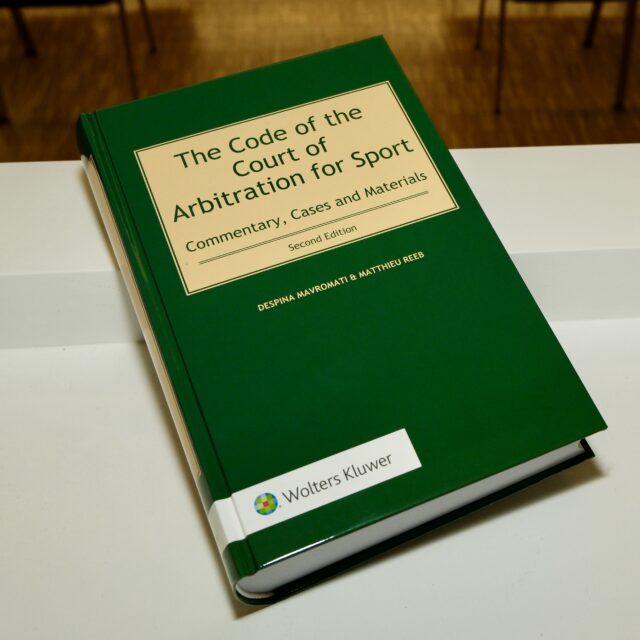
The Code of the Court of Arbitration for Sport – Commentary, Cases and Materials

by Despina Mavromati / Matthieu Reeb, Wolters Kluwer 2025

Ιn its fully revised second edition, The Code of the Court of Arbitration for Sport offers a comprehensive, article-by-article commentary of the CAS Rules. Drawing on leading CAS and Swiss Federal Tribunal case law, CAS practices and international arbitration principles, the book is an indispensable reference for practitioners, arbitrators, and scholars working in sports arbitration.

This second edition introduces significant updates, including new model documents and new chapters on the ICAS, the CAS ad hoc Rules and the CAS Anti-Doping Division Rules during the Olympic Games.

Order Here