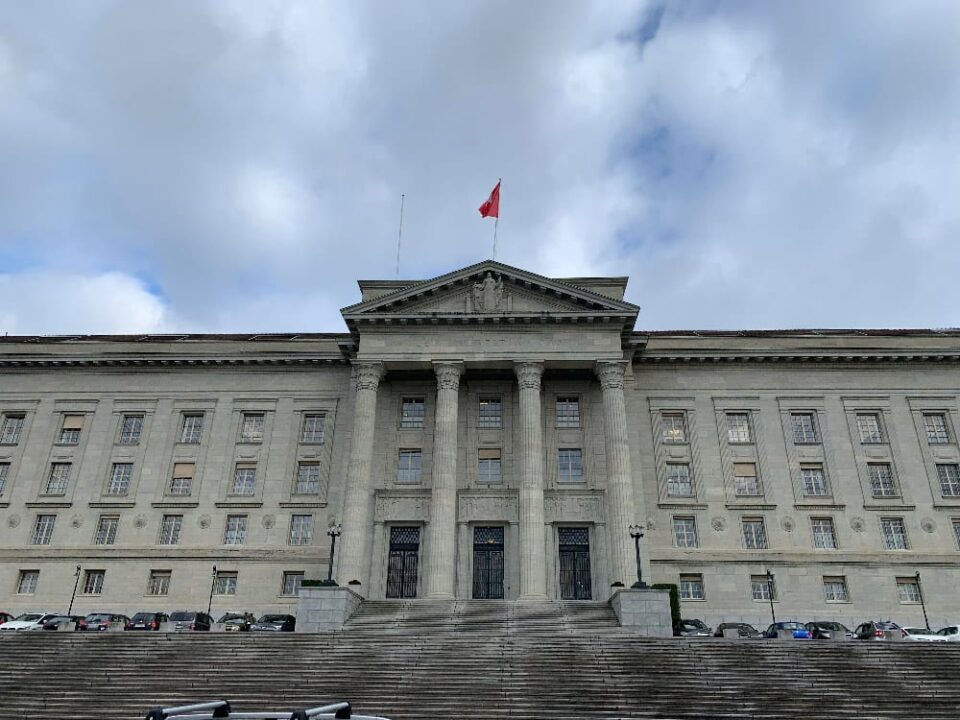
Sports Arbitration class at the University of Geneva (with Prof. Jacques de Werra)
November 18, 2022
Despina Mavromati gave a lecture on sports arbitration during the sports law seminar organised by Prof. Jacques de Werra at the University of Geneva on 18 November 2022 (Mémoire et Séminaire – Droit du sport: aspects de droit privé).
Sport Dispute Resolution Centre of Canada – CAS Annual Conference in Vancouver
February 13, 2016
Despina Mavromati, Justice Graeme Mew and Mr Paul Godin presented the Perspectives and Contraints of Mediation in Sports Disputes at the SDRCC Annual Conference in Vancouver on February 11, 2016.
Soirée de l’Association Suisse de Droit du Sport (ASDS) à Lausanne
March 20, 2025
On 18 March 2025, the Soirée de droit du sport organized by the Association Suisse de Droit du Sport (ASDS) took place at the Maison du Sport International in Lausanne. The event brought together legal professionals and academics to discuss pressing issues in sports law.
Dr. Despina Mavromati spoke alongside Giulio Palermo, addressing the recent Opinion of Advocate General Ćapeta in the Seraing case, examining its implications in the context of the Achmea judgment and the ongoing debate over the compatibility of arbitration clauses with EU law.
SLA webinar: Immigration issues and sponsoring opportunities for Athletes
May 8, 2023
On the International Women’s Day, Dr. Despina Mavromati moderated a panel of female lawyers discussing immigration issues and sponsoring opportunities of international athletes. Find more information about the Sports Lawyers Association (SLA) and its events here.
Erroneous judgment on Jurisdiction / violation of public policy (inadmissible); violation of the parties’ right to be heard (unfounded)
The Issue Termination of a football contract of employment by the player with just cause – Deciding in equity without the parties’ permission (instead of applying a particular set of rules) is not a ground for annulment of the arbitral award based on Art. 190 (2) (b) PILA
The Facts
On 17 November 2016, the CAS rejected the appeal filed by the Football Player Z (the Player) against a FIFA DRC Decision between the Player and the Football Club X (the Club). The CAS also partially upheld the appeal filed by the same Club X, ordering it to pay the Player a total of USD 366’166 for unpaid salaries. However, it did not order compensation for breach of contract without just cause (under the provisions of Art. 17 (1) of the FIFA Regulations on the Status and Transfer of Players, RSTP).
In the subsequent appeal before the Swiss Federal Tribunal, the Appellant (the Club) attacked the Award on the ground that the Arbitral Tribunal ruled on the case in equity instead of applying a specific set of rules (in casu the Swiss Code of Obligations). The Appellant employed the same argument but alleging the various grounds for annulment of an arbitral award under Art. 190 (2) Swiss Private International Law Act (PILA).
Deciding in equity is not a ground for annulment of the award based on Art. 190 (2) b PILA
More specifically, the Club alleged violation of Article 190 (2) (b) PILA (which relates to the erroneous jurisdiction of the arbitral tribunal) because the Panel ruled in equity and therefore ruled “extra potestatem”. The Federal Tribunal rejected this ground as inadmissible since deciding in equity (without the parties’ authorization) might constitute an irregularity which does not affect the jurisdiction of the arbitral tribunal in the sense of Art. 190 (2) b PILA (4A_40/2017 at 3).
It is worth adding that a similar question (ruling ex aequo et bono instead of applying a specific set of rules) was also dealt with in a previous SFT judgment in 2012 (SFT 4A_14/2012 of 2 May 2012, at 3.2.2, a commercial arbitration procedure). In this case, the SFT had acknowledged that ruling ex aequo et bono was an irregularity that falls outside the scope of jurisdiction (even if this question was unclear in the doctrine). It further held that this irregularity could somehow relate to the violation of public policy (Art. 190 (2) (e) PILA, see ATF 116 II 634 at 4a) if it meets the conditions for violation of public policy. In any event, there is no such violation if the Panel simply reinforces its legal reasoning and does not abandon the realm of the law to go into ex aequo et bono.
Criticisms related to the non-application or the incorrect application of a specific legal provision fall outside the scope of Art. 190 (2) d PILA
The Appellant equally attacked the CAS Award for violation of his right to be heard (Art. 190 (2) d PILA) because the Panel failed to expressly state in its award what law it applied and the reasons why it did not apply the law that corresponded to the applicable regulations of FIFA and CAS and the agreement between the parties (4A_40/2017 at 4.2).
The Federal Tribunal dismissed the aforementioned argument by holding that the Panel had indeed dedicated an entire section analyzing the question of applicable law in which it reserved itself the right to apply Swiss law subsidiarily, according to the pertinent FIFA and CAS Rules.
The CAS Panel had further concluded that the Player had terminated the contract of employment with just cause and on such basis the Club had to pay the unpaid salaries to the Player. However, and based on the specificity of sport (provided for in Art. 17 of the FIFA RSTP) the Panel found that the club only owed the outstanding salaries for having terminated the contract without just cause.
The Federal Tribunal concluded that the Panel did not violate the Appellant’s right to be heard through its analysis. It considered that, in reality, the Appellant was criticizing the fact that the Panel did not apply – or inappropriately applied – a specific legal provision. However, said criticisms fall outside the scope of review of the Federal Tribunal under Art. 190 (2) PILA (4A_40.2017 at 4.2).
The Takeaway
In essence, this was a very short judgment where the Panel swiftly dismissed the one and sole argument that the Appellant raised by invoking the violation of Art. 190 (2) PILA under different angles: erroneous jurisdiction, violation of his right to be heard and, finally, violation of public policy – however without further comments on the last ground, see 4A_40/2017 at 5). There are very few takeaways from this judgment. The parties invoking various grounds for appeal (even based on the same main argument, as it was the case here) must develop each ground separately and establish the reasons that the particular argument / situation violated the particular provision of Art. 190 (2) PILA (see also Art. 77 (3) of the Swiss LTF (Law of the Federal Tribunal); see 4A_40/2017 at 5).
A. v. IWF (doping), Parties’ right to be heard and Public Policy Judgment 4A_80/2017 of 25 July 2017
The Issue
Request for an expert report should be unequivocally made before the arbitral tribunal / Violation of the parties’ right to be heard requires to establish how the judicial oversight deprived a party from introducing and proving its position.
The Appellant (Alexei Lovchev) is a Russian weightlifter at international level who participated in the 2015 World Championships of Weightlifting in Houston, USA, as a member of the Russian team and won the gold medal and set two world records.
In November 2015, the Appellant underwent a doping control that resulted in an Adverse Analytical Finding (AAF) and showed the presence of the prohibited substance Ipamorelin in the Appellant’s sample in an extremely low concentration of 0.1 ng / ml. The WADA-accredited Laboratory B (B. Laboratory) conducted the controls and both the A and the B samples were found to be positive.
Following a hearing that took place before the IWF Committee in Budapest, the Committee issued a decision disqualifying the Appellant from the 2015 World Championships and imposing a sanction of ineligibility of four years. The IWF Committee held that it was comfortably satisfied that the analytical reports confirmed the existence of the prohibited substance Ipamorelin in the Appellant’s sample.
The Appellant appealed this decision to the Court of Arbitration for Sport (CAS), which confirmed the IWF decision with an arbitral award rendered on December 1, 2016. The Arbitrators were The Hon. Michael J. Beloff QC (Chairman), Prof. Ulrich Haas & Prof. Luigi Fumagalli.
The Federal Tribunal judgment
The Appellant lodged a civil law appeal to the Swiss Federal Tribunal requesting to annul the CAS Award and to revert the case back to CAS for a new decision, invoking in particular a violation of his right to be heard and a violation of public policy.
a) Violation of the parties’ right to be heard / equality of the parties
In essence, the Appellant argued that the CAS Panel violated his right to be heard by wrongly appreciating the concentration of the prohibited substance in question (1 ng/ml instead of 0.1 ng/ml). The Swiss Federal Tribunal dismissed this argument as not being part of the violation of the parties’ right to be heard (or public policy). In accordance with the well-established jurisprudence of the Federal Tribunal, a manifestly false or conflicting finding alone is not sufficient to annul an international arbitration award.
Furthermore, the Appellant alleged a violation of his right to be heard based on the fact that the CAS wrongly refused to admit his request for an expert report on the Limits of Detection [LOD], on Measurement Uncertainty [MU], and another analysis of the B sample. However, as it could be found from the file of the CAS proceedings, the Appellant merely requested that the Respondent disclose the parameters and criteria for LOD and MU for Ipamorelin but had not asked for an expert report on LOD and MU.
The other point in the Appellant’s plea before the Federal Tribunal concerned his request to have the analysis of the B sample conducted by the WADA-accredited laboratory but using an alternative detection method. The Federal Tribunal equally rejected this argument as inadmissible criticism of appellatory nature in that the Appellant failed to make a plea under Article 190 (2) PILA for his considerations that diverged from the Panel’s assessment (4A_80/2017 at 6.2). The Federal Tribunal therefore limited itself in controlling that the CAS Panel followed the procedure provided for in the IWF Anti-Doping Rules (the Appellant had the burden to rebut the presumption – based on the standard of a balance of probabilities) – of the violation of the anti-doping rules, which he failed to do in the case at hand (4A_80/2017 at 6.3). In particular, the Appellant should have raised doubts as to the results of the B. Laboratory (which were found to have complied with the applicable standards). The Appellant further alleged a violation of the principle of equal treatment because the CAS did not reveal a third analysis carried out by the B. Laboratory, but failed to substantiate in a sufficient manner why this was linked to the violation of the principle of equal treatment.
b) Violation of public policy
Lastly, the Appellant tried to invoke a violation of the principle of good faith and the prohibition of abuse of rights based on the four-year ban on exercising his professional activity (which, he argued, constituted a breach of public policy). Again, this was swiftly dismissed by the Federal Tribunal because the Appellant failed to substantiate how the different assessment of evidence by the Panel infringed public policy.
The Takeaway
This Federal Tribunal judgment reiterated the limits in validly alleging a breach of a parties’ right to be heard: It is clearly insufficient to allege such violation due to a wrong interpretation made by the arbitral tribunal. In other words, a manifestly false or conflicting finding alone is not sufficient to annul an international arbitration award. It is necessary to establish that, due to the judicial oversight of the arbitral tribunal, the concerned party was deprived of introducing and proving its position with respect to a procedural issue (BGE 127 III 576 E. 2 f. p. 580; 4A_80/2017 at 4).
Another point to retain is the importance to make a clear, unequivocal and official request for an expert report before the arbitral tribunal if a party is to bring forward a violation of his right to be heard based on this ground at a later stage (i.e., before the Swiss Federal Tribunal, see 4A_80/2017, at 5).
SFT 4A_548/2019 & 4A_550/2019, Judgment of April 29, 2020, A, B, C v. CAF
Appeal against the CAS Award CAS 2019/A/6348 & 2019/A/6351
This dispute arose between a national football federation, two players (Appellants) and the African Football Confederation (CAF, Respondent) over the African Cup of Nations U17 (CAN U17), an African football tournament organized at the continental level for players under 17, whose first and second teams qualify for the FIFA U-17 World Cup.
The team that finished second, as revealed following a subsequent investigation, included two players not eligible to play because of their age. Following CAF disciplinary decisions that cancelled the disputed match and issued disciplinary sanctions against the team, the third-place team was then ranked as second and thus qualified for the FIFA U17 World Cup in 2019. The decision was confirmed by the CAS in appeal.
In particular, the CAS held that the Appellants should have directed their appeals not only against the Confederation but also against the federation that was qualified in their place. In the subsequent motion to set aside the CAS Award, the SFT considered the admissibility question of legal interest worthy of protection on behalf of the appellants, to the extent that the tournaments had already taken place. The SFT avoided dealing with the question insofar as it eventually dismissed the appeals on the merits.
This is an interesting case showing the conundrum of procedural requirements in disciplinary proceedings involving sports federations. While – normally– a party seeking the annulment of a disciplinary decision of a sports federation will only call the latter as a party (as the only party having “standing to be sued”), the situation is different when the decision affects the rights of a third party. In these cases, the appeal should also imperatively be directed against this third party as co-respondent alongside the sports federation from which the decision emanates, so that the arbitral tribunal can ensure that its right to be heard is respected.
The Appellant attacked the panel’s finding on the “consorité passive necessaire” from the angle of procedural public policy, to the extent that such principle was not based on any applicable procedural rules. The SFT dismissed the plea since, even if the Panel’s decision were to be considered contradictory, it could still not qualify as violating procedural public policy under Article 190 (2) (e) PILA.
SFT Judgment 4A_502/2017 of June 25, 2018, appeal against a CAS Award rendered on July 11, 2017 (CAS 2016/A/4520 & 4521)
The Issue
Before the CAS: Termination of a contract of employment between a football club and a player without just cause.
Before the Swiss Federal Tribunal: The Panel’s assessment of the evidence cannot be reviewed by the Federal Tribunal.
The Facts
The case relates to the termination of a contract of employment without just cause between an Egyptian professional football club X and the professional player A. Club X requested the annulment of a CAS award that awarded the player compensation in the amount of 650’000 USD, partially confirming a previous DRC Decision. The ground invoked for the annulment of the CAS award was the violation of the Club’s right to be heard.
The Findings of the Swiss Federal Tribunal
Violation of the parties’ right to be heard and assessment of evidence by the arbitral tribunal
In essence, the Appellant club alleged a violation of its right to be heard because the Panel refused to add an amount of USD 35’000 to the outstanding debt, even though it had produced other checks to prove that payments had been made to the local tax administration, and the Panel had not questioned these elements of evidence.
The Federal Tribunal dismissed the plea for two distinct reasons. First, questions related to the assessment of evidence cannot be reviewed and fall outside the scope of the plea of the right to be heard. Second, the principal matter related to these payments was discussed only to determine whether the Appellant was entitled to make certain deductions from the Respondent’s salary for income tax purposes. There was therefore no link between this question, which was decided in favor of the Appellant, and the taking into account of checks, copies of which the Appellant produced in order to prove the partial repayment of its debt to the Respondent (at 3.2.1).
The Appellant further submitted before the SFT that the Panel should have reduced the amount by taking into account the Appellant’s internal rules but failed to do so. On this point the Panel found that it was unconvinced of the probative force of the written testimonies by the Appellant to support its claim. In the Appellant’s view, the Panel had failed to take into consideration the Financial List for Football First Team, a document which had been signed by the Respondent. Again, the Federal Tribunal dismissed the argument since it relates to the assessment of the evidence by the CAS Panel, which is non-reviewable by the SFT.
Violation of material public policy for lack of consideration of the principle of Force Majeure
The Appellant referred to the tragic events of the Port Said Stadium riot back in 2012, which had caused more than 70 deaths and were followed by the cancellation of the championship. The events had caused a massive loss of revenue related to sponsorship as well as the sale of tickets for Egyptian football clubs. According to the Appellant, the fact that the CAS Panel did not consider these events as a force majeure constituted a violation of substantive public policy.
Without questioning the gravity of the events, the CAS Panel considered that there was no causal link between the events in Port Said and the failure of the Appellant Club to pay the Respondent’s salary. Furthermore, the Panel found that the Appellant had not raised this argument until much later, without demonstrating that these same events would have led to the non-payment of the salaries of the other players of the team. Again, these findings of the Panel could not be reviewed by the Federal Tribunal and were dismissed as inadmissible without needing to check whether the force majeure falls within the scope of material public policy under Swiss international arbitration law (at 4.2.1).
Violation of material public policy through the violation of the principle of contractual fidelity
Finally, the Appellant endeavored to attack the award from the angle of violation of contractual fidelity due to an alleged misinterpretation of a contractual clause (at 4.2.2). The Federal Tribunal reiterated that such misinterpretation falls outside the scope of the principle of contractual fidelity, which would only be violated if the Panel proceeded to the required imputation after having maintained, as it did, after interpreting the contract, that such imputation was not justified.
The Takeaway
In summary, there are no revolutionary findings in this judgment but only a reminder of the wide powers of the arbitral tribunal to assess the evidence in the circumstances of the case, which cannot be reviewed by the Federal Tribunal under the scope of Art. 190 (2) (d) PILA. Also, even though the principle of force majeure theoretically falls within the scope of public policy (Art. 190 (2) (e) PILA), it is required to substantiate such allegations and show the causal link between the events that constitute the force majeure and the issues at stake.
Strict admissibility conditions in motions to set aside CAS awards – the requirement of a legally protected interest
Summary of the CAS proceedings that led to the appeal to the Swiss Federal Tribunal
In this judgment the Federal Tribunal reiterated the strict admissibility conditions in motions to set aside arbitral awards, and more particularly the requirement of a legally protected interest (or interest “worthy of protection”). The case involved an appeal against a CAS award (2016/A/4830). The CAS Award was rendered shortly before the FIFA World Cup Russia in June 2017. A football club of Cameroon requested FIFA to postpone the playing of all qualifying matches of the third round of group B “until legality is restored” within the national association (FECAFOOT). The reason alleged was that the national association was not validly represented by its President. According to the Club, this affected the designation of Cameroon’s national team.
The FIFA Secretary General summarily dismissed the request through a letter holding that the case fell outside the jurisdiction of the FIFA bodies due to its internal character. The Club subsequently filed an appeal with the CAS and requested the reprogramming of various matches, appeal dismissed by the CAS, essentially for lack of jurisdiction ratione materiae.
Legally protected interest in the annulment of a CAS award related to a competition that already took place: mission impossible?
In the subsequent motion to set aside the CAS Award, the Federal Tribunal repeated that an award denying jurisdiction is a final award (as opposed to an interim award), thereby challengeable on all grounds set out in Art. 190 (2) PILA. It further reiterated that arbitrariness is only a ground for annulment within the framework of domestic arbitration (at 2).
Most importantly, however, the Federal Tribunal analyzed its essential admissibility requirement of a legally protected interest in the annulment of the award under appeal in the context of a sporting competition. First, the interest has a practical aspect of this interest, which consists in preventing the appellant from undergoing some damage of an economic, ideal, substantive or other nature that would be caused by the decision under appeal. Second, the interest must exist not only at the time the appeal is made, but also when the decision is issued (Art. 76 (1) b Loi sur le Tribunal Fédéral, LTF).
In the particular case, the alleged interest was linked to the assumption – clearly not sufficient to establish a legal interest – that the national team of Cameroon was not “representative” of the FECAFOOT since the President of the latter was not validly elected. The Club equally failed to highlight the existence of a causal link between the appointment of the leaders of a federation and the “representativeness” of the national team. The Federal Tribunal dismissed all other arguments raised by the appellant club as purely hypothetical and therefore not sufficient to establish a legally protected interest present at the moment of the appeal to the Federal Tribunal (at 3.2.1).
The SFT held that it is technically possible to have several decisions before the enforcement tribunal, particularly when enforcement measures are inefficient.
Exceptions to the requirement of a present legally protected interest
The Federal Tribunal also highlighted that there are exceptions to the requirements of a present interest in cases where the dispute under appeal may arise again under identical or analogous circumstances, when its nature makes it impossible to adjudicate it before it loses its relevance and when, as a matter of principle, there is a sufficiently important public interest to resolve the issue in dispute (at 3.1). However, the SFT found that these conditions were not met in the case at hand.
Difference between lack of a legally protected interest at the filing of the appeal and a moot appeal (“recours sans objet”)
Finally, even if the appellant had a protected legal interest at the moment of filing of the appeal (which the Federal Tribunal denied), such an interest no longer existed and the appeal would therefore have become moot (“recours sans objet”, at 3.1). The Federal Tribunal reached this conclusion after an analysis of the FIFA World Cup program and in particular the complexity in the organization of the matches.
In summary, assumptions and hypothetical arguments are not sufficient and it is very difficult to establish and substantiate a “present” legal interest in the annulment of a CAS award in cases related to competitions which have already taken place in the past.
SFT Judgment 4A_424/2017 Athlete X. v. World Anti-Doping Agency (WADA) & World Squash Federation
Difference between the violation of ne ultra petita and the violation of the right to be heard (dismissed)
The Facts
On October 2, 2016, the professional squash player X. concluded an “Agreement” with the World Squash Federation (WSF), according to which he admitted having violated the anti-doping rules. He accepted, to this end, a one-year suspension starting on February 7, 2016 as well as the annulment of all the results obtained by him at the 2016 South-Asian Games.
The World Anti-Doping Agency (WADA) subsequently appealed against this “agreement” to the Court of Arbitration for Sport (CAS), which upheld the appeal (number 1 of the operative part). Furthremore, the CAS Panel annulled the sanction stipulated in the Agreement (number 2), imposed a four-year suspension on X. starting on February 29, 2016 (number 3), and rejected all other requests and submissions (number 8). In the subsequent appeal to the Swiss Federal Tribunal, the Athlete X. requested the annulment of the award for violation of his right to be heard and violation of the principle of ne infra petita.
The Swiss Federal Tribunal Judgment
A) The plea of violation of the Athlete’s right to be heard
In his first plea, the Athlete alleged that the Panel failed to examine an argument that he raised. More specifically, the Panel did not examine whether the conditions for a reduction of the suspension for doping to a minimum of two years for “prompt admission” were met in the present case. The conditions for the “prompt admission” are provided for in Art. 10.6.2 & 10.6.3 of the applicable Antidoping Rules. In particular, the Athlete contended that he admitted immediately the infraction of the Anti-Doping Rules of which he was accused (second condition for the application of this provision). The third condition for the application of this provision was the discretionary consent by WADA and the WSF. According to the Athlete, the WSF had given its approval and he had requested WADA’s approval in his answer.
The Federal Tribunal dismissed this argument. It did so because the application of Art. 10.6.2 requires the discretionary consent of both WADA and the WSF. First, the Panel’s finding that WADA refused to give its consent as to the application of this provision is binding upon the Federal Tribunal.
Second, the Panel found that the (cumulative) conditions for the provision were not met in the case at hand and this resulted in the Panel not applying the provision at issue (therefore there was no violation of the Athlete’s right to be heard). In summary, the fact that the Panel left unanswered whether the Athlete’s prompt admission (one of the two other cumulative conditions) was not relevant in this respect.
B) The plea of violation of the principle of Ne Infra Petita
In a second plea, based on Art. 190 (2) (c) PILA, the Athlete alleged that the Panel omitted to address one of the claims, which would result in a formal denial of justice. The Federal Tribunal proceeded to the interpretation of the word “claims” (“conclusions”, in French) which means all requests and submissions of the parties. However, the plea does not cover the panel’s omission to address a question important for the outcome of the case. This is the difference between a denial of justice / ne utra petita plea and the one of the violation of the parties’ right to be heard.
Furthermore, the Athlete referred to one of his own claims, under which he requested the reduction of the suspension period based on Art. 10.6.3 of the Rules: By not examining the question of his prompt admission (and by not rejecting it in its operative part), the Panel had allegedly violated Art. 190 (2) (c) PILA. In his view, it was not sufficient that the Panel rejected all the other requests and submissions in the number 8 of the operative part of the award.
Again, the Federal Tribunal dismissed this argument after comparing numbers 8 and 3 of the operative part of the award to the reasons of the award, and finding that the CAS Panel had sufficiently addressed the Appellant’s claim.
The Takeaway
Overall, this is a judgment of no particular interest. One point to retain is the difference between the plea of the violation of the parties’ right to be heard and the plea of “ne infra petita”: the former includes the oversight of submissions and legal arguments that were regularly raised and they could have influenced the outcome of the case. The latter refers to the Panel’s omission to address one of the claims (all requests and submissions) but not the Panel’s omission to address a question important for the outcome of the case. As found in a previous judgment, there is a distinction between claims / requests (“Rechtsbegehren”) and pleas in defense of one’s claims (“Verteidigungsmittel”).
Compatibility of an Agent’s Commission Fee with Public Policy
The Issue Validity of a football agent’s (intermediary’s) total commission fee for the signing of a football player with a club that represents ten times the agreed annual salary of the player under Swiss law – Compatibility of such a commission fee with substantive public policy (Art. 190 (2) (e) PILA.
The Facts Following an award rendered by the Court of Arbitration for Sport (CAS) on April 19, 2017, the professional football club X. (the Club) was ordered to pay to the former player’s Intermediary A. (the Intermediary) the outstanding amount of a commission of EUR 2’700’000, plus interest, according to the contract concluded on August 23, 2013 (the total commission fee was EUR 3’100’000). As per the contract, the Intermediary undertook to ensure the transfer of Player B. to the Club for the payment of a commission. The transfer took place in 2014 and the Player joined the Club for a duration of five years for a total remuneration of EUR 1’360’000 (EUR 272’000 annually).
The proceedings before the Swiss Federal Tribunal The appeal of Football Club X. to the SFT The Club subsequently filed an appeal to the Swiss Federal Tribunal (SFT Judgment 4A_312/2017 of 27 November 2017) requesting the annulment of the award for violation of substantive public policy (Art. 190 (2) (e) Private International Law Act, PILA).1 It alleged that by validating a contract that included an excessive commission fee, the CAS Panel violated the principle of public policy. It argued that the agreement was a brokerage contract on the placement of an employee with an employer. This is a sensitive and regulated area under Swiss law (which was the law applicable to the merits under Art. R45 CAS Code).
More specifically, the Club considered excessive the payment of EUR 3’100’000, compared to the salary of the Player for a period of five years which was EUR 1’360’000. This commission represented 228% of the salary of the Player for the full duration of the employment contract, i.e., more than ten times the annual salary of the Player. According to the Club, by allowing a commission that was grossly disproportionate to the Player’s salary violated public policy. More particularly, it violated the prohibition of excessive commissions in the field of brokerage for the placement of a worker (at 3.2.2).
The SFT judgment
Not a specific notion of public policy adapted to sports / football
The Swiss Federal Tribunal proceeded to a detailed analysis of the plea invoked but refused to make a general statement as to when high commission fees are “excessive”. It held that each case is different and it has to take into account the specific circumstances of each case. Referring to a previous judgment related to the transfer of a football player, the Federal Tribunal found that the particularities of sports and more particularly football should not create a specific notion of substantive public policy, since this would also contravene the principle of legal certainty when it comes to the definition of this concept. Furthermore, and even though sports arbitration bears some particularities compared to commercial arbitration (e.g., with respect to the waiver of the right to appeal, ATF 133 III 235 at 4.3. 2.2, p. 244), these particularities should not extend to the concept of substantive public policy (at 3.3.2).
Mandatory provisions under Swiss law and violation of public policy under Art. 190 (2) (e) PILA
Another point that was dealt with by the Federal Tribunal was the issue of contractual penalties and the duty of the judge to reduce them when they are excessive under Art. 163 (3) Swiss Code of Obligations (CO) (at 3.3.3). Even though this is a mandatory provision under Swiss law (meaning that the judge should apply it even in the absence of a request by the parties concerned), like Art. 417 CO and other mandatory laws, its violation does not amount to a violation of public policy of Art. 190 (2) (e) PILA.
Placing the commission fee into a broader context
Importantly, the Federal Tribunal endorsed the CAS Panel’s view in that the determination of a commission fee as excessive should not be made by the comparison of the amount to the agreed salary of the player, nor should there be a fixed percentage for the placement of workers irrespective of the other circumstances surrounding the case (at 3.3.3).
The Federal Tribunal repeated the analysis made by the CAS Panel, which consisted of placing the commission fee into a broader context: even though the amount of EUR 3’100’000 seemed too high compared to the annual salary of the player (more than ten times higher), the Club is a renowned football club that discovered a young footballer and employed the services of the Intermediary in order to conclude the contract of employment. The parties agreed on the amount in writing and the Club waited until the claim to the CAS in order to argue that this amount was excessive.
Doctrine of unforeseeability vs. principle of contractual fidelity
Moreover, the SFT opined, that it is not possible to oppose the doctrine of unforeseeability (clausula rebus sic stantibus) to the principle of contractual fidelity (pacta sunt servanda). This is so because the potential of a player cannot be considered as an “unforeseeable” circumstance. The Federal Tribunal found that the factual findings of the CAS Panel bind the Court (at 3.3.4.2). Also, it found that the Club failed to establish how the payment of the commission fee to the Intermediary would suppress its economic freedom to such an extent that it would endanger the basis of its existence.
Overall, it endorsed the CAS Panel’s position and found that, by allowing the commission fee, the CAS Panel did not violate substantive public policy.
The Takeaway: No Specific Notion of Public Policy in the field of Sports Arbitration / Football
This is an interesting case where the Federal Tribunal confirmed that substantive public policy should not be adapted to the specific field in question, in casu the field of sports and, more particularly, football, since this could lead to lack of legal certainty. It also found that it is not possible to issue general criteria as to when commission fees are excessive (in violation of Art. 190 (2) (e) PILA). It should rather examine each case separately, based on the particular circumstances at issue.
While the Appellant Club pleaded for the applicability of specific Swiss laws prohibiting excessive commissions in the field of brokerage for the placement of workers, the Federal Tribunal held that Art. 27 (2) CC generally covers similar abuses. Art. 27 prohibits the contractual restriction of the economic freedom, which however is excessive only when it suppresses the economic freedom of the party concerned to such an extent that it would endanger the basis of its existence.
An interesting procedural point of the judgment relates to the facts established in the arbitral award that generally bind the Federal Tribunal: it is not necessary for the findings to appear in the factual summary of the award but they can also be part of its legal reasoning.2
The FIFA Regulations on working with Football Intermediaries
Overall, the Federal Tribunal reiterated the limited scope of substantive public policy, notwithstanding the particularities of sports arbitration and refrained (as did the CAS Panel in its award) from issuing a definitive opinion on when a commission fee is excessive. However, it must also be noted that the FIFA Regulations on working with Intermediaries3that set limits to the total commission fee (and which the Panel did not apply because they were not yet in force at the time of the relevant facts) should somehow clarify the situation and regulate this field, at least when it comes to the cases falling within the scope of the FIFA Regulations.
SFT Judgment 4A_592/2017 Agent A. v. Football Club B.
Agent A. v. Football Club B. – The Issue
1) The plea of violation of the right to be heard is not an end in itself – the impact on the outcome of the case must be established
2) Request for legal aid is possible in setting aside proceedings before the SFT, but is to be dismissed when there is no chance of success
The Federal Tribunal Judgment
The case concerned the payment of EUR 84’764 for the transfer of a player and other expenses from Club B to the professional players’ Agent A. After an unsuccessful claim before the Single Judge of the FIFA Player’s Status Committee, Agent A filed an appeal to the Court of Arbitration for Sport (CAS), which dismissed the appeal after interpreting the contract under Swiss law.
A) Violation of the parties’ right to be heard & the principle of equality of the parties
In the subsequent appeal to the Swiss Federal Tribunal, Agent A alleged the Panel’s violation of the principle of equality of the parties and the right to be heard in adversarial proceedings (Art. 190 para. 2 (b) PILA). The Federal Tribunal reiterated that the right to be heard is a constitutional guarantee with a formal character, i.e., independently of the chances of success of the appeal itself (at 4.1.1 f.). However, such right is not an “end in itself”. It rather serves as a means to avoid an arbitral procedure that will result in an erroneous judgment due to the fact that the parties could not participate in the procedure. This is particularly so when it comes to the administration of evidence.
In this respect, and notwithstanding the formal character of that right, it is important to show the impact of such violation on the arbitral proceedings (see also SFT 6B_986/2016 of September 20, 2017, at 1.4.1). This means that the party alleging such violation must prove that all facts, proof and legal arguments brought forward but disregarded by the arbitral tribunal could influence the outcome of the case. By the same token, in case of alleged violation of the equality of the parties, it must at least be shown how the proceedings would be different if the alleged violations of the right to be heard had not been committed.
B) Need to provide reasons for the violation of the parties’ right to be heard
In the case at hand, the Federal Tribunal found that Agent A simply referred to the violation of his right to be heard for being refused to exercise his right to reply. The Appellant equally referred to the proceedings and the arguments raised by the Sole Arbitrator for refusing to take into account the evidence submitted after the answer of the respondent (at 4.2.1). He criticized said arguments from the perspective of the parties’ right to be heard (under Art. 190 (2) (d) PILA). However, the Federal Tribunal held that these vague statements
More specifically, the appeal was manifestly inadmissible (for lack of reasoning) and thereby the chances of success criterion of Art. 64 para. 1 LTF was obviously not fulfilled. Even in less straightforward cases,
this condition would be very difficult to meet given that the “usual” chances of success in proceedings to set aside an arbitral award are less than 10%.
4A_170 / 2017 & 4A_194 / 2017 , Judgment of May 22, 2018, Club L. v. FECAFOOT and FECAFOOT v. Club L. Appeal against the CAS award rendered on February 27, 2017 (CAS 2016/A/4415)
The Facts
The case before the CAS involved a dispute between a Cameroonian football club playing in the first division (Etoile Filante de Garoua, the Club) and the national football federation FECAFOOT. Within a larger context of difficulties facing FECAFOOT since its 2013 elections and a series of related CAS awards, the Club filed an appeal to the CAS (TAS 2016/A/4415) requesting, inter alia, the reinstatement of the Executive Committee until the final elections. In a preliminary award on jurisdiction and admissibility, the Sole Arbitrator held that the CAS had jurisdiction ratione materiae, but the appeal was inadmissible for being late.
Time Limit to Appeal to the CAS (Art. R49 CAS Code)
The entire debate before the Federal Tribunal related to the time limit to appeal to the CAS. According to Art. R49 of the CAS Code, in the absence of a time limit in the rules of the federation, the time limit for appeal is twenty-one days from the receipt of the decision appealed against. The Sole Arbitrator found that there was a contradiction in the relevant rules and statutes of the federation but the rule in force at that time provided for 20 days, and, therefore, the appeal was inadmissible for being filed after 21 days.
Before the Swiss Federal Tribunal, the Appellant club invoked a violation of its right to be heard, erroneous finding on jurisdiction and a violation of public policy (which was swiftly dismissed and does not merit any further mention).
Time Limit to appeal and Violation of the Right to be Heard: Conditions
The only relatively interesting point from the angle of the violation of the right to be heard is the need to draw the attention of the arbitrator to the specific piece of evidence or argument made during the proceedings. In this respect, the Federal Tribunal found that it was not sufficient to file the CAS award in which the Panel had admitted a time limit of 21 days, but the Appellant had to draw the attention of the Arbitrator to the specific argument raised. Moreover, the appellant’s allegation that the operative part of the decision indicated 21 days to appeal to the CAS could not be traced in the award under appeal.
Lack of Jurisdiction “ratione temporis” or Inadmissibility?
In an argument raised by the Appellant from the angle of jurisdiction ratione temporis, the Federal Tribunal left, once again, the question whether the late filing of the appeal entails the inadmissibility or the dismissal for lack of jurisdiction open (5.2).
Legal Interest of the Appeal filed by FECAFOOT
As regards the appeal filed by FECAFOOT (that the Federal Tribunal decided to join to the appeal filed by the Club), it was found that FECAFOOT lacked legal interest because the argument raised (the lack of legitimacy of the CAS Award and the detrimental effect of its publication in Cameroon) could not be found in the arbitrator’s findings and was thus inadmissible. In any event, such argument was insufficient to establish the legal interest of this association in appealing against the disputed award.
Australian Football (“Essendon”) Doping Case / De novo review by the CAS – objection to the full power of review
SFT Judgment 4A_102/2016, A, B, C et al v. WADA, AFL & ASADA
The Issue in Essendon
Before the CAS: De novo review of a doping-related decision (“Essendon”) by the CAS Panel – violation of the anti-doping regulations
Before the SFT: Objections of the Essendon Players to the scope of review of the arbitral tribunal
The Facts in the Essendon CAS appeal
This Federal Tribunal judgment was the last step in a long series of proceedings over the widely known supplement program of the Australian Rules Football Club Essendon (the Club). The 34 players (the Appellants) were all professional players for the Essendon Club in the Australian Football League. The Club introduced a program of supplements for its players in September 2011, administering injections and allegedly using a prohibited substance. After ASADA’s initial investigations and the AFL proceedings against the Appellants, the AFL Anti-Doping Tribunal rendered a decision on March 31, 2015 finding that there was no evidence of a violation of the applicable Anti-Doping Regulations.
WADA subsequently filed an appeal to the Court of Arbitration for Sport (CAS), and the Panel was composed of the Hon. Michael J. Beloff QC, Romano Subiotto QC and the Hon. James Spigelman QC. AFL and ASADA were also allowed to participate in the proceedings. Pursuant to Art. R57 of the CAS Code, the CAS held that it would decide on the appeal de novo and would also take into account new evidence filed by all parties involved. The Panel ruled through a final award rendered on January 11, 2016, finding that the players were in violation of the relevant Anti-Doping Regulations imposing a two-year ineligibility period.
The appeal to the Swiss Federal Tribunal against the Essendon CAS Award
Existence and Scope of the Arbitration Agreement in the Essendon case: Full Power of Review (Art. R57) vs. Limited Review in Appeal
In the civil law appeal to the Federal Tribunal, the Appellants principally requested the annulment of the CAS Award for lack of jurisdiction. In essence, the Appellants alleged that due to the de novo assessment, the CAS Panel exceeded its jurisdiction (Art. 190 (2) (b) PILA) and, alternatively, it violated public policy (Art. 190 (2) (e) PILA). More specifically, at the relevant time, the 2010 version of the AFL Anti-Doping Code provided for a limited review in appeal (i.e., error in law, “unreasonableness” and manifest disproportionality). The full power of review came only after the 2015 version of the rules, which however was not applicable at the relevant time of the facts.
After reiterating the general principles applying to arbitration clauses under Swiss law, the Federal Tribunal proceeded to the interpretation of the “defective” arbitration clause in question according to the principle of good faith (i.e., the presumable will in the way it would and had to have been understood, in good faith, by the respective recipient of the declaration). Accordingly, once it is established that the parties wanted to exclude the dispute from state jurisdiction and submit it to arbitration, the principle of utility applies in order to give to the arbitration clause a meaning that would “save” the arbitration clause. The Federal Tribunal reiterated the fact that a jurisdictional defense must be raised before the submission to the merits (“Einlassung”) in accordance with the principle of good faith.
Initial jurisdictional Objections of the Essendon Players fail upon subsequent signing – without reservation – of the Order of Procedure
In the particular case, the Appellants initially raised their objections as to the de novo review of the Panel but did not subsequently question the power of review by the CAS after the latter decided to review the case de novo and hear new evidence (3.3). The Appellants even signed – without reservations – the Order of Procedure according to which the CAS Panel would decide the case in compliance with the CAS Code. They subsequently made full use of the de novo hearing, by submitting new pieces of evidence (including expert opinions) and insisted upon extensions concerning the backgrounds of certain laboratory tests, without making any reservation.
Relationship between Article R57 CAS Code (de novo) and the Regulations of the National Association
The Federal Tribunal also made an interesting comment with respect to the relationship between the CAS Procedural Rules and the specific regulations of the national association and noted that Article R57 of the Code (de novo review by the CAS Panel) did not foresee any reservation giving priority to the respective regulations of national associations. The Federal Tribunal concluded that the Appellants had lost their right to appeal and rejected the appeal.
As a side note, the Federal Tribunal also found that Article R57 of the CAS Code is a binding procedural provision, particularly in doping cases, it is used in order to ensure the observation of international standards within the worldwide fight against doping and a standard application of the relevant anti-doping regulations. Even if the view of the Appellants were to be retained with respect to the application of the national regulations (providing for narrowly defined grounds for appeal) notwithstanding the compulsory procedural rules of the CAS (providing for a full power of review), the arbitration agreement would still not be null and void per se but would be an agreement with “partially-impossible content” (BGE 138 III 29 at 2.3).
The Takeaway
Overall, this is an important judgment; it is interesting to note that the Appellants merely challenged the scope of the arbitration agreement — and not its existence. Another interesting point to retain is that – even if a party raises its objections with respect to jurisdiction at an early stage of the proceedings, its subsequent behavior and, particularly, the signing of the order of procedure without reservations will preclude such party from objecting to the jurisdiction / scope of review at the setting aside proceedings.
Swiss Federal Supreme Court Judgment of 20 May 2025, A. v. UIB
Motion to set aside CAS Award CAS 2020/A/7509 of 18 November 2024
The case concerns a former Russian biathlete, multiple Olympic medallist, whose Athlete Biological Passport (ABP), based on 17 blood samples collected between 2010 and 2014, showed highly abnormal haemoglobin values suggesting blood manipulation. After a multi-year expert review process – including four successive joint expert reports – the International Biathlon Union (IBU) brought the case before the CAS Anti-Doping Division (CAD). In October 2020, CAD found an anti-doping rule violation (ADRV), imposed a four-year suspension, and disqualified all results from 2010–2014. The athlete appealed to the CAS Appeals Division and, in parallel, filed a motion with the Swiss Federal Tribunal (SFT), which the SFT dismissed as inadmissible in June 2021 (see my note on the SFT 4A_612/2020 here). After CAS confirmed CAD’s jurisdiction in 2022, the SFT again dismissed the athlete’s challenge (see my note on SFT 4A_232/2022 here). The CAS ultimately rejected the appeal in November 2024, confirming the ADRV, which led to the present motion before the SFT.
In essence, the CAS Panel held that all ABP samples were valid and found that the genetic variation invoked by the athlete (EGLN2 mutation) could not explain the haemoglobin patterns. It accepted as admissible the genetic expert report prepared at WADA’s request and reasoned that, even hypothetically assuming elevated baseline haemoglobin, the significant fluctuations documented remained unexplained. The Panel highlighted circumstantial indicators: peaks coinciding with major competitions and the athlete’s status as a “protected athlete” in the Sochi-era Russian doping system. It concluded, to its comfortable satisfaction, that an ADRV occurred between 2010 and 2014 and confirmed the full set of sanctions.
Before the SFT, the athlete relied exclusively on material public policy (Art. 190 para. 2 (e) PILA), framing his arguments as violations of the presumption of innocence, the in dubio pro reo principle, and legal certainty. He claimed that CAS had improperly shifted the burden of proof, failed to resolve scientific doubt regarding genetic explanations, and relied on evidence from long-past events in breach of legal security. He also argued that the SFT should directly apply Art. 6 ECHR in light of the ECtHR’s Semenya judgment.
The SFT rejected the appeal. Similar to other judgments, and since the Semenya ECHR judgment was still pending before the Grand Chamber (see my note here) it reiterated that Art. 6 ECHR cannot be invoked directly in challenges against international arbitration awards. Moreover, disciplinary proceedings of private sports bodies do not trigger the criminal-law standards of presumption of innocence or in dubio pro reo. It also noted that CAS had no reasonable doubts regarding the ADRV after assessing the full evidentiary record. The allegation of breach of “legal certainty” was dismissed as unfounded, since the athlete had been informed of the investigation as early as 2017, and the applicable 10-year prescription period had not expired. The SFT held that none of the athlete’s objections reached the extremely high threshold required to establish a violation of Swiss ordre public, and the appeal was therefore rejected.
Swiss Federal Supreme Court Judgment of 8 October 2025, A. v. RUSADA, ISU & WADA
Request for revision of the CAS Award CAS 2023/A/9451, CAS 2023/A/9455 and CAS 2023/A/9456 of 29 January 2024
This decision concerns the Russian figure skater Kamila Valieva’s (the Athlete) request for revision of the CAS award issued on 29 January 2024 in the widely publicised doping case involving prohibited substance trimetazidine (see also my earlier notes on the CAS Ad Hoc Decision on her provisional suspension). The subsequent CAS award had imposed a four-year period of ineligibility starting 25 December 2021 and disqualified all results thereafter. The Athlete had already challenged the award before the SFT, but her motion to annul the decision was rejected on 5 September 2024 (see my note on the SFT judgment 4A_136/2024 here). The Athlete then sought to reopen the proceedings, relying on an allegedly undisclosed expert report by Professor B., which she claimed supported her contamination explanation and had been deliberately withheld by RUSADA and WADA during the CAS proceedings. The revision request was filed on 10 December 2024.
The revision proceedings were procedurally complex, marked by late filings and disputes over admissibility – particularly RUSADA’s failure to comply with Swiss procedural rules on notifications abroad, leading to its submissions being declared inadmissible. The SFT emphasised that revision under Art. 190a PILA is exceptional and strictly limited to situations where a party discovers pre-existing facts or evidence, not previously accessible despite due diligence, and which would be conclusive for the outcome. WADA and the ISU contested the admissibility and relevance of the alleged “new evidence”, and WADA produced a September 2022 document from Prof. B. (the only version it claims to have received), arguing that the report was not favourable and certainly not outcome-determinative.
The SFT held that the revision request was inadmissible or unfounded for multiple independent reasons. First, the alleged “new evidence” was not produced and its existence was based primarily on a media article from September 2024, which cannot constitute a pre-existing fact under Art. 190a para. 1 (a) PILA. Even assuming the 19 September 2022 document constituted the report in question, it was not conclusive: it merely stated that contamination was “theoretically possible”, but still considered iintentional ingestion the most plausible scenario, and this was fully consistent with CAS’s own findings. The CAS panel had rejected the contamination explanation not on scientific grounds but due to insufficient factual proof by the athlete. The SFT further found no substantiation of alleged procedural fraud by WADA or RUSADA from the non-production of a private expert report : the non-production of a private expert report that was not a part of the investigation file.
The SFT dismissed the request, reaffirming the strict and exceptional nature of revision in international arbitration (“une arme à manier avec prudence”) and its role in preserving legal certainty: revision cannot serve as a disguised appeal nor provide a second opportunity to litigate issues already assessed by CAS. Most importantly, the alleged report – even if it existed – would not have altered the outcome, as the CAS award focused on factual deficiencies in the athlete’s contamination scenario.
Swiss Federal Supreme Court Judgment of 16 June 2025, A. v. FC B
Motion to set aside CAS Award CAS 2023/A/9923 of 17 December 2024
This case forms part of a series of SFT judgments relating to the “famous” Clause 49 in Hungarian football contracts of employment (see also my note on the more recent – and important – case 4A_92/2025 here). This case concerned the termination, by a player (the Player) of his contract of employment with Hungarian Football Club (Club B) after a disagreement regarding his relegation to the second team and alleged contractual breaches. The Player filed a claim with the FIFA Dispute Resolution Chamber (DRC), which asserted jurisdiction under Art. 22 RSTP and awarded him compensation. The Club appealed to the CAS, arguing that Clause 49 of the contract conferred exclusive jurisdiction to the Hungarian Administrative and Labour Court for labour disputes. CAS Accepted the claim and overturned the FIFA decision.
Clause 49 read as follows: “49. The Parties agree that they shall make efforts to settle their possible dispute in amicable way by negotiations. lf these efforts fail – in cases determined by the rules of MLSZ and FIFA – the Parties may turn to the organizational units with MLSZ or FIFA scope of authority, in case of labour dispute to the Administrative and Labour Court having competence and scope of authority, and in all other disputes arising out of their legal relationship the Parties stipulate the exclusive jurisdiction of the Sports Standing Arbitration Court based on the Article 47 of the Sports Law. The number of arbitrators is three; the procedure is determined by the Procedural Rules of the Arbitration Court.”
In the motion to the SFT, the Player invoked an erroneous judgment on jurisdiction (Art. 190 para. 2 b PILA), arguing that the dispute was of international dimension and that FIFA had correctly asserted jurisdiction based on Art. 22 para. 1 (b) RSTP unless the parties opted clearly and expressly in favour of a national arbitration body, conditions that the Player considered as not fulfilled.
The SFT confirmed the CAS’ finding that its jurisdiction as an appellate body could not go beyond the first instance jurisdiction (FIFA DRC) (at 1.1). It further confirmed that FIFA jurisdiction enshrined in Art. 22 (1) RSTP is not absolute but depends on the choice of the parties – who could opt for the exclusive jurisdiction of the state courts. In this regard, the CAS had rightly interpreted Clause 49 of the contract, which foresees different competent instances such as MLSZ, FIFA, Administrative and Labour Court and a “Sport Standing Arbitration Court” depending on the scope of the dispute. More specifically, the jurisdiction of the Hungarian Administrative and Labour Court was foreseen for labour law disputes, whereas the Sport Standing Arbitration Court for all other disputes. Therefore, a literal interpretation would lead to the jurisdiction of Hungarian state courts for labour law disputes such as the present dispute. The CAS also considered the fact that the football player was an experienced player aware of the terms of the contract he had signed and that there was no structural imbalance between the parties.
This is an interesting SFT judgment which clarifies the widely discussed “alternative” jurisdiction of Art 22 (1) b RSTP, providing for both the FIFA DRC and for state courts. Accordingly, and other than suggested by the Player, the SFT did not consider that there was no consent of the parties to Clause 49. The judgment confirmed that (experienced) players remain bound by forum-selection clauses in standard contracts, absent clear evidence of imbalance or coercion. Moreover, the SFT stressed that the material element in the interpretation of the jurisdiction clause was the referral to state courts, irrespective of the unclear designation of the “Administrative and Labour Court”. This brings us back to the well-established federal case law whereby the waiver to state court jurisdiction should not be easily assumed, with the SFT following a restrictive interpretation of such waiver. This applies irrespective of who seizes the arbitral tribunal, hence the distinction between employee or employer cannot be considered to be decisive.
Swiss Federal Supreme Court Judgment of 27 March 2025, FC A v. B
Motion to set aside a CAS Award CAS 2021/A/8268 of 31 October 2024
FC A (the Club) and Portuguese Coach B (the Coach) signed an employment contract in 2020 (the Contract). Article 5 of this Contract provided that “If any party for what so ever reason terminates the contract before the end of the contract, the terminating party will pay the other party an amount of EUR 204,000 […] NET of any taxes.” In March 2021, the Club dismissed the Coach, and later that year, in August 2021, the Club won the national championship. Following his dismissal, the Coach filed a claim before the FIFA Players’ Status Chamber (PSC) in April 2021 seeking salaries and compensation. The PSC partially upheld his claim, prompting him to appeal to the CAS. The CAS confirmed the PSC’s findings regarding the salaries and bonus owed and reformed the decision by granting additional compensation for breach of contract and a bonus linked to the Club winning the championship.
The Club filed a motion to the Swiss Federal Tribunal (SFT), invoking solely a violation of public policy under Art. 190 para. 2 (e) PILA and, more specifically, a breach of the principle of pacta sunt servanda. The Club argued that the CAS improperly disregarded Article 5 of the Contract of Employment, which, in its view, clearly governed the compensation due in case of early termination.
The SFT recalled its very limited scope of review under Art. 190 para. 2 (e) PILA and reiterated that public policy is only violated when the result of the award – not its reasoning – contradicts fundamental legal principles. In the present case, the CAS Panel had concluded that the Club had terminated the employment contract without just cause, applying both FIFA regulations and Swiss law. As to the consequences of this breach, the Panel held that Article 5 of the contract was null and void because it contravened Art. 337c para. 1 CO, a mandatory provision, leading the Panel to award a higher compensation. The SFT found no inconsistency in the Panel’s reasoning: although the Panel initially acknowledged that the contractual clause could potentially be valid, it correctly held that, under Art. 341 para. 1 and Art. 362 CO, an employee cannot waive rights arising from mandatory legal provisions during the employment relationship or within one month after its end, and that Art. 337c CO is one such mandatory rule.
Overall, the SFT held that the CAS acted consistently and within the framework of Swiss mandatory employment law when it declined to apply Article 5 of the contract and instead applied Art. 337 para. C (1) CO. Since the result of the award did not violate public policy, the complaint based on pacta sunt servanda was dismissed, reaffirming the limited scope of this principle.
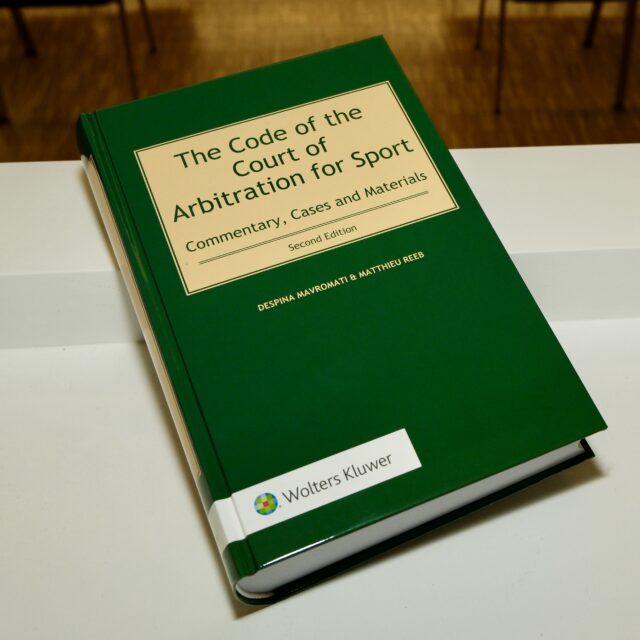
NEW BOOK RELEASE
The Code of the Court of Arbitration for Sport – Commentary, Cases and Materials
by Despina Mavromati / Matthieu Reeb, Wolters Kluwer 2025
Ιn its fully revised second edition, The Code of the Court of Arbitration for Sport offers a comprehensive, article-by-article commentary of the CAS Rules. Drawing on leading CAS and Swiss Federal Tribunal case law, CAS practices and international arbitration principles, the book is an indispensable reference for practitioners, arbitrators, and scholars working in sports arbitration.
This second edition introduces significant updates, including new model documents and new chapters on the ICAS, the CAS ad hoc Rules and the CAS Anti-Doping Division Rules during the Olympic Games.
This site uses cookies to improve site functionality - you can manage your preferences. Legal Notice & Privacy Policy
Functional
Always active
The technical storage or access is strictly necessary for the legitimate purpose of enabling the use of a specific service explicitly requested by the subscriber or user, or for the sole purpose of carrying out the transmission of a communication over an electronic communications network.
Preferences
The technical storage or access is necessary for the legitimate purpose of storing preferences that are not requested by the subscriber or user.
Statistics
The technical storage or access that is used exclusively for statistical purposes.The technical storage or access that is used exclusively for anonymous statistical purposes. Without a subpoena, voluntary compliance on the part of your Internet Service Provider, or additional records from a third party, information stored or retrieved for this purpose alone cannot usually be used to identify you.
Marketing
The technical storage or access is required to create user profiles to send advertising, or to track the user on a website or across several websites for similar marketing purposes.