
Sportlegis ×
Notes

SFT 4A_616/2024: Validity of CAS Jurisdiction in Player-Agent Agreements and Limited Scope of Public Policy 

April 30, 2025 | 3-min read

SFT 4A_616/2024: Validity of CAS Jurisdiction in Player-Agent Agreements and Limited Scope of Public Policy  - www.sportlegis.com

Swiss Federal Supreme Court Judgment of 24 March 2025

A. v. B. & C. SRL, Motion to set aside a CAS Award CAS 2022/O/9269 of 22 October 2024

A Swiss professional footballer (A. or the “Player”)  had entered into two consecutive agency agreements with a French-registered intermediary (B. or the “Agent”) and a Romanian company (C. SRL; together with B. “the Agents”). Both agreements appointed the Agents exclusively and entitled them to a 10% commission on all employment contracts concluded for the Player. Each contract contained a broad arbitration clause designating the CAS as the sole forum and expressly excluding the applicability of Swiss employment-placement legislation (LSE/AVG). In September 2022 the Player terminated the second agreement, shortly before signing a new employment contract with FC St. Gallen. The Agent initiated CAS proceedings, seeking CHF 207,600 plus a percentage of potential bonuses; the CAS upheld its jurisdiction and partially granted the claim, ordering the Player to pay CHF 100,000. 

In his motion to the SFT, the Player argued that the CAS lacked jurisdiction (Art. 190 para. 2 (b) PILA), contending that the Agents, lacking the required Swiss licence under the Arbeitsvermittlungsgesetz (AVG), had only been able to structure the contract as “international” to circumvent Swiss mandatory law, and therefore the arbitration clause should be invalid. Alternatively, he argued that the dispute was not arbitrable or that the arbitration agreement was void due to illegality. In addition, the Player invoked a violation of both procedural and substantive public policy under Art. 190 para. 2 (e) PILA, claiming that the award enforced a “void” contract, disregarded employee-protection norms, and imposed a penalty comparable to “bribery.”

The SFT dismissed the jurisdictional challenge, emphasising that it is bound by the facts as established by the CAS (Art. 105 BGG). Accordingly, alleged breaches of the AVG by the Agents were irrelevant for determining their actual domicile or seat, which was outside Switzerland, thus making the 12th Chapter of the PILA applicable. The SFT also confirmed the arbitrability of the dispute under Art. 177 para. 1 PILA and rejected arguments on the alleged nullity of the arbitration clause, recalling the autonomy of arbitration agreements and considering all the Player’s appellate criticisms as inadmissible. The SFT equally rejected the allegation of public policy violation as it did not find that the award’s outcome, i.e. a damages payment resulting from early termination, contradicted fundamental principles such as pacta sunt servanda or procedural fairness. 

Overall, the judgment reinforces settled jurisprudence on the autonomy of arbitration clauses, the narrow scope of public-policy review, and the strict limits on factual reassessment by the SFT. It also confirmed that alleged violations of Swiss licensing or employment-placement rules do not retroactively alter the international character of the relationship nor undermine the validity of an arbitration clause governed by Art. 178 PILA. 

Notes

SFT 4A_608/2024: Training Compensation, Late Waivers and Necessary Parties in FIFA TMS Procedures

March 11, 2025 | 3-min read

SFT 4A_608/2024: Training Compensation, Late Waivers and Necessary Parties in FIFA TMS Procedures - www.sportlegis.com

Swiss Federal Supreme Court Judgment of 22 January 2025

A. v. FIFA, Motion to set aside CAS Award CAS 2023/A/10002 of 14 October 2024

A Latvian professional football club (the Club) disputed a FIFA decision that determined the training compensation owed to a Ghanaian club (Club C) following the transfer of a player in March 2023. Under the applicable procedure, an Electronic Player Passport (EPP) was generated and reviewed. During this process, FIFA invited two times the Club to upload any waiver of training compensation. The club failed to do so within the deadlines and only submitted a renunciation document from Club C on 14 September 2023, i.e. after the final EPP and the training compensation had been issued. The CAS dismissed the club’s appeal, holding that the Club should have joined Club C a respondent, since said club had a direct interest in the procedure, and that the late-uploaded waiver could not be considered. 

In the subsequent motion to the SFT, the Club invoked a violation of its right to be heard (Art. 190 para. 2 (d) PILA), arguing that the arbitrator ignored key arguments concerning regulatory inconsistencies, the absence of a time limit for filing waivers, and the allegedly disciplinary nature of the procedure. It also invoked a violation of public policy (Art. 190 para. 2 (e) PILA), claiming that the award disregarded fundamental principles such as contractual freedom, personal freedom, pacta sunt servanda, and the burden of proof. 

The SFT swiftly rejected the claim of a violated right to be heard, noting that the motion merely reframed its disagreement with the arbitrator’s assessment of the evidence, as the CAS had implicitly – yet clearly – considered and dismissed arguments about regulatory contradictions and the alleged abuse of rights. The Court also held that criticisms about the arbitrator’s legal expertise were irrelevant under Art. 190 para. 2 (d) PILA. On the allegations of violation of public policy, the SFT emphasised that the misapplication of rules or erroneous factual findings cannot establish a breach. The club failed to demonstrate any result incompatible with Swiss ordre public, as the arbitrator’s conclusion – that Club C should have been a co-respondent and that the waiver was filed too late – was neither arbitrary nor shocking to fundamental legal values. 

Once again, the SFT judgment confirmed well-established SFT jurisprudence on the strict limits on the right to be heard complaints in international arbitration, the extremely narrow scope of public policy, and the deference afforded to CAS in procedural matters, especially where parties fail to respect regulatory deadlines (see also the almost identical judgments involving other players SFT 4A_612/2024 & SFT 4A_614/2024 of 22 January 2025).

Notes

SFT 4A_544/2024: LIMS Evidence, Presumption of Innocence & Limits of SFT Review in Anti-Doping Procedures

June 18, 2025 | 2-min read

SFT 4A_544/2024: LIMS Evidence, Presumption of Innocence & Limits of SFT Review in Anti-Doping Procedures - www.sportlegis.com

Swiss Federal Supreme Court Judgment of 20 May 2025, A. v. IBU

Motion to set aside CAS Award CAS 2020/A/6834 of 9 September 2024

The case concerns a former elite Russian biathlete (the Athlete) sanctioned by the International Biathlon Union (IBU) for an anti-doping rule violation based on data extracted from the Moscow laboratory’s LIMS system. According to the IBU, her 22 March 2013 urine sample initially tested positive for a prohibited substance (ostarine) but was falsely recorded as negative in ADAMS, which was later discovered through the LIMS 2015 data. After disciplinary proceedings, the IBU suspended the athlete for two years and disqualified all results from March 2013 to her retirement. The Athlete appealed to the CAS, which rejected her case in September 2024, finding the LIMS 2015 data authentic and concluding that the Athlete had used a prohibited substance.

In her subsequent motion for annulment to the SFT, the Athlete invoked a violation of her right to be heard (Art. 190 para. 2 (d) PILA) and violation of public policy (Art. 190 para. 2 (e) PILA based on the principle in dubio pro reo, claiming that the panel had relied on insufficiently reliable evidence and that doubts should have favoured her innocence. 

The SFT dismissed both grievances. First, it held that the CAS had thoroughly analysed the evidence—including the re-analysis statistics highlighted by the Athlete—and had implicitly but clearly rejected her arguments on the alleged unreliability of the LIMS system. Second, and similar to several other prior judgments, the SFT confirmed its case law that the ECHR presumption of innocence does not apply directly to discplinary proceedings of private sports bodies. With respect to the arguments raised by the Athlete following the ECHR Semenya judgment, the SFT repeated that the Grand Chamber ECHR judgment was, at that time, still pending; interestingly, said judgment was issued shortly afterwards, i.e. in July 2025 (see my note here) so that it will be interesting to see the SFT’s reaction to this argument in its subsequent judgments, now that the ECHR Semenya judgment is final. 

All in all, the SFT judgment repeats the well-established federal jurisprudence on the very narrow scope of review within the scope of public policy (it should be the result, not the reasoning of the CAS award, that should be incompatible with Swiss public policy) and the non-application of criminal-law principles to sports disciplinary cases (see also the similar SFT 4A_546/2024 of 20 May 2025).

Notes

SFT 4A_474/2024: CAS Discretion in rEPO Analysis in Doping-Related Proceedings

June 11, 2025 | 5-min read

SFT 4A_474/2024: CAS Discretion in rEPO Analysis in Doping-Related Proceedings - www.sportlegis.com

Judgment of 6 February 2025, A. v. NADA, WADA & DFB

Motion to set aside CAS Award of 27 August 2024 CAS 2023/A/9550, CAS 2023/A/9586 & CAS 2023/A/9607

This is the SFT judgment following the CAS award involving Croatian professional football player Mario Vušković (the Athlete) and NADA, WADA and the German Football Federation (DFB). The Athlete had undergone an out-of-competition doping test and the results showed an adverse analytical finding for prohibited substance rEPO in November 2022. He was provisionally suspended a couple of days later, whereas the opening of the B sample confirmed the presence of rEPO in December 2022, and the result of the second expert opinion was also issued shortly afterwards. In March 2023, the Athlete was issued a two-year suspension from the federation’s sports tribunal (as of 15 November 2022), but after an appeal from all parties involved (the Athlete, NADA, WADA and DFB), the CAS dismissed the Athlete’s appeal and confirmed WADA / NADA’s appeal, imposing 4 years on the Athlete. 

In the subsequent motion to the SFT, the Athlete invoked a violation of his right to be heard denying his right to submit evidence. The SFT held that the Athlete should have expected a full review of the evidentiary record, however it is inadmissible to invoke an incorrect assessment of the evidence before the SFT. 

The SFT further dismissed the Athlete’s argument that the CAS did not inform the parties prior to the hearing that it would rely decisively on a particular element of the file for its decision, to the extent that said element was on record and was the subject of an oral hearing. It follows that the CAS does not need to draw the parties’ attention to a specific element of the file. 

With respect to the alleged violation of public policy, the Athlete invoked a violation of Art. 27 para. 2 CC (excessive commitment) considering that he was forced to submit to the SAR-PAGE method, which is used to determine whether an athlete’s urine sample should be considered positive or negative for rEPO. More specifically, the CAS panel, composed of non-medical experts, was called to issue sanctions based on the examination of technical images. The Athlete also alleged a violation of public policy to the extent that WADA prohibits the eight experts in its EPO Working Group from assisting him, preventing him from providing exculpatory proof and violating his personality rights.

The SFT swiftly dismissed these arguments confirming its longstanding case law whereby the CAS panel may issue “far-reaching sanctions” against an athlete and enjoys broad discretion in doing so (cf. SFT 4A_318/2018 of 4 March 2019, paras. 4.5.2 and 4.5.4). The interpretation of samples forms part of the examination of whether an anti-doping rule violation occurred and this is not incompatible with ordre public. Similarly, there is no proof of public policy violation through the allegations concerning the purported impossibility of proving the Athlete’s innocence, as the presumption of doping under the “strict liability principle”, and the athlete’s rebutting that presumption having both been accepted by the SFT (SFT 134 III 193 para. 4.6.2.3; SFT 4A_528/2022 of 13 March 2023 para. 4.3.1). The assertion that the Athlete was not capable of submitting evidence was also discarded in view of the fact that the Athlete himself had submitted expert reports from several experts. 

Interestingly, the argument invoking WADA rendering the exculpatory proof impossible does not lead to a violation of public policy, since it should be the CAS itself – and therefore not a party – that would rende the exculpatory proof impossible. The subsequent question of whether the appellant succeeded in producing exculpatory evidence pertains to the assessment of evidence, which is not subject to ordre public review by the Federal Supreme Court (BGE 144 III 120 para. 5.1).

Finally, with respect to the principles in dubio pro reo and lex mitior, the SFT repeated its longstanding jurisprudence that disciplinary measures imposed by private sports federations in cases of doping findings are not to be assessed under criminal law principles such as the presumption of innocence or the principle of in dubio pro reo (judgments 4A_528/2022 of 13 March 2023 para. 4.3.3; 4A_470/2016 of 3 April 2017 para. 3.4; 4A_178/2014 of 11 June 2014 para. 5.2; each with references) and that, in any event, the CAS panel did not have any doubts as to the doping violation.

The allegation that the CAS violated the principle of lex mitior was also dismissed as he could not establish how the new version applied by the CAS was actually harsher than the previous version, and even questioned whether the violation of this principle could fall within public policy altogether. Finally, the Athlete relied on Art. 6 ECHR, and more specifically to the right to a fair trial. However, the SFT found that the Athlete did not meet these strict requirements by merely equating the alleged violation of a fair trial under Art. 6 ECHR with the objections raised through the previous grounds (alleged violation of the principles in dubio pro reo etc.) and discarded this argument as inadmissible.

Notes

SFT 4A_324/2025: CAS May Apply Swiss Law by Analogy in Ukraine War Football Employment Disputes

April 2, 2026 | 3-min read

SFT 4A_324/2025: CAS May Apply Swiss Law by Analogy in Ukraine War Football Employment Disputes - www.sportlegis.com

The Swiss Federal Tribunal (SFT) addressed an appeal against a CAS award rendered in the context of the contractual fallout from the war in Ukraine. The dispute opposed a Russian football club and a Norwegian player who had unilaterally terminated his employment contract in May 2022 after leaving Russia and subsequently signing with an Italian club. While the FIFA DRC had partially upheld the player’s claim, the Court of Arbitration for Sport (CAS 2023/A/9686) ultimately dismissed all claims from both parties. 

The CAS found that the player had terminated the contract without just cause but refused to award any compensation to the club. The panel held that neither the contractual penalty clause (EUR 30 million) nor Article 17(1) of the FIFA Regulations on the Status and Transfer of Players (RSTP) was appropriate in light of the exceptional circumstances created by the war. In particular, the CAS reasoned that the club had not suffered a definitive loss of the player’s services, since Annex 7 RSTP allowed players to temporarily suspend their contracts. It further identified a legal gap and applied Swiss law subsidiarily, relying by analogy on Article 337b CO to conclude that no compensation was due. 

Before the SFT, the club relied solely on a violation of the right to be heard under Article 190(2)(d) of the Swiss Private International Law Act (PILA). It argued that the CAS had based its decision on an unforeseeable legal reasoning, namely the application of Article 337b CO by analogy, without giving the parties a proper opportunity to comment.

The SFT rejected the appeal, reaffirming its restrictive approach to judicial review of arbitral awards and the principle of iura novit curia. A duty to invite further submissions arises only where the legal reasoning is truly unforeseeable. In the present case, the SFT found that the CAS had expressly invited the parties to address the applicability of Articles 337 et seq. CO, including Article 337b, and that the club had in fact argued against its application during the arbitration. Accordingly, the reasoning could not be considered surprising (at 5.4). 

From a practical perspective, the judgment confirms the extremely limited scope of review of the “effet de surprise” under Article 190(2)(d) PILA, the broad discretion of CAS panels to rely on legal concepts not pleaded by the parties, and the tribunal’s flexibility to apply Swiss law subsidiarily next to the RSTP and Annex 7 thereof.

Notes

SFT 4A_313/2025: Reaffirming the Limits of FIFA Jurisdiction in Employment Disputes

April 14, 2026 | 3-min read

SFT 4A_313/2025: Reaffirming the Limits of FIFA Jurisdiction in Employment Disputes - www.sportlegis.com

Swiss Federal Supreme Court Judgment 4A_313/2025 of 27 January 2026; challenge of CAS Award CAS 2024/A/10709 of 21 May 2025

This judgment forms part of a wider series of SFT judgments on jurisdictional challenges based on Art. 22 FIFA Rules on the Status and Transfer of Players (RSTP). The dispute arose from an employment dispute between a national football association and a national team coach. The coach, dismissed prematurely, brought a claim before the FIFA Players’ Status Chamber seeking outstanding salary and compensation. FIFA upheld its jurisdiction and partially granted the claim, a position later confirmed by the Court of Arbitration for Sport (CAS). The federation challenged the CAS award before the SFT, arguing that the underlying employment contract referred disputes to “the competent court,” thereby excluding FIFA jurisdiction. 

From a legal standpoint, the core issue concerned – once again – the interpretation of the dispute resolution clause in light of Article 22 RSTP. The CAS adopted a broad reading, considering that the wording “competent court” did not necessarily exclude arbitral or FIFA bodies and that FIFA jurisdiction operated alternatively. The SFT, however, confirmed its restrictive interpretation of arbitration agreements, emphasizing that any waiver of state court jurisdiction must be clear and unequivocal. 

The SFT ultimately annulled the CAS award, finding that the clause “the dispute shall be referred to the competent court”must, under the principle of good faith, be understood as referring to state courts. It rejected CAS’s expansive interpretation and clarified that such wording does not encompass arbitral tribunals or FIFA bodies. Importantly, the SFT highlighted – probably for the first time so explicitly – that Article 22 RSTP establishes only a subsidiary jurisdiction of FIFA: once the parties designate state courts, FIFA jurisdiction is excluded, without the need for an explicit opt-out. The SFT also rejected arguments based on the employee’s weaker position and found no abuse of rights in invoking state jurisdiction. In those respects, the judgment adopts a similar approach to SFT 4A_92/2025. 

In terms of practical consequences, the judgment seems to restrict the scope of Art. 22 RSTP, since jurisdiction depends on the existence of a valid arbitration agreement. In this respect, even relatively generic clauses referring to “courts” may suffice to exclude FIFA and CAS jurisdiction, provided they can reasonably be interpreted as designating state courts.

Even though consistent with the SFT’s long-standing jurisprudence, this judgment does suggest a more restrictive approach in jurisdictional matters related to Art. 22 RSTP, exposing a structural tension in the FIFA system: the assumption of “default” jurisdiction under Article 22 RSTP is fragile when confronted with broadly drafted contractual clauses. In light of this, FIFA may indeed wish to consider amending its rules, for example by requiring express and specific arbitration clauses referring to FIFA/CAS jurisdiction.

Notes

SFT 4A_28/2025 : Anonymous Witnesses, Sexual-Abuse Allegations and Limits of Review in FIFA Ethics Cases

May 16, 2025 | 3-min read

SFT 4A_28/2025 : Anonymous Witnesses, Sexual-Abuse Allegations and Limits of Review in FIFA Ethics Cases - www.sportlegis.com

Swiss Federal Supreme Court Judgment of 3 March 2025

Motion to set aside CAS Award TAS 2021/A/8388 of 4 December 2024

This case forms part of several FIFA’s wide-ranging ethics proceedings after allegations of systemic sexual abuse within the national football federation of Haiti started in 2020 (see also my note on another related case here). During the investigation, a vice-president of that federation (the Official) was identified as a potential perpetrator and provisionally suspended. In July 2021, FIFA’s adjudicatory chamber issued a life ban and a CHF 100,000 fine, finding that he had committed repeated acts of sexual harassment, abuse, coercion and misuse of authority against women referees over several years. A three-member CAS panel confirmed the violations of the FIFA Code of Ethics, upheld the lifetime ban, and reduced the fine to CHF 35,000, relying in particular on the consistent testimony of a protected victim, supported by additional corroborating evidence. 

The subsequent motion to the SFT included primarily allegations of violation of the right to be heard (Art. 190 para. 2 (d) PILA). The Official claimed that the CAS failed to justify its refusal to hear 11 other alleged victims, relied improperly on anonymous testimony, and prevented him from effectively contesting the allegations. He further asserted a breach of procedural and substantive ordre public (Art. 190 para. 2 (e) PILA), contending that the award was based solely on unverified anonymous statements and that it was “arbitrary” to impose a lifetime ban based on the testimony of a single alleged victim. 

The SFT dismissed this grievance, considering that the CAS had sufficiently explained why additional witness hearings were unnecessary: the facts deemed proven through the principal victim’s testimony – supported by corroborating evidence from another protected witness and a journalist – were already sufficiently serious to decide the case. The SFT further noted that the CAS had implemented appropriate safeguards for anonymous witnesses (voice distortion, identity checks, supervised questioning) and that the appellant had been able to participate in the examination. Complaints about the CAS’s evaluation of evidence were characterised as impermissible appellate criticisms. 

In conclusion, the SFT rejected the ordre public arguments, recalling that neither alleged arbitrariness nor dissatisfaction with the assessment of evidence meets the very high threshold of Art. 190 para. 2 (e) PILA. Anonymous testimony is admissible where procedural protections exist, and the result of the CAS award – upholding a lifetime ban for sexual-abuse misconduct – was not incompatible with fundamental Swiss values. Overall, this judgment confirmed the SFT’s consistent deference to CAS fact-finding in ethics cases and its very narrow approach to reviewing challenges based on procedural fairness and public policy. 

Notes

SFT 4A_268/2025 – Revision of an Award based on Criminal Forgery and Fraud

December 12, 2025 | 3-min read

SFT 4A_268/2025 – Revision of an Award based on Criminal Forgery and Fraud - www.sportlegis.com

Swiss Federal Supreme Court Judgment of A. v. B. of 22 October 2025

Request for Revision of a CAS Award (CAS 2018/O/5735) of 8 August 2019

A professional football player (the Player) sought the revision of a CAS award rendered on 8 August 2019, by which he had been ordered to pay an agent (the Agent) approximately EUR 84,900 in commission. The CAS had accepted that the parties were bound by a representation agreement containing an arbitration clause in favour of CAS and had rejected the Player’s allegations that the underlying contracts and related email evidence were forged. The award was therefore based on the existence and validity of contractual documents allegedly signed and transmitted by the Player. 

Following the CAS award, the Player initiated criminal proceedings in Switzerland against the Agent. These proceedings resulted in final criminal judgments establishing that the Agent had indeed committed forgery and fraud by fabricating the representation contracts and forging the email purportedly sent by the Player. Swiss criminal courts found, on the basis of expert handwriting and IT evidence, that the signatures had been copied and pasted and that the email relied upon before CAS had been entirely fabricated, with the aim of misleading the arbitral tribunal and obtaining an undue commission. These findings were definitively confirmed by the SFT in criminal matters (a 4.1.2). 

Relying on the final decision, the Player filed a request for revision before the SFT pursuant to Art. 190a para. 1 (b) PILA (in force since 2021), arguing that the CAS award had been influenced to his detriment by criminal conduct. He submitted that the falsified contracts and fabricated email were decisive for the arbitral tribunal’s jurisdiction and for the outcome of the case, and that the causal link required by Art. 190a para. 1 (b) PILA was clearly established. 

The SFT upheld the request for revision, holding that the CAS award had indeed been directly influenced by the Agent’s criminal acts. While rejecting the argument that the award was absolutely null (nullité absolue), which can be invoked at any time, the SFT found that all conditions for revision were met. It therefore annulled the CAS award in its entirety and remitted the case to CAS for a new decision. 

This judgment is particularly noteworthy given the exceptional nature of revision proceedings in international arbitration. Requests for revision are rarely admitted, reflecting the SFT’s consistently restrictive approach (“une arme à manier avec prudence”) as a more extended use would endanger legal certainty and the finality of arbitral awards (cf. also the Valieva Judgment, SFT 4A_654/2024 of 8 October 2025). The decision illustrates that, in truly extraordinary circumstances, the system provides an effective corrective mechanism where an arbitral award has been decisively influenced by proven criminal conduct. 

Notes

SFT 4A_230/2025: Distinction between Admissibility and Jurisdiction in Multi-Tier Dispute Resolution Clauses

December 15, 2025 | 2-min read

SFT 4A_230/2025: Distinction between Admissibility and Jurisdiction in Multi-Tier Dispute Resolution Clauses - www.sportlegis.com

Swiss Federal Supreme Court Judgment of 10 November 2025, Motion to set aside CAS Award CAS 2024/O/10564 of 15 April 2025

A cooperation agreement between two professional football clubs (the Agreement) provided for FIFA jurisdiction as a primary forum, with CAS arbitration as a subsidiary mechanism if FIFA proved to be incompetent. After the expiration of the Agreement, one club (the Club) initiated proceedings before FIFA, which declined to hear the case on the ground that the claim was time-barred under Article 23 para. 3 of the FIFA Regulations on the Status and Transfer of Players (RSTP). The Club subsequently brought the claim to the CAS, arguing that FIFA’s refusal triggered CAS jurisdiction as per the Agreement. 

The CAS panel rejected this argument, holding that FIFA’s decision was based on inadmissibility rather than lack of jurisdiction. According to the panel, FIFA remained competent in principle to hear the dispute, but was prevented from examining it due to the expiry of the regulatory time limit in the FIFA RSTP. As a result, the condition for CAS’s subsidiary jurisdiction – namely, FIFA’s lack of competence – was not fulfilled and declined jurisdiction.

In the subsequent motion before the SFT, the Club argued that the arbitration clause should be interpreted broadly and that the term “competent” encompassed all situations in which FIFA refused to hear a case, including issues related to the time barred claim. The SFT swiftly rejected this position. Following the contractual interpretation principles, the SFT held that the parties had clearly intended FIFA to be the primary forum and CAS to act only where FIFA lacked jurisdiction. As such, a procedural rule rendering a claim inadmissible does not affect FIFA’s jurisdictional power (ratione temporis) but rather the underlying right and therefore cannot activate CAS’s subsidiary jurisdiction (at 5.4).

Altogether, this is an interesting judgment that reinforces the distinction between jurisdiction and admissibility (with respect to the time limit to bring a claim to the competent instance) but also the practical consequences arising out of it. Accordingly, regulatory deadlines – whether before FIFA or CAS – are procedural conditions governing access to a forum: Parties cannot circumvent an agreed jurisdictional hierarchy in multi-tier dispute resolution clauses by allowing time limits to lapse. 

Notes

SFT 4A_226/2025: systemic implications – and limited effect – of the Semenya ECHR judgment in sports arbitration

February 16, 2026 | 4-min read

SFT 4A_226/2025: systemic implications – and limited effect – of the Semenya ECHR judgment in sports arbitration - www.sportlegis.com

Swiss Federal Supreme Court Judgment 4A_226/2025 of 11 December 2025; challenge of CAS Award CAS 2024/A/10279, 2024/A/10280 und 2024/A/10281 of 31 March 2025

Facts of the case

In this judgment, the Swiss Federal Supreme Court (SFT) ruled on a challenge against a CAS award arising out of the war-related contractual framework introduced by FIFA. A Norwegian footballer (the Player) had been under contract with a Russian club (the Club) until 2025. Following Russia’s invasion of Ukraine, FIFA issued temporary regulatory measures (Annex 7 to the RSTP) allowing foreign players to suspend contracts with Russian clubs. The Player initially made use of these measures, later “reactivated” his contract, and returned to Russia.

In summer 2023, amid escalating security concerns – the Player sought to terminate his employment with immediate effect, invoking just cause and force majeure. Shortly thereafter, he signed with a Saudi Arabian club. The FIFA DRC partially upheld the Club’s claim for compensation for breach of contract and said decision was confirmed by the CAS in appeal. The CAS ruled that the termination was without just cause and ordered the Player and his new club to pay over EUR 3 million in compensation. 

Arguments invoked before the SFT

In his challenge before the SFT, the Player relied primarily on Article 190(2)(e) PILA, alleging a violation of substantive public policy (ordre public). He argued that the CAS award resulted in an excessive personal commitment contrary to Article 27(2) CC and amounted, in substance, to indirect forced labour. In his view, remaining contractually bound in a war-affected territory exposed him to unacceptable risks to life and health, such that immediate termination was justified.

He further invoked force majeure and challenged the CAS’s assessment of just cause. In addition, he relied on Articles 2, 4(2), 5(1) and 8 ECtHR, arguing that the award violated fundamental rights. For the first time before the SFT, he contended that he had not freely consented to CAS arbitration and referred to the recent Grand Chamber judgment of the European Court of Human Rights (ECHR in Semenya v. Switzerland (see my note on this judgment here).

The SFT’s approach to ordre public

The SFT reiterated its well-established, restrictive review under Article 190(2)(e) PILA: only awards that are incompatible with fundamental and widely recognised principles of the Swiss legal order may be set aside, and only if the incompatibility affects not merely the reasoning but also the result. The SFT does not review the panel’s application of substantive law, nor does it reassess the evidence as an appellate court. 

Applying this standard, the SFT rejected the player’s reliance on excessive commitment and forced labour. The CAS had found that the continuation of the contract was not objectively intolerable and that the player had other options (including pursuing a loan or transfer) rather than immediate termination. The mere fact that termination without just cause triggers damages does not amount to forced labour or an intolerable violation of the Player’s personality rights. The same applied for the amount of compensation decided by the CAS, which could not reach a level comparable to situations previously found problematic under public policy (as in the Matuzalem case). 

The SFT also dismissed the force majeure argument, considering that the Player’s renewed return to Russia after the outbreak of war was a relevant factual element but not issues of public policy. 

The direct reference to the ECHR provisions, the reference to Semenya and the limits of its reach

The most notable aspect of the judgment lies in the SFT’s reaction to the Player’s direct reliance on the ECtHR provisions (Articles 2, 4, 5 and 8 ECtHR) and on the Semenya judgment. The Court declared inadmissible the argument – raised for the first time before it – that CAS arbitration had not been freely accepted. In any event, it distinguished the case from Semenya. The SFT reiterated  that simple references to the ECHR are not sufficient to substantiate a violation.

Most importantly, and even though it did not reiterate its previous position that the ECtHR provisions cannot be directly invoked before the SFT (see, for example, my note on the SFT 4A_682/2024), it found said general criticisms to be unsubstantiated (at 4.2). Moreover, the Court signalled that Semenya does not automatically extend to all CAS-related disputes. The concept of “forced arbitration” developed by the ECHR does not apply in ordinary contractual disputes between clubs and players. The judgment is therefore interesting, as it confirms the continued narrow scope of review under Article 190 PILA, according to which all pleas must be sufficiently substantiated, and illustrates the SFT’s careful review of the systemic implications of Semenya for international sports arbitration.

Notes

SFT 4A_180/2025: Sporting Succession and the Limits of Lex Sportiva in the Interpretation of the Arbitration Agreement 

December 14, 2025 | 3-min read

SFT 4A_180/2025: Sporting Succession and the Limits of Lex Sportiva in the Interpretation of the Arbitration Agreement  - www.sportlegis.com

Swiss Federal Supreme Court Judgment of 6 November 2025, A. v. B.

Motion to set aside CAS Award CAS 2023/O/10217 of 7 March 2025

This is an interesting case that arose from an unpaid agent commission for a high-value player transfer and involved a football agent (the Agent) and a newly created Italian club  (the new Club) alleged to be the “sporting successor” of a former club (the original Club). Although the Agent had previously obtained a CAS award against the original Club, the latter subsequently entered insolvency proceedings and was excluded from the Italian federation, prompting the Agent to pursue the claim against the new Club that had taken over sporting activities. 

At the core of the dispute was whether the arbitration clause contained in the original commission agreement could be extended to the new Club on the basis of alleged sporting succession. The CAS panel held that it lacked jurisdiction, finding no valid arbitration agreement binding the new Club. Before the SFT, the Agent argued that the CAS had adopted an overly restrictive approach to Article 178 para. 2 PILA by refusing to recognise sporting succession as a basis for extending the arbitration clause, despite its widespread acceptance in CAS jurisprudence and FIFA regulations.

The SFT rejected these arguments, confirming the wording of Art. 178 PILA: in the absence of a choice of law by the parties, the subjective scope of an arbitration agreement must be assessed under Swiss substantive law as the law of the seat. While Swiss law allows the extension of arbitration clauses to non-signatories under specific circumstances (e.g. in cases of debt assumption, transfer of contract, or clear conduct evidencing an intention to be bound), the concept of “sporting succession” as developed in lex sportiva is not recognised as a legal institution under Swiss law. The fact that such a construct is valid under the FIFA regulations or recognized in CAS case law does not transform it into a source of Swiss law for the purposes of Article 178 PILA. What is more, neither FIFA rules nor CAS precedent are sources of arbitration and a fortiori Swiss law (at 5.5).

Importantly, the SFT also clarified that the fact that sporting succession is not contrary to international public policy under federal law does not render this concept part of the Swiss legal order. The review of public policy under Article 190 para. 2 (e) PILA is autonomous and does not render non-Swiss legal concepts valid for jurisdictional purposes. What matters is to establish the new Club’s intention to assume the contractual obligations of the original Club, as such the CAS Panel was right to decline jurisdiction.

This interesting judgment reinforces the strict, consent-based approach in arbitration agreements in (voluntary) sports arbitration and limits the effect of sporting succession – or other concepts of lex sportiva – when it comes to the interpretation of the agreement. 

Notes

SFT 4A_12/2025: FIFA Jurisdiction can only be challenged before the SFT if raised during the CAS Proceedings

March 30, 2025 | 3-min read

SFT 4A_12/2025: FIFA Jurisdiction can only be challenged before the SFT if raised during the CAS Proceedings - www.sportlegis.com

Swiss Federal Supreme Court Judgment of 10 March 2025, FC A v. Player B

Motion to set aside CAS Award CAS 2022/A/9311 of 3 December 2024

A contract of employment between a Chinese football club A (A FC) and a Player from Ecuador (B) included the following clause (Art. 12): “Any dispute … shall be settled alternatively and at the election of the claiming party, to the legal bodies of FIFA or the CAS. In the event the claiming party decides that FIFA shall settle any dispute arising out of or in connection with the present contract as first instance Body, any appeal to a ruling of the FIFA Dispute Resolution Chamber shall be addressed to the CAS (…).” 

Apart from that agreement, the Player signed an “Advertising Image Endorsement Agreement” with company C, which included a “liability for breach contract” clause as follows: “If a dispute is caused by this contract, Party A and Party B shall be settled through friendly negotiation. If the negotiation fails, any dispute (…) in connection with the present contract shall be solved exclusively by the CAS”.

Upon termination of the contract of employment, the Player brought the case to the FIFA DRC, requesting several amounts under both the Contract of Employment and the Image Rights Contract. The FIFA DRC partially upheld some claims based on the Contract of Employment and dismissed all other requests. The Club appealed to the CAS, seeking annulment of the FIFA DRC decision and a declaration that the Club owes nothing to the Player. The CAS fully dismissed the appeal. 

In the subsequent motion to the SFT, the Applicant invoked erroneous findings on jurisdiction (Art. 190 para. 2 (b) PILA) on the ground that the FIFA DRC had wrongly assumed jurisdiction. The Club supported, among others, that the CAS lacked jurisdiction because the FIFA DRC had wrongly accepted its jurisdiction: due to the arbitration agreement in the Image Rights Contract, the FIFA jurisdiction should be excluded, also because Company C is not a FIFA member. 

The SFT reiterated its position that it can only review the jurisdiction of the CAS and not the jurisdiction of the previous instance (here the FIFA DRC), apart from cases where the first-instance body and then the CAS declared themselves incompent (4A_232/2022 at 5.2.4; 4A_180/2023 of 24 July 2023 para. 3.3). 

However, what was decisive in this case was that the Club had not raised any challenge to FIFA DRC’s jurisdiction before the CAS, all the more that it was the Club that brought the appeal to the CAS. As such, the SFT declared the motion inadmissible. 

Notes

Several extensions to issue the CAS award in a match-fixing case and impact on the arbitration agreement

November 10, 2023 | 2-min read

Several extensions to issue the CAS award in a match-fixing case and impact on the arbitration agreement - www.sportlegis.com

4A_22/2023 of 16 May 2023
Civil law appeal against the award rendered by the CAS 2020/A/7616

In a tennis case linked to match-fixing, a professional tennis player was suspended for eight years for violations of the relevant integrity program of his international federation. The appeal to the CAS was filed in December 2020, a hearing was held one year later and the CAS panel issued its award in November 2022, after eight extensions of the time limit to issue the award under the CAS Code. In the subsequent challenge proceedings, the SFT exceptionally considered procedural elements subsequent to the issuance of the challenged award as they were pertinent to establish the player’s case (at 5). 

The SFT held that an award rendered after the expiration of its mission is not void but voidable (at 6.1.2). As expected, the SFT held that the player could not rely on the subsequent amendment of the CAS Code (Art. R59) as said rules only applied to procedures initiated after 2022. To the extent that the parties had not revoked the mandate of the arbitrators, they were fully authorized to render their award so that there was no violation of Art. 190 (2) b PILA. 

The SFT also found that there was no violation of the principle of celerity of the proceedings,  after leaving the question open as to whether such principle indeed falls within the scope of procedural public policy: in the specific circumstances of the present case, the SFT considered its complexity and the various exchange of submissions as well as the fact that the player only raised an objection with respect to the delay of the proceedings after the seventh request for extension by the CAS panel. 

The SFT concluded that, notwithstanding the length of the proceedings compared to other CAS cases, the duration of the proceedings was still reasonable for a case related to match fixing that required a more complex assessment.

News

Selected procedural issues –and questions– arising out the Caster Semenya Judgment of the Swiss Federal Tribunal

September 27, 2020

Selected procedural issues –and questions– arising out the Caster Semenya Judgment of the Swiss Federal Tribunal - www.sportlegis.com

Published in the Asser International Sports Law Blog, 11 September 2020

This note deals with selected procedural issues and questions arising out of the very lengthy Semenya Judgment. In a nutshell, the SFT dismissed Semenya’s appeal to set aside the CAS Award, which had denied the request of Caster Semenya (Semenya, the Athlete) to declare unlawful the Differences of Sex Development (DSD) Regulations of World Athletics (formerly IAAF).


Read note

News

Second International Sports Law Journal (ISJL) Conference at the Asser Institute in the Hague

October 18, 2018

Second International Sports Law Journal (ISJL) Conference at the Asser Institute in the Hague - www.sportlegis.com

After the success of its first conference, the International Sports Law Journal (ISLJ) organized its second ISLJ Annual Conference in The Hague, on October 25-26, 2019. Despina Mavromati (editorial board member of the ISLJ) chaired a panel on the interdisciplinary aspects of sports regulation and presented on the Burden and Standard of Proof in CAS proceedings. The conference also featured a WISLaw lunch talk on the Pechstein Judgment, where all attendees could participate in an animated and interactive discussion.

Notes

Scope of res judicata of a previous CAS Award related to the same contract and the same parties

May 27, 2020 | 4-min read

Scope of res judicata of a previous CAS Award related to the same contract and the same parties - www.sportlegis.com

4A_536/2018 Judgment of March 16, 2020, Football Club A. v. Football Agent Z.

The contract and the subsequent arbitration proceedings before the CAS

The dispute related to a football club (the Appellant) and an Agent for the payment of a sum based on an agency contract for the conclusion of an employment contract and the potential transfers of a young player. The contract had two main clauses, one providing for (1) the remuneration of the Agent for the contracts of employment between the Appellant and the player, and (2)  a financial contribution in the event of a future transfer of the Player to a third club.

In his first request for arbitration before the CAS, the Agent requested that the remuneration be based on the employment contract and a declaratory judgment as to the club’s financial obligation in case of a future transfer of the player. In the First CAS Award, the Panel dismissed the claim for remuneration and refused to decide on the declaratory request. In a subsequent request for arbitration before the CAS (the Second CAS Award), whereby the Agent requested a financial contribution following the transfer of the player to a third club, the CAS accepted the claim and awarded the Agent with compensation as provided in the contract.

Res judicata as part of the procedural public policy under Art. 190 (2) (e) PILA

As expected, the Club filed a motion to the SFT requesting annulment of the CAS award for violation of its right to be heard, but essentially for violation of the principle of res judicata, alleging that the First CAS Award had also decided on the issue of the financial contribution in a final and binding way. Res judicata forms part of the “procedural public policy” and as such falls within the reasons to set aside an arbitral award under Art. 190 (2) (e) PILA.

Res judicata covers only the operative part and not the grounds of the decision

The SFT reiterated some basic principles on res judicata, the principle prohibiting the rehearing of a claim that has already been decided by another final judgment, either a state court decision or an arbitral award). Accordingly, the binding effect of the judgment applies only to the operative part of the award and not to its grounds, even if the latter may complement the meaning of the operative part—especially in cases where the operative part simply dismisses the claim (at 3.1.1). Therefore, the factual findings and legal grounds do not bind the tribunal in a subsequent trial since the res judicata principle is a consequence of the jurisdiction of a specific tribunal to decide a specific dispute, and such jurisdiction is limited to the requests brought before such tribunal.

Need for a final judgment or a preliminary ruling “to the merits”

Furthermore, it is not only necessary to have a judgment for res judicata to apply, but a final judgment to the merits on the same claim: this means, inversely, that a refusal to enter into the merits of the case (such as the case of the CAS panel that refused to issue such declaratory judgment requested by the Agent, or any other decision e.g. reverting the case back to the previous instance) cannot qualify as a final decision vested with res judicata effect (at 3.1.2 and 3.3.2). The SFT proceeded to an interesting analysis of what is a “preliminary ruling” to the merits of a case: an example of such ruling is, for example, when the arbitral tribunal rules on the liability of the defendant and is subsequently bound by such decision when at a later stage will have to decide on any monetary claims based on such liability.

The SFT concluded that the denial of a court to issue a declaratory judgment could not possibly be equated to a “preliminary ruling” to the merits that could lead to a violation of the principle of res judicata and dismissed the appeal in its entirety.

Overall, the judgment is a good reminder of the strict conditions that have to be met for a ruling to be vested with res judicata effect, even when a subsequent decision involves the same parties and the dispute derives from the same contract.

Need for a final Judgment or a preliminary Ruling “to the merits” of the dispute

News

School of Transnational Governance of the European University Institute (EUI) – High Policy on Sports Governance

December 16, 2020

School of Transnational Governance of the European University Institute (EUI) – High Policy on Sports Governance - www.sportlegis.com

High-level policy dialogue on sports governance and EU law organised by the School of Transnational Governance of the European University Institute

Despina Mavromati was invited to participate in a high-level policy dialogue on sports governance and the interaction with EU law that was organised by the School of Transnational Governance of the European University Institute (STG).

The event, held under the Chatham House Rule, took place online on 14 and on 15 December 2020 and included several experienced practitioners, academics, sports administrators and journalists from all over the world. 

The EUI STG delivers teaching and high-level training in the methods, knowledge and practice of governance beyond the State. Based within the European University Institute in Florence, the School brings the worlds of academia and policy-making together. You can find more information about the STG here.

News

Schiefelbein global dispute resolution conference in Phoenix (AZ), USA

January 22, 2020

Schiefelbein global dispute resolution conference in Phoenix (AZ), USA - www.sportlegis.com

Despina Mavromati was a speaker at “Schiefelbein Global Resolution Conference” that took place at the Arizona State University on January 16, 2020. Despina participated in a panel entitled “Resolving International Sports Disputes” alongside Jeff Benz, Louise Reilly, Kenneth Shropshire, and Ray Anderson. Here is more information on the conference agenda and the speakers.

Book Promotion - www.sportlegis.com

NEW BOOK RELEASE

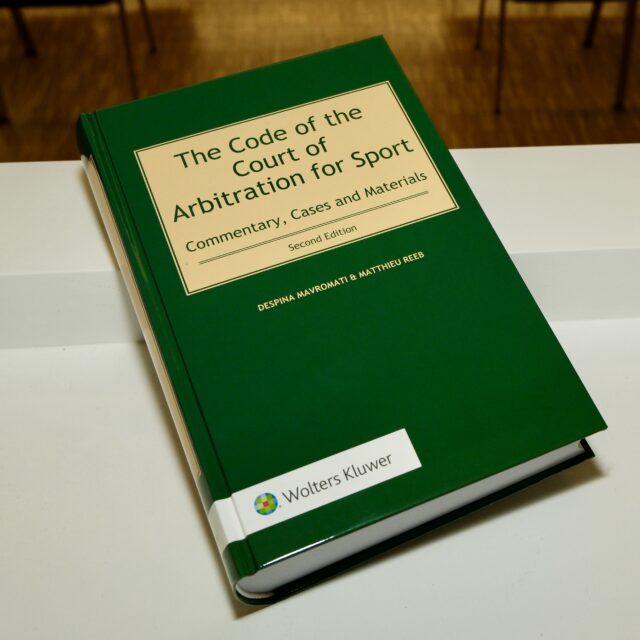
The Code of the Court of Arbitration for Sport – Commentary, Cases and Materials

by Despina Mavromati / Matthieu Reeb, Wolters Kluwer 2025

Ιn its fully revised second edition, The Code of the Court of Arbitration for Sport offers a comprehensive, article-by-article commentary of the CAS Rules. Drawing on leading CAS and Swiss Federal Tribunal case law, CAS practices and international arbitration principles, the book is an indispensable reference for practitioners, arbitrators, and scholars working in sports arbitration.

This second edition introduces significant updates, including new model documents and new chapters on the ICAS, the CAS ad hoc Rules and the CAS Anti-Doping Division Rules during the Olympic Games.

Order Here