Sportlegis ×
News

Presentation on due Process to the FEI Tribunal Members at the FEI Headquarters in Lausanne

November 1, 2017

Presentation on due Process to the FEI Tribunal Members at the FEI Headquarters in Lausanne - www.sportlegis.com

Despina Mavromati gave a presentation to the Members of the International Equestrian Federation (FEI) Tribunal in Lausanne on February 10, 2018. Her presentation focused on due process considerations according to Swiss law and was entitled: “Due Process vs. Due Process Paranoia – Do’s & Don’ts”.

News

WISLaw Seminar on Sports Arbitration in Montreal

November 1, 2017

WISLaw Seminar on Sports Arbitration in Montreal - www.sportlegis.com

Despina Mavromati was a speaker at the WISLaw Seminar on Sports Arbitration that was hosted by the Canadian Olympic Committee in Montreal, on November 6, 2017. Her topic was entitled: “Corruption Cases and the Court of Arbitration for Sport: Jurisdiction, Scope and Limits”.

News

1st Asser Sports Law Conference in the Hague

October 26, 2017

1st Asser Sports Law Conference in the Hague - www.sportlegis.com

Despina Mavromati (Editorial Board Member of the International Sports Law Journal  -ISLJ) chaired a panel on sports arbitration (Panellists included H. Jacobs, L. Brandon, L. Černič and K. Ogawa) at the 1st Asser Sports Law Conference that took place in the Hague on October 26-27, 2017.

See more about this event

Notes

SFT Judgment 4A_80/2017 – A. v. IWF (doping) – Parties’ right to be heard, Public Policy

October 21, 2017 | 5-min read

SFT Judgment 4A_80/2017 – A. v. IWF (doping) – Parties’ right to be heard, Public Policy - www.sportlegis.com

A. v. IWF (doping), Parties’ right to be heard and Public Policy
Judgment 4A_80/2017 of 25 July 2017

The Issue

Request for an expert report should be unequivocally made before the arbitral tribunal / Violation of the parties’ right to be heard requires to establish how the judicial oversight deprived a party from introducing and proving its position.

The Appellant (Alexei Lovchev) is a Russian weightlifter at international level who participated in the 2015 World Championships of Weightlifting in Houston, USA, as a member of the Russian team and won the gold medal and set two world records.

In November 2015, the Appellant underwent a doping control that resulted in an Adverse Analytical Finding (AAF) and showed the presence of the prohibited substance Ipamorelin in the Appellant’s sample in an extremely low concentration of 0.1 ng / ml. The WADA-accredited Laboratory B (B. Laboratory) conducted the controls and both the A and the B samples were found to be positive.

Following a hearing that took place before the IWF Committee in Budapest, the Committee issued a decision disqualifying the Appellant from the 2015 World Championships and imposing a sanction of ineligibility of four years. The IWF Committee held that it was comfortably satisfied that the analytical reports confirmed the existence of the prohibited substance Ipamorelin in the Appellant’s sample.

The Appellant appealed this decision to the Court of Arbitration for Sport (CAS), which confirmed the IWF decision with an arbitral award rendered on December 1, 2016. The Arbitrators were The Hon. Michael J. Beloff QC (Chairman), Prof. Ulrich Haas & Prof. Luigi Fumagalli.

The Federal Tribunal judgment

The Appellant lodged a civil law appeal to the Swiss Federal Tribunal requesting to annul the CAS Award and to revert the case back to CAS for a new decision, invoking in particular a violation of his right to be heard and a violation of public policy.

a) Violation of the parties’ right to be heard / equality of the parties

In essence, the Appellant argued that the CAS Panel violated his right to be heard by wrongly appreciating the concentration of the prohibited substance in question (1 ng/ml instead of 0.1 ng/ml). The Swiss Federal Tribunal dismissed this argument as not being part of the violation of the parties’ right to be heard (or public policy). In accordance with the well-established jurisprudence of the Federal Tribunal, a manifestly false or conflicting finding alone is not sufficient to annul an international arbitration award.

Furthermore, the Appellant alleged a violation of his right to be heard based on the fact that the CAS wrongly refused to admit his request for an expert report on the Limits of Detection [LOD], on Measurement Uncertainty [MU], and another analysis of the B sample. However, as it could be found from the file of the CAS proceedings, the Appellant merely requested that the Respondent disclose the parameters and criteria for LOD and MU for Ipamorelin but had not asked for an expert report on LOD and MU.

The other point in the Appellant’s plea before the Federal Tribunal concerned his request to have the analysis of the B sample conducted by the WADA-accredited laboratory but using an alternative detection method. The Federal Tribunal equally rejected this argument as inadmissible criticism of appellatory nature in that the Appellant failed to make a plea under Article 190 (2) PILA for his considerations that diverged from the Panel’s assessment (4A_80/2017 at 6.2). The Federal Tribunal therefore limited itself in controlling that the CAS Panel followed the procedure provided for in the IWF Anti-Doping Rules (the Appellant had the burden to rebut the presumption – based on the standard of a balance of probabilities) – of the violation of the anti-doping rules, which he failed to do in the case at hand (4A_80/2017 at 6.3). In particular, the Appellant should have raised doubts as to the results of the B. Laboratory (which were found to have complied with the applicable standards). The Appellant further alleged a violation of the principle of equal treatment because the CAS did not reveal a third analysis carried out by the B. Laboratory, but failed to substantiate in a sufficient manner why this was linked to the violation of the principle of equal treatment.

b) Violation of public policy

Lastly, the Appellant tried to invoke a violation of the principle of good faith and the prohibition of abuse of rights based on the four-year ban on exercising his professional activity (which, he argued, constituted a breach of public policy). Again, this was swiftly dismissed by the Federal Tribunal because the Appellant failed to substantiate how the different assessment of evidence by the Panel infringed public policy.

The Takeaway

This Federal Tribunal judgment reiterated the limits in validly alleging a breach of a parties’ right to be heard: It is clearly insufficient to allege such violation due to a wrong interpretation made by the arbitral tribunal. In other words, a manifestly false or conflicting finding alone is not sufficient to annul an international arbitration award. It is necessary to establish that, due to the judicial oversight of the arbitral tribunal, the concerned party was deprived of introducing and proving its position with respect to a procedural issue (BGE 127 III 576 E. 2 f. p. 580; 4A_80/2017 at 4).

Another point to retain is the importance to make a clear, unequivocal and official request for an expert report before the arbitral tribunal if a party is to bring forward a violation of his right to be heard based on this ground at a later stage (i.e., before the Swiss Federal Tribunal, see 4A_80/2017, at 5).

News

Intensive Course on Sports Arbitration at Western University (Canada)

October 18, 2017

Intensive Course on Sports Arbitration at Western University (Canada) - www.sportlegis.com

Despina Mavromati (Visiting Professor at Western University for 2017) tought an intensive class on sports law and sports arbitration to the students of Western Law from October 30 to November 3, 2017.

News

WISLaw Lunch Talk on the Whereabouts System at the Asser Sports Law Conference in The Hague

October 18, 2017

WISLaw Lunch Talk on the Whereabouts System at the Asser Sports Law Conference in The Hague - www.sportlegis.com

Despina Mavromati moderated a WISLaw lunch talk on the current state of the whereabouts system (doping) with Lindsay Brandon and Prof. Richard McLaren at the Asser Sports Conference in the Hague.

News

LawInSport Annual Conference in London – September 2017

September 18, 2017

LawInSport Annual Conference in London – September 2017 - www.sportlegis.com

Despina Mavromati was a speaker at the Law In Sport Annual Conference that took place in London on September 7-8, 2017. She participated in a panel discussing best practices in sports arbitration. See the agenda of the conference here

News

WISLaw Round Table on Sports Arbitration & Mediation in London

September 18, 2017

WISLaw Round Table on Sports Arbitration & Mediation in London - www.sportlegis.com

Despina Mavromati participated in a WISLaw round table (together with Catherine Pitre and Christine Bowyer-Jones) discussing the differences between CAS arbitration & proceedings administered by Sport Resolutions (UK) as well as the differences between arbitration and mediation in resolving sports disputes.

Notes

SFT Judgment 4A_40/2017 – Termination of a football contract of employment with just cause

September 16, 2017 | 5-min read

SFT Judgment 4A_40/2017 – Termination of a football contract of employment with just cause - www.sportlegis.com

Erroneous judgment on Jurisdiction / violation of public policy (inadmissible); violation of the parties’ right to be heard (unfounded)

The Issue
Termination of a football contract of employment by the player with just cause – Deciding in equity without the parties’ permission (instead of applying a particular set of rules) is not a ground for annulment of the arbitral award based on Art. 190 (2) (b) PILA

The Facts

On 17 November 2016, the CAS rejected the appeal filed by the Football Player Z (the Player) against a FIFA DRC Decision between the Player and the Football Club X (the Club). The CAS also partially upheld the appeal filed by the same Club X, ordering it to pay the Player  a total of USD 366’166 for unpaid salaries. However, it did not order compensation for breach of contract without just cause (under the provisions of Art. 17 (1) of the FIFA Regulations on the Status and Transfer of Players, RSTP).

In the subsequent appeal before the Swiss Federal Tribunal, the Appellant (the Club) attacked the Award on the ground that the Arbitral Tribunal ruled on the case in equity instead of applying a specific set of rules (in casu the Swiss Code of Obligations). The Appellant employed the same argument but alleging the various grounds for annulment of an arbitral award under Art. 190 (2) Swiss Private International Law Act (PILA).

Deciding in equity is not a ground for annulment of the award based on Art. 190 (2) b PILA

More specifically, the Club  alleged violation of Article 190 (2) (b) PILA (which relates to the erroneous jurisdiction of the arbitral tribunal) because the Panel ruled in equity and therefore ruled “extra potestatem”. The Federal Tribunal rejected this ground as inadmissible since deciding in equity (without the parties’ authorization) might constitute an irregularity which does not affect the jurisdiction of the arbitral tribunal in the sense of Art. 190 (2) b PILA (4A_40/2017 at 3).

It is worth adding that a similar question (ruling ex aequo et bono instead of applying a specific set of rules) was also dealt with in a previous SFT judgment in 2012 (SFT 4A_14/2012 of 2 May 2012, at 3.2.2, a commercial arbitration procedure). In this case, the SFT had acknowledged that ruling ex aequo et bono was an irregularity that falls outside the scope of jurisdiction (even if this question was unclear in the doctrine). It further held that this irregularity could somehow relate to the violation of public policy (Art. 190 (2) (e) PILA, see ATF 116 II 634 at 4a) if it meets the conditions for violation of public policy. In any event, there is no such violation if the Panel simply reinforces its legal reasoning and does not abandon the realm of the law to go into ex aequo et bono.

Criticisms related to the non-application or the incorrect application of a specific legal provision fall outside the scope of Art. 190 (2) d PILA

The Appellant equally attacked the CAS Award for violation of his right to be heard (Art. 190 (2) d PILA) because the Panel failed to expressly state in its award what law it applied and the reasons why it did not apply the law that corresponded to the applicable regulations of FIFA and CAS and the agreement between the parties (4A_40/2017 at 4.2).

The Federal Tribunal dismissed the aforementioned argument by holding that the Panel had indeed dedicated an entire section analyzing the question of applicable law in which it reserved itself the right to apply Swiss law subsidiarily, according to the pertinent FIFA and CAS Rules.

The CAS Panel had further concluded that the Player had terminated the contract of employment with just cause and on such basis the Club had to pay the unpaid salaries to the Player. However, and based on the specificity of sport (provided for in Art. 17 of the FIFA RSTP) the Panel found that the club only owed the outstanding salaries for having terminated the contract without just cause.

The Federal Tribunal concluded that the Panel did not violate the Appellant’s right to be heard through its analysis. It considered that, in reality, the Appellant was criticizing the fact that the Panel did not apply – or inappropriately applied – a specific legal provision. However, said criticisms fall outside the scope of review of the Federal Tribunal under Art. 190 (2) PILA (4A_40.2017 at 4.2).

The Takeaway

In essence, this was a very short judgment where the Panel swiftly dismissed the one and sole argument that the Appellant raised by invoking the violation of Art. 190 (2) PILA under different angles: erroneous jurisdiction, violation of his right to be heard and, finally, violation of public policy – however without further comments on the last ground, see 4A_40/2017 at 5). There are very few takeaways from this judgment. The parties invoking various grounds for appeal (even based on the same main argument, as it was the case here) must develop each ground separately and establish the reasons that the particular argument / situation violated the particular provision of Art. 190 (2) PILA (see also Art. 77 (3) of the Swiss LTF (Law of the Federal Tribunal); see 4A_40/2017 at 5).

Notes

SFT Judgment 4A_600/2016 – Platini v. FIFA – Violation of the FIFA Code of Ethics

August 30, 2017 | 5-min read

SFT Judgment 4A_600/2016 – Platini v. FIFA – Violation of the FIFA Code of Ethics - www.sportlegis.com

The Issue  

No legal basis for a payment to a FIFA official (Mr. Platini) – violation of the FIFA Code of Ethics. Domestic arbitration in Switzerland; Arbitrariness of a CAS award in its result

Facts

The case involved Mr. Michel Platini, UEFA President until 2016, who filed an appeal against a CAS award partially upholding the decision of the FIFA Appeal Committee and banning Mr. Platini from all football-related activities for four years. The FIFA Ethics Committe initially banned Mr. Platini for eight years by the FIFA Ethics Committee over a CHF 2’000’000 payment made by the former FIFA President Joseph Blatter to Mr. Platini in 2011 for consultancy work carried out for FIFA from 1998 until 2002. The FIFA Appeal Committee subsequently reduced the sanction to six years and Mr. Platini appealed against this decision to the CAS, which in turn reduced the sanction to four years. In summary, the FIFA Decisions had found no legal basis for such payment, thereby violating the FIFA Code of Ethics.

Eventually, Michel Platini filed a motion to set aside the CAS Award invoking solely the arbitrariness of the decision, a ground for appeal provided for only in domestic arbitration procedures under Article 393 CPC.

Takeaways from the Swiss Federal Tribunal judgment

I. The preliminary issue of “domestic arbitration” in Switzerland (Art. 393 CPC)

In its lengthy judgment, the Federal Tribunal extensively analyzed the preliminary issue of “domestic arbitration” in Switzerland, and specifically the pertinent criteria in order to define an arbitration as domestic but also the scope of review, by the Federal Tribunal, of the arbitral award under Art. 393 lit. e CPC. More specifically, an arbitration is treated as domestic when the arbitral tribunal has its seat in Switzerland and Chapter 12 of the LDIP does not apply (4A_600/2016 at 1.1), the pertinent time for the determination of the domicile or habitual residence of the parties being that of the conclusion of the arbitration agreement. In this case, although both FIFA and the CAS had their seat in Switzerland and Mr. Platini was also domiciled in Switzerland when the appeal was filed, the only decisive factor was Mr. Platini’s domicile at the time of the conclusion of the arbitration agreement.

In view of the particularities of sports arbitration in disciplinary matters (where jurisdiction does not arise directly from the conclusion of an arbitration agreement), the Federal Tribunal set the pertinent time for the conclusion of the arbitration agreement in 2004, the year the FIFA Statutes recognized CAS’ jurisdiction. At that time Mr. Platini was still domiciled in France. However, since the CAS Panel proceeded to an (incorrect) qualification of the arbitration as domestic and FIFA did not object to it, such qualification had become binding upon the parties and FIFA could no longer raise any objections without violating the principle of good faith.

II. The control of arbitrariness of the CAS Award

Overall, this is one of the very few cases related to CAS that was adjudicated under the domestic arbitration rules of the CPC (see also 4A_627/2011 of 3 August 2012, which however related to Art. 393 lit. c CPC). It is true that the scope of review of an arbitral award is more extended in domestic arbitration when the ground of arbitrariness is invoked, a ground that has no counterpart in international arbitration (public policy is a more restrictive concept than the one of arbitrariness).

Nonetheless, it is still difficult to overcome this burden and the party claiming that the award is arbitrary in its result must establish that the award is either contrary to the law or based on findings that evidently contradicted the record. The Federal Tribunal concluded that the CAS award was not arbitrary after analyzing all the allegations of arbitrariness raised by Mr. Platini (application of the incorrect version of the applicable FIFA regulations; incorrect interpretation of the FIFA Code of ethics; reversal of the burden of proof).

III. The control of arbitrariness of the CAS Award – the proportionality of the sanction

Another interesting issue concerned the proportionality of the sanction. Accordingly, neither the prohibition to take part in any activity related to football nor its duration (for a period of 4 years) were found to be in violation with Art. 27 CC, Art. 163 CO and Art. 4 CC argued by Mr. Platini. More specifically, the lack of precision of the sanction (“any activity relating to football”) was not sufficient to annul the contested award. In any event, if FIFA had sanctioned Mr. Platini for actions that were not prohibited under the FIFA Code of Ethics, such decision could be annulled in appeal.

The Federal Tribunal equally distinguished this case from the Matuzalem judgment (ATF 138 III 322, the only judgment found to have violated substantive public policy), due to the fact that the Matuzalem judgment concerned a statutory penalty imposed on an active professional Brazilian footballer and the threat of an unlimited ban on practicing his profession in the case where he would not pay a compensation in excess of EUR 11 million at short notice.

Notes

SFT Judgment 4A_692/2016 – WADA v. X & USADA – Excessive Formalism (dismissed)

August 29, 2017 | 6-min read

SFT Judgment 4A_692/2016 – WADA v. X & USADA – Excessive Formalism (dismissed) - www.sportlegis.com

The Issue 

Does the Termination Order for non-timely payment of the CAS advance of costs under Article R64 CAS Code constitute “excessive formalism” and therefore a violation of the procedural public policy under Article 190 (2) (e) Swiss PILA?

The Facts

On August 11, 2016, the World Anti-Doping Agency (WADA) filed a statement of appeal to the CAS against an agreement, entitled “Acceptance of Sanction”, between US gymnast X (the Athlete) and the United States Anti-Doping Agency (USADA) (jointly referred to as the Respondents). After paying the Court Office Fee according to Art. R48 and R64.1 of the CAS Code, the arbitration procedure started with CAS reference 2016 / A / 4743 WADA v. X & USADA. However, after the Respondents denied to pay their share of the advance of costs (CHF 18’000), CAS invited WADA to pay both parties’ shares under the pertinent provisions of Art. R64 CAS Code.

Under this provision and Art. R48 CAS Code, the parties were reminded that the advance of costs must be paid within a certain deadline, failing which the appeal would be considered to be withdrawn and the proceedings would be terminated. After WADA paid it’s half of the fees (i.e., CHF 18’000 of the total CHF 36’000), and following an exchange of correspondence in which WADA’s Counsel brought forward a clerical mistake for the non-payment of the full amount, the CAS Court Office terminated the proceedings. The procedure was officially terminated through a termination order by the CAS Appeals Division President.

WADA subsequently filed an appeal to the Swiss Federal Tribunal alleging a violation of its right to be heard for « excessive formalism » (Art. 190 (2) (d) PILA) and violation of public policy (Art. 190 (2) (e) PILA.

The Federal Tribunal judgment

a) Admissibility of an Appeal against a CAS Procedural Order

The Federal Tribunal reiterated that the appeal is admissible against an award (final, partial, preliminary or interlocutory) (at 2.3). A simple procedural order is in principle not subject to appeal to the extent that it can be modified in the course of the proceedings (4A_600 / 2008 of 20 February 2009, at 2.3). The same applies to an order on provisional measures under Art. 183 PILA (ATF 136 III 200 at 2.3). However, and since the name given to a contested act is not decisive (ATF 142 III 284 recital 1.1.1), a Termination Order would necessarily put an end to the arbitration and qualifies as an award appealable to the Federal Tribunal. Indeed, by failing to pay the advance of costs, Art. R64.2 of the CAS Code applies and the unavoidable consequence is the “withdrawal” of the appeal. Under these circumstances, the appeal was found to be admissible.

b) Violation of the Appellant’s Right to be Heard

The Appellant (WADA) principally invoked a violation of its right to be heard before the CAS proceedings because the CAS failed to examine an essential argument raised by it, namely, whether strict application of the relevant provision was justified in light of the circumstances of the case. Under Art. R64.2 CAS Code, in the event of nonpayment of the full advance of costs within the time limit set by the CAS, the appeal is deemed to be withdrawn and the CAS terminates the arbitration. The Federal Tribunal held that the interpretation and application of this provision by the CAS Division President fell outside the scope of the Federal Tribunal’s review and an incorrect or even arbitrary application of an arbitration rule would not amount to violation of public policy (ATF 126 III 249, at 3b) (4A_692/2016, at 5.2).

c) Violation of Procedural Public Policy – Excessive Formalism

The Federal Tribunal equally dismissed the allegation of excessive formalism of the CAS Division President (at 6). Excessive formalism falls within the violation of (procedural) public policy of Art. 190 (2) (e) PILA and has been examined by the Federal Tribunal on various occasions (4A_690 / 2016 of 9 February 2017 at 4.2; 4A_600 / 2008 of 20 February 2009, at 5). Under Swiss jurisprudence, excessive formalism is a particular aspect of the denial of justice prohibited by Art. 29 (1) Cst. (ATF 142 I 10, at 2.4.2). Formalism is considered to be excessive when the strict application of the rules is not justified by an interest worthy of protection and unsustainably complicates the realization of substantive law or restricts access to courts (at 6.2) (ATF 130 V 177, 5.4.1, p.183, 128 II 139, at 2a, pp. 142, 127 I 31).

The jurisprudence of the Federal Tribunal has shown that the termination of the proceedings for failure to pay an advance of costs does not constitute excessive formalism nor a denial of justice, provided that the parties have been notified of the amount to be paid, the time limit for payment and the consequences of the non-observance of that time-limit (ATF 133 V 402 at 3.3 pp. 405, 104 Ia 105 at 5 pp. 112, 96 I 521 4 pp. 523).

By citing examples from the Swiss jurisprudence, the Federal Tribunal showed that inadmissibility for non- payment of the advance of costs does not lead to excessive formalism even in case of an almost complete partial payment (93%) of the required advance of costs (2D_45 / 2012 of 10 September 2012 at 5.2). There have been similar cases before the CAS (also related to the procedural defect of sending the statement of appeal by fax, 4A_690/2016 at 4.2). The non-payment of the advance of costs in a CAS procedure was also brought before the CAS some years ago and the Federal Tribunal reached the same conclusion (4A_600/2008, at 5.2.2) (4A_692/2016, at 6.2).

The Takeaway

In these proceedings, the Appellant (WADA) unsuccessfully argued that its case was distinguishable from the prior cases where similar situations have been dealt with by teh Swiss Federal Tribunal. The latter reiterated its definition of excessive formalism and brought together numerous examples from cantonal and federal case law in order to conclude and confirm – once again – that termination of the CAS proceedings due to the not timely payment of the advance of costs does not amount to excessive formalism. This is true particularly if a) the amount and the payment deadline were clearly stated at the outset of the procedure and b) the consequences of the non-payment were also clear.

Other factors that weigh against the person / entity alleging excessive formalism in these cases include a) the previous experience /status of the person/ entity (in the present case, WADA, the widely known body regulating doping at world level, had brought numerous similar cases before CAS and was therefore familiar with the payment conditions) and b) the fact that such person / entity benefits from professional legal advice (at 4A_692/2016, at 6.3).

Notes

SFT Judgment 4A_668/2016 – Player X v. Z – Exclusive nature of a player’s agent contract / diregard of FIFA regulations not sufficient (as such) to establish violation of public policy

August 15, 2017 | 7-min read

SFT Judgment 4A_668/2016 – Player X v. Z – Exclusive nature of a player’s agent contract / diregard of FIFA regulations not sufficient (as such) to establish violation of public policy - www.sportlegis.com

Exclusive nature of a player’s agent contract / diregard of FIFA regulations not sufficient (as such) to establish violation of public policy

SFT 4A_668/2016 of 24 July 2017

The Issue

Before the CAS: Does anyone other than an exclusive representative have standing to enforce an agency contract under FIFA Rules and Swiss law? Exclusive nature of a player’s agent contract. Before the SFT: Disregard of FIFA regulations not sufficient (as such) to establish violation of substantive public policy

The Facts

FIFA Player X wished to go on a loan to another team. His exclusive representative, B contacted the “Sub-Agent” Z who had links to various clubs, including Club C. All three (X, B, and Z) signed a contract in December 2014 (“the First Contract”), according to which B assigned Z as a “Sub-Agent” for a specific duration in order to negotiate the conditions for the loan of the player to the Club C. Both B and Z would jointly receive 10% of the total income of the player for the entire duration of the contract.

After B was paid for his services, Player X accepted to go on a loan to Club C. Shortly afterwards, Player X signed a second agreement with Z in 2015 (Agreement for payment of player’s agent commission, “the Second Contract”), whereby Player X committed to pay Z, a first payment of 37’500 euros (the first payment would be paid by the Club C on behalf of the Player) and a second payment of the same amount four months later, failing which a penalty clause was foreseen (10% of the unpaid fee). The Second Contract also included an arbitral clause in favour of the Court of Arbitration for Sport (CAS) in Lausanne.

The Court of Arbitration for Sport Proceedings

The second payment of 37’500 euros to Z remained unpaid and Z filed an appeal against the Player based on the Second Contract to the CAS. The Sole Arbitrator who was appointed in this case wished to hold a hearing but Player X objected to it for financial reasons. The CAS Secretariat confirmed the holding of a hearing and that Player X could attend via conference call.

In summary, the Arbitrator applied the 2008 FIFA Players’ Agents Regulations and Swiss law, subsidiarily,  since the FIFA Regulations for Working with Intermediaries were not yet applicable (ratione temporis). The main question was the validity of the Second Contract and its compatibility with the First Contract between the Player, his exclusive representative B and the sub-agent Z. The Arbitrator applied Swiss law (principle of contractual freedom, Art. 19 CO). Accordingly, he found that the parties were free to negotiate the modalities of the calculation of the commission in a second contract and the Player was personally liable for the payment of the second part to the Sub-Agent Z.

As a consequence, the Sole Arbitrator upheld the claim and ordered X to pay 37’500 euros, in addition to the penalty of 3’750 euros and 5% interest.

The appeal to the Swiss Federal Tribunal

I. Violation of the parties’ right to be heard (Art. 190 para. 2 d PILA)

Player X subsequently filed a motion to set aside the CAS Award to the Swiss Federal Tribunal, in which he alleged a violation of the equality of the parties by the arbitrator: he claimed that his lawyer ceased his mandate just 2 days before the hearing and it was convened that his exclusive representative would assist the hearing. However, representative B had a personal interest in the outcome of this case, which opposed to the Player’s (B had an interest in Player X losing the case so that Player X would be solely liable for the payment to Z). The Swiss Federal Tribunal (SFT) found that the allegations made by Player X were neither supported by additional evidence nor were they consistent with the facts confirmed by the arbitrator in the arbitral award: these facts bind the SFT (at 3.2.2).

Nothing from the file could establish that the Panel did not respect the equality of the parties or that it deprived the Appellant of the possibility to express itself. Player X’s lawyer was still in charge of the case when he renounced his right to participate—even through a video conference—in the hearing or to ask for legal aid (see also SFT 4A_690/2016 of 9 February 2017; at 5.1). Moreover, Player X waited until the final award was rendered in order to attack the latter before the SFT invoking grounds of procedural fairness.

II. Violation of substantive public policy (Art. 190 para. 2 e PILA)

Player X also alleged a violation of substantive public policy, by not applying the FIFA Regulations for Working with Intermediaries and by ignoring the exclusive nature of the first contract between the parties (which, he alleged, would not allow the conclusion of the second parallel contract under Art. 20 Swiss Code of Obligations (CO). Here again, the SFT held that the simple fact of disregarding a provision of the FIFA Regulations does not qualify as a violation of substantive public policy.

More specifically, the SFT drew an analogy to a violation of Article 27 CO from the Matuzalem case (ATF 138 III; 322 at 4.3.2), which alone does not violate public policy, unless it is of a certain gravity and the violation concerns a fundamental right: a contractual restriction of the economic freedom is not considered as excessive (under Art. 27 CO) unless the other party is deprived of its economic freedom to a point that its economic existence is endangered. In this respect, a commission agreement obliging a player of a good reputation to pay the specific amount for services rendered by an agent was not excessive in the sense of Article 190 para. 2 e PILA.

Most importantly, however, the SFT reiterated that the application by the Panel of the applicable rules and the case law on the interpretation of contracts is outside of its scope of review (at 4.2).

Player X further alleged a violation of public policy for disregard of the strict prohibition of the double mandate, which consists in prohibiting an agent to intervene for both the club and the player (at 4.3.1-2). Also, according to the Player, the Panel reversed the burden of proof by failing to ask Z to prove that the basis for the payment of the first part by the Club was the authorization by the Player (under Article 19 para. 4 of the FIFA Players’ Agents Regulations) and not a contractual relationship between Z and Club C. The SFT held that this was not proven by the appellant, and the reversal of the burden of proof could not qualify as violating public policy under article 190 para. 2 lit. e PILA.

The Takeaway

This was a low-value dispute between a professional football player and his (second) agent, about the validity of a second agreement for the payment of a sub-agent’s commission prior to the adoption of the FIFA Regulations on working with Intermediaries. The grounds invoked before the SFT were the violation of the equality of the parties during the CAS proceedings and the violation of public policy, among others for disregarding the exclusive nature of the parties’ agent agreement and therefore violation of Article 20 Swiss CO.

The SFT swiftly dismissed all claims. This is not a groundbreaking judgment but it gave an opportunity to the SFT to reiterate some of its basic principles that had already highlighted in some of its previous CAS-related judgments (e.g., Matuzalem, ATF 138 III 322 at 4.3.2; Kovago 4A_730/2012 at 3.3.2; Diakhaté, 4A_690/2016 at 5.1; Mutu, 4A_458/2009 at 4.4.3.2):

(1) Violation of procedural fairness must be invoked in a timely manner; (2) all procedural violations must be sufficiently substantiated; (3) the facts confirmed in the arbitral award bind the SFT; (4) a person invoking financial difficulties may request legal aid from the CAS Legal Aid Fund; (5) the reversal of the burden of proof does not violate (procedural) public policy; (6) the sole fact of disregarding the FIFA Regulations does not, as such, violate (substantive) public policy; and (7) contractual restrictions of economic freedom must be excessive in order to violate public policy.

Notes

IAP Decision of 20 July 2017 – ITF v. I. – Disciplinary Sanctions for Misconduct in Tennis

August 14, 2017 | 11-min read

IAP Decision of 20 July 2017 – ITF v. I. – Disciplinary Sanctions for Misconduct in Tennis - www.sportlegis.com

Disciplinary Sanctions for Misconduct in Tennis

Decision of the International Tennis Federation – ITF v. I. Nǎstase

The Issue
Breach of the ITF Fed Cup Regulations 2017

The Facts

The ITF recently published the full decision rendered by its Internal Adjudication Panel in the matter of ITF v. Ilie Nǎstase.1 The Internal Adjudication Panel is a standing committee of the Board of Directors (the Board) of ITF empowered, among others, to determine whether the ITF Fed Cup Regulations 2017 (including Appendix I – Fed Cup Welfare Policy) has been breached.2

The claim was filed by the ITF, an International Federation (IF) against Ilie Nǎstase, a former elite-level tennis player and currently the Captain of the Romanian Fed Cup team. The claim was filed following a number of incidents occurred during the tie match at the Fed Cup World Group II Playoffs between Romania and Great Britain from April 20 to April 23, for which Mr Ilie Nǎstase was charged by the ITF for breach of the Welfare Policy (the “Charges”).

In summary, the Charges included the following:

A comment about Serena William’s unborn child that could be interpreted as racist (Articles a.ii. a and a.v.b of the Welfare Policy) (Serena Williams charge);3

Advances of sexual nature towards Anne Keothavong, the Captain of the GB team (Articles a.ii.a) ( Keothavong charge);

Entrance without authorization into the GB team lounge (Article a.ii.a) (GB lounge charge)4

Making insulting comments to a member of the accredited press (Articles a.ii.b and a.v.b) (press charge)5

Making abusive and offensive comments to the match officials and to members of the GB team (Articles a.ii.a, a.iii.a, a.iii.b and a.v.b) (on-court charge)6

Ilie Nǎstase’s overall conduct, in breach of the Introduction to the Welfare Policy (as per the ITF’s charge). When taken together, all individual breaches of the Welfare Policy increase the severity of Mr. Nǎstase’s conduct: (overall conduct charge).7

In essence, Mr Nǎstase did not deny the facts8 but denied breaching Articles a.ii.a., a.iii.a, a.iv.c of the Welfare Policy: his choice of words was unfortunate, but these were meant as a joke and made on the spur of the moment.9 The same goes for the requests to Ms. Keothavong, which were made in public (in order to display friendliness towards the GB Team) for which Mr. Nǎstase apologized to her in a private letter.10 As to the comments to the Press, Mr. Nǎstase admitted that they were inappropriate, but they were made in frustration in response to an exaggerated media coverage that he was more interested in non-tennis events. Furthermore, he sent a private apology letter to the journalist concerned, who accepted the mitigating circumstances and had invited the Panel to do the same.11 With respect to the on-court charge, he accepted having lost his temper and making inappropriate remarks to the Chair Umpire, but stated that his comments were precipitated by unequal treatment of the two teams.12 Finally, with respect to his overall conduct, Mr. Nǎstase highlighted that his numerous attempts to apologize -both publicly and privately to the persons concerned – should be considered as mitigating factors.13

The Panel’s decision

First, the Panel found that Mr. Nǎstase falls within the scope of the Welfare Policy (“covered person”). Second, Mr. Nǎstase did not deny any act forming the basis of the charges but only contextualized them. Therefore, the Panel limited its determination to whether those acts breached the Welfare Policy and to the appropriate sanction to be imposed.

Specifically, the Panel imposed a 3-year suspension from acting in an official capacity in all Official ITF Competitions and Circuits (until 31 December 2020) along with a fine of $ 10,000.14

The charges: “total disrespect to officials”, “sexual innuendo”, “racially insensitive” comments and “harassment of a member of the media

The Panel did not qualify Mr. Nǎstase as racist with respect to the “racially insensitive” comment about Serera William’s baby (the Serena Williams charge).15 However his behavior was found to fall within the general introductory provisions of the Welfare Policy which requires a professional conduct “at all times” and the comment was found to reflect unfavourably on the Fed Cup, the ITF and tennis in breach of Article a.v.b of the Welfare Policy (“Other matters”, “conduct in general”).

With regard to the advances of sexual nature to the GB Team’s Captain (the A. Keothavong charge), the Panel unequivocally found that Mr. Nǎstase engaged in a form of sexual harassment. As lack of intent was not relevant, the Panel confirmed the violation of Article a.iv.c of the Welfare Policy (“sexual harassment”).16

The insults to members of the press were found to constitute a serious violation of Article a.iii.b of the Welfare Policy, particularly in view of the longstanding exposure of Mr. Nǎstase to the media (“abusive conduct, physical or verbal, or threatening conduct”).17

Furthermore, Mr. Nǎstase’s uncontrolled behavior on court, i.e. verbal abuses and threats to the officials and refusing to exit the court (on-court charge) was found to be unjustified and as such constituted a serious violation of Articles a.ii.a, a.iii.a, a.iii.b and a.v.b of the Welfare Policy (“unethical conduct”, “abuse of control”, “abusive conduct”, “conduct in general”).18

Finally, with respect to the overall conduct charge brought by the ITF, the Panel considered that it should rather be an aggravating factor on the penalty imposed than a separate charge.

Extensive authority of the ITF Internal Adjudication Panel to calculate the sanctions based on fairness and proportionality “in all of the circumstances of the case”

The Takeaway

It must generally be noted that the ITF Internal Adjudication Panel has extensive authority to calculate the sanctions based on what it considers “just and proportionate in all of the circumstances of the case”, based on the charges brought by the ITF and according to Article 5.2.6

and Article b.ii  of the Appendix I to the ITF Fed Cup Regulations 2017.

More specifically, in this particular case the Panel considered factors such as the severity of the violations, any useful precedents, mitigating or aggravating factors and the principle of proportionality.19

When calculating the applicable sanction, the Panel denied to use other cases as precedent and found this case to be unique due to the number of incidents and the sequence of events.20 In their majority, cases related to sexual harassment, discriminatory behavior or verbal abuse are assessed in separate procedures.21 Therefore, the violation of multiple provisions of the Welfare Policy could count as an aggravating factor.

Another point showing the increased flexibility of the Panel in both asserting a violation and calculating the sanction under the ITF Regulations is that an act that could not fall within a specific category of breach (e.g., the Serena Williams charge could not fall within the discriminatory acts under Article a.ii.a) was nevertheless admitted as breach under the general obligation of professional conduct “at all times” in the introductory comments of the Welfare Policy or the “Conduct in general” of Article a.v.ii.22

The Panel repeatedly stressed the respondent’s increasing responsibility arising from the “fifty-year experience” and his role as the captain of the Romanian Fed Cup team.23

When it comes to the mitigating factors pleaded, the Panel only partially accepted Mr. Nǎstase’s initial apologies as timely and genuine and having a minimal mitigating effect.24 However, the apology to the GB team was not considered by the Panel as a mitigating factor because it lacked the reasons for – and the addressees of – his apologies, but also because in a later interview, Mr. Nǎstase said that he did not “regret it”. As to the later personal apologies to practically all persons directly affected, the Panel did not consider them as they were sent after he was notified of the charges that led to the ITF proceedings.25 Again, the Panel made use of its increased flexibility to consider the mitigating value of Mr. Nǎstase’s apologies and it is open to consideration whether another Panel would follow the same strict approach.

Overall, the Panel found that contextualization of facts and lack of intent could not be relevant for such a high level of unprofessional conduct (“total disrespect to officials”, “sexual innuendo”, “racially insensitive” comments and “harassment of a member of the media”).26

Finally, an interesting point to retain is that ITF does not have jurisdiction over Grand Slam tournaments. Therefore Mr. Nǎstase’s sanction does not include ATP / WTA tournaments. It is for the organizers of those tournaments to determine whether to admit a person suspended by the ITF.

It must be noted that an appeal against this decision is possible as per Article 6 of the Procedural Rules of an Internal Adjudication Panel. Accordingly, both parties have the right to file an appeal before the ITF Independent Tribunal within 21 days from the notification of the full decision (i.e. 20 July 2017).27 Under Article 9.3 of the Procedural Rules of the ITF Independent Tribunal, appeals do not have a suspensive effect, whereas the decision of the Independent Tribunal is the last instance since no possibility for an appeal to the Court of Arbitration for Sport (CAS) in Lausanne is provided for in the Procedural Rules of the Independent Tribunal.28

Notes

SFT Judgment 4A_50/2017 (commercial arbitration) Violation of Ne Ultra Petita & Public Policy

August 10, 2017 | 6-min read

SFT Judgment 4A_50/2017 (commercial arbitration) Violation of Ne Ultra Petita & Public Policy - www.sportlegis.com

SFT Judgment 4A_50/2017 (commercial arbitration) Violation of Ne Ultra Petita & Public Policy X1 Ltd & X2 SA v. Z. Ltd

The Issue
No violation of Ultra Petita if no legal interest worthy of protection; Conditions under which acts of corruption can lead to a violation of substantive public policy under Art. 190 (2) (e) PILA

The Facts

Based on two consultancy Agreements (regulated under Swiss law), the companies X1 and X2 assigned to Z the task to help them with the submission of offers related to a rail project initiated by A. The arbitral clause for disputes resulting from the execution of the two Agreements provided for a three-member panel under the administration of the International Chamber of Commerce (ICC) in Paris and with seat in Geneva, Switzerland.

X1 and X2 refused to pay Z EUR 1’555’000 based on the first contract, and EUR 1’569’150 based on the second contract. X1 and X2 justified their refusal to pay alleging various criminal investigations of Z related to suspicions of corruption with respect to the project, in the USA and the UK. They alleged risking serious criminal sanctions if they paid the outstanding amount to Z and subsequently terminated the consultancy agreements for serious breach of contract by Z.

The Federal Tribunal judgment

Z initiated the ICC arbitration proceedings. The panel rendered the final reward in favor of Z, finding, also that X1 and X2 breached the consultancy agreements by failing to pay Z the two payments.

X1 and X2 subsequently filed an appeal to the Swiss Federal Tribunal alleging that the arbitral tribunal had ruled beyond what was submitted to it (violation of ne ultra petita, Art. 190 (2) c PILA) and violated public policy (Art. 190 (2) e PILA).

a) No violation of ne ultra petita if no legal interest worthy of protection

The Federal Tribunal rejected the argument regarding violation of ne ultra petita for lack of legal interest. In fact, the Appellants’ sole ground was that the operative part of the award included unnecessary findings without a specific scope. This was not an interest worthy of protection as the Federal Tribunal has repeatedly held (see also Art. 76 (1) (b) LTF that applies to all grounds of Art. 190 (2) PILA when annulment is sought).

In this case, the Arbitral Tribunal ordered the financial compensation that was still below the requested amount. Even though it wrongly included in the operative part the reason for each of the penalties, this cannot qualify as a violation of ne ultra petita within the meaning of Art. 190 (2) (c) PILA. The Federal Tribunal thus once again confirmed the very limited scope of this ground for appeal and the importance of having a legal interest in invoking this ground (see 4A_50/2017 at 3).

b) Violation of substantive public policy linked to corruption allegations

X1 and X2 alleged a violation of substantive public policy on the basis that the arbitral tribunal ordered them to make a payment that would violate their “rules of compliance” with respect to the fight against corruption and would therefore be liable to heavy criminal sanctions (4A_50/2017 at 4.3).

First, the Federal Tribunal highlighted the bad faith of the Appellants, since other companies of the same group (X) had unsuccessfully invoked the same grounds before the Swiss Federal Tribunal in the past (at 4.3.1). The Federal Tribunal further noted that it was the same legal team representing the companies of the same group and the same arguments in order to avoid paying their debt (see also 4A_69/2009 of 8 April 2009, 4A_213/2014 of 23 September 2014, 4A_247/2014 of 23 September 2014, 4A_532,534/2014 of 29 January 2015 & 4A_136/2016 of 3 November 2016).

In any event, the Federal Tribunal held that bribery is illegal and is therefore considered null and void under Swiss law (4A_50/2017 at 4.3.2). However, for the bribery to be contrary to public policy in the meaning of Art. 190 (2) (e) PILA, the parties must clearly establish it and the arbitral tribunal must refuse to take it into account (ATF 119 II 380 at 4b; see also 4A_136/2016). In the present case, the contract did not include a provision that could infer bribery, however, there were indications that the Respondent (Z) might have used the disputed amounts in order to bribe other officials. The Arbitral Tribunal had indeed examined all these allegations and reached the conclusion that the offense was not established. Its appreciation fell therefore outside the scope of review of the Federal Tribunal.

As to the argument that the payment to Z would be contrary the Appellants’ « Compliance Rules », the Federal Tribunal referred to its previous similar judgment holding that it is not for a group of companies (as a private law entity) to define what falls within public policy and therefore its qualification had no value before the Federal Tribunal (ATF 132 III 389 at 2.2.3). Moreover, a criminal act (corruption or other) is against public policy if it has been established under the pertinent legal system (in casu in England) or at least a criminal investigation has started in this respect (4A_50/2017, at 4.3.4).

The Takeaway

This is a commercial arbitration (i.e., not CAS-related) that was interesting for several reasons. First, the Federal Tribunal highlighted the limited scope of the plea of violation of ne ultra petita (Art. 190 (2) (c) PILA), which requires a legal interest worthy of protection in line with Art. 76 (2) (b) LTF.

Apart from the legal interest missing in this case, the Federal Tribunal also found that the final amount was inferior to what was requested. In fact, in line with consistent jurisprudence, there is no violation of this principle if the final amount granted does not exceed the amount requested (4P.54/2006 of 11 May 2006, A., at 2.1; see also Mavromati / Reeb, Commentary of the CAS Code, Kluwer Law International 2015, p. 574).

Additionally, the Federal Tribunal showed the limited scope of the plea of corruption in many respects: (1) it is not for a private law entity (in casu the group of companies) to define the scope of substantive public policy (through their “compliance rules”); (2) for a company to justify the non-payment of a debt for corruption under Swiss law, corruption has to be established. Moreover, the arbitral tribunal must simply refuse to consider it in the award (what was not what happened in the present case).

Finally, the Federal Tribunal found that it is against the principle of good faith for companies of the same group to (unsuccessfully) and persistently bring forward the same argument before the Federal Tribunal, especially when they are represented by the same counsel (4A_50/2017, at 4.3.1).

Notes

SFT Judgment 4A_98/2017 – Interlocutory Award on Jurisdiction

August 2, 2017 | 5-min read

SFT Judgment 4A_98/2017 – Interlocutory Award on Jurisdiction - www.sportlegis.com

SFT Judgment 4A_98/2017 of 20 July 2017 – Fédération X. v. Z. Sàrl

The Issue
Does a decision on jurisdiction qualify as an “Interlocutory Award on Jurisdiction” if it does not address all the issues related to jurisdiction and leaves them to be decided with the final award?

The Facts

The limited liability company Z filed an arbitration request based on Art. 26 para. 4 of the Energy Treaty of 17 December 1994 (TCE), against Federation X to recover USD 13 billion for damages arising out of alleged unlawful expropriation of investments made by Federation X. Company Z filed a request for arbitration before the Permanent Court of Arbitration (PCA) under the UNCITRAL Arbitration Rules. As per the arbitration agreement, Geneva, Switzerland was the seat of the arbitration and English  was the language of the procedure.

Federation X objected to jurisdiction by invoking various grounds (among others: it never ratified the TCE and that the loans from Z to another company could be considered as investments in the sense of Art. 1 (6) TCE; the scope of the TCE excluded the fiscal nature of the dispute; Z is a company that does not pursue substantive commercial activities in country Y so that the Federation X could refuse the benefit of the third part of the treaty based on article 17 TCE; the investments were illegal and were therefore not protected by the TCE).

The arbitral tribunal issued an order of procedure in which it first examined some of the arguments on the lack of jurisdiction and eventually rendered an act entitled “Interlocutory Award on Jurisdiction”. Through this decision, it dismissed three of the aforementioned grounds while two of them had to be dealt together with the merits of the case.

The Swiss Federal Tribunal judgment

Meaning of an interlocutory award on jurisdiction

The Federal Tribunal repeated that the admissibility of the appeal depends on the content of the decision and not the name given to it by the arbitral tribunal (4A_98/2017 at 2.1. See also ATF 142 III 284 at 1.1.1; 4A_222/2015, at 3.1.1). Accordingly, an arbitral tribunal renders an interlocutory award on jurisdiction that is appealable before the Swiss Federal Tribunal when it dismisses an objection to jurisdiction, irrespective of the name given to this decision. As a general rule, Article 186 para. 3 PILA provides that the arbitral tribunal can issue an interlocutory decision on jurisdiction. However, the arbitral tribunal might rule otherwise if it sees that the objection to jurisdiction is too closely linked to the facts of the case to be decided separately (4A_98/2017 at 2.2; see also ATF 121 III 495 6d p. 503).

Therefore, the essential characteristic of all appealable decisions rendered by an arbitral tribunal is that they decide on the question of jurisdiction in a final manner (4A_98/2017 at 3.2). In this respect, and even though it is admitted that reasons of procedural economy would justify the arbitral tribunal to rule on its own jurisdiction first (and terminate the procedure in the event of no jurisdiction), this may have the counterpart of delays of many immediate appeals (4A_98/2017 at 3.2.1).

No interlocutory award on jurisdiction if some issues are left to be decided with the final award

In this commercial (i.e., not CAS-related) judgment, the Federal Tribunal gave the admissibility conditions of an appeal based on jurisdiction (Art. 190 (2) (b) PILA) by examining the text of the provision itself: the right to file an appeal to the Federal Tribunal is based on the existence of a decision in which the arbitral tribunal expresses itself on several issues related to jurisdiction, but also declares itself “competent” or “incompetent”.

In this respect, if a tribunal only deals with some of the issues, referring the others to a later stage of the proceedings, it does not render a decision – positive or negative. In the particular case the arbitral tribunal ruled (in a final and binding manner) on three out of the five grounds by the appellant regarding lack of jurisdiction, and left the other two grounds open to be dealt with on the merits of the case.

The Takeaway

It is a general rule under the Swiss PILA that, as soon as the arbitral tribunal issues a binding award on its own jurisdiction, the parties wishing to oppose to it have to file an appeal before the Swiss Federal Tribunal (otherwise they lose their right to do so at a later stage).

This is an interesting judgment to the extent that it analyzes the conditions for an interim award and an interlocutory award on jurisdiction. In this respect, interlocutory awards on jurisdiction do not qualify as such (irrespective of their name) unless they deal with all the issues related to jurisdiction. This is however still very confusing for the parties, who, in case of doubt, should attack the interim / interlocutory award directly. They should do so even at a high risk of having their appeal rejected as inadmissible – because otherwise they risk losing their right to appeal based on the “Einlassung” doctrine (see also a similar case related to CAS jurisdiction, 4A_222/2015, X v. USADA & WADA, of 28 January 2016).

News

Colorado Bar Association Discussion

May 18, 2017

Colorado Bar Association Discussion - www.sportlegis.com

Despina Mavromati spoke to the Colorado Bar Association (USA) about the role of the Court of Arbitration for Sport and its latest case law on May 18, 2017.

News

Women’s Career Panel at the New York University

May 18, 2017

Women’s Career Panel at the New York University - www.sportlegis.com

Despina Mavromati participated in the Women’s Career Panel organized by Prof. Cameron Myler at the New York University (NYU) – Tisch Institute for Sport Management on 23 March 2017.

Book Promotion - www.sportlegis.com

NEW BOOK RELEASE

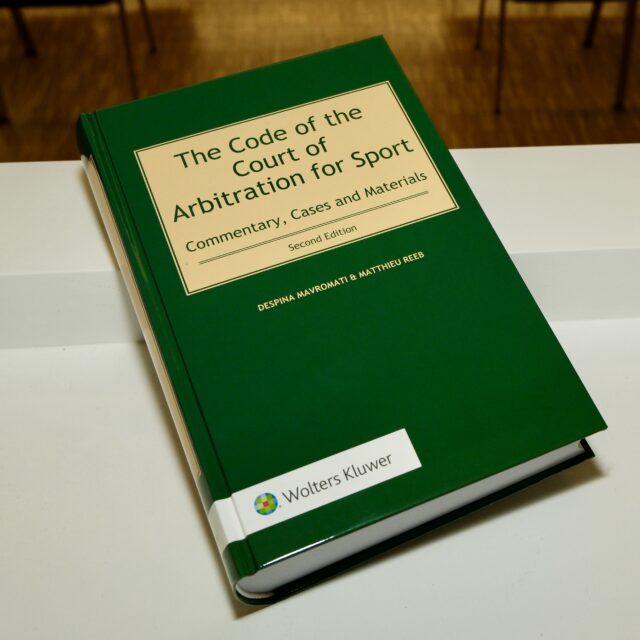
The Code of the Court of Arbitration for Sport – Commentary, Cases and Materials

by Despina Mavromati / Matthieu Reeb, Wolters Kluwer 2025

Ιn its fully revised second edition, The Code of the Court of Arbitration for Sport offers a comprehensive, article-by-article commentary of the CAS Rules. Drawing on leading CAS and Swiss Federal Tribunal case law, CAS practices and international arbitration principles, the book is an indispensable reference for practitioners, arbitrators, and scholars working in sports arbitration.

This second edition introduces significant updates, including new model documents and new chapters on the ICAS, the CAS ad hoc Rules and the CAS Anti-Doping Division Rules during the Olympic Games.

Order Here