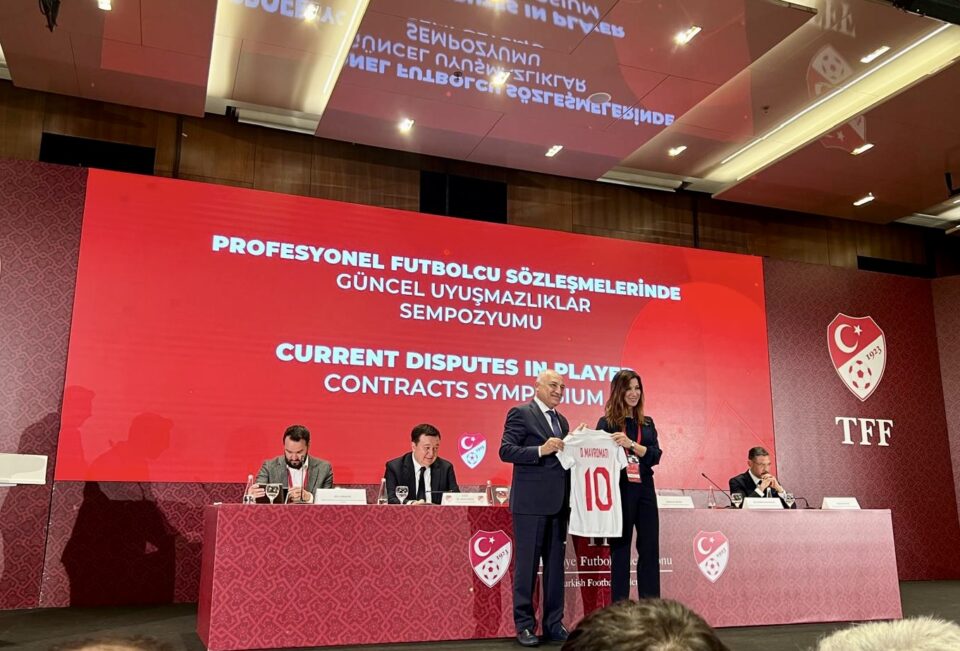
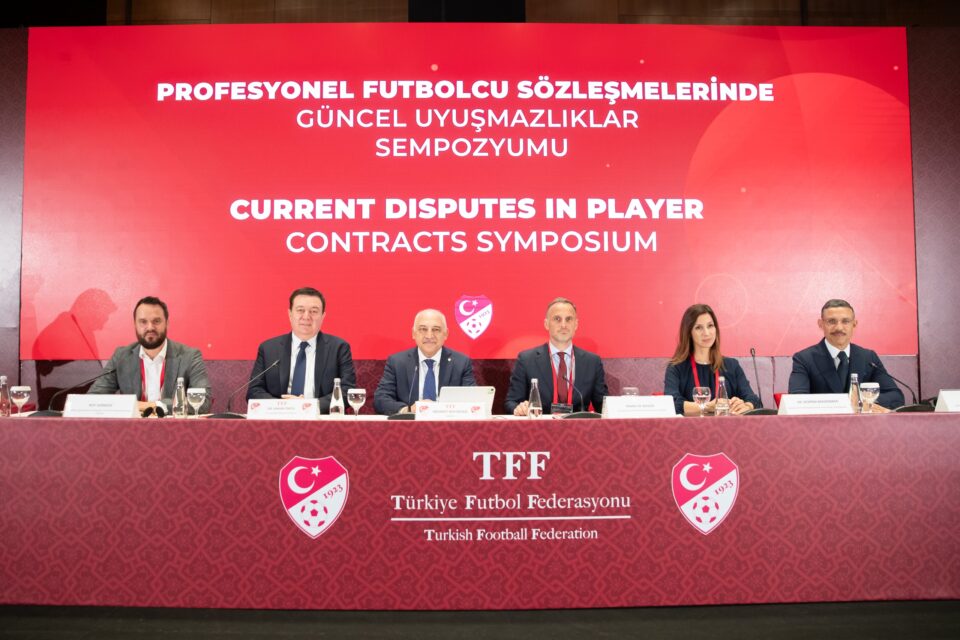
Turkish Football Federation Symposium “Current Issues in Player Contracts” in Istanbul
May 29, 2024
Turkish Football Federation Symposium “Current Issues in Player Contracts” in Istanbul
Despina Mavromati was invited to speak at the Turkish Football Federation Symposium “Current Issues in Player Contracts” on 24 May 2024. She discussed “Termination of Player Contracts with Just Cause: Selected Issues under Swiss law, CAS – and Swiss Federal Tribunal Jurisprudence” alongside FIFA DRC Chair Franz de Weger, sports lawyer Marcos Motta and FIFPro Legal Director Roy Vermeer. You can find more information about the Symposium here.
UEFA Appeals Body members present on-site at the UEFA Euro 2020
May 18, 2021
Despina Mavromati, UEFA Appeals Body Member, will be present in London during the UEFA Euro 2020, alongside the UEFA Appeals Body Chairman, Mr. Pedro Tomás Marqués and the UEFA Appeals Body Vice-Chair, Mr. Michael Joseph Maessen. The Appeals Body hears appeals against decisions by the Control, Ethics and Disciplinary Body and rules on particularly urgent cases referred to it directly by the chairman of the Control, Ethics and Disciplinary Body. UEFA’s Appeals Body consists of a chairman, two vice-chairmen and eleven other members. You can find more information on the UEFA Appeals Body here.
The ECtHR offers important guidelines for establishing sports tribunals – Ali Riza et al. v. Turkey
On 28 January 2020, the European Court of Human Rights (“ECtHR”) published its decision in the application of Mr. Riza et al against Turkey (“ECtHR Judgment” or “Riza et al. Judgment”). It’s worth noting that the Judgment, similar to the Pechstein Judgment. The ECtHR found that Turkey violated Article 6 § 1 of the European Convention of Human Rights (“the Convention”) due to the structural deficiencies of the Arbitration Committee of the Turkish Football Federation and ordered that the TFF dispute resolution instances be reformed.
Even though the case relates to the football dispute resolution instances in Turkey, the recent judgment of the ECtHR is of systemic importance and will impact on the structure and governance of sports adjudicating instances on a wider geographical scale.
The Swiss Federal Tribunal (“SFT”) has repeatedly declared that the internal instances of sports federations are not “genuine arbitral tribunals” but merely the expression of the will of the association (see 4A_492/2016, Judgment of February 7, 2017, at 3.3.3). However, the ECtHR Judgment imposes higher requirements on the “independent” tribunals of sports federations, to the extent that recourse is compulsory and there is no subsequent judicial review by an independent court. This judgment, that relates to a purely contractual matter (Mr. Riza) and a regulatory issue (Mr. Akal), comes after the Mutu and Pechstein judgment that was rendered by the ECtHR in October 2018 and related to a contractual- and a doping-related matter, respectively.
This note discusses the particular facts, the key findings of the ECtHR Judgment; the similarities and differences when compared to the Mutu and Pechstein Judgment of the ECtHR; some fundamental principles that sports tribunals must take into account in case there is no possibility for a subsequent appeal venue against their decisions; and, finally, the limits within which these high standards apply.
1) Overview of facts and various proceedings prior to the ECtHR Judgment
All Applicants contested the independence of the TFF Arbitration Committee that had previously issued decisions against them: Mr Riza (a former professional football player of dual British and Turkish nationality) was found liable for breach of contract with his former club; Mr Akal, a football referee of Turkish nationality was downgraded from top-level assistant referee to “provincial referee”; and three other Turkish amateur football players were found guilty of match-fixing charges. The facts have also been summarized in a Press Release of the Court dated 28 January 2020. Only Mr. Riza appealed to the CAS and then to the SFT, with a pending application before the ECtHR against Switzerland and these proceedings are summarized below.
The TFF Arbitration Committee Decision, the CAS Award and the SFT Judgment
Mr. Riza and his former football club (“the Club”) entered into an employment dispute. The Club started proceedings against him for breach of contract before the Turkish Football Federation (“the TFF”) Arbitration Committee. The Committee found that Mr Riza had wrongfully terminated his contract and imposed a financial sanction.
Mr. Riza appealed against the decision to the CAS in Lausanne but the latter rejected the appeal for lack of jurisdiction. In this interesting CAS award – one of the first to discuss the “international dimension” of football cases – the CAS Panel held that Article 63.1 of the FIFA Statutes (2008 version), which requires national federations to confer jurisdiction to an independent and duly constituted arbitration tribunal, could not be regarded as an arbitration clause in favour of CAS for national disputes per se. By the same token, claims regarding the lack of independence of the national sports tribunals raised by Mr. Riza (as they were also – successfully – raised before the ECtHR) could not give rise to the jurisdiction of the CAS automatically (see CAS 2010/A/1996, para. 50).
According to the CAS Panel, the TFF Rules provided for an appeal to the CAS only under specific requirements, including the existence of an «international dimension». It found that this condition was not met by the sole fact that Mr. Riza was a dual (British and Turkish) national. This was confirmed by the SFT in the subsequent SFT judgment 4A_404/A2010 (see below, at 4.1.3 and 4.3.3.2).
The ensuing motion to set aside the CAS award was equally dismissed by the Swiss Federal Tribunal (“the SFT”). (see 4A_404/2010, judgment of April 19, 2011).
Ali Riza v. Switzerland
Following the dismissal of his appeal by the SFT, Mr. Riza lodged a complaint (no. 74989/11) against Switzerland before the ECtHR, which is still pending. The claims raised in this application related to alleged violations of Article 6 § 1 ECtHR with respect to the CAS and SFT proceedings and his access to courts because the CAS found that it lacked jurisdiction (see the ECtHR Judgment, para. 24). Mr. Riza also claimed violation of his right to a public hearing before the CAS and the SFT and various violations of his right to a fair hearing (equality of arms) before the SFT because the other parties were granted five times more time to file their answer than he had to file his motion.
2)The ECtHR Judgment – Some key Takeaways
Non-Applicability of Article 6 § 1 on the Amateur Football Players’ complaints
The Amateur Players’ case related to proceedings before the TFF against them with match-fixing charges. Both the first instance decision by the Amateur Football Disciplinary Committee of the TFF and the Arbitration Committee found that the Amateur Players had committed the disciplinary offence of “influencing the match result” and were banned from any football-related activities for a year.
However, Article 6 § 1 does not automatically apply to all cases. The charges imposed on the Amateur Football Players were, at the material time, considered as a “disciplinary offence” and not a criminal charge under that provision (see the ECtHR Judgment, para. 154).
Viewed from the angle of civil rights and obligations (an autonomous concept that is not interpreted according to recourse to any national law (i.e. Turkish law), see the ECtHR Judgment, para. 150) and even though disciplinary proceedings involving the right to practice a profession fall within the scope of “civil rights and obligations” under Article 6, amateur football was considered to be a non-remunerated activity. Moreover, the Amateur Players failed to adduce evidence regarding salaries (or any pecuniary losses under Article 1 of Protocol No. 1 and Article 13 ECHR).
As a result, the ECtHR rejected the Amateur Players’ complaints under Article 6 § 1 as inadmissible (see Article 35 § 3 and 35 § 4 of the Convention; see the ECtHR Judgment, para. 157).
The ECtHR Findings – a Comparison to the Mutu and Pechstein Judgment
All Applicants claimed that the decisions rendered against them by the TFF Arbitration Committee violated Article 6 § 1 of the Convention relating to the right to a fair hearing and access to court. In this regard, all Applicants alleged that the TFF Arbitration Committee proceedings lacked independence and impartiality.
Article 6 § 1 of the Convention provides that “In the determination of his civil rights and obligations or of any criminal charge against him, everyone is entitled to a fair and public hearing within a reasonable time by an independent and impartial tribunal established by law” (emphasis added).
All judgments (specifically, the Riza et al and the Mutu and Pechstein Judgment) tackled, among other grounds, the structural independence of an arbitral institution (the Arbitration Committee and the CAS, respectively) based on Article 6 § 1 of the Convention.
In Riza et al., the TFF Arbitration Committee had clear structural deficiencies that constituted, according to the unanimous view of the Chamber, a clear violation of Article 6 § 1 of the Convention. In the interesting, partly concurring partly dissenting opinion of Judge Bošnjak (annexed to the main ECtHR Judgment), the sole dissenting Judge acknowledged that two of the grounds (i.e. the lack of immunity from actions brought against the members and the lack of rules fixing the term of office of the members) would suffice for a violation of Article 6 § 1 of the Convention (at para. 5).
In essence, the ECtHR found that at the material time of the Applicants’ proceedings before the TFF Arbitration Committee, the latter had exclusive and compulsory jurisdiction over the respective football disputes brought by Mr Riza and Mr Akal and decided in a final and binding way (without a possibility to appeal to an independent court). Therefore such a Committee had to provide the same safeguards as guaranteed under Article 6 § 1 of the Convention.
a) The “Compulsory” Character of the Arbitration and the Waiver to contest the Tribunal’s Independence
Similar to the Mutu and Pechstein Judgment, the ECtHR drew a distinction between voluntary and compulsory arbitration. In the latter case, all the guarantees of Article 6 § 1 should be safeguarded (see the ECtHR Judgment, para. 174). Unlike the Pechstein case, however, the “compulsory” recourse to the TFF Arbitration Committee was not even disputed by the parties in the Riza et al. Judgment (see the Mutu and Pechstein Judgment, para. 115).
In the case of Mr. Mutu, the ECtHR held that, even though there was not forced arbitration, Mr. Mutu had not unequivocally waived his right to challenge the independence of CAS, therefore the guarantees of Article 6 § 1 should also be safeguarded (see the ECtHR Judgment, para. 176. See the Mutu and Pechstein Judgment, paras. 120 and 123).
b) Composition of the Members of the Arbitration Committee and Balance of Powers
Contrary to the Mutu and Pechstein Judgment (which related to the CAS and not the TFF Arbitration Committee), the ECtHR found in the Riza et al. Judgment that the guarantees to protect the members of the Committee from outside pressure, and in particular from the TFF Board of Directors, were insufficient: the Board, which largely consisted of representatives of football clubs, appointed the members of the Arbitration Committee.
The ECtHR put great emphasis on the balance of powers within the Board and its influence over the members of the Arbitration Committee (in the contractual case of Mr. Riza) or the drafting of rules of the Referee Committee (in the case of regulatory nature of Mr. Akal). This legitimate doubt as to the members’ independence and impartiality was sufficient for the ECtHR to admit a violation of Article 6 § 1 of the Convention, even though this view was not shared by the dissenting Judge.
The Mutu and Pechstein Judgment also dealt with the issue of structural imbalance between athletes and federations when it comes to appointing the CAS arbitrators. Nevertheless, even though the ECtHR acknowledged that sports federations could have a certain influence on the selection mechanism of the CAS Arbitrators to become part of the list, it could not conclude based on this element only that the arbitrators on the CAS list could not be regarded as independent and impartial vis-à-vis these federations.
All judgments (specifically, the Riza et al and the Mutu and Pechstein Judgment) tackled, among other grounds, the structural independence of an arbitral institution (the Arbitration Committee and the CAS, respectively) based on Article 6 § 1 of the Convention.
In Riza et al., the TFF Arbitration Committee had clear structural deficiencies that constituted, according to the unanimous view of the Chamber, a clear violation of Article 6 § 1 of the Convention.
In essence, the ECtHR found that at the material time of the Applicants’ proceedings before the TFF Arbitration Committee, the latter had exclusive and compulsory jurisdiction over the respective football disputes brought by Mr Riza and Mr Akal and decided in a final and binding way (without a possibility to appeal to an independent court). Therefore such a Committee had to provide the same safeguards as guaranteed under Article 6 § 1 of the Convention.
a) The “Compulsory” Character of the Arbitration and the Waiver to contest the Tribunal’s Independence
Similar to the Mutu and Pechstein Judgment, the ECtHR drew a distinction between voluntary and compulsory arbitration. In the latter case, all the guarantees of Article 6 § 1 should be safeguarded. Unlike the Pechstein case, however, the “compulsory” recourse to the TFF Arbitration Committee was not even disputed by the parties in the Riza et al. Judgment.
In the case of Mr. Mutu, the ECtHR held that, even though there was not forced arbitration, Mr. Mutu had not unequivocally waived his right to challenge the independence of CAS, therefore the guarantees of Article 6 § 1 should also be safeguarded.
b) Composition of the Members of the Arbitration Committee and Balance of Powers
Contrary to the Mutu and Pechstein Judgment (which related to the CAS and not the TFF Arbitration Committee), the ECtHR found in the Riza et al. Judgment that the guarantees to protect the members of the Committee from outside pressure, and in particular from the TFF Board of Directors, were insufficient: the Board, which largely consisted of representatives of football clubs, appointed the members of the Arbitration Committee (see the ECtHR Judgment, para. 210 f. It is worth noting that in his Disssenting Opinion, Judge Bošnjak considers that this is not a sufficient criterion for a violation of Article 6 § 1 of the Convention, see paras. 6-7).
The ECtHR put great emphasis on the balance of powers within the Board and its influence over the members of the Arbitration Committee (in the contractual case of Mr. Riza) or the drafting of rules of the Referee Committee (in the case of regulatory nature of Mr. Akal). This legitimate doubt as to the members’ independence and impartiality was sufficient for the ECtHR to admit a violation of Article 6 § 1 of the Convention, even though this view was not shared by the dissenting Judge.
The Mutu and Pechstein Judgment also dealt with the issue of structural imbalance between athletes and federations when it comes to appointing the CAS arbitrators. Nevertheless, even though the ECtHR acknowledged that sports federations could have a certain influence on the selection mechanism of the CAS Arbitrators to become part of the list, it could not conclude based on this element only that the arbitrators on the CAS list could not be regarded as independent and impartial vis-à-vis these federations.
c) Terms of office, Immunity and Challenge Procedure
In the Riza et al. Judgment, the ECtHR proceeded to a scrutiny of the actual members of the Arbitration Committee and found that there were a number of other problematic elements, starting with the fact that the Arbitration Committee members were not bound by rules of professional conduct. Furthermore, the Members of the Committee did not have to swear an oath or make a solemn declaration before taking up their duties nor were they protected from civil liability actions.
Another important shortcoming was that the TFF rules had no fixed terms of office for the Arbitration Committee members.
Most importantly however, the Members of the TFF Arbitration Committee did not have to disclose circumstances affecting their independence and impartiality, whereas there was no specific procedure to deal with challenges to a member on those grounds. In this respect, it’s interesting to note that general provisions imposing on members of the Committee a duty to decide in an independent and impartial manner would not necessarily suffice without a specific obligation of disclosure and independence in each case but also a procedure foreseen in case of challenges. The ECtHR compared the TFF Arbitration Committee to the CAS, which provides for a detailed challenge procedure.
Similar to the Riza et al. Judgment, the Mutu and Pechstein judgment scrutinized the terms of office under the CAS Code. Specifically, the appointment of CAS arbitrators is on a four year –renewable – term, without limitation as to the number of terms, while the ICAS Board has the power to remove arbitrators based on Article R35 of the CAS Code. However, and this could be the main difference between Riza et al. and the Mutu and Pechstein Judgment, the CAS list of arbitrators included at that time more than 300 arbitrators, while the Arbitration Committee is composed of a Chairman, 6 principal and 6 substitute Members.
Furthermore, Ms Pechstein did not raise doubts as to the lack of objective independence and impartiality of the totality of CAS arbitrators on the CAS list but only challenged the president of her panel, without further substantiating her allegations. Mr Mutu had also challenged the independence of the President of the Panel and one of the Arbitrators, but his complaints were dismissed by the ECtHR. Inversely, the Applicants in the Riza et al. Judgment did not raise doubts as to the subjective impartiality of any member of the Arbitration Committee but only questioned their independence and objective impartiality.
A further difference between the two cases relates to the question of absence of a public hearing (in the case of Ms. Pechstein), which was not even raised in the Riza et al. Judgment (see the Pechstein Judgment, para. 169). The ECtHR concluded that the absence of a public hearing (even though this was validly requested by Ms. Pechstein) constituted a violation of Article 6 § 1 of the Convention, while limiting the scope of such guarantee to specific cases (disciplinary cases; cases involving natural persons; matters not strictly limited to technical legal issues, etc.).
Finally, similar to the Mutu and Pechstein case, the financing of the TFF Arbitration Committee by the TFF was not found to be a sufficient element to demonstrate lack of independence (see the ECtHR Judgment, para. 214; see the Mutu & Pechstein Judgment, para. 151).
d) The Importance of the “Finality” of the Decisions of the Arbitration Committee
The fact that the decisions of the Arbitration Committee (and, more generally, the decisions of all sports tribunals) were final was also decisive in the Riza et al. Judgment. The pertinent provisions of the Constitution on the development of sports provided that “(…) Decisions of arbitration committees are final and shall not be appealed to any judicial authority” (see the ECtHR Judgment, para. 105).
Most importantly, however, the TFF Statutes provided that the Arbitration Committee decisions were not amenable to review by any authority, excluding even the possibility to file a motion to set aside an arbitral award (for exhaustively enumerated reasons) with the Supreme Court of the seat of the arbitral tribunal (see e.g. the procedure set out in Art. 190 ff. of the Swiss PILA and the possibility to have a waiver). However, the Swiss Federal Tribunal has held that such waivers are unenforceable and cannot be used against athletes in case of a (compulsory) arbitration clause in the regulations of the sports federation (see the SFT Judgment 4P.172/2006, Judgment of 22 March 2007 (Cañas v. ATP Tour), at 4.3.2.1 ff., in particular at 4.4.2 in fine).
3) Criteria established from the ECtHR Judgment for “independent and impartial tribunals”
Criteria of independence & impartiality of sports tribunals (Article 6 § 1 of the Convention)
The ECtHR Judgment, read in conjunction with the Mutu and Pechstein Judgment, may offer important guidance as to the steps to take when establishing “independent and impartial tribunals established by law” to the extent that recourse to such tribunals is compulsory and there is no right to a de novo judicial review. It should be reminded that the ECtHR Judgment (like the Mutu and Pechstein Judgment) was published almost 10 years after the filing of the first application, which is problematic especially in view of the fact that the ECtHR dealt with “fair hearing” and “access to courts” complaints under Article 6 § 1 of the Convention. These key elements include, but are not limited to, the following:
The tribunal’s board should be entirely independent from the arbitrators’ roster;
There should be clear terms of office, ideally not aligned with the Board’s members
The arbitrators should disclose any conditions likely to affect their independence or impartiality on any given case (a general duty of independence signed in the beginning of the term or a general provision in the rules would clearly be insufficient)
A formal challenge procedure (similar to the one at the CAS under Article R34 CAS Code) should be put in place.
There should be a certain balance in the constitution of the panel members in order to ensure the sufficient representation of athletes
In view of the acknowledgement of the advantages of sports disputes resolution by specialized instances (also for purely contractual cases), the distinction between “doping-related” cases (where the parties seize the CAS based on the WADA Code) and “contractual cases” (in the case of Mr. Riza) or “regulatory” cases (in the case of the referee – Mr. Akal) becomes less important, with the criterion of “forced” or “compulsory” arbitration becoming the predominant one to define the arbitral tribunal’s obligations and criteria to comply with.
One must keep in mind that it is not necessary for all sports disputes tribunals to comply with these conditions. As the SFT has acknowledged, the judicial instances of sports federations are not “arbitral tribunals” (see 4A_492/2016, Judgment of February 7, 2017, at 3.3.3). The stricter standards of Article 6 § 1 apply to “independent arbitral tribunals” where recourse is compulsory (or there is no unequivocal waiver of challenge of the tribunal’s independence) and there is no subsequent judicial review.
These standards would not necessarily apply in case there is an appeal to a “true court of arbitration”, for example, the CAS, as found by the Swiss Federal Tribunal but also by the ECtHR in the Pechstein Judgment or a court that can guarantee an independent judicial review. Therefore, the finality of the decision of a sports tribunal is the decisive criterion for determining whether the guarantees of Article 6 § 1 of the Convention should be respected.
Finally, the guarantees of Article 6 § 1 of the Convention do not seem to apply to purely amateur athletes, to the extent that such activity falls neither under the “civil” head nor the “criminal” head of the provision.
ThinkSport Conference Organized by the University of Lausanne
June 6, 2019
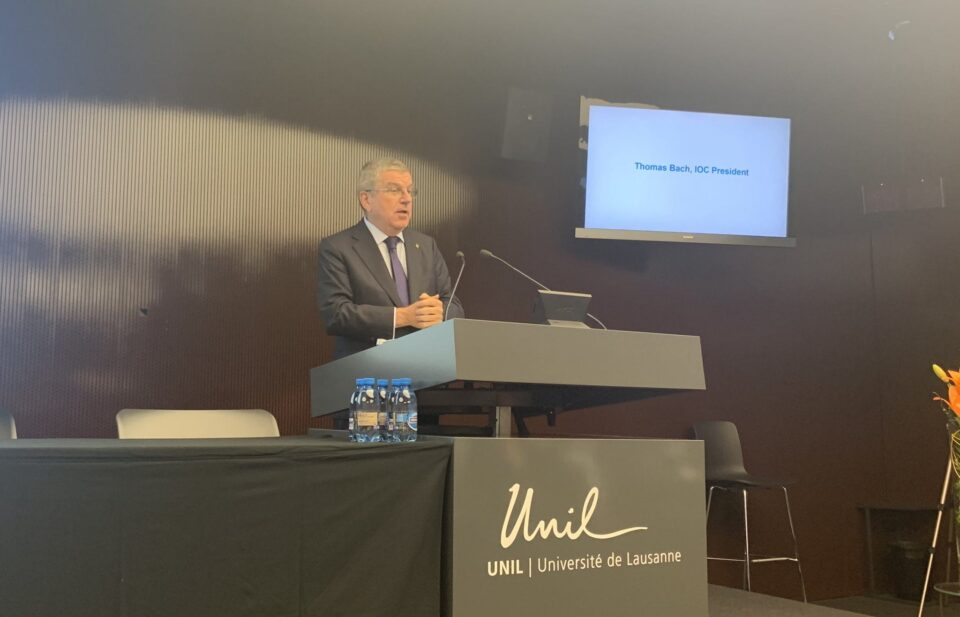
Despina Mavromati participated in a round table on the future of sport and sport governance with several experts from the field. The fifth edition of the 2019 Sport Future Rendez-Vous took place on Wednesday 5th June 2019 from 16:15 to 20:30 with a keynote presentation by Mr. Thomas Bach, IOC President, Olympic champion fencing Montreal 1976. You can find the agenda here.
The validity of FIFA’s arbitration clause and the independence of the CAS: A detailed review of the RFC Seraing cases
October 4, 2018
Published in LawInSport, 4 October 2018
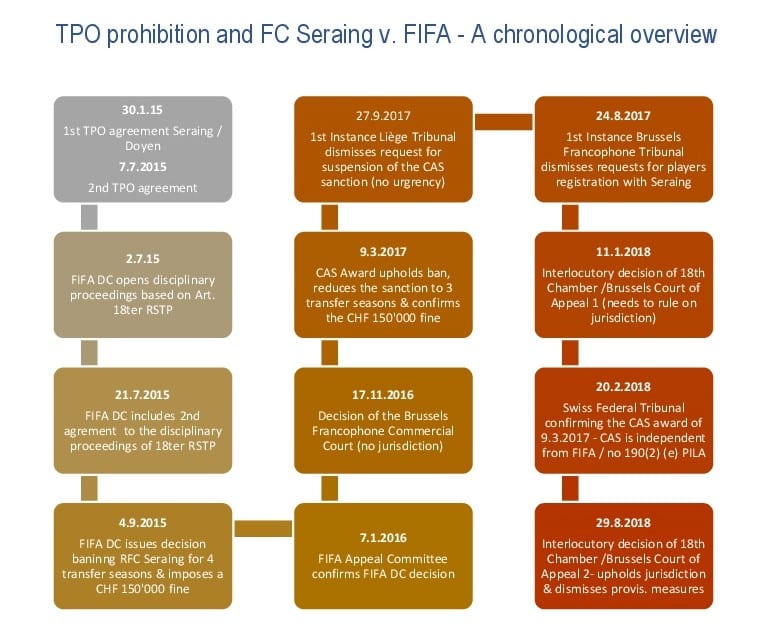
This article explains the disciplinary and competition law proceedings relating to RFC Seraing and the third-party ownership (TPO) contracts that they concluded with Doyen Sports Investment Limited (Doyen Sports). There were two sets of proceedings: one initiated by Doyen Sports and Seraing before the Belgian courts challenging the legality of FIFA’s TPO ban; and the other initiated by the FIFA Disciplinary Committee against Seraing for violation of the FIFA Regulations on the Status and Transfer of Players (RSTP), subsequently appealed to the Court of Arbitration for Sport, and then the Swiss Federal Tribunal and the Liège Tribunal.
Trinidad and Tobago Football Association v. FIFA – the validity of normalisation committees and exclusive jurisdiction of CAS
October 24, 2020
Published in LawInSport, 23 October 2020
On 13 October 2020, the High Court of Justice in Trinidad and Tobago issued their decision on a claim filed by the TTFA against FIFA. It ruled, in essence, that the FIFA’s decision to remove the TTFA’s executive board from office and to appoint a normalisation committee to run its affairs was null and void as it was made in bad faith and “for an improper and illegal motive”. This decision was eventually overturned by the Court of Appeal on 23 October 2020. In this decision, the Court of Appeal confirmed that the filings of these proceedings were ultra vires, null and void, confirming the exclusive jurisdiction of the CAS. This note reviews the case and analyses its potential repercussions for sports arbitration more generally.
The Swiss Federal Tribunal and its impact on CAS arbitration
May 14, 2017
The Swiss Federal Tribunal and its impact on CAS arbitration, American Bar Association – Special Issue on the CAS and the Olympics (March 2017)
This paper provides an overview of how the Swiss Federal Tribunal judgments have a two-fold impact on the functioning and development of CAS as an international arbitral tribunal Read article
SFT Judgment 4A_260/2017 of February 20, 2018 (motion to set aside the CAS Award TAS 2016/A/4490)
The Issue
Prohibition of Third Party Ownership (TPO) agreements in football under the FIFA Regulations. Legality of the CAS awards and CAS independence from FIFA. European competition law and violation of substantive public policy. Restriction of the economic freedom of the clubs with respect to TPO agreements and prohibition of excessive commitments of Art. 27 (2) Swiss Civil Code.
The Facts
This judgment can also be characterized as a sequel of the Lazutina judgment rendered by the Swiss Federal Tribunal 15 years ago. It is also interesting for a number of other reasons.
The case related to a disciplinary sanction imposed by FIFA on a football club for violation of the Third-Party Ownership (TPO) provisions of the FIFA Regulations on the Status and Transfer of Players (RSTP). The Appellant, a third division club (RFC Seraing) registered with the Royal Belgian Football Association (RBFA) had concluded TPO contracts with the investment company (Doyen Sports Investment Ltd). The TPO agreements are prohibited under Art. 18ter of the FIFA RSTP.
The FIFA Disciplinary Commission imposed a four-year transfer ban on the Appellant and a CHF 150’000 fine, a decision that was subsequently confirmed by the FIFA Appeal Commission. The sanction was partially confirmed by the CAS in a lengthy and quite interesting award.
RFC Seraing and the TPO Company Doyen Sports Investments Ltd had initiated other proceedings before the European Commission and the state courts in Belgium.
The TPO Provisions
The provisions on TPO aim at preventing third parties from acquiring ownership of the players’ economic rights. The TPO practice consists of having a professional football club selling, totally or partially, its economic rights over a player to a third-party investor, so that this investor may benefit from any potential capital gain that the club will make upon the future transfer of the player. In return, the investor provides financial assistance to the club to allow it to resolve cash flow problems or helps acquire a player, among other objectives.
A club that is interested in a player but is unable to pay the transfer fee required by the player’s current employer may call upon an investor who will provide the necessary funds for the payment of all or part of the transfer fee. In exchange, the investor obtains a share of the profits on the indemnity that the club will get in case of subsequent transfer of the player (at A.a. and A.b of the SFT judgment).
The CAS Award of March 9, 2017
In its award rendered on March 9, 2017, the CAS Panel applied the FIFA RSTP and Swiss law and considered the mandatory rules of European law but refused to apply Belgian law.
The CAS Panel considered the rights guaranteed by the Treaty on the Functioning of the EU (TFEU), including the free movement of capital (Art. 63 TFEU). The restrictions on capital movements from, to or between the EU Member States from Art. 18bis and Art. 18ter RSTP were found to respect the principle of proportionality: they pursue a legitimate objective (such as safeguarding the regularity of sports competitions) and they were appropriate to achieve such objective without going beyond what is necessary in order to achieve said objective (since the measures only prohibit certain financing schemes which give the investor the power to influence the independence and policy of a club).
The Panel found another case related to the TPO that led to the SFT judgment 4A_116/2016 not relevant to the case at hand since it involved different parties and did not deal with the compliance of the TPO type contracts with Art. 18ter RSTP.
The sanctions imposed by FIFA were also found to be proportionate to the violation – two separate offences, deliberate and repeated violations of the RSTP and unwillingness to cooperate in the FIFA proceedings. However, since this was the first case dealing with the matter of prohibition of TPO, the panel reduced the sanction to three consecutive transfer periods while confirming the amount of fine (at B.b.a and B.b.b. of the SFT judgment).
The findings of the SFT Judgment
In the subsequent appeal to the SFT, the Appellant primarily alleged that the CAS is not a true arbitral tribunal (thus invoking the incorrect constitution of the arbitral tribunal of Art. 190 (2) (a) PILA); it also alleged that the Chaiman of the Panel violated its right to be heard through his conduct during the proceedings (Art. 190 (2) (d) PILA) and a violation of substantive public policy (Art. 190 (2) (e) PILA) for endorsing FIFA’s total ban on TPO and imposing manifestly disproportionate sanctions.
Legality of CAS (Art. 190 (2) a PILA)
The main part of the judgment focuses on the “legality” of the CAS as an arbitral institution but also its independence from FIFA, since the Lazutina judgment had only reviewed the independence of the CAS from the IOC. According to the Appellant, the obligation to have recourse to CAS is illegal also because it is imposed by a “mafia-like” association that is FIFA (at 3.1.1). Another argument raised was that FIFA is the dominant federation in terms of volume of business to the extent that it affects its independence.
The Parties’ Positions
In its answer, the CAS gave – for the first time – important information on its governance and internal financial structure. It disclosed, for example, that FIFA’s annual financial contribution to CAS’ overhead costs was CHF 1’500’000. This amount was compared to CHF 7’500’000 paid by the entire Olympic movement out of a total CAS budget of CHF 16’000’000. The CAS also highlighted the fact that most football arbitration proceedings are of commercial nature (where the parties need to pay the arbitration costs) and FIFA only plays an active role in the CAS proceedings in cases arising out of the FIFA Disciplinary Code and the FIFA Code of Ethics (approximately 5% on average).
The CAS Secretary General further disclosed that 65% of the CAS’ workload involves football cases but almost half of them do not concern FIFA since they are either domestic cases, decisions rendered by continental confederations such as UEFA and so-called “direct” proceedings involving parties wishing to bring their case to the CAS without going through the FIFA instances.
The SFT Findings: Lazutina II?
The SFT repeated the arguments laid down in the Lazutina judgment of May 27, 2003 (and the subsequent jurisprudence confirming said judgment), where it had found that the CAS was sufficiently independent of the IOC as well as of all the parties calling upon its services and its decisions can be considered as “real” awards assimilated to state court decisions. It also referred to the Pechstein judgment of the German Bundesgerichtshof of 7 June 2016 which confirmed that the CAS is a genuine, independent and impartial arbitral tribunal (3.4.1).
As held by the SFT in its judgment, and in accordance with the principle of sovereign nations, the opinions expressed by the superior courts of an EU member state have no more weight than that of the supreme judicial authority of the country in which the case in dispute is pending (in casu, Switzerland, at 3.4.1).
The SFT reiterated its mission when controlling the legality of an arbitral institution based in Switzerland, which is not to reform the CAS nor to recast its governing regulations but must only ensure that it reaches the independence level required to be assimilated to a State court (at 3.4.2.).
The SFT further highlighted the institutional amendments made by the ICAS in the last years, such as the President of the Appeals Division is no longer the IOC Vice-President but a former athlete. Furthermore, the ICAS is no longer required to have a quota of arbitrators selected from among the persons proposed by the sports organizations (1/5th each for the IOC, the IFs and the NOCs).
The alleged violation of the parties’ right to be heard (Art. 190 (2) d PILA)
Regarding the violation of the parties’ right to be heard by the Chairman of the Panel during the CAS proceedings, the SFT found these criticisms to be unfounded: the Chairman of the Panel, who had stopped the Appellant from criticizing FIFA as an organization and the conduct of some of the members of its Executive Committee, was merely directing the debates, ensuring that they were concise and inviting the parties to focus on the subject of the dispute (Art. R44.2(2) of the Code by reference to Art. R57 (3) CAS Code.
Competition Law, Excessive Commitments and Substantive Public Policy (Art. 190 (2) e PILA)
Finally, with respect to the alleged violation of substantive public policy, the SFT referred to the Tensacciai judgment of March 8, 2006 and confirmed that the provisions of any competition law do not fall within the scope of substantive public policy (at 5.2). What is more, an obligation imposed by an award to compensate another party fairly would not fall within the restricted scope of substantive public policy even if it contradicted a norm of supranational law (at 5.2).
Within the scope of substantive public policy, the Appellant also attacked the CAS award for violation of Art. 27 (2) Swiss Civil Code that prohibits excessive commitments (at 5.4.1). The SFT reiterated that there needs to be a severe and obvious violation of Art. 27 (2) CC to fall within the scope of substantive public policy, a condition that was not fulfilled in this case: By prohibiting TPOs, FIFA is restricting the economic freedom of the clubs for certain types of investment but does not suppress it. Clubs remain free to pursue investments, as long as they do not secure them by assigning the economic rights of the players to third party investors.
The Brussels Court of Appeals Decision: a Parallel Universe?
FC Seraing, Doyen Sports Ltd and other parties filed claims with the State Courts in Belgium with a view to authorize TPO agreements and declare the TPO prohibition illegal. The 18th Chamber of the Brussels Court of Appeal issued, on August 29, 2018, an interlocutory decision dismissing the request for suspension of the disciplinary sanction filed by FC Seraing and Doyen Sports Investments Ltd against FIFA et al. (see 18th Chamber of the Brussels Court of Appeal of August 29, 2018 (2018/6348). This decision followed another interlocutory decision rendered by the same court on January 11, 2018. Various other proceedings were initiated by FC Seraing and Doyen Sports Investments Ltd). In this decision, the Court accepted its jurisdiction, considered that it can hear the case to the extent that its effects are limited to the Belgian territory (based on Art. 6 (1) Lugano Convention) and, finally, rejected the request for provisional measures filed by Doyen & FC Seraing for lack of new elements that would otherwise constitute a change of circumstances compared to the Court’s judgment of March 10, 2016.
Legality of the FIFA arbitration clause
The most interesting point of the interlocutory decision of August 29, 2018 is the examination of validity of the arbitration clause enshrined in the FIFA Statutes. The Belgian Court proceeded to the interpretation of the FIFA arbitration clauses under Belgian law and found them to be too broad to be valid since the scope is not limited to a specific legal relationship 1
The fact that the FIFA clause was meant to cover FIFA’s activities and its relationship with its members through its specialized statutes was found to be irrelevant, all the more since RFC Seraing is only an indirect member of FIFA / UEFA. The argument that disputes covered by the FIFA clause would implicitly only cover “sporting disputes” (since the CAS could only accept those disputes) was equally dismissed, since it is not part of the arbitration clause and the CAS is a third party free to amend its rules at all times irrespective of the FIFA statutes.
The Court further found that the principle of “favor arbitrandum” is not a general principle that would go so far as to circumvent the specificity of the scope of the arbitration clause.
Finally, and more generally, an arbitration clause, even when it only involves two parties, can merely cover a specific legal relationship between them and not all possible disputes. The exceptions from the CAS jurisdiction for cases where the jurisdiction of the Zurich State Courts is foreseen only confirm the broad scope of the FIFA arbitration clauses (paras. 14-16 of the Decision of the Brussels Court of Appeal).
The practical consequences
The debate is set to continue in the next months / years. However, what is the value of the finding that the FIFA arbitration clause is too broad and thus unenforceable under Belgian law? The SFT held in its 4A_260/2017 judgment that, based on the principle of national sovereignty, the opinions expressed by the superior courts of an EU member state have no more weight than that of the Swiss supreme judicial authority (4A_260/2017, at 3.4.1).
Furthermore, this finding does not affect the CAS and its legality as an arbitral institution. CAS Panels are called to rule on their jurisdiction based on the Kompetenz-Kompetenz doctrine and on a case-by-case basis. While the FIFA arbitration clause has been under scrutiny by many CAS Panels to date, there has not been a case where the legality of the clause was questioned as such. 2
Also, Swiss courts have not dealt with this specific question related to the arbitration clauses of sports associations. It should be noted that the Brussels Court of Appeals is merely an interlocutory decision that ruled on its jurisdiction and dismissed the request for provisional measures. The final decision of the Court might as well reach the same conclusion as the CAS Panel in the TAS 2016/A/4490 award and confirm the measures taken by FIFA with respect to the substance of the dispute, which relates to the TPO prohibition.
In any event, the Belgian Court finding was enough to allow the claim to proceed and dismiss the “exception d’arbitrage” objection filed by FIFA et al. The finding that the FIFA arbitration clause was too broad means that other similar arbitration clauses of sports federations may have an analogous fate, if their validity is challenged before other Belgian state courts. In any event, this should lead to a reconsideration of the arbitration clauses of all sports federations in order to resist potential challenges in the future.
The Takeaway
The SFT judgment 4A_260/2017 put an end to the judicial journey of the RFC Seraing in Switzerland but the debate seems far from over in Belgium. The issues that the SFT discussed and decided in a final and binding manner in this “Lazutina reloaded” judgment are the following (relevant in terms of Art. 190 (2) (a) and (e) PILA):
– First, the CAS is an independent arbitral tribunal and its awards can be assimilated to state court judgments (at 3.4.2). The CAS is further sufficiently independent from the FIFA, notwithstanding the fact that the latter is one of the principal users of its services.
– Second, a prohibition of TPO agreements seems to be compliant with European law: it pursues a legitimate objective (safeguarding the regularity of sports competitions) and seems appropriate to achieve such objective since the measures only prohibit certain financing schemes which give the investor the power to influence the independence and policy of a club.
On the other side, the debate continues in Belgium where the Brussels Court of Appeals proceeded to a strict and objective interpretation of the FIFA arbitration clause, irrespective of the principle “favor arbitrandum” and the “specificity of sport” that once led the Swiss Federal Tribunal to see arbitration clauses related to sport (and more specifically doping-related disputes) with a certain “benevolence” (ATF 129 III 445).
Irrespective of the practical consequences and the impact this finding might have on Swiss Courts, the Brussels Court of Appeal interlocutory decision is a good reminder that sports federations should draft their clauses carefully since CAS jurisdiction is neither self-evident nor automatic and should rely upon a valid and not overly broad arbitration clause.
4A_248/2019, Caster Semenya v. World Athletics & Athletics South Africa (ASA), 4A_398/2019, ASA v World Athletics, judgment of 20 August 2020
In a nutshell, the case related to the adoption by World Athletics, the world-governing body of Athletics based in Monaco, of a set of regulations (the DSD Regulations) that set out the specific conditions regarding eligibility for a specific category of female athletes, namely athletes with “Differences in Sex Development” (DSD), which must be met in order to compete in specific events in the womens’ category of an international competition, or to set a world record in a non-international competition. The conditions involve lowering the blood testosterone level to below 5 nmol/L for an uninterrupted period of at least six months and maintaining such levels low at all times.
Caster Semenya, a South African gold medalist and Olympic Athlete and specialist in middle-distance races (800 to 3’000 meters), fell within the DSD Athlete category and was directly impacted by these regulations. She unsuccessfully challenged the adoption and validity of the DSD Regulations before the CAS. The hearing lasted five days and the panel accepted a very large number of experts, subsequently rendering a 165-page award. In the following motion to set aside the CAS award before the SFT.
In her subsequent motion to set aside the CAS award, the SFT initially granted her request for interim measures, but eventually withdrew such suspensive effect holding that the likelihood of success condition for granting interim measures was not met in the present case.
As a side issue, and since the Athlete’s national federation (ASA) also filed a motion to set aside the CAS award, the SFT discussed the standing of a third party in federal proceedings (interest worthy of protection distinct from the one of the Athlete) and highlighted the difference between this case and the Guerrero motion filed by FIFA in support of the decision rendered by one of its bodies (FIFA Disciplinary Committee). Accordingly, in this case the national federation not only had a direct interest at stake since it would be called to enact the disputed regulations, but had also filed a claim before the CAS (at 4.1.3 f.)
Another interesting issue discussed was the validity of the waiver of the appeal to the SFT enshrined in the DSD Regulations. The SFT swiftly confirmed its Cañas jurisprudence (BGE 133 Ill 235, para. 4) and held that such a waiver is not enforceable against an athlete since it was not the result of a freely expressed consent by the Appellant association and that it is therefore inoperative (at 4.2.3 f.).
At the outset of its analysis, the SFT reiterated its scope of review, which is limited to the legality of the challenged award with respect to the regulations adopted by an international federation with its seat in Monaco (at 5.1.1 f.). The SFT then stressed the finality of the decisions rendered by the CAS and the structural independence of said arbitral institution as confirmed by several landmark judgments, by reiterating the Lazutina judgment and the Pechstein jurisprudence of the European Court of Human Rights (ECHR) (at 5.1.2).
Notwithstanding the highly hierarchical structure of sports federations, the SFT left the question whether the DSD Regulations (as regulations of a private actor) could fall within the scope of the discrimination prohibition open.
Overall, the Athlete unsuccessfully pleaded an undue restriction of the Panel’s power of review under Art. 190 (2) (a) and (d) LDIP and divided her plea of violation of public policy into several parts (at 9). Among other issues, the Athlete submitted that the contested Award was contrary to the principle of prohibition of discrimination and that her fundamental rights had been violated. The SFT reiterated that a party cannot directly invoke the violation of provisions of the ECHR, as it has to show how these violations fall within the scope of public policy under Art. 190 para. 2 (e) LDIP.
Another interesting issue that the SFT touched upon – but eventually left undecided – was the scope of the prohibition of discrimination, traditionally addressed to the State under the Swiss Constitution.
The SFT further confirmed that the CAS Panel had carefully carried out its examination from the point of view of the principle of proportionality (at 9.8.3.1) and concluded that the contested award had not violated the principle of public policy, since it held that the DSD Regulations aimed at ensuring fair sport and this constituted a “perfectly legitimate interest” (at 9.8.3.3). Overall, the SFT examined the various pleas raised, including violation of the Athlete’s personality rights, protection of privacy, and economic freedom, and differentiated from other cases such as the Matuzalem judgment, concluding that the DSD regulations were an appropriate, necessary and proportionate measure to the legitimate aims of sporting fairness.
Caster Semenya’s case is now pending before the ECtHR.
The wider interest of the Seraing Judgment lies primarily in the extent of reviewability of CAS awards by EU-based national courts when it comes to rights falling within EU public policy.
A lot has already been said and written about said judgment, specifically on its potential effect on CAS arbitration and the international dispute resolution more generally. For a more detailed timeline of the case since the beginning you can see my earlier note on the Swiss Federal Supreme Court (SFT) judgment against the Seraing CAS Award;see also TAS 2016/A/4490).
Very briefly, the case started in 2015 when FIFA enacted its ban on Third Party Ownership (TPO) agreements arguing that they threaten, among others, integrity, club independence and fairness. FIFA then imposed a ban imposed on the Belgian Club Seraing, which was partially confirmed – following a detailed review of the compatibility of the TPO regulations with EU law – by the CAS in the Seraing CAS award and the SFT.
Seraing also opened proceedings before the Belgian courts, invoking a breach of EU competition law and EU fundamental freedoms. In 2023, the Belgian Court de Cassation filed a request for preliminary ruling to the Court of Justice of the EU (CJEU, the Court), on the extent to which national courts can review CAS awards when compulsory arbitration is involved and EU public policy rights are at stake. AG Tamara Ćapeta issued her opinion in January 2025 (see my note on the opinion here) and the Court issued its decision on 1 August 2025. Below are some core elements of the judgment, followed by considerations on the potential implications, limitations and perspectives for CAS and the international sports dispute resolution system more generally.
2. Compulsory arbitration and effective judicial review: some not so new findings
In essence, most of the findings of the Seraing Judgment are not new and have already been addressed in previous judgments, either by the CJEU itself or (based on a different legal framework) by the European Court of Human Rights (ECHR).
Compulsory Arbitration – Is it compatible with EU law?
In its analysis, the Court recalls that recourse to arbitration is possible insofar as it is consistent with EU public policy, along with the possibility to obtain interim relief and to have a reference made to the Court of Justice for a preliminary ruling. Similar to other judgments (e.g. Pechstein ECHR Judgment, Semenya ECHR Judgment, ISU Judgment), the Court confirms the legitimacy of compulsory arbitration in some types of CAS proceedings, highlighting its significant advantages (see e.g. Seraing, §94, with reference to the European Superleague Company (ESL) Judgment, §75 and §142).
Similar to other judgments (e.g.Semenya ECHR Judgmentand the Mutu & Pechstein ECHR Judgment) the CJEU finds that compulsory CAS arbitration entails consequences (see the reference to the Mutu & Pechstein ECHR Judgment in Seraing, §80), only that in this case they are linked to the effective judicial review of rights falling within EU public policy rather than the enhanced institutional and procedural guarantees or the level of review of CAS awards by the SFT based on Article 6 of the Convention.
Effective Judicial Review: Must EU-based courts be able to review CAS awards in cases involving EU public policy?
Similar to the ISU Judgment (Case C-124/21 P), the Seraing judgment deals with the autonomy of sports federations and touches upon its cardinal principle of effective judicial protection. In both judgments, the Court acknowledged the numerous advantages linked to a centralized sports arbitration system in terms of consistency, integrity and efficiency, even if said advantages – and the autonomy of arbitration – cannot override the primacy of effective judicial protection within the EU.
The Court further recalls that effective judicial protection by member states (Art. 19(1) TEU) obliges EU national courts to interpret and apply EU law and meet effective judicial protection standards, while the right to an effective remedy (Art. 47 Charter) means effective judicial review of acts infringing rights or freedoms conferred by EU law.
Importantly, in the present case, the Court firmly (and rightly, in my opinion) departs from the AG Ćapeta Opinion in the scope of rights amenable to review by the EU national courts, limiting them to the core of what constitutes EU public policy, i.e., competition law and fundamental freedoms (therefore not all EU-based rights). As such, this is nothing new or revolutionary (so far).
Furthermore, like in the Semenya ECHR judgment, the focal point for the departure from the virtually all-mighty autonomy of arbitration is the compulsory character of certain sports arbitration disputes / a system requiring compliance for participation in competitions.
The Court therefore considers that in cases where CAS arbitration is imposed upon the parties, effective judicial review by EU-based national courts should be possible when the case touches upon a sports-related economic activity within the EU. National courts could also have the right to grant interim relief to comply with such effective judicial protection(§ 106 f.).
3. So what is new? Scope of review of EU national courts
What powers do EU-based courts have when reviewing CAS awards?
The novelty lies not so much in the control of compatibility with the EU public policy as such – which is already possible through the New York Convention of 1958 (NYC58) public policy angle – but rather its scope and the powers conferred to national courts. Accordingly, the Court holds that EU-based national courts could not be limited to merely determining whether such infringement of EU public policy exists (or not) and awarding damages for the harm caused: they should also have the power to invalidate any rules that hinder such effective judicial protection as regards individuals, within the framework of their respective powers and in accordance with the applicable national provisions (Seraing, §102-103).
National courts will therefore be able to review the interpretation of those principles or provisions that fall within the boundaries of EU public policy, the legal consequences and the legal classification given, to the facts as they were established and assessed by the arbitration body (Seraing, §86 and §95).
Interaction with International Arbitration Law – How does the New York Convention (NYC 1958) fit with EU principles of effective judicial protection?
When it comes to the application of the NYC58 to compulsory CAS arbitration, the Court finds a correlation (“goes hand in hand”) rather than a conflict between the effective judicial review principle and the review available under the NYC58 of the compatibility of EU public policy through its public policy angle (cf also the Eco Swiss Judgment, §37).
Importantly, however, the Seraing judgment concludes that a national rule granting res judicata effect to a final arbitral award (valid only between the parties) and the ensuing probative value of the award (towards third parties) should be disregarded in the name of effective judicial protection under EU law (Seraing, §120).
4. Not a full / de novo review – limited by the factual findings of the CAS award
Notwithstanding the enlarged review mentioned above, national courts will still be bound by the factual findings established by the arbitral tribunal and the national court will not proceed to a de novo review: This means that, in the case at hand, the Belgian court will have to determine the validity of the TPO rules based on the factual findings as they were established in the CAS Award.
It is noteworthy that the CAS panel in the Seraing CAS Award (composed of three eminent EU-qualified CAS arbitrators) dedicated a large part of its analysis to the compatibility of the TPO ban with EU competition law and the fundamental freedoms falling within EU public policy. Interestingly, the CAS award included several factual findings that will eventually bind the Belgian court (c.f. §106 of the Seraing CAS Award, where the Panel considered that the Club had not adduced any convincing element to refute the TPO regulations’ legitimate objectives raised by FIFA).
5. Implications, perspectives and concluding remarks
Overall, the Seraing Judgment essentially confirms and builds upon the ISU Judgment, while it departs from AG Ćapeta’s opinion on the scope of the rights that may be reviewed (re-opened) by EU national courts, limiting said control to the hard core of what constitutes “EU public policy”. In this regard, it seems to somehow dilute the internationally recognized principle of res judicata effect through the enhanced review of EU public policy principles, even though not completely undermining the principle of arbitration autonomy. By so doing, it incorporates the principle of effective judicial review into the sports arbitration system, when arbitration is compulsory and for the specific category of disputes that touch upon EU public policy.
For this reason, and notwithstanding the enlarged review by national courts, the Seraing Judgment has a relatively limited practical scope within the wide range of CAS disputes currently being decided before the CAS, as most CAS cases are either non-EU-law-related or fall outside the compulsory arbitration considerations of the Court.
Still, for the scope of disputes covered by the Seraing Judgment, the main risk is the delay in finality and the potential fragmentation of the international sports dispute resolution system, the advantages and efficiency of which have also been highlighted not only by the CJEU in this judgment but also by the ECHR (see also my note on the Semenya Grand Chamber Judgment).
To the extent that CAS arbitrations have their seat in Lausanne, Switzerland, the courts of which cannot file a request for preliminary ruling before the CJEU, the offer of an alternative seat to an EU country could offer some advantages. It has been suggested (and already adopted by UEFA in certain types of disputes following the ISU Judgment) to amend Article R28 of the CAS Code and allow for an alternative CAS seat in an EU member state (e.g. in Dublin as an English-speaking EU member state) for cases falling within the scope of the Seraing Judgment. In such a case, it should be incumbent upon the parties to choose an EU seat or a Swiss seat for their CAS arbitration. If the parties still opt for a seat in Switzerland, with the efficiency and finality advantages linked thereto, the compulsory element – which plays a crucial role in the considerations of the Court regarding the extent of review – would likely lose some of its relevance.
Since the arbitration seat is not linked to the physical hearing location, no physical move from Lausanne would be needed for the CAS. If such alternative seat is e.g. Dublin (as in the case of UEFA), the Irish High Court (in lieu of the SFT) would be able to formally review the CAS award and potentially file requests for preliminary rulings directly to the CJEU. As such, the parties would naturally seize the courts of that EU state rather than courts in multiple jurisdictions.
All in all, the exact depth of scrutiny by EU national courts will need to be tested in practice. When arbitration is compulsory and the questions raised touch upon the scope mentioned in the Seraing Judgment, the parties’ choice of arbitrators with deep EU law knowledge (from among the CAS list of arbitrators), will be key in order to ensure that awards are resistant to subsequent national court review.
Following the adoption, by World Athletics, of the “DSD Regulations”, South African champion Caster Semenya (Semenya, the Athlete) was excluded from international women’s middle-distance races unless she medically – or surgically – lowered her naturally high testosterone levels. The Athlete lost before the Court of Arbitration for Sport (CAS) in April 2019 and the Swiss Federal Supreme Court (SFT) in 2020 (see my note here) and subsequently filed an application against Switzerland with the European Court of Human Rights (ECHR). In July 2023, the ECHR issued its judgment (the First Semenya Judgment) considering that Switzerland had violated Articles 8, 13, and 14 (privacy, effective remedy, non-discrimination) and indirectly Article 6 (right to a fair hearing) of the European Convention on Human Rights (the Convention).
Switzerland subsequently referred the case to the ECHR Grand Chamber, whose final judgment was delivered on 10 July 2025 (the Grand Chamber Semenya Judgment). Below I address some key findings of this interesting judgment -but also what was left undecided and why – along with some takeaways and potential implications for the CAS and the SFT.
2. Main legal points addressed in the Grand Chamber Semenya Judgment
As will be shown in more detail below, the Grand Chamber departed from the findings of the First Semenya Judgment and considered that the SFT had no jurisdiction over the Athlete’s substantive grievances (based on Articles 8, 13 and 14) to the extent that she is a South African athlete and the International Federation (World Athletics) is based in Monaco. As such, all these substantive violations of the Convention alleged by the Athlete were left undecided by the Grand Chamber.
On the other side, the Grand Chamber found that Article 6 did apply, finding by fifteen votes to two that the Athlete had been deprived of her right to a fair hearing. Similar to the recent Seraing CJEU Judgment (albeit based on a different legal framework), the central point of the Grand Chamber’s analysis was the standard of effective judicial review of fundamental human rights when arbitration is compulsory: in so doing, the Grand Chamber included a large number of references to its own case law (Mutu & Pechstein v. Switzerland) but also to the case law of the CJEU, in particular the ISU Judgment (when it comes to the standard of effective judicial review of EU public policy provisions).
The Grand Chamber considered that the SFT, in the particular circumstances of the case (where fundamental civil rights of bodily integrity, dignity and discrimination are at stake) should have conducted a “particularly rigorous examination” instead of the narrow control through the public policy angle, which however is a well-established and longstanding practice of the SFT under Article 190 para. 2 (e) PILA.
3. Compulsory arbitration and effective judicial review: Another consequence of compulsory arbitration under Article 6 ECHR?
Similar to previous ECHR and CJEU judgments (Mutu & Pechstein v. Switzerland, ISU v. Commission, Seraing v. FIFA) the decisive argument for the Grand Chamber’s finding was the compulsory character of arbitration.
The Grand Chamber albeit recalled the numerous advantages of arbitration and, more specifically, sports arbitration (§ 195 ff.) but also the findings of its Mutu & Pechstein Judgment when it comes to the advantages of sports arbitration (“a specialized body which is able to give a ruling swiftly and inexpensively”, “recourse to a single and specialized international arbitral tribunal facilitates a certain procedural uniformity and strengthens legal certainty” § 199). However, the Grand Chamber also noted the regulatory character of (private) sports federations and the structural imbalance between sportspersons and sport governing bodies in the international sports arbitration system that would justify an enhanced review of the CAS awards by the SFT, which did not occur in this case. Among others, the Grand Chamber criticized the SFT for simply rejecting, without thoroughly examining, the Athlete’s arguments based on the SFT Matuzalem Judgment (the only judgment where the SFT accepted a violation of substantive public policy), even though both cases bore significant similarities (Grand Chamber Semenya Judgment, § 235).
Accordingly, in those cases where the athletes are compelled to bring their case to the CAS (compulsory arbitration), when fundamental civil rights are involved, the review by the SFT should be “particularly rigorous” as opposed to the very strict control within the realms of public policy shown by the SFT so far. The SFT will therefore need to impose higher scrutiny standars – again not for all CAS awards but for those cases involving compulsory arbitration and fundamental human rights.
3. What was left undecided and what happens next
As seen above, the substantive claims of Semenya, i.e. whether the DSD regulations themselves are discriminatory or violate privacy (Articles 8, 13 and 14), were left undecided by the Grand Chamber, considering that their substantive assessment was reserved for domestic or sports tribunals. The Grand Chamber thus (rightly, in my opinion) departed from the First Semenya Judgment on the extraterritorial aspects of the case and accepted that only the arbitration proceedings had taken place in Switzerland (hence the territorial link to Article 6, relating exclusively to procedural rights). Accordingly, neither the events in question (Athlete’s ineligibility following the DSD Regulations) took place in Switzerland nor the parties were Swiss residents or nationals, and Switzerland had no influence on the activities of World Athletics, itself based in Monaco (Grand Chamber Judgment, § 136 ff). Interestingly, the Grand Chamber differentiated this case from the Platini ECHR Judgment, where FIFA was based in Switzerland. Moreover, the compulsory arbitration argument raised by the Athlete was not sufficient to establish extraterritorial jurisdiction (§ 149).
The Grand Chamber further refused to review the Athlete’s claim based on Article 3 of the Convention to the extent that this was already found inadmissible in the First Semenya Judgment.
Another noteworthy element was that the claim questioning the independence of the CAS was also not reviewed by the Grand Chamber because the Athlete, in her application to the ECHR, had merely relied on Article 6 para. 1 and Article 13 of the Convention arguing a lack of effective remedy rather than a lack of access to an independent and impartial tribunal (Grand Chamber Semenya Judgment, § 87-89).
4. Concluding remarks
The case is not over, as it will return to the SFT which will conduct the “particularly vigorous review” of the CAS award as dictated by the Grand Chamber. The DSD will remain in force as the Grand Chamber did not invalidate them. Even if the SFT concludes that the CAS Panel violated public policy by not invalidating the DSD Regulations and finding violations of the Convention, the CAS award could be annulled but the DSD Regulations as such would not be automatically invalidated. Meanwhile, the World Athletics Council approved in March 2025 a reform of its eligibility framework, replacing the contested testosterone-suppression regime for DSD athletes with a one-time SRY gene test, applicable from 1 September 2025. The test, determines the Y chromosome and establishes a biological rather than a hormonal criterion for participation in the female category at world ranking competitions. Unlike the previous DSD Regulations, which required lowering the athletes’ testosterone levels in order to be eligible to compete, a positive SRY result excludes the athlete from elite female competition, irrespective of hormonal treatment. This regulatory change will likely have consequences for the broader legal debate between sporting fairness and fundamental rights.
It is undeniable that the Semenya Grand Chamber Judgment is important to the extent that it now reframes the level of judicial review in compulsory sports arbitration. Even though the Grand Chamber Semenya Judgment does not directly affect the CAS, the latter is still indirectly concerned in that it will be subject to a more robust judicial review of its awards by the SFT. It seems that athletes and other parties challenging rules on the basis of violation of fundamental human rights in compulsory arbitration proceedings will have the right of an extended review by the SFT, something that was denied .
The “particularly rigorous” examination expressed by the Grand Chamber will still need to be tested in practice: will it be more akin to the control of “arbitrariness” (a wider standard of review of manifestly unjustified decisions applicable to domestic arbitration only) or an even more thorough control of the Convention’s fundamental rights? The Grand Chamber criticised in particular the narrow scope of public policy according to the SFT, which is only violated if the consequences of the award (and therefore not the assessment of the arbitral tribunal) infringe public policy. Interestingly, pending the Semenya case before the Grand Chamber, the SFT showed reluctant to accept a direct application of the ECHR provisions – beyond the exhaustively enumerated grounds of Article 190 para. 2 PILA (see my note here). In any event, the SFT can still not be converted into an appellate tribunal or perform a de novo examination.
All in all, this new judgment is a welcome development to the extent that it raises the bar of review by the SFT but does not necessarily imply a further or significant delay of CAS awards or fragmentation of the centralized sports dispute resolution system by allowing claims in different fora (as the Seraing CJEU Judgment did).
The rules of the CAS Anti-Doping Division and the CAS Ad Hoc Division at the Olympic Games – A commentary
August 14, 2016
Published in the International Sports Law Review (ISLR), Issue 1/2017, Thomson Reuters UK, (March 2017)
The CAS has been adjudicating on a variety of disputes arising on the occasion of the Olympic Games (OG) through its CAS Ad Hoc Divisions since 1996. Over the years, it has dealt with qualification matters, doping and other disciplinary issues, primarily as a last instance body. The Rio Games marked the first time in the history of CAS where the international sports tribunal was in charge of doping-related matters as a first-instance authority (through its newly established CAS Anti-Doping Division, ADD).
The Revised Lugano Convention from a Swiss Perspective, European Business Law Review, Vol. 20, Issue 4/2009 (with Prof. Rodrigo Rodriguez), pp. 579-590
November 2, 2009
The broadly known Brussels Convention has for a very long time had a monopoly on issues related to jurisdiction and enforcement of judgments in civil and commercial matters for the EC Member States. Following the success of the Brussels Convention, the Lugano Convention was adopted twenty years later, i.e. in 1988, as its counterpart for matters arising between and EC Member State and an EFTA Member State (except Lichtenstein) as well as between EFTA Member States alone. Read article
The Panel’s right to exclude evidence based on Article R57 para. 3 CAS Code: a limit to CAS’ full power of review?
July 13, 2014
CAS Bulletin 1/2014, pp. 48-57
The CAS Panels’ power of review of a decision appealed against is a well-known feature and fundamental principle of the appeals against decisions issued by the jurisdictional instances of federations and sports-governing bodies to the Court of Arbitration for Sport (CAS). Notwithstanding the Panel’s full power of review, a newly inserted paragraph in Article R57 gives the possibility to the Panel to refuse evidence submitted by the parties “if it was available to them or could reasonably have been discovered by them before the challenged decision was rendered”.
The Legality of the Arbitration Agreement in favour of CAS under German Civil and Competition Law, CAS Bulletin 1/2016, pp. 27-41
July 15, 2016
The German Federal Tribunal (BGH) issued its decision in the long-awaited Pechstein case on June 7, 2016 (“BGH Ruling”). The core issue at stake before the BGH was the validity of the arbitration agreement between Ms. Claudia Pechstein (the Athlete), a speed skater and five-time Olympic gold medallist, and the International Skating Union (ISU). The BGH overturned the decision of the Munich Court of Appeals (OLG München) and upheld the arbitration clause between the Athlete and ISU. The present note offers an account of the jurisdictional issues raised in the BGH Ruling under German law and discusses the legal dimensions and the repercussions of the decision for sports arbitration in Germany and at the international level.
The Judicial System of the International Tennis Federation (ITF)
April 7, 2023
The Judicial System of the International Tennis Federation (ITF) forms part of a book edited by Michele Colucci and Massimo Coccia entitled “International and Comparative Sports Justice” (Sports Law and Policy Bulletin, May 2023). The Author analyses the dispute resolution system of the ITF through its various decision-making bodies and examines issues related to jurisdiction, applicable law, composition of its members, sanctions and enforcement of its decisions. Unlike other major international Olympic federations that are based in Switzerland, the ITF is seated in London (UK) and its major decision-making body, namely the ITF Independent Tribunal, is administered by Sport Resolutions, an independent case management organization based in London (UK). The ITF has also delegated its doping-control and education responsibilities and its monitoring and prosecution of anti-corruption offences to an independent organization (International Tennis Integrity Agency).
Swiss Federal Supreme Court Judgments 4A_494/2024; 4A_510/2024 and 4A_512/2024; SFT 4A_438/2024; 4A_594/2024, rendered on 23 January 2026. Challenges of CAS Award CAS OG 24-15 & CAS OG 24-16 of 10 August 2024
Background Facts
On 23 January 2026, the SFT issued four judgments – all stemming from the women’s floor final at the Paris 2024 Olympic Games, where the allocation of the bronze medal became contested: The coach of US gymnast Jordan Chiles lodged an inquiry against the difficulty score after her routine, which was accepted by the superior jury and resulted in Chiles provisionally moving into third place instead of Romanian gymnast Ana Maria Bărbosu. However, the Romanian Gymnastics Federation (RGF) challenged that outcome before the CAS ad hoc Division, arguing that the inquiry had been submitted outside the strict one-minute deadline set out in Article 8.5 of the FIG Technical Regulations.
The CAS ad hoc Division issued a joint award on this occasion (CAS OG 24-15 & CAS OG 24-16, the Award), that resulted in four SFT judgments as will be shown below: in its CAS award OG 24-15, the Panel found that the inquiry was indeed filed late and was therefore legally ineffective, rejecting arguments that the review of such inquiry fell under the “field of play” doctrine (which prevents CAS from reviewing a case). It further reinstated Chiles’ original score and ordered the International Gymnastics Federation (FIG) to reassign the bronze medal to Ana Maria Bărbosu. At the same time, in CAS OG 24-16, the Panel rejected another Romanian gymnast’s separate challenge (the one of Sabrina Maneca-Voinea) concerning the 0.1 out-of-bounds penalty imposed on her exercise, holding that this challenge fell squarely within the field of play doctrine and was therefore non-reviewable.
Proceedings before the SFT
The CAS Award triggered several proceedings before the SFT. The RFG and Maneca-Voinea filed a setting-aside motion regarding the field-of-play decision (4A_438/2024), followed by a request for revision (4A_594/2024), Both challenges were rejected as inadmissible and do not present any interesting findings (apart from the confirmation of the Award’s finding on what constitutes a “field of play” decision), so that they will not be further discussed here.
On the other side, Jordan Chiles filed a motion to set aside the part of the award concerning her inquiry (4A_494/2024), while both Chiles and USA Gymnastics separately sought revision of the award based on newly discovered evidence (4A_510/2024 and 4A_512/2024). The SFT thus had to address, in parallel, ordinary setting-aside proceedings under Article 190 (2) PILA and revision requests under Article 190a PILA.
4A_494/2024: Jordan Chiles’ setting-aside proceedings: field of play and procedural forfeiture
The SFT started its analysis by offering an interesting review of the field of play doctrine. While reaffirming that performance evaluation, scoring, and penalties imposed on the field remain immune from judicial review, the SFT accepted that procedural rules governing the validity of inquiries may, in exceptional cases like in this one, fall outside that doctrine. This is particularly so in this case, where FIG had failed to provide a proper mechanism to ensure finality and fairness in competition.
In a plea alleging a violation of her right to be heard, Jordan Chiles argued that the CAS ad hoc Division should have reopened the proceedings after she submitted additional and conclusive evidence one day after notification of the operative part of the award. The SFT rejected this argument and, in doing so, addressed the issue of when an arbitral award acquires res judicata effect. Without taking a definitive position, the SFT indicated that, by analogy with state courts, arbitral awards appear to acquire res judicata upon notification of the operative part, irrespective of whether the reasoning has been issued, and even though the 30-day time limit to challenge the award before the Tribunal runs from notification of the grounds. In the specific circumstances of the case, the CAS ad hoc Panel was therefore not required – and actually not permitted – to reopen the proceedings. This approach was found to be consistent with the very purpose of the CAS ad hoc Division, namely to ensure the rapid and final resolution of Olympic disputes in the interest of athletes, sports bodies, and the public.
The SFT then rejected Jordan Chiles’ challenge of the constitution of the arbitral tribunal (Art. 190(2)(a) PILA) as both inadmissible and, in the alternative, unfounded. The SFT held that the challenge to the independence of the CAS panel president was time-barred, since the relevant information had been disclosed during the arbitration and no timely objection had been raised: the Panel Chair had disclosed, in his declaration of independence, that he was acting as counsel for Romania in unrelated ICSID investment arbitrations, so that the applicant had failed to exercise the required “duty of curiosity” during the arbitral proceedings. Even accepting the severe time constraints of CAS ad hoc proceedings and the fact that the applicant joined the case late (due to no fault of her own), the SFT considered that she should at least have conducted basic checks, such as consulting the arbitrators’ publicly available CVs on the CAS website. Since the relevant information was easily accessible and could have been discovered with minimal diligence, the challenge was time-barred.
In any event, the SFT held that the disclosure did not reveal an evident conflict of interest considering that it was speculative, the FIG had not raised any objection, and the award appeared to have been rendered unanimously. What is more, the Panel chair had in fact ruled against the Romanian parties in part of the case. The ground under Article 190(2)(a) PILA was therefore both inadmissible and unfounded.
4A_510/2024 and 4A_512/2024: Jordan Chiles’ revision proceedings – potentially decisive new evidence that could not reasonably have been obtained later
Interestingly, in the joined cases 4A_510/2024 and 4A_512/2024, after confirming the Panel’s finding that this dispute was, exceptionally, not a field-of-play dispute (at 6.3), the SFT admitted the revision requests filed by Jordan Chiles and USA Gymnastics. It held that the interest of the applicants in overturning the CAS award was obvious (at 8.2), and that the audio-visual recording produced after the award constituted a) potentially decisive new evidence that b) could not reasonably have been obtained earlier. As a result, the Tribunal partially annulled the CAS award insofar as it concerned CAS OG 24-15 and remitted the case to the CAS for a new decision taking the new evidence into account.
More specifically, the decisive factual issue was whether the verbal inquiry lodged by Jordan Chiles’ coach had been submitted within the one-minute deadline prescribed by Article 8.5 of the FIG Technical Regulations. The CAS panel had concluded that the inquiry was late, relying essentially on the Omega timing report and on the absence of any contrary contemporaneous evidence. The new recording produced by Jordan Chiles, however, directly captured the immediate post-routine sequence and the interactions between the coach and the inquiry desk. According to the SFT, this material was capable of calling into question the factual reconstruction adopted by the CAS, either by suggesting that the inquiry was made within the deadline or by undermining the reliability of the timing evidence on which the CAS had relied. At the revision stage, and contrary to what the other parties’ arguments, the SFT highlighted that it was not required to determine whether this new evidence effectively proved timeliness of the protest, but it sufficed that said evidence could influence the outcome if assessed by the arbitral tribunal. On that basis, the “potentially decisive” criterion was met.
Most importantly, on the due diligence requirement under Article 190a PILA, the SFT found that such recording (a “pseudo-novum”, since it existed prior to the issuance of the award, at 9.5.1) could not reasonably have been obtained earlier, as it was shot by an independent third-party documentary crew, not affiliated with any party to the arbitration and not subject to the FIG’s evidentiary control. At the time of the CAS ad hoc proceedings, neither Jordan Chiles nor USA Gymnastics knew that such footage existed. Interestingly, the SFT placed particular emphasis on the specific character and the extreme temporary constraints of the ad hoc proceedings (at 9.5.5). It also considered the fact that a notification error by the CAS resulted in Jordan Chiles and her federation being notified of the CAS ad hoc proceedings only on 9 August 2025, i.e. three days after the filing of the applications. The SFT also took into account what it characterised as “gross negligence” on the part of the FIG, which had failed to put in place a system to ensure compliance with the time limit for lodging a protest during the competition. All in all, and much like in Sun Yang (albeit in a completely different context), the SFT delineated the limits of the diligence required under Article 190a PILA, while at the same time acknowledging the highly specific circumstances of the case.
On this basis, the Federal Tribunal admitted the revision requests, partially annulled the CAS award insofar as it concerned CAS OG 24-15, and remitted the case to the same CAS Panel.
First revision of an award rendered by the CAS ad hoc division during the Olympic Games
Overall, these two judgments in the motions filed by Jordan Chiles and USAGoffer a rich set of legal findings and mark the first successful revision of an award rendered by the CAS ad hoc division during the Olympic Games. The matter will now be back to the original CAS Panel, which will be required to reassess the case in light of the newly admitted evidence. At the same time, the SFT confirmed the Award’s approach to the scope of the field-of-play doctrine, as well as its settled case law on the forfeiture of procedural objections that are not raised in due time. Together, these judgments strike a balance between the finality of Olympic dispute resolution and the exceptional corrective function of revision under Swiss arbitration law.
SFT 4A_494/2024 of 23 January 2026, Jordan Chiles v. FRG, Ana Maria Barbosu & FIG, motion to set aside CAS Award CAS OG 24-15 of 10 August 2024 (dismissed)
SFT 4A_510/2024 of 23 January 2026, Jordan Chiles v. FRG, Ana Maria Barbosu & FIG and 4A_512/2024, of 23 January 2026, USA Gymnastics v. FRG, Ana Maria Barbosu & FIG requests for revision of CAS Award CAS OG 24 -15 of 23 January 2026 (upheld)
SFT 4A_438/2024 of 23 January 2026, FRG & Sabrina Maneca-Voinea v. FIG, motion to set aside CAS Award CAS OG 24-16 (inadmissible)
SFT 4A_594/2024 of 23 January 2026, Sabrina Maneca-Voinea v. FIG, request for revision of CAS Award CAS OG 24-16 of 10 August 2024 (inadmissible)
The impact of Covid-19 on alternative dispute resolution and sports
May 19, 2020
19 May 2020 – Despina Mavromati participated in a LawInSport working group assessing the impact of COVID-19 on procedures in Sport Disputes Resolution. Other panelists included Nick DeMarco QC, Murray Rosen QC, Jeff Benz, Steven Flynn, Kendrah Potts, Roberto Barracco et al.
The Code of the Court of Arbitration for Sport – Commentary, Cases and Materials
by Despina Mavromati / Matthieu Reeb, Wolters Kluwer 2025
Ιn its fully revised second edition, The Code of the Court of Arbitration for Sport offers a comprehensive, article-by-article commentary of the CAS Rules. Drawing on leading CAS and Swiss Federal Tribunal case law, CAS practices and international arbitration principles, the book is an indispensable reference for practitioners, arbitrators, and scholars working in sports arbitration.
This second edition introduces significant updates, including new model documents and new chapters on the ICAS, the CAS ad hoc Rules and the CAS Anti-Doping Division Rules during the Olympic Games.
This site uses cookies to improve site functionality - you can manage your preferences. Legal Notice & Privacy Policy
Functional
Always active
The technical storage or access is strictly necessary for the legitimate purpose of enabling the use of a specific service explicitly requested by the subscriber or user, or for the sole purpose of carrying out the transmission of a communication over an electronic communications network.
Preferences
The technical storage or access is necessary for the legitimate purpose of storing preferences that are not requested by the subscriber or user.
Statistics
The technical storage or access that is used exclusively for statistical purposes.The technical storage or access that is used exclusively for anonymous statistical purposes. Without a subpoena, voluntary compliance on the part of your Internet Service Provider, or additional records from a third party, information stored or retrieved for this purpose alone cannot usually be used to identify you.
Marketing
The technical storage or access is required to create user profiles to send advertising, or to track the user on a website or across several websites for similar marketing purposes.