
Sportlegis ×
Notes

International Sports-Related Disputes in 2025 and What to Expect in 2026

December 22, 2025 | 18-min read

International Sports-Related Disputes in 2025 and What to Expect in 2026 - www.sportlegis.com

As every year, I prepared my 2025 compilation of notable international sports-related cases. This year included a number of major sporting events, such as the FIFA Club World Cup in the United States and the UEFA Women’s Euro 2025 in Switzerland, but these events did not give rise to many notable disputes decided by the Court of Arbitration for Sport (CAS). The year was nevertheless marked by several landmark rulings – primarily from the European Court of Human Rights (ECtHR) and the Court of Justice of the European Union (CJEU), as well as from the CAS and the Swiss Federal Supreme Court (SFT) – which are briefly presented below.

1) Compilation of Sports-related Judgments rendered by the Swiss Federal Supreme Court (SFT) in 2025 

This year was rich in SFT findings regarding CAS’ jurisdiction. In two important judgments, the SFT clarified and reconfirmed the scope of the arbitration agreement in favour of the FIFA tribunal vis-à-vis state courts. Accordingly, FIFA’s jurisdiction under Art. 22 para. 1 (b) RSTP is default for international-dimension disputes but not exclusive, and the parties may validly opt-out or seize national courts for the specific category of labour-law disputes (see my notes on 4A_64/2025 and 4A_92/2025). The SFT also clafiried the admissibility threshold for review of the FIFA jurisdiction by the SFT, which must be raised during the CAS proceedings, even though it is not necessary to explicitly object at the outset of the FIFA proceedings (see my note on 4A_92/2025).

In another judgment, the SFT held that it is immaterial for the validity of the arbitration agreement that an agent lacked the required Swiss licence under the national laws: so long as the foreign seat of the agent is established, alleged breaches of Swiss employment-placement licensing rules cannot retroactively alter the international character of the relationship or invalidate an otherwise autonomous arbitration clause governed by Art. 178 PILA, nor render the dispute non-arbitrable under Art. 177 para. 1) PILA (see my note on 4A_616/2024).

In an interesting dispute related to the extension of the arbitration agreement to non-signatories due to alleged sporting succession, the SFT held that sporting succession is not recognized as a Swiss legal institution (see my note on 4A_188/2025): The fact that the SFT has found sporting succession to be in line with international public policy does not render it part of the Swiss legal order for jurisdictional purposes, limiting thus the effect of sporting succession – or other concepts of lex sportiva – when it comes to the interpretation of arbitration agreements under Art. 178 PILA. In another dispute, the SFT clarified the consequences of the distinction between admissibility and jurisdiction in multi-tier (FIFA & CAS) dispute resolution clauses: accordingly, when a case is rejected by FIFA as being time-bared, the parties cannot bring the claim to CAS and thus circumvent an agreed jurisdiction hierarchy by allowing time limits to lapse (see my note on 4A_230/2025).

With respect to the violation of public policy, the SFT reiterated on numerous occasions that it must be the outcome of the award – and not the panel’s reasoning – that violates public policy, showing the high admissibility threshold for such grievance (see e.g. my notes on 4A_616/20244A_608/2024, and 4A_28/2025). In 2025, and prior to the ECHR Grand Chamber judgment in Semenya v. Switzerland issued in July 2025, the SFT still denied to apply directly the ECHR provisions and repeated that these guarantees fall within the restrictive scope of Art. 190 para. 2 (e) PILA (see my notes on 4A_682/2024 and 4A_544/2024). It is equally found inadmissible to reiterate due process grounds separately invoking Art. 6 ECHR (4A_474/2024). It is now settled federal case law that criminal law principles are not directly applicable in disciplinary proceedings (see my notes on 4A_682/2024 and 4A_544/20244A_474/2024). Furthermore, the disregard of a contractual provision regarding liquidated damages is not violating public policy /pacta sunt servanda when the arbitral tribunal considers said provision as void (see my note on SFT 4A_638/2024). 

Moreover, 2025 marked numerous alleged violations of the parties’ right to be heard, which were all dismissed by the SFT: accordingly, there is no such violation when the panel (only) implicitly considers and rejects raised arguments (see my notes on 4A_608/2024 and 4A_168/2025; on arguments regarding the reliability and authenticity of the LIMS evidence, see my note on4A_544/2024); objections to the weighing of testimony typically amount to inadmissible appellate criticism (see my note on 4A_28/2025). The CAS is further not obliged to highlight specific elements of the file relied upon so long as they were on record and discussed at the hearing (see my note on 4A_474/2024). 

Finally, the SFT issued two interesting cases regarding requests for revision of CAS Awards under Art. 190a PILA: the first was filed by Russian figure skater Kamila Valieva and relied on an undisclosed expert report allegedly withheld by RUSADA and WADA during the CAS proceedings: the SFT dismissed the request considering that there was no procedural fraud and not a basis to reopen the CAS Award (see my note on 4A_654/2024). In the second, published in December 2025, the SFT admitted the request for revision in view of a final state court decision establishing forgery of a document linked to the outcome of the CAS award (see my note on 4A_268/2025).  

2)         Landmark sports-related judgments from the European Court of Human Rights (ECtHR) and the Court of Justice of the EU (CJEU) rendered in 2025: the Semenya ECtHR Judgment, the Seraing CJEU Judgment and AG Spielmann’s Opinion of 18 December 2025 

Semenya v. Switzerland, Application no. 10934/21 / Judgment of the ECHR Grand Chamber of 10 July 2025

The landmark judgment issued by the ECtHR Grand Chamber in Semenya v. Switzerland (see my note here) originates from the exclusion of Caster Semenya (the Athlete) from international women’s competitions under World Athletics’ DSD Regulations, upheld by the CAS in 2019 and by the SFT in 2020 (see also my earlier note on the CAS and SFT proceedings). In its final judgment, the Grand Chamber significantly narrowed the case’s scope, declining jurisdiction over the alleged substantive violations of Articles 8, 13 and 14 ECHR, but finding a violation of Article 6 ECHR, holding that the Athlete had been deprived of her right to a fair hearing due to insufficient judicial review by the SFT.

In essence, the Grand Chamber’s parallels, at a human-rights level, developments seen in Seraing one month later, though based on Article 6 ECHR rather than EU law. While reaffirming the legitimacy and systemic advantages of CAS arbitration, the ECtHR stressed that compulsory arbitration fundamentally alters the standard of judicial review where core human rights are at stake. In this context, the Grand Chamber held that the SFT should not have confined itself to its traditional, extremely narrow public-policy review under Article 190 para. 2 (e) PILA, but should instead have conducted a “particularly rigorous examination” of the CAS award. 

Overall, the judgment left unresolved both the substantive legality of the DSD Regulations and the exact contours of such “particularly rigorous” standard imposed on the SFT, confining its intervention strictly to procedural guarantees. The ambiguity remains however critical: it seems highly doubtful that the SFT’s enhanced scrutiny will resemble an expanded arbitrariness test; what seems more likely is that such standard will be akin to a proportionality review of fundamental rights. Unlike Seraing, the judgment does not risk systemic fragmentation through parallel national proceedings, but it nonetheless calls the SFT to raise the bar of review of CAS awards in the specific category of compulsory, human-rights-sensitive cases. With the time limit to request a revision of the CAS Award having now elapsed, the SFT will not deal with the same case again but new challenges remain open, in particular following the reform, by World Athletics, of its eligibility framework imposing a genetic test for all its athletes as of September 2025. It will therefore be for the SFT to establish the contours of this “particularly rigorous examination”. 

RFC Seraing SA v. FIFA, C-600/23, Judgment of 1 August 2025, ECLI:EU:C:2025:617 (Seraing Judgment)

The landmark ruling of RFC Seraing SA v. FIFA started with the FIFA’s 2015 ban on Third-Party Ownership (TPO). Following the sanction imposed on Belgian football club RFC Seraing (the Club) by the FIFA Disciplinary Committee, partially upheld by the CAS after an in-depth EU-law compatibility analysis, the case was confirmed by the SFT. Meanwhile, parallel proceedings before the Belgian courts led the Belgian highest instance (Cour de cassation) to refer questions to the CJEU on the extent of national-court review of CAS awards (see also my previous notes on the procedural history of the Seraing sagathe SFT judgment, and the AG Ćapeta Opinion). 

In essence, the CJEU found that – consistently with its own case law and the ECHR – compulsory CAS arbitration is not per se incompatible with EU law, provided that effective judicial protection is ensured. Departing from the broader approach suggested in AG Ćapeta’s Opinion (see my note here), the CJEU limited mandatory national-court review to the hard core of EU public policy, namely EU competition law and fundamental freedoms, rather than all EU-law rights. Notwithstanding the numerous advantages of centralized sports arbitration, where such arbitration is imposed as a condition of participation in economic activity within the EU, national courts must be able to review CAS awards effectively, grant interim relief if necessary, and ensure compliance with Articles 19 para. 1 TEU and 47 of the Charter.

The CJEU’s stance regarding its authoritative interpretation of EU law is not new, nor is the existence of EU-public-policy review (already available via the NYC 1958). The novelty here lies rather in its depth and remedial consequences: EU courts may review the interpretation, legal classification, and consequences of EU-public-policy norms applied by CAS, albeit without reopening factual findings (i.e. not a de novo review). Interestingly, the CAS panel in the Seraing CAS Award (composed of three eminent EU-qualified CAS arbitrators) dedicated a large part of its analysis to the compatibility of the TPO ban with EU competition law and the fundamental freedoms and included several factual findings that will eventually bind the Belgian court (c.f. §106 of the Seraing CAS Award). Therefore, it seems that the parties’ choice of arbitrators with deep EU law knowledge (from among the CAS list of arbitrators), will be key in order to ensure that awards are resistant to subsequent national court review. 

All in all, national rules conferring res judicata or probative effects on CAS awards must be set aside insofar as they undermine effective judicial protection under EU law. As explained in my note on the CJEU judgment, this produces a calibrated but real tension with arbitration finality, with limited practical reach but tangible risks of delay and fragmentation in the category of compulsory, EU-law-sensitive sports disputes.

Opinion of Advocate General Spielmann of 18 December 2025, Joined Cases C-424/24 and C-425/24, Requests for a Preliminary Ruling from the Lazio Administrative Court, FIGC & CONI

In his Opinion issued just before Christmas (see my full note here), AG Spielmann considers that the principle of effective judicial protection under EU law requires that national courts be able to annul unlawful sporting sanctions and, where appropriate, grant interim relief. While EU law does not, as such, preclude disciplinary sanctions imposed by sports federations – provided they pursue legitimate objectives such as the integrity of competitions and comply with the requirements of transparency, objectivity, non-discrimination and proportionality – the absence of review powers at national level may infringe the right to effective judicial review.

Crucially, however, the AG’s conclusions depend on whether the judicial bodies established under Italian sports law qualify as a “court or tribunal” within the meaning of EU law. If that qualification were met, national legislation excluding further judicial review would not necessarily be incompatible with EU law. It is interesting to note that the assessment of that qualification (which is left to the referring court, § 72-113) draws heavily on the criteria developed under Article 6 para. 1 ECtHR in the Ali Riza v. Turkey EctHR Judgment (see also my note on the Ali Riza v. Turkey ECtHR Judgment here). 

3)         Notable CAS Awards rendered in 2025

Disciplinary / Ethics

From the disciplinary cases issued in 2025, a notable case is the one of the former President of the Royal Spanish Football Federation Luis Rubiales, who appealed the FIFA disciplinary sanctions imposed for breaches of the FIFA Disciplinary Code and Code of Ethics arising from conduct at the 2023 FIFA Women’s World Cup medal ceremony. The CAS upheld FIFA’s assessment that the conduct constituted a serious violation of ethical principles and personal integrity, rejecting arguments based on consent, proportionality, and procedural irregularities. (CAS 2024/A/10384 – Luis Rubiales v. FIFA).

Another interesting CAS Award is the one of Laureano González against the sanction imposed by FIFA on the basis of his ethical responsibility as a federation president for financial governance failures and suspicious transactions. Here again, the CAS confirmed the FIFA decision and the accountability of presidents of member associations for financial conduct occurring during their mandate under the FIFA Code of Ethics, regardless of delegation to internal bodies (TAS 2023/A/9362 Laureano González v. FIFA).

Doping-related disputes

The CAS heard and decided several noteworthy doping-related cases in 2025. 

In weightlifting, the CAS Anti-Doping Division (CAS ADD) partially upheld the request by the International Weightlifting Federation (IWF) against Chinese weightlifter Lyu Xiaojun, whose out-of-competition test revealed recombinant erythropoietin (rEPO). The CAS ADD confirmed an ADRV under Art. 2.1 IWF ADR and imposed a four-year ineligibility period, backdating to the date of sample collection due to procedural delays not attributable to the athlete. 

In wrestling, the CAS issued its award in the appeal of WADA and the International Wrestling Federation against the Georgian Anti-Doping Agency (GADA) & four Georgian athletes, finding that the sabotage theory retained by the appealed decision was unsupported, due to lack of factual investigation and contradicted by scientific evidence, imposing thus a four-year sanction for intentional use on the athletes (CAS 2024/A/10960, IWF v. G. Giorbelidze & GADA).

In football, the CAS issued its award in the appeal filed by Paul Pogba against a four-year ban imposed for an ADRV following a positive test for DHEA (a prohibited non-specified substance).  CAS partially upheld the appeal and reduced the sanction to 18 months for non-intentional ingestion, finding no performance-enhancing evidence and inadvertent consumption (CAS 2024/A/10443, Paul Pogba v. NADO Italia). 

In cycling, Miguel Ángel López appealed his four-year sanction due to possession and use of prohibited substance menotropin to the CAS. The appealed decision was fully confirmed by the CAS which concluded that the athlete possessed and used Menotropin during the relevant period, with the ineligibility running from 25 July 2023.

In tennis, the CAS issued its award in the appeal of International Tennis Integrity Agency (ITIA) against a decision finding that Tara Moore had no fault or negligence after she tested positive for prohibited substances boldenone and nandrolone at the 2022 Bogotá tournament, where she argued meat contamination in Colombia. The CAS upheld ITIA’s appeal and imposed a four-year period of ineligibility finding that she had failed to prove the nandrolone concentration was consistent with contaminated meat ingestion and therefore did not establish that the ADRV was not intentional. Moore’s cross-appeal was declared inadmissible. 

Finally, the biggest doping-related case of the year did not result – as many would expect – in a CAS award: Tennis player Jannik Sinner, after testing positive for the banned steroid clostebol and being cleared of fault and negligence by an independent tribunal, had this decision appealed by WADA to the CAS, ultimately resulting in a negotiated three-month suspension agreed in early 2025.

Selection / eligibility

2025 also marked several eligibility cases, not least due to geopolitical tensions but also due to genetic testing: With respect to the Russian – and Belarussian athletes’ exclusion from international competitions, the CAS issued its award (operative part only) in the appeal of the Russian Luge Federation together with 6 athletes against the international Luge Federation (FIL), challenging their refusal to implement a programme allowing Russians to compete as Individual Neutral Athletes (AIN), impacting OWG Milano/Cortina 2026 qualification. CAS held the blanket prohibition on AIN participation was disproportionate to the stated safety aim and therefore set aside that prohibition, but maintained the exclusion of RLF athletes from FIL competitions; the athletes’ request for immediate participation was dismissed. 

Moreover, the Russian Ski Association (RSF) and 12 Russian athletes and para-athletes together with the  Russian Paralympic Committee appealed against the FIS Council resolution “not to facilitate” Russian/Belarusian participation as AINs in FIS qualification events for OWG/Paralympics 2026: CAS partially upheld both appeals (operative part only), ruling the resolution amounted to a blanket exclusion by nationality inconsistent with FIS Statutes (including political neutrality/non-discrimination protections), so athletes meeting IOC AIN criteria must be allowed into FIS qualification events. What is more, Russian para-athletes were allowed to participate under the same conditions as other para-athletes absent an IPC AIN framework, while broader requests were dismissed as within FIS remit. 

On the other side, speed skater Daria Kachanova unsuccessfully appealed against the ISU’s refusal to include her on the list of AIN-eligible athletes for OWG 2026 qualifiers, reportedly based on affiliation with CSKA Moscow (linked to the Russian Ministry of Defence). 

In October 2025, CAS rejected urgent requests by the Israel Gymnastics Federation (and, in a parallel appeal, six qualified gymnasts) seeking provisional measures to secure Israeli participation in the 2025 World Artistic Gymnastics Championships after Indonesia denied visas. The CAS held that the conditions for interim relief were not met. One appeal was also terminated for lack of jurisdiction, while the other remained pending on the merits (most likely expected in 2026).

Another eligibility decision that is still pending and is expected in 2026 is the one of Olympic champion Imane Khelif, who appealed to CAS against World Boxing’s decision conditioning her eligibility on mandatory genetic sex testing. She sought provisional measures to compete without undergoing the test, but CAS denied the request, leaving the rule in force pending the arbitration proceedings

Multi-Club Ownership

The CAS also decided several cases relating to multi-club ownership. In FK DAC 1904 v. UEFA, CAS dismissed FK DAC 1904’s appeal against its removal from the 2025/26 UEFA Conference League, holding that UEFA lawfully amended the assessment date and that DAC breached the multi-club ownership rules because the same individual exercised decisive influence through senior management roles at both clubs. 

An important case that was heard this summer on an expedited basis by the CAS was the appeal  filed by Crystal Palace FC against the decision rendered by UEFA, excluding the club from the 2025/26 UEFA Europa League. CAS dismissed the appeal, ruling that the club was non-compliant with UEFA’s multi-club ownership rules at the fixed assessment date and that UEFA had no discretion to accept governance changes implemented after the regulatory deadline.

Another interesting case arose from the Club World Cup 2025 multi-club ownership rules (Art. 10.1). The CAS, after an expedited procedure and a hearing in May 2025, dismissed consolidated appeals by Club León and CF Pachuca against FIFA’s decision, confirming that governance and trust arrangements were insufficient to remove common control and upholding León’s exclusion while Pachuca remained qualified. CAS also rejected Liga Deportiva Alajuelense’s separate appeal seeking admission in their place (operative decisions with reasons to follow).

4)         Selected regulatory and other developments in international sport from 2025 and what to expect in 2026

In September 2025, World Athletics enacted its reforms on the DSD and Female Eligibility regulations, replacing old eligibility rules with a unified framework, requiring athletes wishing to compete in the female category to undergo a one-time SRY gene test to confirm biological sex and establishes eligibility criteria (e.g., restrictions on testosterone exposure after male gender-affirming treatment). In 2026, the federation will enforce these new eligibility rules across its major competitions through an expanded testing schedule (i.e. World Athletics Series, Diamond League, and other leading events). This will likely generate new disputes and challenges concerning privacy, discrimination and proportionality of the regulatory measures. 

Also, and while the IOC 2021 framework on Fairness, Inclusion and Non-Discrimination remains in force, the IOC aims to come up with a new policy on eligibility in female sports in early 2026.  

Furthermore, in 2025 FIFA continued its FIFA RSTP revision process following the Diarra CJEU judgment following extensive consultation with various stakeholders. In 2026, FIFA will continue and likely proceed to regulatory amendments, softening the effects of joint and several liability and narrowing sporting sanctions for unilateral contractual termination without just cause. Overall, these regulatory developments will further unfold in 2026 and show that international federations are moving towards smoother sanctions and eligibility rules, embedded proportionality tests, in anticipation of review by EU but also national courts and the CAS. With the Milano-Cortina Winter Olympic Games 2026, the FIFA World Cup and the Glasgow Commonwealth Games on the horizon, 2026 is set to be a busy year for sports governance, eligibility and selection – and, inevitably, for sports disputes.

Notes

Key Judgments in Sports Arbitration Rendered by the Swiss Federal Supreme Court (SFT) in 2025

December 16, 2025 | 23-min read

Key Judgments in Sports Arbitration Rendered by the Swiss Federal Supreme Court (SFT) in 2025 - www.sportlegis.com

This compilation reflects a selection of the SFT judgments in sports arbitration rendered in 2025, focusing on jurisdiction, due process, public policy, and the revision of CAS awards.

2025 was rich in SFT findings regarding the jurisdiction of the Court of Arbitration for Sport (CAS). In two important judgments, the SFT clarified and reconfirmed the scope of the arbitration agreement in favour of the FIFA tribunal vis-à-vis state courts. Accordingly, FIFA’s jurisdiction under Art. 22 para. 1 (b) RSTP is default for international-dimension disputes but not exclusive, and the parties may validly opt-out or seize national courts for the specific category of labour-law disputes (see my notes on 4A_64/2025 and 4A_92/2025). The SFT also clafiried the admissibility threshold for review of the FIFA jurisdiction by the SFT (see my note on 4A_12/2025), which must be raised during the CAS proceedings, even though it is not necessary to explicitly object at the outset of the FIFA proceedings (see my note on 4A_92/2025). 

In another judgment, the SFT held that it is immaterial for the validity of the arbitration agreement that an agent lacked the required Swiss licence under the national laws: so long as the foreign seat of the agent is established, alleged breaches of Swiss employment-placement licensing rules cannot retroactively alter the international character of the relationship or invalidate an otherwise autonomous arbitration clause governed by Art. 178 PILA, nor render the dispute non-arbitrable under Art. 177 para. 1) PILA (see my note on 4A_616/2024). 

In an interesting dispute related to the extension of the arbitration agreement to non-signatories due to alleged sporting succession, the SFT held that sporting succession is not recognized as a Swiss legal institution (see my note on 4A_188/2025): The fact that the SFT has found sporting succession to be in line with international public policy does not render it part of the Swiss legal order for jurisdictional purposes, limiting thus the effect of sporting succession – or other concepts of lex sportiva – when it comes to the interpretation of arbitration agreements under Art. 178 PILA. In another dispute, the SFT clarified the consequences of the distinction between admissibility and jurisdiction in multi-tier (FIFA & CAS) dispute resolution clauses: accordingly, when a case is rejected by FIFA as being time-bared, the parties cannot bring the claim to CAS and thus circumvent an agreed jurisdiction hierarchy by allowing time limits to lapse (see my note on 4A_230/2025).

With respect to the violation of public policy, the SFT reiterated on numerous occasions that it must be the outcome of the award – and not the panel’s reasoning – that violates public policy, showing the high admissibility threshold for such grievance (see e.g. my notes on 4A_616/20244A_608/2024, and 4A_28/2025). In 2025, and prior to the ECHR Grand Chamber judgment in Semenya v. Switzerland issued in July 2025, the SFT still denied to apply directly the ECHR provisions and repeated that these guarantees fall within the restrictive scope of Art. 190 para. 2 (e) PILA (see my notes on 4A_682/2024 and 4A_544/2024). It is equally found inadmissible to reiterate due process grounds separately invoking Art. 6 ECHR (4A_474/2024). It is now settled federal case law that criminal law principles are not directly applicable in disciplinary proceedings (see my notes on 4A_682/2024 and 4A_544/2024;4A_474/2024). Furthermore, the disregard of a contractual provision regarding liquidated damages is not violating public policy /pacta sunt servanda when the arbitral tribunal considers said provision as void (see my note on SFT 4A_638/2024). 

Moreover, 2025 marked numerous alleged violations of the parties’ right to be heard, which were all dismissed by the SFT: accordingly, there is no such violation when the panel (only) implicitly considers and rejects raised arguments (see my notes on 4A_608/2024 and 4A_168/2025; on arguments regarding the reliability and authenticity of the LIMS evidence, see my note on 4A_544/2024); objections to the weighing of testimony typically amount to inadmissible appellate criticism (see my note on 4A_28/2025). The CAS is further not obliged to highlight specific elements of the file relied upon so long as they were on record and discussed at the hearing (see my note on 4A_474/2024).

Finally, the SFT issued two interesting cases regarding requests for revision of CAS Awards under Art. 190a PILA: the first was filed by Russian figure skater Kamila Valieva and relied on an undisclosed expert report allegedly withheld by RUSADA and WADA during the CAS proceedings: the SFT dismissed the request considering that there was no procedural fraud and not a basis to reopen the CAS Award (see my note on 4A_654/2024). In the second, published in December 2025, the SFT admitted the request for revision in view of a final state court decision establishing forgery of a document linked to the outcome of the CAS award (see my note on 4A_268/2025). 

Jurisdiction – Football (contractual)

4A_64/2025 – FIFA vs. National Courts: Contractual State Jurisdiction Clauses override FIFA Jurisdiction, SFT Judgment of 16 June 2025, A. v. FC B, Motion to set aside CAS Award CAS 2023/A/9923 of 17 December 2024

A football employment dispute arising from the unilateral termination of a Hungarian player’s contract governed by the widely debated “Clause 49”. While the FIFA tribunal accepted its jurisdiction, the CAS found that it lacked jurisdiction and said award was later confirmed by the SFT. In essence, the SFT held that CAS, as an appellate body, could not extend its jurisdiction beyond that of the FIFA DRC; moreover, FIFA jurisdiction under Art. 22 para. 1 (b) RSTP is not absolute nor exclusive but subject to the parties’ contractual choice of forum, including state courts. The SFT further upheld the CAS’s interpretation of Clause 49 as conferring jurisdiction on the Hungarian Administrative and Labour Court for labour-law disputes and on a sports arbitration body only for other types of disputes, stressing that a literal and contextual reading of the clause, the player’s experience, and the absence of structural imbalance supported the conclusion that the parties validly opted for state court jurisdiction. This was an opportunity for the SFT to reiterate its restrictive approach to waivers of state court jurisdiction, holding that the decisive element was the clear reference to state courts irrespective of any imprecision in their designation. Moreover, FIFA’s alternative jurisdiction under Art. 22 RSTP does not prevail over a valid contractual choice of state courts. 

4A_92/2025 – Football Disputes of International Dimension: SFT upholds Exclusive Jurisdiction of Hungarian Labour Courts, SFT Judgment of 4 July 2025FC A. v. B. & FIFA, Motion to set aside CAS Award CAS 2023/A/9636 of 15 January 2025

This is an important football employment dispute arising from the termination of a Hungarian player’s contract governed by the widely litigated “Clause 49”, which provides for the jurisdiction of Hungarian state courts for labour-law disputes. In this judgment, the SFT set aside the CAS award, holding that the CAS had wrongly assumed jurisdiction in breach of Art. 190 para. 2 (b) PILA: the SFT reiterated that CAS appellate jurisdiction cannot exceed the jurisdiction of the FIFA body appealed from and depends on the existence of a valid arbitration agreement; as such, FIFA’s competence under Art. 22 para. 1 (b) RSTP is default but not absolute, and  subject to the parties’ contractual choice of forum. 

After interpreting Clause 49 restrictively, in line with its settled case law, the SFT held that the clause grants exclusive jurisdiction to the competent Hungarian labour courts for employment disputes, notwithstanding its imprecise wording, the use of the term “may,” the standardised nature of the clause, or the international character of the employment relationship. Therefore, the CAS had erred in treating the state-court jurisdiction as merely alternative or non-exclusive. The SFT further clarified that the distinction between voluntary and compulsory arbitration is irrelevant where the clause preserves state-court jurisdiction and that parties do not tacitly waive jurisdictional objections by silence during the FIFA proceedings, so long as these objections were validly raised at the outset of the CAS proceedings. Having found a lack of CAS jurisdiction, the SFT did not examine the subsidiary res judicata argument under Art. 190 para. 2 (e) PILA. Overall, it is now settled federal case law that now “famous” Clause 49 excludes FIFA and CAS jurisdiction in favour of Hungarian labour courts for both domestic and international employment disputes.

4A_12/2025 – FIFA Jurisdiction can only be challenged before the SFT if raised during the CAS Proceedings, SFT Judgment of 10 March 2025, FC A v. Player B, Motion to set aside CAS Award CAS 2022/A/9311 of 3 December 2024

The case related to a football employment dispute involving a Chinese club  (the Club) and an Ecuadorian player and arose from the termination of an employment contract containing an optional FIFA/CAS jurisdiction clause and parallel claims under an image rights agreement providing for exclusive CAS arbitration. Both FIFA and subsequently CAS upheld jurisdiction; the SFT dismissed the Club’s motion for erroneous findings on jurisdiction as inadmissible: it reiterated that, in principle, it may review only CAS jurisdiction – and therefore not that of the prior instance (here the FIFA DRC) – save for exceptional cases where both bodies decline jurisdiction; it also emphasised that any objection to FIFA DRC jurisdiction must be raised during the CAS proceedings; since the Club itself had appealed to CAS and had failed to challenge FIFA’s jurisdiction before the arbitral tribunal, it was precluded from doing so for the first time before the SFT, thereby reaffirming the strict procedural preclusion rules governing jurisdictional challenges in FIFA–CAS dispute resolution.

4A_12/2025 – FIFA Jurisdiction can only be challenged before the SFT if raised during the CAS Proceedings, SFT Judgment of 10 March 2025, FC A v. Player B, Motion to set aside CAS Award CAS 2022/A/9311 of 3 December 2024

The case related to a football employment dispute involving a Chinese club  (the Club) and an Ecuadorian player and arose from the termination of an employment contract containing an optional FIFA/CAS jurisdiction clause and parallel claims under an image rights agreement providing for exclusive CAS arbitration. Both FIFA and subsequently CAS upheld jurisdiction; the SFT dismissed the Club’s motion for erroneous findings on jurisdiction as inadmissible: it reiterated that, in principle, it may review only CAS jurisdiction – and therefore not that of the prior instance (here the FIFA DRC) – save for exceptional cases where both bodies decline jurisdiction; it also emphasised that any objection to FIFA DRC jurisdiction must be raised during the CAS proceedings; since the Club itself had appealed to CAS and had failed to challenge FIFA’s jurisdiction before the arbitral tribunal, it was precluded from doing so for the first time before the SFT, thereby reaffirming the strict procedural preclusion rules governing jurisdictional challenges in FIFA–CAS dispute resolution.

4A_230/2025 – Consequences of the Distinction between Admissibility and Jurisdiction in Multi-Tier Dispute Resolution Clauses, SFT Judgment of 10 November 2025, Motion to set aside CAS Award CAS 2024/O/10564 of 15 April 2025

A cooperation agreement between two football clubs provided for FIFA as the primary forum and CAS arbitration only on a subsidiary basis if FIFA lacked jurisdiction. After FIFA declined to hear the claim as time-barred under Article 23 para. 3 FIFA RSTP, the claimant sought to seize CAS, arguing that FIFA’s refusal triggered CAS jurisdiction. Both the CAS and the SFT rejected this view, holding that FIFA’s decision was based on inadmissibility, not lack of jurisdiction, since FIFA remained competent in principle but was procedurally barred from examining the case. The SFT confirmed that a procedural time bar cannot activate CAS’s subsidiary jurisdiction and reaffirmed the distinction between jurisdiction and admissibility: Parties cannot circumvent an agreed jurisdictional hierarchy in multi-tier dispute resolution clauses by allowing time limits to lapse.

Jurisdiction and Public Policy – Football (contractual)

4A_616/2024: Validity of CAS Jurisdiction in Player-Agent Agreements and Limited Scope of Public Policy, SFT Judgment of 24 March 2025, A. v. B. & C. SRL, Motion to set aside a CAS Award CAS 2022/O/9269 of 22 October 2024

In a football-related contractual dispute between a Swiss professional player (the Player) and his intermediaries (the Agents) arising from the early termination of exclusive player-agent agreements providing for CAS arbitration and a 10% commission on employment contracts, the SFT rejected the motion to set aside the CAS award, holding that none of the grounds invoked under Art. 190 para. 2 PILA were established: the Player challenged CAS jurisdiction (Art. 190 para. 2 (b) PILA) contending that the Agents lacked the required Swiss licence under the Arbeitsvermittlungsgesetz (AVG, LSE) and only structured their contract as “international” in order to circumvent Swiss mandatory law, rendering the arbitration clause invalid. The SFT held that it was bound by the facts as established by the CAS, in particular the Agents’ foreign seat, and alleged breaches of Swiss employment-placement licensing rules could not retroactively alter the international character of the relationship or invalidate an otherwise autonomous arbitration clause governed by Art. 178 PILA, nor render the dispute non-arbitrable under Art. 177 para. 1) PILA. 

The alleged violation of procedural and substantive public policy (Art. 190 para. 2 (e) PILA), based on claims that the award enforced a void contract, disregarded employee-protection norms, or imposed a sanction akin to bribery, was likewise rejected, as the outcome – ordering payment of damages for premature termination – did not contradict fundamental principles such as pacta sunt servanda or procedural fairness, thereby reaffirming the SFT’s settled jurisprudence on the autonomy of arbitration agreements, the extremely narrow scope of ordre public review, and the prohibition on factual re-assessment at the annulment stage.

Public Policy – Football (contractual)

4A_638/2024 – Pacta Sunt Servanda and Liquidated Damages Clauses in International Football Contracts, SFT Judgment of 27 March 2025, FC A v. B, Motion to set aside CAS Award CAS 2021/A/8268

A football employment dispute arose after the early termination of a Portuguese coach (the Coach) by his club (the Club), with a contract including a contractual liquidated-damages clause. The SFT held that the alleged violation of public policy under Art. 190 para. 2 (e) PILA based on pacta sunt servanda was not established: the SFT reiterated that public policy review is strictly limited to whether the result of the award, and not its reasoning, contradicts fundamental legal principles. It also found that the CAS had acted consistently in holding the Club liable for termination without just cause while refusing to apply the contractual compensation clause because it conflicted with mandatory Swiss employment law (notably Art. 337c para. 1 CO in conjunction with Arts. 341 para. 1 and 362 CO). To the extent that an employee cannot validly waive rights arising from mandatory provisions during the employment relationship or shortly thereafter, the CAS was entitled to disregard Article 5 of the contract as null and void and to award a higher compensation. The SFT found no inconsistency or violation of pacta sundt servanda in the Panel’s reasoning: although the Panel initially acknowledged that the contractual clause could potentially be valid, it correctly held that, under Art. 341 para. 1 and Art. 362 CO, an employee cannot waive rights arising from mandatory legal provisions during the employment relationship or within one month after its end, and that Art. 337c CO is one such mandatory rule.

Right to be heard and Public Policy – Football (contractual)

4A_608/2024 – Training Compensation, Late Waivers and Necessary Parties in FIFA TMS Procedures, SFT Judgment of 22 January 2025, A. v. FIFA, Motion to set aside CAS Award CAS 2023/A/10002 of 14 October 2024

In a football-related dispute (training compensation) arising from a player transfer processed through FIFA’s TMS and EPP system, a Latvian club (the Club) unsuccessfully sought to rely on a late-submitted waiver from the training club and saw its CAS appeal dismissed for failure to join the training club as a necessary party. The SFT subsequently rejected the motion to set aside the CAS award based on the alleged violation of the right to be heard (Art. 190 para. 2 (d) PILA), to the extent that the Club merely criticized CAS’s assessment of the facts and law and the arbitrator had implicitly but clearly addressed and rejected all arguments: as such, submissions concerning regulatory inconsistencies, the absence of a time limit for waivers and the allegedly disciplinary nature of the procedure. Importantly, criticisms of the arbitrator’s expertise were found to be irrelevant. With respect to the alleged violation of public policy (Art. 190 para. 2 (e) PILA), the SFT rejected grievances based on contractual freedom, personal freedom, pacta sunt servanda and the burden of proof, as misapplication of FIFA regulations or erroneous factual findings cannot amount to a breach of ordre public. the outcome of the award – requiring the joinder of the training club as a necessary party and disregarding a waiver filed after the final EPP – was neither arbitrary nor incompatible with fundamental Swiss legal values (see also the almost identical judgments involving other players SFT 4A_612/2024 & SFT 4A_614/2024 of 22 January 2025).

Right to be heard and public policy – Football (ethics)

4A_28/2025 – Anonymous Witnesses, Sexual-Abuse Allegations and Limits of Review in FIFA Ethics Cases, SFT Judgment of 3 March 2025, Motion to set aside CAS Award TAS 2021/A/8388 of 4 December 2024

In a FIFA ethics case arising from allegations of systemic sexual abuse within the Haitian Football Federation, a federation vice-president (the Official) was sanctioned with a lifetime ban and fine later upheld by CAS on the basis of protected victim testimony and corroborating evidence. The SFT dismissed the Official’s motion to set aside the CAS award, finding no violation of the right to be heard (Art. 190 para. 2 (d) PILA). More specifically, the CAS had sufficiently reasoned its decision not to hear additional alleged victims, had lawfully relied on anonymous witness testimony subject to adequate procedural safeguards, and had afforded the official an effective opportunity to participate in – and challenge – the examination of evidence, while objections to the weighing of testimony amounted to inadmissible appellate criticism. The alleged violation of procedural and substantive public policy (Art. 190 para. 2 (e) PILA) was equally dismissed, as neither claims of arbitrariness nor disagreement with the evidentiary assessment meet the stringent ordre public threshold, and the outcome – confirming a lifetime ban for serious sexual-abuse misconduct – was not incompatible with fundamental Swiss legal values, thereby reaffirming the SFT’s consistent deference to CAS fact-finding and its restrictive review of ethics-related sanctions.

Right to be heard and Public Policy (Doping)

4A_474/2024 – CAS Discretion in rEPO Analysis in Doping-Related Proceedings – SFT Judgment of 6 February 2025, A. v. NADA, WADA & DFB, Motion to set aside CAS Award CAS 2023/A/9550, CAS 2023/A/9586 & CAS 2023/A/9607 of 27 August 2024

Croatian football Player Mario Vušković (the Athlete) was sanctioned for an anti-doping rule violation following an out-of-competition test revealing rEPO in November 2022 following a CAS award that increased the first-instance sanction from two to four years. The SFT rejected the alleged violation of the Player’s right to be heard (Art. 190 para. 2 (d) PILA) as he should have expected a full review of the evidentiary record; moreover, the CAS was under no duty to highlight specific elements of the file relied upon if they were on record and discussed at the hearing. The Athlete also invoked a violation of public policy (Art. 190 para. 2 (e) PILA), based on the excessive commitments provision under Art. 27 para. 2 CC, the use of the SAR-PAGE method, the CAS panel’s reliance on technical images (without the expertise to do so), and the purported impossibility of producing exculpatory evidence due to WADA’s regulatory framework. All the pleas were rejected in line with the SFT’s settled case law recognising the CAS’s broad discretion in doping matters and the compatibility of strict liability and anti-doping evidentiary rules with ordre public; arguments relying on in dubio pro reo and lex mitior were also dismissed as inapplicable to disciplinary sanctions imposed by private sports federations and, in any event, they were not shown to be violated. The Athlete’s reliance on Art. 6 ECHR was found inadmissible to the extent that it reiterated previously rejected grounds without satisfying the strict threshold required to establish a breach of public policy.

4A_544/2024 – LIMS Evidence, Presumption of Innocence & Limits of SFT Review in Anti-Doping Procedures, SFT Judgment of 20 May 2025, A. v. IBU, Motion to set aside CAS Award CAS 2020/A/6834 of 9 September 2024

A former elite Russian bi-athlete was sanctioned by the IBU for an anti-doping rule violation relating to the use of prohibited substance ostarine in 2013, later discovered through the LIMS data from the Moscow laboratory; his CAS appeal was dismissed and the SFT rejected the motion to set aside the CAS award: the alleged violation of the right to be heard (Art. 190 para. 2 (d) PILA) was dismissed because the CAS had comprehensively examined the evidentiary record, including the statistical arguments relied upon by the athlete, and had implicitly but clearly rejected arguments regarding the reliability and authenticity of the LIMS evidence; the alleged violation of public policy (Art. 190 para. 2 (e) PILA), based on the presumption of innocence and the principle of in dubio pro reo, was equally rejected in line with the SFT’s settled case law that criminal-law guarantees under Art. 6 ECHR do not directly apply to disciplinary proceedings conducted by private sports federations; moreover, the SFT reconfirmed the non-application of criminal law principles in disciplinary sanctions and the limitation of public policy review to the outcome – rather than the reasoning – of the CAS award, showing the limits of the SFT control in anti-doping cases relying on LIMS evidence.

4A_682/2024: Athlete’s Biological Passport Review and Presumption of Innocence in Long-Term Doping Cases, SFT Judgment of 20 May 2025, A. v. UIB, Motion to set aside CAS Award CAS 2020/A/7509 of 18 November 2024

In a long-term doping dispute relating to the Athlete Biological Passport (ABP) of a former Russian biathlete and Olympic medallist, the CAS ultimately confirmed an anti-doping rule violation covering the period 2010–2014 and imposed a four-year suspension with disqualification of results. The subsequent motion to the SFT for violation of public policy was also dismissed: similar to other judgments, and since the Semenya ECHR judgment was still pending before the Grand Chamber (see my note here), the SFT reiterated that Art. 6 ECHR cannot be invoked directly in challenges against international arbitration awards. Also, criminal-law principles such as the presumption of innocence and in dubio pro reo do not apply to disciplinary proceedings of private sports bodies; it further found that the CAS had not reversed the burden of proof, had assessed the ABP and genetic evidence without harbouring any reasonable doubt, and was entitled to rely on circumstantial indicators in reaching its “comfortable satisfaction”; finally, the allegation of a breach of legal certainty was dismissed, as the Athlete had been notified of the investigation well within the applicable ten-year limitation period, confirming once again the exceptionally high threshold for establishing a violation of Swiss ordre public in complex, long-running anti-doping cases.

4A_168/2025 – Implicit Reasoning and Violation of the Right to be Heard, SFT Judgment of 4 August 2025, A. v. USADA, Motion to set aside CAS Award CAS 2024/A/10291 of 21 June 2024

In an anti-doping dispute involving an American elite swimmer sanctioned on the basis of abnormal ABP findings, the SFT dismissed the motion to set aside the CAS award for alleged violation of the right to be heard under Art. 190 para. 2 (d) PILA. In essence, the SFT found that the CAS panel had sufficiently considered the athlete’s key defence that the hematological abnormalities could be explained by “detraining” following a reduction in training load and a Covid-19 infection, even though it did not address this argument in detail, noting that the panel implicitly rejected the explanation by reasoning that such detraining could equally support the blood-doping hypothesis. Reiterating its settled case law, the SFT confirmed that an arbitral tribunal is not required to respond expressly to every argument, that implicit reasoning suffices where the issue has been addressed, and that Art. 190 para. 2 (d) PILA cannot be used to challenge the assessment of scientific evidence or the persuasiveness of expert testimony.

Request for Revision – Doping (dismissed)

4A_654/2024 – Revision Request Dismissed: No New Evidence, No Fraud, No basis to Reopen the CAS Award, SFT Judgment of 8 October 2025, A. v. RUSADA, ISU & WADA, Request for revision of the CAS Award CAS 2023/A/9451, CAS 2023/A/9455 and CAS 2023/A/9456 of 29 January 2024

This judgment concerns Russian figure skater Kamila Valieva’s (the Athlete) request for revision of the CAS award of 29 January 2024, imposing a four-year ineligibility for trimetazidine. The SFT dismissed the request,  holding that the stringent requirements of Art. 190a PILA were not met. The Athlete had claimed that an allegedly undisclosed expert report constituted new, outcome-determinative evidence or established procedural fraud by RUSADA or WADA. The SFT rejected these arguments, noting that the report’s existence was unproven (could not constitute a pre-existing fact under Art. 190a para. 1 (a) PILA) and, in any event not conclusive as it stated that the contamination scenario was theoretically possible. In any event, the CAS had rejected the contamination defence for lack of factual proof rather than scientific uncertainty. Emphasising that revision is exceptional and cannot function as a disguised appeal or a second attempt to relitigate the merits, the SFT reaffirmed the finality of CAS awards and the high threshold for reopening international sports arbitration decisions. 

Request for Revision – Football (admitted) 

4A_268/2025 – Revision Request admitted following a Final Court decision establishing Forgery, SFT Judgment of 22 October 2025, A. v. B., Request for Revision of the CAS Award CAS 2018/O/5735 of 8 August 2019

In 2025, the SFT exceptionally admitted a request for revision of a CAS award pursuant to Article 190a para. 1 (b) PILA, holding that the 2019 decision had been decisively influenced by criminal conduct. The case arose from a dispute between a professional footballer and his agent, in which the CAS had ordered the payment of a commission on the basis of representation contracts and an email later proven to be forged. Final Swiss criminal judgments established that the agent had fabricated the contracts and falsified the email to mislead the arbitral tribunal and obtain an undue payment. The Federal Supreme Court found a clear causal link between these criminal acts and the outcome of the arbitral award, annulled the CAS decision in its entirety, and remitted the case to CAS for a new decision. The judgment stands out as a rare but important illustration of the revision mechanism operating as an exceptional corrective measure, where the finality of arbitral awards is disregarded due to proven fraud affecting both jurisdiction and the merits. 

News

Women’s Career Panel at the New York University

May 18, 2017

Women’s Career Panel at the New York University - www.sportlegis.com

Despina Mavromati participated in the Women’s Career Panel organized by Prof. Cameron Myler at the New York University (NYU) – Tisch Institute for Sport Management on 23 March 2017.

News

WISLaw Talk on Football and Jurisdiction hosted by the Hellenic Football Federation in Athens, Greece

March 22, 2019

WISLaw Talk on Football and Jurisdiction hosted by the Hellenic Football Federation in Athens, Greece - www.sportlegis.com

WISLaw hosted its first evening talk in Athens, Greece, generously hosted by the Hellenic Football Federation (HFF) on March 22, 2019. Despina Mavromati (WISLaw co-founder and Board Member) and Penny Konitsioti presented on some jurisdictional issues in domestic football cases followed by an interactive discussion among the participants. You can find more information here.

News

WISLaw Talk on Article 10 WADA Code during the WADA Symposium in Lausanne

May 14, 2019

WISLaw Talk on Article 10 WADA Code during the WADA Symposium in Lausanne - www.sportlegis.com

WISLaw organized a lunch talk during the World Anti-Doping Congress that took place in Lausanne on March 14, 2019. Despina Mavromati and Janie Soublière opened the floor followed by an interactive discussion on “The Practical Implications of the Anticipated Modifications to Article 10 WADA Code for Legal Counsel”.

News

WISLaw Seminar on Sports Arbitration in Montreal

November 1, 2017

WISLaw Seminar on Sports Arbitration in Montreal - www.sportlegis.com

Despina Mavromati was a speaker at the WISLaw Seminar on Sports Arbitration that was hosted by the Canadian Olympic Committee in Montreal, on November 6, 2017. Her topic was entitled: “Corruption Cases and the Court of Arbitration for Sport: Jurisdiction, Scope and Limits”.

News

WISLaw Round Table on Sports Arbitration & Mediation in London

September 18, 2017

WISLaw Round Table on Sports Arbitration & Mediation in London - www.sportlegis.com

Despina Mavromati participated in a WISLaw round table (together with Catherine Pitre and Christine Bowyer-Jones) discussing the differences between CAS arbitration & proceedings administered by Sport Resolutions (UK) as well as the differences between arbitration and mediation in resolving sports disputes.
News

WISLaw Panel on Investigations in Football in Lausanne

December 18, 2016

WISLaw Panel on Investigations in Football in Lausanne - www.sportlegis.com

Despina Mavromati participated in a WISLaw Panel held in Lausanne on December 8, 2016, in which Ms Kendrah Potts, Ms Liz Ellen and Ms Melanie Schärer discussed Investigations in abuse and corruption cases in football.

See more about this event.

News

WISLaw Lunch Talk on the Whereabouts System at the Asser Sports Law Conference in The Hague

October 18, 2017

WISLaw Lunch Talk on the Whereabouts System at the Asser Sports Law Conference in The Hague - www.sportlegis.com

Despina Mavromati moderated a WISLaw lunch talk on the current state of the whereabouts system (doping) with Lindsay Brandon and Prof. Richard McLaren at the Asser Sports Conference in the Hague.

News

WISLaw Lunch Talk on the International Testing Agency During the WADA Congress in Lausanne

March 13, 2018

WISLaw Lunch Talk on the International Testing Agency During the WADA Congress in Lausanne - www.sportlegis.com

Despina Mavromati, Janie Soublière and the General Director of the International Testing Agency (ITA) Benjamin Cohen discussed the perspectives and challenges of this newly appointed agency at a WISLaw lunch talk that took place during the WADA Congress in Lausanne on March 22, 2018.

News

WISLaw Lunch Talk on Football Agents hosted by Mishcon De Reya in London

March 13, 2018

WISLaw Lunch Talk on Football Agents hosted by Mishcon De Reya in London - www.sportlegis.com

WISLaw Lunch talk on Football Agents Hosted by Mishcon De Reya in London

Despina Mavromati participated in a WISLaw Lunch Talk on Football Agents together with Liz Ellen, Stefania Genesis and Rebecca Caplehorn. The event was hosted by Mishcon De Reya in London on March 13, 2018.

Previous
Next

News

Who’s Who Legal – Thought Leaders Sport 2023 – Despina Mavromati

May 8, 2023

Who’s Who Legal – Thought Leaders Sport 2023 – Despina Mavromati - www.sportlegis.com

For a sixth consecutive year, Despina Mavromati was ranked as a Thought Leader in Sports by Who’s Who Legal, according to which Despina Mavromati stands out as an “extremely well-known name in the field” “with significant experience representing clubs and athletes in complex disputes”

In 2023, WWL says: “Despina Mavromati is a leading name in sports law according to market commentators, who describe her as ‘an amazing lawyer with immense knowledge and expertise when it comes to disputes before the CAS’”.

News

Who’s Who Legal – Thought Leaders Sport 2021 – Despina Mavromati

March 20, 2022

Who’s Who Legal – Thought Leaders Sport 2021 – Despina Mavromati - www.sportlegis.com

For a fourth consecutive year, Despina Mavromati was ranked as a Thought Leader in Sports by Who’s Who Legal, according to which Despina Mavromati stands out as an “extremely well-known name in the field” “with significant experience representing clubs and athletes in complex disputes”.You can read Despina’s WWL 2021 interview here.d

News

VII Annual Seminar on Sports Arbitration of the Spanish Arbitration Association

October 2, 2020

VII Annual Seminar on Sports Arbitration of the Spanish Arbitration Association - www.sportlegis.com

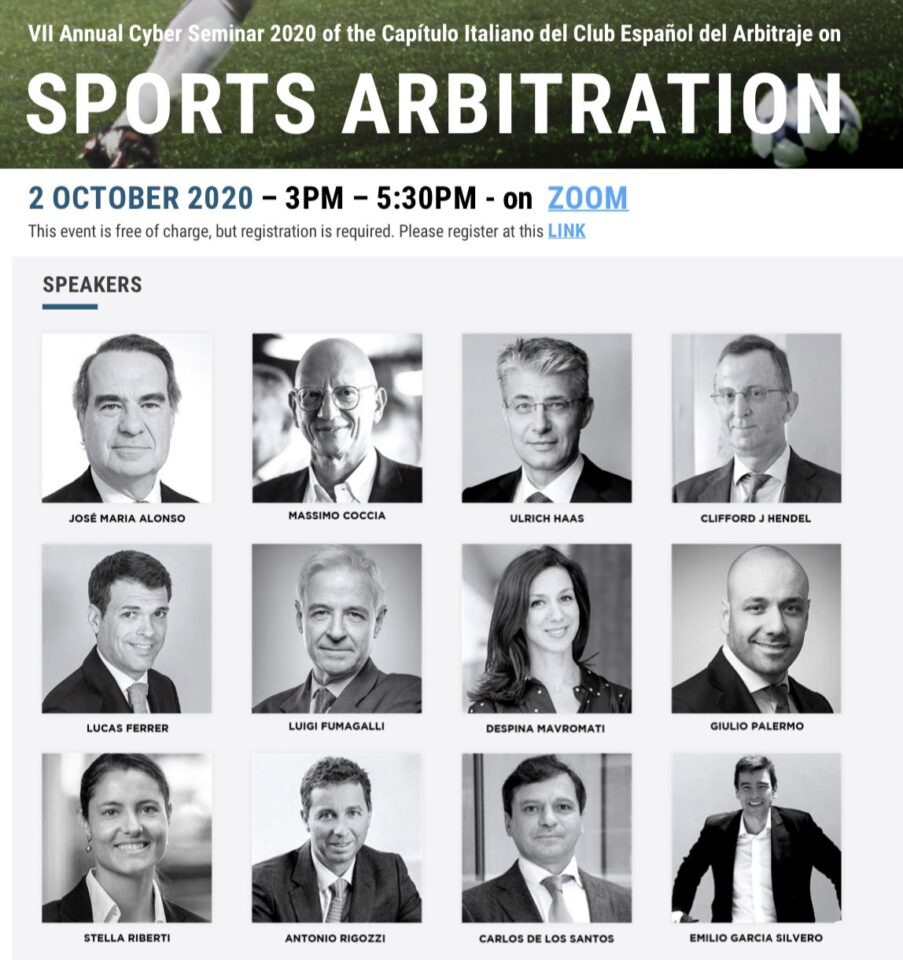
On 2 October 2020, the Italian Chapter of the Spanish Arbitration Association held its VII Annual Cyber Seminar for 2020. Despina Mavromati was a panelist at the roundtable on sports arbitration, alongside some of the foremost experts in the field: Prof. Massimo Coccia, Prof Ulrich Haas, Prof Luigi Fumagalli, Mr Clifford Hendel, Mr Lucas Ferrer, Mr. Giulio Palermo and FIFA Chief Legal Officer, Dr Emilio Garcia Silvero. More information about the Spanish Arbitration Association (CEA) can be found here.

Notes

Very restrictive notion of ‘abuse of rights’ in employment claims based on mandatory labour law in football

October 12, 2024 | 2-min read

Very restrictive notion of ‘abuse of rights’ in employment claims based on mandatory labour law in football - www.sportlegis.com

SFT Judgment 4A_134/2024 of 28 June 2024, motion to set aside CAS 2023/A/9574

In this case, the dispute arose from an agreement between a Turkish Club and a Brasilian Player to terminate their employment contract prematurely in order to facilitate the Player’s transfer to another club. The Club initially obtained a favourable decision from the FIFA DRC but lost in appeal to the CAS, as the Sole Arbitrator essentially found that the Club had not proven damages.

More specifically, the Sole Arbitrator awarded the Player’s counterclaims on the grounds that the termination agreement was null and void due to a breach of mandatory law (Art. 341 para. 1 CO), as it did not provide for balanced mutual concessions and lacked reciprocity. At the same time, the Sole Arbitrator rejected the Club’s objection that the Player had acted in abuse of rights by subsequently invoking the nullity of the agreement despite his concessions and the payment of instalments. Accordingly, it was decided that the Club should pay outstanding wages due to the nullity of the cancellation agreement and repay the partial payments to the Player for unjust enrichment.

In the subsequent motion to set aside the CAS Award, the Club alleged that the Sole Arbitrator had not recognized the player’s conduct as an abuse of rights (venire contra factum proprium), amounting to a violation of public policy.

The SFT reiterated the very restrictive notion of abuse of rights falling within the scope of public policy, which is possible for an employer only if special circumstances exist

The SFT reiterated the very restrictive notion of abuse of rights falling within the scope of public policy, which is possible for an employer only if special circumstances exist (BGE 131 III 439 E. 5.1 with references), in view of the very limited view of labour law claims based on mandatory law, the SFT could not establish – on the basis of the binding findings in the award – that the Sole Arbitrator granted legal protection to abusive conduct by the Player and therefore could not annul the award for violation of public policy.

Notes

Very limited scope of review in case of non-compliance with the form requirements and the applicable time limits

January 19, 2022 | 1-min read

Very limited scope of review in case of non-compliance with the form requirements and the applicable time limits - www.sportlegis.com

4A_324/2021, judgment of 3 August 2021

In this recent football-related procedure the Appellant—represented by legal counsel—had sent its statement of appeal to the CAS by e-mail but failed to send it by courier within the granted time limit, invoking force majeure due to the COVID-19 pandemic. The appeal was declared inadmissible by the CAS Division President. In the subsequent motion to set aside the CAS award, the SFT rejected the force majeure argument, considering that the Appellant was able to reply to a CAS submission by post one day after its receipt, and that there was also the possibility to file the submissions by electronic filing. The SFT dismissed the appeal recalling the very limited scope of review in case of non-compliance with the form requirements and applicable time limits. See also the judgment 4A_416/2020.

News

Despina Mavromati’s Lecture at the UEFA Football Law Program

May 18, 2021

Despina Mavromati’s Lecture at the UEFA Football Law Program - www.sportlegis.com

Despina Mavromati lectured to the students of the UEFA Football Law Program on 27 April 2021. She gave a presentation on the appeals to the Swiss Federal Tribunal against CAS Awards in football-related matters.

You can find more information about the UEFA Football Law Program (for 2021) and the UEFA Academy here.

News

UEFA Disciplinary Workshop in Lisbon

October 20, 2022

UEFA Disciplinary Workshop in Lisbon - www.sportlegis.com

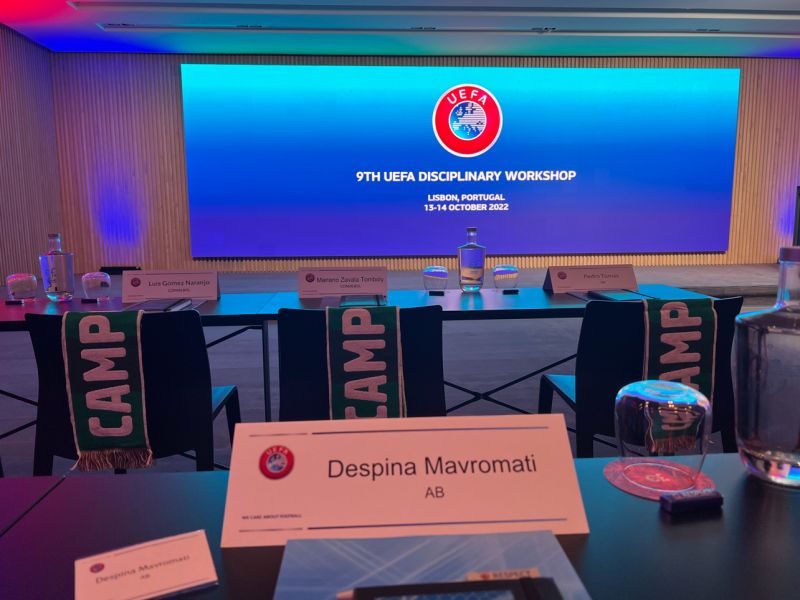
UEFA Appeals Body Member Dr Despina Mavromati participated in the 9th UEFA Disciplinary Workshop that took place in Lisbon, Portugal on 13-14 October 2022. UEFA’s disciplinary bodies – the Control, Ethics and Disciplinary Body (CEDB) and Appeals Body (AB), as well as the Ethics and Disciplinary Inspectors (EDIs) – were briefed about the new provisions contained in the 2022 UEFA Disciplinary Regulations. The new format of the UEFA men’s club competitions from the 2024/25 season was also presented. You can find more information about the workshop here.

News

UEFA Disciplinary Workshop In Cyprus

September 11, 2018

UEFA Disciplinary Workshop In Cyprus - www.sportlegis.com

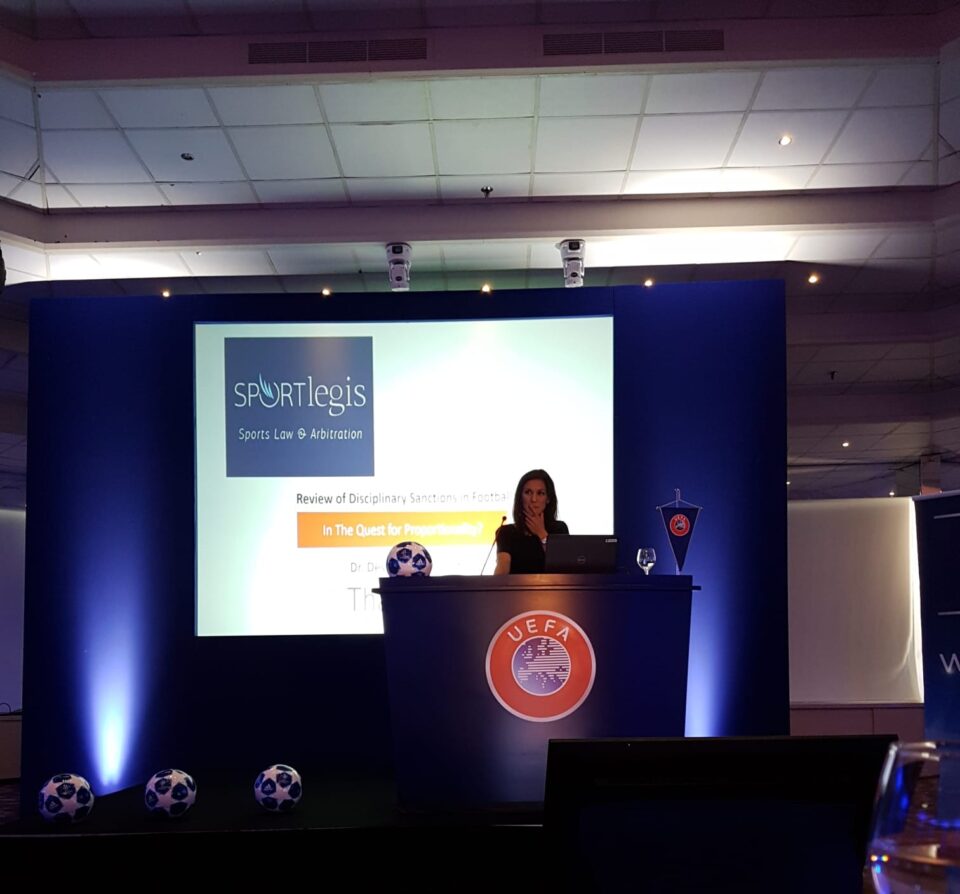
Despina Mavromati presented on “The review of disciplinary sanctions in football and the question of proportionality” at the UEFA Disciplinary Workshop that took place in Cyprus on September 28, 2018. 

Book Promotion - www.sportlegis.com

NEW BOOK RELEASE

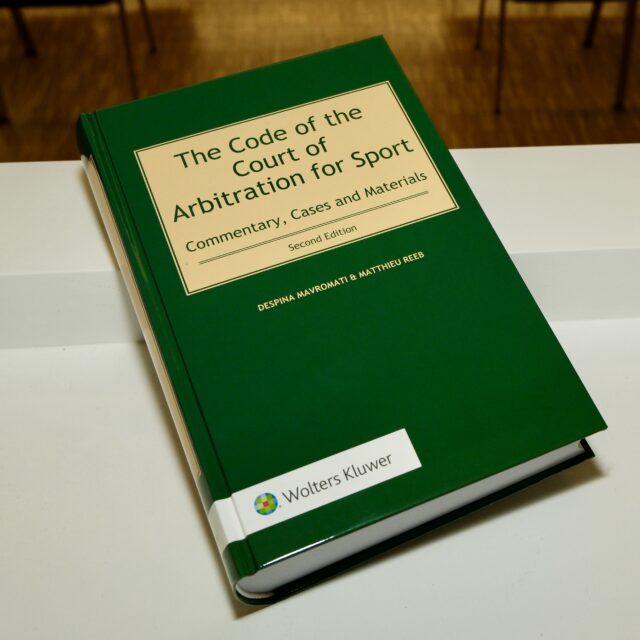
The Code of the Court of Arbitration for Sport – Commentary, Cases and Materials

by Despina Mavromati / Matthieu Reeb, Wolters Kluwer 2025

Ιn its fully revised second edition, The Code of the Court of Arbitration for Sport offers a comprehensive, article-by-article commentary of the CAS Rules. Drawing on leading CAS and Swiss Federal Tribunal case law, CAS practices and international arbitration principles, the book is an indispensable reference for practitioners, arbitrators, and scholars working in sports arbitration.

This second edition introduces significant updates, including new model documents and new chapters on the ICAS, the CAS ad hoc Rules and the CAS Anti-Doping Division Rules during the Olympic Games.

Order Here