
Despina Mavromati participated as a speaker at the IX St. Petersburg Legal Forum. The title of the round table was “Development of UNESCO International Convention Against Doping in Sport: Current Challenges and Prospects’.
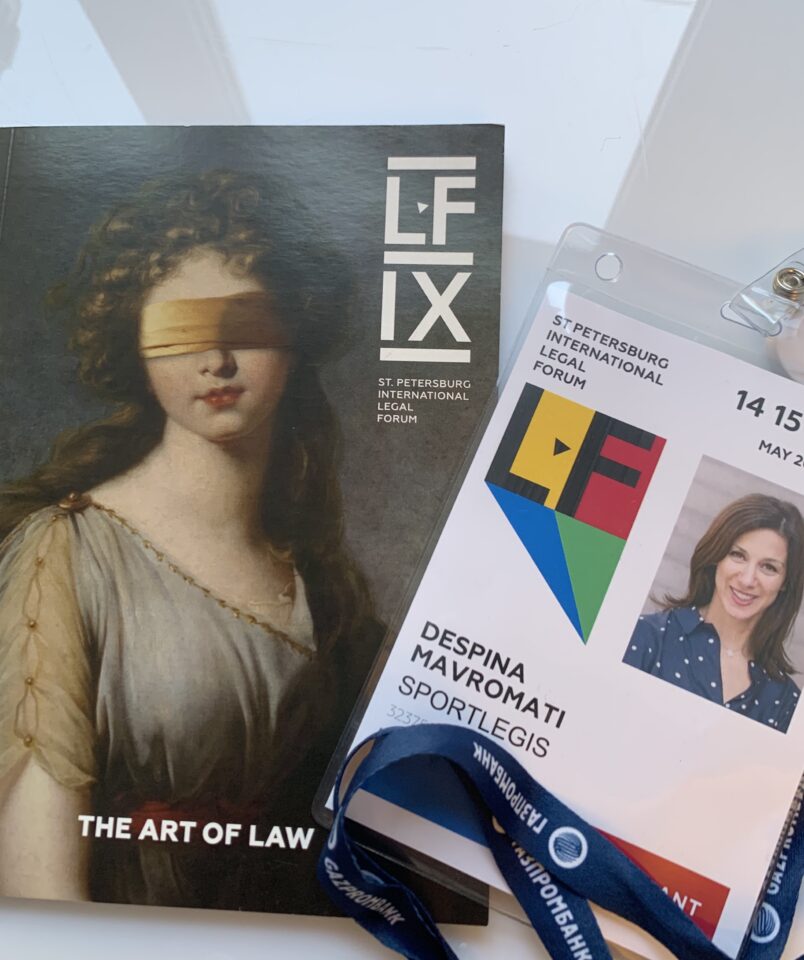

Despina Mavromati participated as a speaker at the IX St. Petersburg Legal Forum. The title of the round table was “Development of UNESCO International Convention Against Doping in Sport: Current Challenges and Prospects’.

WISLaw organized a lunch talk during the World Anti-Doping Congress that took place in Lausanne on March 14, 2019. Despina Mavromati and Janie Soublière opened the floor followed by an interactive discussion on “The Practical Implications of the Anticipated Modifications to Article 10 WADA Code for Legal Counsel”.
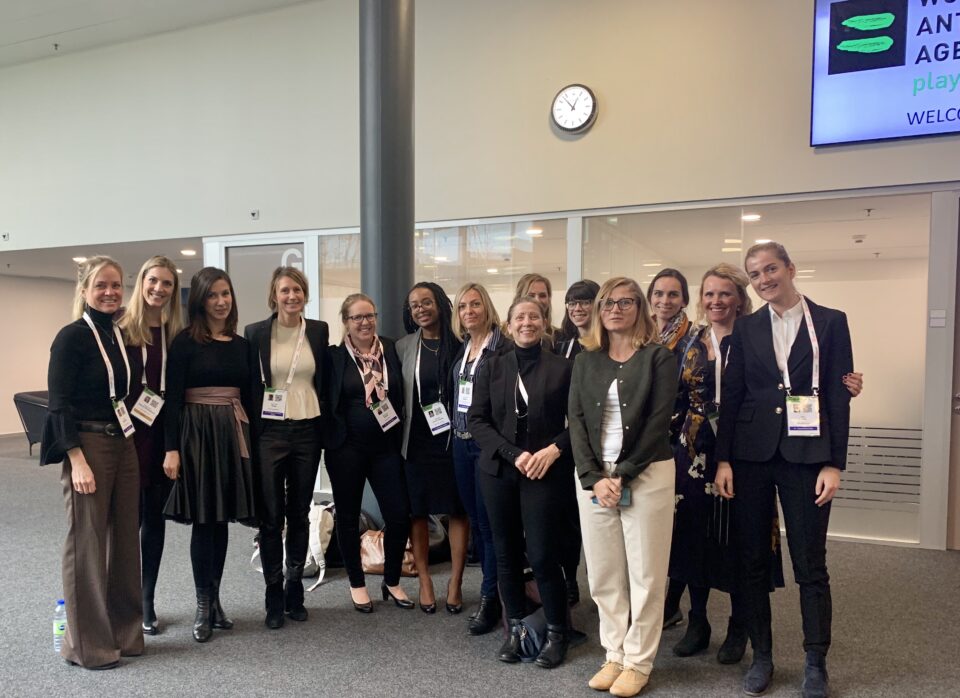

Like every year, Despina Mavromati taught a full morning class on Sports Dispute Resolution to the students of the 19th edition of the FIFA Master program at the University of Neuchâtel, Switzerland. You can find more information about the FIFA Master program here.
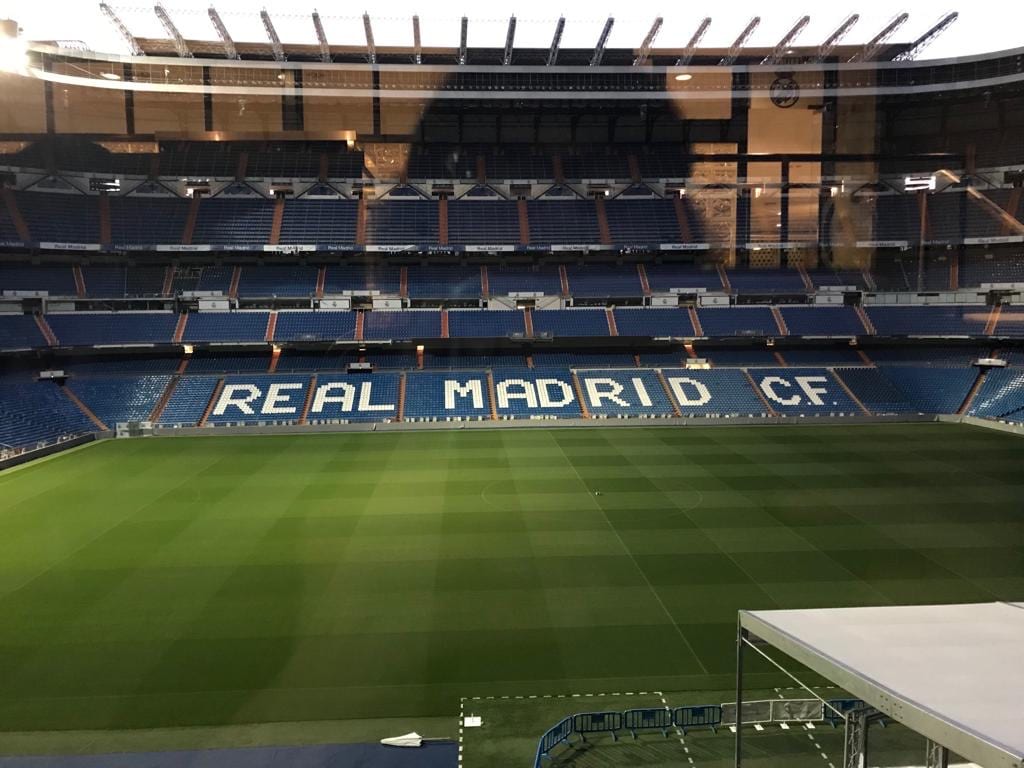
Despina Mavromati delivered a presentation on “eSports and Doping” at the RexSport Conference held in Madrid on May 11, 2019. The conference included several thought-provoking sessions on the football transfer market but also eSports. You can find more information about the speakers and the topics discussed at the conference and a press release following her presentation here.


The Partnership for Clean Competition (PCC) organized its second annual conference in London from April 16 to April 18, 2019. Despina Mavromati participated in a round table discussing the protection of clean athletes from a legal perspective. The panel was moderated by Brent Nowicki (CAS) and other panelists included Mike Morgan (Morgan Sports Law), Travis Tygard (USADA) & Adolpho Birch (NFL). See an overview of the main issues discussed here.


International Motorcycling Federation v. Kuwait Motor Sports Club (Appeal against TAS 2015/O/4316)
This judgment is very interesting—particularly for sports arbitration practitioners. It discusses, reviews and delimits several issues related to the interpretation of an arbitration clause and its interaction with Article 75 Swiss Civil Code for international sports federations based in Switzerland. After shortly reviewing the facts of the cases, this note draws some general remarks on the interpretation of arbitration clauses from the Federal Tribunal judgment.
The dispute initially started between two associations, each wishing to become the sole and legitimate member federation of a country (Kuwait) affiliated to the International Motorcycling Federation (FIM).
The Kuwait Motor Sports Club (KMSC), a non-profit entity of Kuwaiti law, filed a request to become a member of FIM in 2009, despite the fact that the KIAC had been recognized by the FIM as the exclusive member for Kuwait since 1980). The KIAC relaunched its application in both 2011 and 2013.
At the same time, a legal proceeding involving KMSC and KIAC was pending in Kuwait and a decision was rendered in December 2013, recognizing KMSC as the sole entity authorized to organize motorcycle sports in that country (a decision which was subsequently appealed by the KIAC before the Kuwait Court of Cassation and was partially admitted). Following this judgment, KMSC reiterated its request for affiliation to the FIM.
Several further requests were filed with the FIM, which issued a report but no decision as to KMSC’s membership’s request. Eventually, the KMSC filed a request for arbitration with the CAS.
The KMSC requested to be admitted as the sole FIM member for Kuwait, the exclusion of the other member (KIAC) and compensation for damages by illegally preventing it from joining the FIM.
The CAS Award denied its jurisdiction as to the damages claim only, but admitted its jurisdiction and the claim for the rest. It considered that the lack of decision constituted a denial of justice, ordering the FIM to issue a decision with respect to the parties’ right to be heard.
The important procedural question was whether the KMSC had the right to file a request for arbitration before the CAS against the “lack of decision” by the FIM (or for “formal denial of justice”) according to the FIM applicable rules.
The CAS Panel accepted its jurisdiction, finding that the FIM’s denial to issue a decision constituted a formal denial of justice and therefore a “decision” giving right to an appeal to the CAS (under Article R47 CAS Code) and remanded the matter to the FIM tribunal in order to render a proper decision in this respect.
The FIM lodged a motion to set aside the CAS Award, invoking lack of CAS’ jurisdiction (and the violation of ne ultra petita that is also shortly presented below). The pertinent arbitration clause reads as follows: “Any recourse to state tribunals against the final decisions rendered by the adjudicating instances or the General Assembly of the FIM is excluded. Said decisions must be exclusively referred to the Court of Arbitration for Sport (CAS) which shall have exclusive authority to impose a rule on the dispute, in accordance with the Code of Arbitration applicable to sport.”
The Appellant (FIM) argued that KMSC was not a FIM member and thus could not invoke the disputed arbitration clause in order to file a claim / appeal with the CAS. It maintained that it could not be inferred, by reading the clause in good faith, that a third party (i.e. not a FIM member) would be subject to the latter clause.
The FIM also supported that there was no formal denial of justice because it had to wait for the pending proceedings before the Kuwaiti state courts to be finalized before rendering a proper decision in this respect. Also, in its view, denial of justice could not apply in private law relationships.
The FIM, like almost all international sports federations, accepts one national federation per nation as its “official” and representative member (under the so-called “Ein-Platz-Prinzip”). Only the official members have voting rights at the FIM General Assembly (GA).
Even though the form of the arbitration agreement must comply with Article 178 para. 1 Private International Law Act (PILA), the Swiss Federal Tribunal has repeatedly expressed its generosity or “latitude” (“bienveillance”) when examining the validity of an arbitration clause, particularly the arbitration clause “by reference” (4A_246/2011 of November 7, 2011 at 2.2.2).
When interpreting an arbitration clause included in a federation’s statutes, the method varies according to the type of federation considered. For large federations such as UEFA, FIFA or the IAAF, the SFT applies principles that apply to the interpretation of laws, while for smaller ones, the SFT applies principles that apply to the interpretation of contracts (such as the objective interpretation according to the principle of trust).
No matter what method of interpretation the arbitral tribunal might choose, this can no longer be reviewed by the SFT in a subsequent motion to set aside the award (see also 4A_314/2017 at 2.3.2.1).
Under the principles of statutory interpretation, we apply the literal, systematic, theological and historical interpretation, without a hierarchy between these principles.
When interpreting the arbitration clause, in favor of validity speak the broad way of formulating the arbitration clause, the exclusion of recourse to ordinary courts (especially when this is made in various parts of the rules of the federation), but also referrals to the CAS Code (which is the procedural regulation of the CAS).
The scope of the arbitration clause is reviewed in view of the decisions included in the arbitration clause (ratione materiae) but also in view of the persons entitled to challenge those decisions (ratione personae).
If drafted in a less restrictive way than Article 75 CC (which gives the right to contest association’s decisions in principle only to members), the arbitration clause should be deemed to include indirect members or even non-members.
Article 75 CC is an imperative law provision and the parties cannot exclude the control of the decisions of an association by an independent tribunal, either the state courts or the CAS.

When there is a valid arbitration clause for an arbitral tribunal in the federation’s statutes, this should apply not only to members but also to non-members which request membership or challenge a decision denying such membership.
This interpretation would favor legal certainty, placing all interested parties on an equal footing as to a possible appeal but also avoid contradictory decisions if, for example, a member goes to CAS and a non-member pursues the state courts, with different review and appeal mechanisms foreseen in each case.
How does the principle of autonomy of associations under Swiss law interact with the right of a person / entity to apply for membership and have the possibility to contest the association’s decision before a state court or an arbitral tribunal?
The freedom of the association under Swiss law is not unlimited, particularly for major sports associations of monopolistic character, such as the FIM. Candidate members may also invoke Article 28 CC if suffered an illicit damage to their personality.
A lack of decision by a competent body extending beyond a reasonable period of time may constitute a denial of justice susceptible of appeal. Citing the CAS commentary (MAVROMATI / REEB, 2015 Wolters Kluwer, n. 23-25 ad art R47 of the Code), the Federal Tribunal has held that “[i]f there is a lacuna in the rules of the sports body regarding cases of inactivity and lack of response to a request, a decision not to open a case or the absence of reaction in general must be considered decision subject to appeal to CAS” (n. 24).
Moreover, “[a] denial of justice should also be affirmed if the first-instance body failed to render a decision within a reasonable period of time” (n. 25). Logically, in these cases it is not required to act within the 21-day appeal period set in Article R49 of the Code.
The formal denial of justice can also be invoked in a private law relationship and is also possible in arbitration.
Furthermore, it is of little relevance whether the party invoking such denial of justice is an athlete complaining of the inaction of their federation or a national sports association requesting its affiliation to the international federation.
Is the establishment of a formal denial of justice a preliminary question that the SFT can review freely in its control of the jurisdictional objection?
When it comes to plea of denial of justice, there are two aspects under Swiss administrative law: the first presupposes a right to a decision (provided that the decision is subject to appeal); the second is whether there was actual delay and falls within the merits. It can therefore not be reviewed by the Swiss Federal Tribunal.
The existence or not of an unjustified delay will not put into question the jurisdiction of the CAS: it may constitute an element examined by the tribunal when upholding or dismissing the appeal and not an element of admissibility.
Therefore, the question of delay relates to the merits and not to CAS’ jurisdiction and cannot be examined by the Swiss Federal Tribunal within this context.
Under Article 190 (2) (c) PILA, it is possible to attack the award when the panel allocated more or something other than what was requested.
Difference between CAS ordinary and appeal proceedings and ne ultra petita
The power of a CAS panel to revert the case back is explicitly foreseen in CAS appeals proceedings under Article R57 of the CAS Code (and has been accepted by the Swiss Federal Tribunal).
According to CAS practice, the allocation of a procedure to ordinary or appeal proceedings (under Article S20 para. 2 CAS Code) cannot be challenged by the parties as a cause of irregularity.
By the same token, the Federal Tribunal has found that the allocation of a mixed case to the ordinary arbitration procedure cannot reduce the powers of the Panel.
In view of the autonomy of sports federations, the CAS should preferably not substitute itself for the competent organ of a federation in cases where the latter did not render a decision.
Ne ultra petita and principle of good faith
Furthermore, a sports federation would likely violate the principle of good faith by invoking ne ultra petita principle for being asked to render a decision itself instead of being ordered to accept or deny an applicant member. Therefore, a plea of ne ultra petita / extra petita seems hopeless in such a case.

WISLaw hosted its first evening talk in Athens, Greece, generously hosted by the Hellenic Football Federation (HFF) on March 22, 2019. Despina Mavromati (WISLaw co-founder and Board Member) and Penny Konitsioti presented on some jurisdictional issues in domestic football cases followed by an interactive discussion among the participants. You can find more information here.
This Federal Tribunal judgment – which is far more interesting for its factual background than for its legal findings – puts an end to the long and highly publicized legal battle between Alexander Legkov (and several other Russian athletes) and the International Olympic Committee, a journey that lies in the heart of the so-called “Russian doping scandal”.
The background Facts
In the aftermath of allegations related to the existence of a state-sponsored doping scheme in Russia during the Sochi Olympic Games, the World Anti-Doping Agency (WADA) mandated two independent (IP) reports that indicated the existence of a vast cover-up scheme in order to protect doped athletes. Following the reports, the IOC Disciplinary Commission (DC) rendered numerous decisions sanctioning several Russian Athletes – including the Respondent – based on violations of the WADA Code.
The IOC Disciplinary Commission Decisions
In its decisions, the IOC highlighted that it would not apply collective justice but would hear each case individually and would only sanction the athletes for whom enough evidence of an individual implication in the violation of the anti-doping rules existed. Notwithstanding that point, the IOC DC used, as a starting point, the establishment of the existence of a generalized fraud scheme and considered this finding in its deliberations against each athlete.
Alexander Legkov (the Athlete), a very successful cross-country skier who won several medals during the Sochi Olympics, was one of the athletes sanctioned by the IOC DC shortly before the 2018 Winter Olympics. Legkov and several other athletes appealed against their sanctions to the CAS, requesting to set aside the IOC sanctions for lack of evidence. Following the parties’ agreement, the CAS proceeded to a limited joinder of causes.
The CAS Award
Following a complex arbitration procedure, the CAS Panel issued a lengthy – more than 150 pages – arbitral award where it upheld the appeal and set aside the IOC decision for lack of sufficient proof against the Athlete. The CAS Panel highlighted the fact that its decision was not about the existence or nonexistence of a state-sponsored scheme, but instead limited the decision to the finding of a specific Anti-Doping Rule Violation (ADRV) by the Athlete, under the specific applicable provisions of the WADA Code.
On the Burden of Proof
Accordingly, the IOC had the burden to establish an ADRV to the “comfortable satisfaction” of the hearing panel. Even though it considered the difficulties in finding direct proof – also due to the limited investigatory powers of the IOC – the seriousness of the allegations required that the IOC provided particularly “cogent” proof as to the concrete ADRV of each athlete, and not simply the existence of a general doping scheme.
De novo Review by the CAS Panel
The CAS Panel ruled on the case de novo based on Article R57 of the CAS Code, thereby hearing new arguments and evidence not previously heard by the IOC DC. It highlighted, once again, that the finding of a state-sponsored doping scheme could not equate to an individual ADRV punishable under the WADA Code.
The first (unsuccessful) Appeal of the IOC against a CAS Award
For the first time since the creation of the CAS, the IOC went against what some consider to be is offspring (i.e. the CAS) and filed a motion to set aside a CAS Award before the Swiss Federal Tribunal, further strengthening arguments as to the independence of the CAS vis-à-vis the IOC. The latter invoked a rather generic violation of its right to be heard, which included the widely employed (yet extremely rarely admitted, according to the Federal Tribunal) “effet de surprise”.
It came as no surprise that the Swiss Federal Tribunal swiftly dismissed the appeal by repeating its established jurisprudence but also highlighting some interesting points.
The Right to be heard relates mainly to Findings of Fact
– The Panel is supposed to know the law (jura novit curia) and may also rule on the basis of rules other than the ones invoked by the parties (unless the arbitration agreement restricts the mission of the Panel in this respect) (at 3.1.2).
– It is only – and exceptionally – appropriate to challenge the law when the Panel bases its reasoning on a rule whose application the parties could not possibly expect (“effet de surprise”).
Assessment of the Evidence falls outside the Scope of the Parties’ Right to be heard.
The IOC’s Arguments
The IOC’s principal argument, which was allegedly disregarded by the Panel, was simply “to come to a conclusion on the existence of a doping and cover-up scheme, and, secondly, draw conclusions with respect to the general involvement of the athletes” (at 3.2.1).
The Panel had thus supposedly failed to take into consideration evidence showing the generalized doping scheme simply because the athlete was not individually affected by anomalies such as mixed DNA, as was the case with some other athletes’ samples.
Right to be heard vs. Assessment of the Evidence
As it was expected, the Federal Tribunal found that the plea was merely an attempt on behalf of the IOC to (impermissibly) question the evidence assessment made by the Panel and revert the case back in order to reach a conclusion that the respondent was involved in such a program.
On individual Justice, collective Sanctions and state-doping Schemes
The Federal Tribunal stressed in particular the fact that it was the IOC DC itself that confirmed it had not applied a system of collective sanctions against all Russian athletes who participated in the Sochi Games, but would examine each case individually in order to punish only those athletes whose personal involvement could have been established in violation of the applicable anti-doping rules.
The Panel held a similar reasoning with regard to the exclusion of collective sanctions but did not find it necessary to establish the existence, supposedly proven, of a generalized doping and cover-up scheme for an individual ADRV. Obviously, this was far beyond the Federal Tribunal’s control zone within the limits of Article 190 (2) PILA.
In any event, the Panel had the choice between the two alternatives, and refused to infer the respondent’s guilt from the mere existence – even if proven – of a doping scheme within the context of a competition in which the athlete had participated under the colors of the organizing country.
The Federal Tribunal further indicated that there could not possibly be any “effet de surprise” stressing that it was a very important, highly publicized case, with experienced arbitration specialists and considerable stakes that could not be disregarded (at 3.2.2). One therefore comes to question whether the admissibility of the plea is dependent on the level of knowledge and specialization of the representing counsel.
The IOC also referred to the Panel’s alternative reasoning according to which the Panel clarified that, even if the presence of a Russian doping scheme was established, it would still not be convinced of the ADRV committed by the Athlete.
It supported that such alternative reasoning was a “clause de style” that could not protect the Panel from a violation of its right to be heard (i.e., whether or not to decide on the existence or inexistence of a state-sponsored doping scheme).
As expected, the Federal Tribunal found that this had nothing to do with the “clause de style” formula described in 4A_730/2012, which relates to the use (mostly by CAS Panels) of the stereotypical phrases like “the Panel took into account all the facts, legal arguments and evidence submitted by the parties, but will only refer to arguments and evidence necessary to explain his reasoning” (at 3.2.2).
The Facts
The case before the CAS involved a dispute between a Cameroonian football club playing in the first division (Etoile Filante de Garoua, the Club) and the national football federation FECAFOOT. Within a larger context of difficulties facing FECAFOOT since its 2013 elections and a series of related CAS awards, the Club filed an appeal to the CAS (TAS 2016/A/4415) requesting, inter alia, the reinstatement of the Executive Committee until the final elections. In a preliminary award on jurisdiction and admissibility, the Sole Arbitrator held that the CAS had jurisdiction ratione materiae, but the appeal was inadmissible for being late.
Time Limit to Appeal to the CAS (Art. R49 CAS Code)
The entire debate before the Federal Tribunal related to the time limit to appeal to the CAS. According to Art. R49 of the CAS Code, in the absence of a time limit in the rules of the federation, the time limit for appeal is twenty-one days from the receipt of the decision appealed against. The Sole Arbitrator found that there was a contradiction in the relevant rules and statutes of the federation but the rule in force at that time provided for 20 days, and, therefore, the appeal was inadmissible for being filed after 21 days.
Before the Swiss Federal Tribunal, the Appellant club invoked a violation of its right to be heard, erroneous finding on jurisdiction and a violation of public policy (which was swiftly dismissed and does not merit any further mention).
Time Limit to appeal and Violation of the Right to be Heard: Conditions
The only relatively interesting point from the angle of the violation of the right to be heard is the need to draw the attention of the arbitrator to the specific piece of evidence or argument made during the proceedings. In this respect, the Federal Tribunal found that it was not sufficient to file the CAS award in which the Panel had admitted a time limit of 21 days, but the Appellant had to draw the attention of the Arbitrator to the specific argument raised. Moreover, the appellant’s allegation that the operative part of the decision indicated 21 days to appeal to the CAS could not be traced in the award under appeal.
Lack of Jurisdiction “ratione temporis” or Inadmissibility?
In an argument raised by the Appellant from the angle of jurisdiction ratione temporis, the Federal Tribunal left, once again, the question whether the late filing of the appeal entails the inadmissibility or the dismissal for lack of jurisdiction open (5.2).
Legal Interest of the Appeal filed by FECAFOOT
As regards the appeal filed by FECAFOOT (that the Federal Tribunal decided to join to the appeal filed by the Club), it was found that FECAFOOT lacked legal interest because the argument raised (the lack of legitimacy of the CAS Award and the detrimental effect of its publication in Cameroon) could not be found in the arbitrator’s findings and was thus inadmissible. In any event, such argument was insufficient to establish the legal interest of this association in appealing against the disputed award.

In the midst of turbulence from the Football Leaks indirectly affecting – among other issues – the Club Licensing and Financial Fair Play Regulations (CL&FFP Regulations) in European football, the Court of Arbitration for Sport (CAS) published the full award in the case AC Milan v. UEFA. The case relates to a sanction that was imposed by the UEFA Club Financial Control Body (UEFA CFCB).

Despina Mavromati (Advisory Board Member of the National Sports Law Institute at Marquette University), presented on the Current Issues in International Sports Disputes at the Annual NSLI Conference in Milwaukee on October 12, 2018. You can find a part of her presentation here: Current Legal Issues in International Sports Disputes

Introduction
In the midst of turbulence from the recent Football Leaks indirectly affecting – among other issues – the Club Licensing and Financial Fair Play Regulations (CL&FFP Regulations) in European football, the CAS published the full award in the case AC Milan v. UEFA. 1 The case relates to a sanction that was imposed by the UEFA Club Financial Control Body (UEFA CFCB). According to the first-instance decision, the Adjudicatory Chamber of the UEFA CFCB initially determined that AC Milan failed to fulfil the break-even requirement of Articles 58 through 63 of the UEFA CL&FFP Regulations, and excluded AC Milan from participating in the next UEFA club competition for which it would otherwise qualify in the next 2 seasons (i.e., in 2018/19 and 2019/20).
Following an appeal to the CAS by AC Milan, the CAS Panel partially upheld AC Milan’s appeal and reverted the case back to Adjudicatory Chamber of the UEFA CFCB for a « proportionate disciplinary measure ».
In the Panel’s view, “certain important elements had not been properly assessed by UEFA’s Adjudicatory Chamber, or could not be properly assessed” when the UEFA Decision was rendered in June 2018 and that AC Milan’s financial position was better following the recent change in ownership. 2
Other than in previous cases related to the UEFA CL&FPP Regulations like the Galatasaray case, where the club challenged the UEFA CL&FFP Regulations (for a second violation of the regulations) and more specifically their compatibility with EU law, AC Milan directly challenged the proportionality of the sanction imposed by the UEFA CFCB. 3 In the Galatasaray case, the Panel had highlighted the existence of mitigating factors in the UEFA CL&FFP Regulations that could be taken into account by the UEFA hearing panel in order to render a proportionate decision under the individual circumstances of each case. 4
In view of the latest developments in European and international football, the CAS Award (which was published on November 8, 2018) is very interesting and worth a closer look because it raises more general questions as to the scope and limits of the UEFA CL&FFP Regulations. More crucially, it brings to the forefront questions of procedural nature before the CAS, such as the scope of the Panel’s full power of review under Art. R57 of the CAS Code, 5 and more particularly the control of proportionality of the sanction and the production of new (factual) evidence before the CAS. Additionally, it addresses the important procedural issue of the admissibility of the appeal (or a portion of it) when a particular part of the decision was not supposed to be subject to appeal.
A summary of the background facts
The UEFA CL&FFP Regulations
The UEFA had been closely following AC Milan’s financial situation for the last years. Such financial control forms part of the obligation imposed on European clubs participating in UEFA competitions to comply with the break-even requirements of the UEFA CL&FFP Regulations. The latter aim, among other things, to « promote and continuously improve the standard of all aspects of football in Europe (…)», « to ensure that clubs have an adequate level of management and organisation »,d) to protect the integrity and smooth running of the UEFA club competitions » ; « to allow the development of benchmarking for clubs in financial, sporting, legal, personnel, administrative and infrastructure-related criteria (…) ».
Regarding financial stability, the CL&FFP Regulations aim to « achieve financial fair play in UEFA club competitions » by improving the economic and financial capability of the clubs, by protecting creditors and by introducing rationality in club football finances and responsible spending for the long-term benefit of football. 6
According to the break-even requirement enshrined in Art. 58-64 of the CL&FFP Regulations, clubs should have a break-even surplus in the monitoring period. The monitoring period is defined as the assessment year and the two previous years. 7 A surplus is defined as the excess of relevant income over relevant expenses. 8 In case of deficit, a deviation of €5 million is tolerated – or an excess of €30 million if a shareholder contribution covers the excess.
AC Milan’s financial situation and the UEFA CFCB Decision of June 2018
Back in 2017, Fininvest S.p.A. sold 99.93% of the shares held in AC Milan to Rossoneri Sport Investment Lux (hereinafter “HoldCo”) for EUR 740 million. The latter was then controlled by a Chinese investor, Mr. Li. 9 HoldCo concluded a loan agreement with the company Redblack Sàrl for EUR 202 million with a maturity date of 15 October 2018. Redblack, a private limited liability company founded under the laws of Luxemburg, is advised by Elliott Advisors (UK) Limited (“Elliott”), which is indirectly controlled by Elliott Management, an American fund manager. The loan provided by Redblack to HoldCo was secured against the shares of AC Milan and Holdco.
The Shareholders’ meeting in May 2018 decided, among others, to increase the share capital of AC Milan up to EUR 49,920,000. However, after HoldCo failed to make a EUR 32 million capital contribution in June 2018, Redblack injected this amount instead of HoldCo, which in turn failed to pay the amount back to Redblack and such default entitled Redblack to enforce the relevant pledge agreement and become the new controlling shareholder of Milan.
AC Milan’s financial situation was assessed by UEFA, which refused to conclude a voluntary assessment 10 with the Club back in December 2017.
The CFCB Investigatory Chamber further announced its decision to refer the case to the CFCB Adjudicatory Chamber (hereinafter referred to as the “Referral Decision”) and, thus, not to enter into a settlement agreement on May 22, 2018. 11 The UEFA CFCB decision was issued on June 27, 2018 (the UEFA Decision).
The CAS Award and the importance of the procedural « details »
As seen above, AC Milan challenged the UEFA Decision on the grounds of proportionality, a principle warranted under both EU competition law and Art. 28 Swiss Civil Code that protects personality rights. 12 It submitted that, instead of imposing a sanction on the Appellant, the CFCB should have concluded a settlement agreement with the Club, an “obviously” less severe measure that was available. It also submitted that the UEFA Decision was based on wrong facts or that the facts were not correctly assessed.
The expedited procedure, the production of documents and the submission of new evidence by AC Milan
Following the parties’ settlement agreement, the procedure was conducted on an expedited basis (according to Art. R52(4) of the CAS Code) with an expedited calendar 13 and the Panel issued the operative part of the award already on July 20, 2018. 14 As per the Swiss Federal Tribunal, the parties who agree on an expedited procedure are presumed to have accepted the limitations that the very tight procedural calendar entails with respect to the conduct of the proceedings and the production of evidence. 15 In this particular case, the Panel accepted (following AC Milan’s request) to order the production of the audio file of the hearing of the CFCB Adjudicatory Chamber on June 19, 2018, based on two things: first, the broad meaning given to the word “documents” in Art. R44.3 CAS Code and second, in view of the expedited proceedings, because it could not exclude the relevance of such evidence. 16 Within the context of (and thanks to) the expedited proceedings, the CAS Panel also ordered the production of the unredacted settlement agreements for Paris Saint-German, FC Internazionale Milano and Manchester City Football Club that were in the custody of the UEFA. 17 The CAS Panel however dismissed the request for production of further evidence 18 as not being specific enough and relating to highly sensitive and confidential information. 19 Interestingly, the CAS Panel accepted the (late) submission of a new document by AC Milan (on July 19, 2018) in the form of an updated profit and loss comparison forecast for the season 2017/2018 notwithstanding an objection by the UEFA. The CAS Panel based its decision on Article R56 CAS Code and considered as “exceptional circumstances” the fact that the proceedings were conducted on an expedited basis and that AC Milan could not have produced such document at an earlier stage of the proceedings. 20 It must be noted that the (late) submission of a document and its acceptance by the Panel based on “exceptional circumstances” 21 can be decisive for the outcome of the case. Finally, the CAS Panel considered that the fact that the parties agreed to an expedited procedure weighed in favor of reverting the case to the previous instance (as per Art. R57 CAS Code) since the Panel was “not in a position to fully investigate and assess the factual basis of the case”. 22 This brings to the forefront the more general question of suitability of expedited procedures in similar – factually and evidentiary – complex cases. Indeed, the advantages of an expedited procedure (linked to the need for an urgent and final resolution of the case) could be “diluted” in cases where the Panel opts to revert the case back to the previous instance. According to Art. R52.4 CAS Code, it is at the Panel’s discretion to accept or refuse to proceed in an expedited manner (“The Panel may…”). 23 The solution undertaken is also questionable since the Panel acknowledged that it was not in a position to fully investigate and assess the factual basis of the case: at the same time, however, it found that the appealed decision «has not assessed the relevant facts correctly …”) and concluded that it was not proportionate, a control that entails – or rather presupposes – an assessment to the merits and therefore also of the factual basis of the case. 24
Is the Referral Decision of the CFCB Investigatory Chamber an “appealable decision” according to Article R47 of the CAS Code?
In this case the Panel proceeded to the determination of whether the UEFA’s Referral Decision (e.g., a decision not to conclude a settlement agreement) was an “appealable decision” according to Art. R47 of the CAS Code. In the UEFA’s view, the appeal to the CAS was “partially inadmissible”: In its view, the Referral Decision of the CFCB Investigatory Chamber, i.e., to refer the case to the CFCB Adjudicatory Chamber and not to conclude a settlement agreement had become final and binding, since it had been issued on May 22, 2018 and was not appealed by the Appellant within the deadline of Article 62(3) UEFA Statutes. 25 In line with established CAS case law, the Panel held that whether or not a decision of a sports federation is appealable is a matter of substance and not of form, in the same way that a letter (which never contains an “operative part”) can also be an “appealable decision”. 26 Furthermore, it is necessary to determine whether the decision affects the legal position of the addressee, independently of the rules of the federation and in line with the jurisprudence of the Swiss Federal Tribunal and the general principle of access to justice. The CAS Panel proceeded to an interpretation of the UEFA Procedural Rules Governing the CFCB (in particular Article 34 thereof) and held that the latter do not provide for a separate appeal against the Referral Decision, a finding that was further confirmed by the UEFA’s practice. 27 Interestingly, the Panel found that the decision of the CFCB Investigatory Chamber not to conclude a settlement agreement with AC Milan would not affect the latter’s rights, since it did not predetermine the outcome of the case. 28 Therefore, to the extent that the Referral Decision was not a separately appealable decision, AC Milan’s appeal to the CAS was considered as admissible in its entirety.
In our view, the most important issue – and the one that proved to be decisive in the case at hand – was the extent of the Panel’s review based on Article R57 CAS Code. Even though it was uncontested that Article R57 CAS Code applied, the parties could not reach an agreement as to the level of review of the case by the CAS Panel. 29 The latter provides in its first paragraph that “The Panel has full power to review the facts and the law. It may issue a new decision which replaces the decision challenged or annul the decision and refer the case back to the previous instance.”
With respect to the “decisive reference date”, the Panel stressed the importance of the relevant reference date for the assessment of the case. While the UEFA referred to a “photo finish” for the facts assessed by the previous instance in its decision (and which could not called into question at the later stage), AC Milan set the decisive reference date as the date of the CAS hearing, since the financial situation of a club is an “ongoing process” and that it would be “wrong to ignore today’s reality”. 30 Even though the analysis made by the CAS Panel is based on the broad discretion of Article R57 CAS Code, one may question how an appealed decision can be found to be disproportionate if it was logically based on facts that were available at the time the decision was rendered, and not on evidence that did not previously exist. The Panel itself seemed to acknowledge this problem linked to the de novo hearing and lack of legal certainty in para. 132 of the Award. It noted, however, that the UEFA Procedural Rules Governing the CFCB lack a specific reference in this respect in order to delimit the point in time where the correctness of a decision must be assessed. This, in our view, indirectly calls for an addition/ precision of the relevant rules in order to enhance legal certainty with respect to the relevant reference date. On the “depth of scrutiny” The other important aspect of Article R57 of the CAS Code is the “depth of scrutiny.” 31 While AC Milan supported that the full power of review should lead the Panel to “re-hear the matter afresh, as if it had not been previously heard or decided”, UEFA seemed to favor another jurisprudential approach whereby “[t]he measure of the sanction imposed by a disciplinary body in the exercise of the discretion allowed by the relevant rule can be reviewed only when the sanction is evidently and grossly disproportionate to the offence.”32 The Panel left the question open as to whether there are reasons to limit the scope of review in disciplinary sanctions (apart from the field of play cases, where review is limited). 33 It held, however, that the approach to limit the review by the hearing authority does not apply to questions of law, such as whether and to what extent a federation is bound by the principle of proportionality or the principle of equal treatment when imposing a disciplinary sanction. 34 The Panel further found that the distinction between “simple” and “gross” disproportionality appears to be “arbitrary”, even though one could argue that such difference is depicted in CAS 2010/A/2283 (cited by the CAS Panel in the AC Milan case), whereby a CAS panel “would not easily ‘tinker’ with a well-reasoned sanction, i.e. to substitute a sanction of 17 or 19 months’ suspension for one of 18. It would naturally […] pay respect to a fully reasoned and well-evidenced decision of such a Tribunal in pursuit of a legitimate and explicit policy. However, the fact that it might not lightly interfere with such a Tribunal’s decision, would not mean that there is in principle any inhibition on its power to do so”. 35 The Panel concluded that its power of review is neither excluded nor limited. 36 The fact remains that Article R57 CAS Code gives vast power to the CAS Panel to decide on the length / scope of the review – and the CAS case law has shown different approaches, which, even though they do not favor legal certainty, fall within the broad discretion of the Panel according to the CAS Code. As such, CAS Panels have limited their review of disciplinary sanctions imposed by the previous instance to “grossly disproportionate sanctions”, while others, like the CAS Panel in the AC Milan case, have opted for a full and fresh re-hearing of the matter, « as it had not been previously heard or decided ». 37
The Merits of the Case – a Detail?
In a relatively short section the Panel proceeded to analyze the merits of the case. In assessing the legality of the settlement agreement – challenged by AC Milan through an expert report in EU law – the Panel found that the settlement is, like the disciplinary sanction, a legal instrument for the regulation of a certain matter, “issued on a similar factual basis and with interchangeable contents”. 38 Furthermore, the Panel held that the choice of offering a settlement agreement or not is within the discretion of the CFCB Chief Investigator according to Article 15(1) of the Procedural Rules Governing the CFCB. The question of acting in a discriminatory way by offering said solution to other licensees but not the Appellant also appeared questionable for the Panel, based on the specific circumstances surrounding the case, leaving the possibility of unequal treatment open had AC Milan adduced additional evidence in this respect. In any event, this would not invalidate the decision to the extent that the choice of the legal instrument is at the discretion of the UEFA Investigatory Chamber. 39 The most important part of the merits lies, in our view, with the control of the factual assessment by the CFCB Adjudicatory Chamber. 40 While the breach of the break-even requirement was uncontested (EUR 121 million in excess of the maximum acceptable deviation) and confirmed in the operative part of the CAS Award, the fact that the CFCB Adjudicatory Chamber approved the factual findings at the time of the Referral Decision was not in line with the mandate of the CFCB Adjudicatory Chamber. In the Panel’s view, the Adjudicatory Chamber should have determined the relevant facts at the time of its hearing on June 19, 2018, since the situation had significantly changed. 41 As the new controlling shareholder of AC Milan, Elliott is a well-known robust company that manages two multi-strategy funds and in both its letter dated June 19, 2018 and the press release on July 10, 2018 held that it supported AC Milan’s business plan and its strategy. Again, this brings us back to the importance of fixing a point in time where the factual assessment must be made as seen above under the Panel’s full power of review.
Concluding Remarks
We should not forget that, within the context of international arbitration and notwithstanding the influence of lex sportiva, the findings of this CAS Panel do not have an absolute precedential value, but relate to the specific and sui generis legal framework of the UEFA CL&FPP Regulations and the even more specific circumstances surrounding the particular case. Notwithstanding the above, the CAS Award in the case AC Milan v. UEFA is a very important ruling not necessarily because the factual issues raised are of utmost timeliness, but mostly because it raised important and decisive procedural matters including the depth of review by the CAS Panel and the point in time where factual and legal evidence can be adduced before CAS. In our view, and in order to enhance legal certainty as to the point in time where the factual assessment should take place, a regulatory amendment of the UEFA Procedural Regulations might be advisable. The CAS Panel concluded in its operative part that the CFCB Adjudicatory Chamber is called to issue a “a proportionate disciplinary measure”. What the outcome will be, and whether the current developments and revelations surrounding other clubs will influence the decision-making process in this case, remains to be seen.

Despina Mavromati and Paul Greene discussed the challenges when drafting sports regulations (including doping and gender classification rules) at the Harvard Law School in Cambridge (MA) on October 16, 2018.


The Issue
Before the CAS: Termination of a contract of employment between a football club and a player without just cause.
Before the Swiss Federal Tribunal: The Panel’s assessment of the evidence cannot be reviewed by the Federal Tribunal.
The Facts
The case relates to the termination of a contract of employment without just cause between an Egyptian professional football club X and the professional player A. Club X requested the annulment of a CAS award that awarded the player compensation in the amount of 650’000 USD, partially confirming a previous DRC Decision. The ground invoked for the annulment of the CAS award was the violation of the Club’s right to be heard.
The Findings of the Swiss Federal Tribunal
Violation of the parties’ right to be heard and assessment of evidence by the arbitral tribunal
In essence, the Appellant club alleged a violation of its right to be heard because the Panel refused to add an amount of USD 35’000 to the outstanding debt, even though it had produced other checks to prove that payments had been made to the local tax administration, and the Panel had not questioned these elements of evidence.
The Federal Tribunal dismissed the plea for two distinct reasons. First, questions related to the assessment of evidence cannot be reviewed and fall outside the scope of the plea of the right to be heard. Second, the principal matter related to these payments was discussed only to determine whether the Appellant was entitled to make certain deductions from the Respondent’s salary for income tax purposes. There was therefore no link between this question, which was decided in favor of the Appellant, and the taking into account of checks, copies of which the Appellant produced in order to prove the partial repayment of its debt to the Respondent (at 3.2.1).
The Appellant further submitted before the SFT that the Panel should have reduced the amount by taking into account the Appellant’s internal rules but failed to do so. On this point the Panel found that it was unconvinced of the probative force of the written testimonies by the Appellant to support its claim. In the Appellant’s view, the Panel had failed to take into consideration the Financial List for Football First Team, a document which had been signed by the Respondent. Again, the Federal Tribunal dismissed the argument since it relates to the assessment of the evidence by the CAS Panel, which is non-reviewable by the SFT.
Violation of material public policy for lack of consideration of the principle of Force Majeure
The Appellant referred to the tragic events of the Port Said Stadium riot back in 2012, which had caused more than 70 deaths and were followed by the cancellation of the championship. The events had caused a massive loss of revenue related to sponsorship as well as the sale of tickets for Egyptian football clubs. According to the Appellant, the fact that the CAS Panel did not consider these events as a force majeure constituted a violation of substantive public policy.
Without questioning the gravity of the events, the CAS Panel considered that there was no causal link between the events in Port Said and the failure of the Appellant Club to pay the Respondent’s salary. Furthermore, the Panel found that the Appellant had not raised this argument until much later, without demonstrating that these same events would have led to the non-payment of the salaries of the other players of the team. Again, these findings of the Panel could not be reviewed by the Federal Tribunal and were dismissed as inadmissible without needing to check whether the force majeure falls within the scope of material public policy under Swiss international arbitration law (at 4.2.1).
Violation of material public policy through the violation of the principle of contractual fidelity
Finally, the Appellant endeavored to attack the award from the angle of violation of contractual fidelity due to an alleged misinterpretation of a contractual clause (at 4.2.2). The Federal Tribunal reiterated that such misinterpretation falls outside the scope of the principle of contractual fidelity, which would only be violated if the Panel proceeded to the required imputation after having maintained, as it did, after interpreting the contract, that such imputation was not justified.
The Takeaway
In summary, there are no revolutionary findings in this judgment but only a reminder of the wide powers of the arbitral tribunal to assess the evidence in the circumstances of the case, which cannot be reviewed by the Federal Tribunal under the scope of Art. 190 (2) (d) PILA. Also, even though the principle of force majeure theoretically falls within the scope of public policy (Art. 190 (2) (e) PILA), it is required to substantiate such allegations and show the causal link between the events that constitute the force majeure and the issues at stake.

Summary of the CAS proceedings that led to the appeal to the Swiss Federal Tribunal
In this judgment the Federal Tribunal reiterated the strict admissibility conditions in motions to set aside arbitral awards, and more particularly the requirement of a legally protected interest (or interest “worthy of protection”). The case involved an appeal against a CAS award (2016/A/4830). The CAS Award was rendered shortly before the FIFA World Cup Russia in June 2017. A football club of Cameroon requested FIFA to postpone the playing of all qualifying matches of the third round of group B “until legality is restored” within the national association (FECAFOOT). The reason alleged was that the national association was not validly represented by its President. According to the Club, this affected the designation of Cameroon’s national team.
The FIFA Secretary General summarily dismissed the request through a letter holding that the case fell outside the jurisdiction of the FIFA bodies due to its internal character. The Club subsequently filed an appeal with the CAS and requested the reprogramming of various matches, appeal dismissed by the CAS, essentially for lack of jurisdiction ratione materiae.
Legally protected interest in the annulment of a CAS award related to a competition that already took place: mission impossible?
In the subsequent motion to set aside the CAS Award, the Federal Tribunal repeated that an award denying jurisdiction is a final award (as opposed to an interim award), thereby challengeable on all grounds set out in Art. 190 (2) PILA. It further reiterated that arbitrariness is only a ground for annulment within the framework of domestic arbitration (at 2).
Most importantly, however, the Federal Tribunal analyzed its essential admissibility requirement of a legally protected interest in the annulment of the award under appeal in the context of a sporting competition. First, the interest has a practical aspect of this interest, which consists in preventing the appellant from undergoing some damage of an economic, ideal, substantive or other nature that would be caused by the decision under appeal. Second, the interest must exist not only at the time the appeal is made, but also when the decision is issued (Art. 76 (1) b Loi sur le Tribunal Fédéral, LTF).
In the particular case, the alleged interest was linked to the assumption – clearly not sufficient to establish a legal interest – that the national team of Cameroon was not “representative” of the FECAFOOT since the President of the latter was not validly elected. The Club equally failed to highlight the existence of a causal link between the appointment of the leaders of a federation and the “representativeness” of the national team. The Federal Tribunal dismissed all other arguments raised by the appellant club as purely hypothetical and therefore not sufficient to establish a legally protected interest present at the moment of the appeal to the Federal Tribunal (at 3.2.1).
Exceptions to the requirement of a present legally protected interest
The Federal Tribunal also highlighted that there are exceptions to the requirements of a present interest in cases where the dispute under appeal may arise again under identical or analogous circumstances, when its nature makes it impossible to adjudicate it before it loses its relevance and when, as a matter of principle, there is a sufficiently important public interest to resolve the issue in dispute (at 3.1). However, the SFT found that these conditions were not met in the case at hand.
Difference between lack of a legally protected interest at the filing of the appeal and a moot appeal (“recours sans objet”)
Finally, even if the appellant had a protected legal interest at the moment of filing of the appeal (which the Federal Tribunal denied), such an interest no longer existed and the appeal would therefore have become moot (“recours sans objet”, at 3.1). The Federal Tribunal reached this conclusion after an analysis of the FIFA World Cup program and in particular the complexity in the organization of the matches.
In summary, assumptions and hypothetical arguments are not sufficient and it is very difficult to establish and substantiate a “present” legal interest in the annulment of a CAS award in cases related to competitions which have already taken place in the past.

After the success of its first conference, the International Sports Law Journal (ISLJ) organized its second ISLJ Annual Conference in The Hague, on October 25-26, 2019. Despina Mavromati (editorial board member of the ISLJ) chaired a panel on the interdisciplinary aspects of sports regulation and presented on the Burden and Standard of Proof in CAS proceedings. The conference also featured a WISLaw lunch talk on the Pechstein Judgment, where all attendees could participate in an animated and interactive discussion.

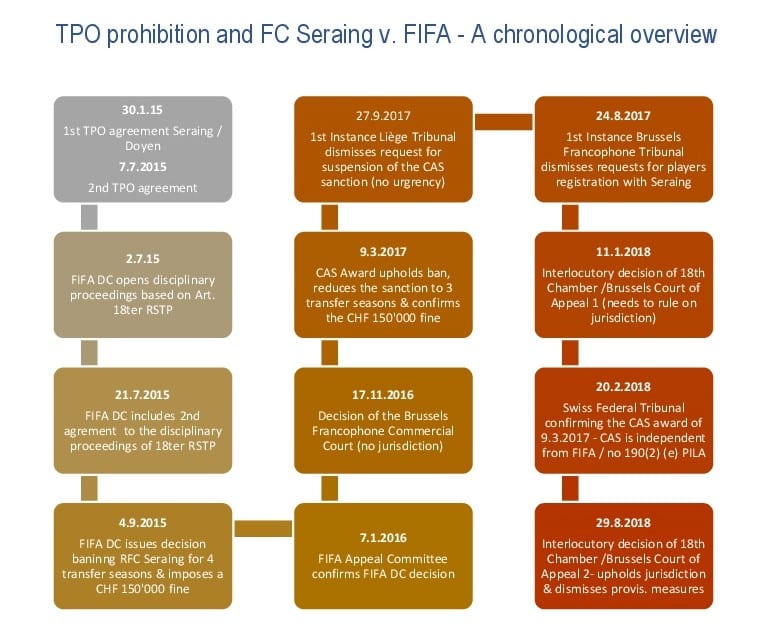
This article explains the disciplinary and competition law proceedings relating to RFC Seraing and the third-party ownership (TPO) contracts that they concluded with Doyen Sports Investment Limited (Doyen Sports). There were two sets of proceedings: one initiated by Doyen Sports and Seraing before the Belgian courts challenging the legality of FIFA’s TPO ban; and the other initiated by the FIFA Disciplinary Committee against Seraing for violation of the FIFA Regulations on the Status and Transfer of Players (RSTP), subsequently appealed to the Court of Arbitration for Sport, and then the Swiss Federal Tribunal and the Liège Tribunal.

As a co-founder and board member of WISLaw, Despina Mavromati co-organized and participated in a panel of the 2nd Annual WISLaw Conference and General Assembly at the Olympic Museum in Lausanne on September 20, 2018. Her panel was entitled “Sports Arbitration Roundtable: insider tips for better dispute resolution”. Despina also presented on the current and future WISLaw matters at the WISLaw General Assembly that same day.

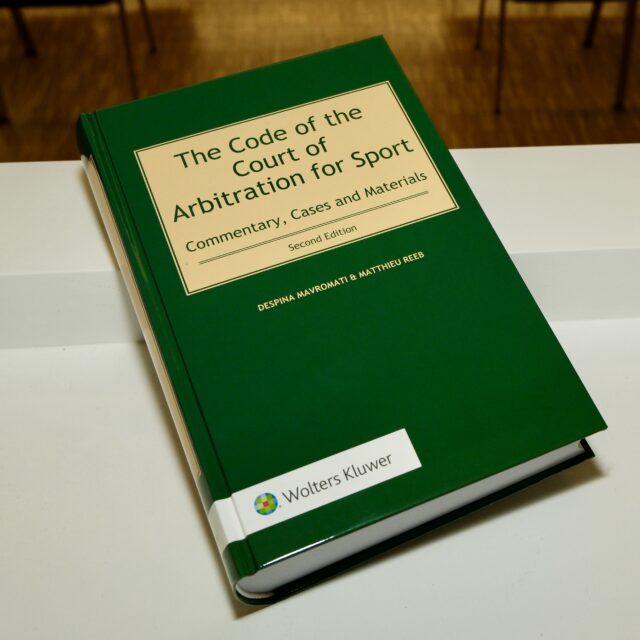
NEW BOOK RELEASE
by Despina Mavromati / Matthieu Reeb, Wolters Kluwer 2025
Ιn its fully revised second edition, The Code of the Court of Arbitration for Sport offers a comprehensive, article-by-article commentary of the CAS Rules. Drawing on leading CAS and Swiss Federal Tribunal case law, CAS practices and international arbitration principles, the book is an indispensable reference for practitioners, arbitrators, and scholars working in sports arbitration.
This second edition introduces significant updates, including new model documents and new chapters on the ICAS, the CAS ad hoc Rules and the CAS Anti-Doping Division Rules during the Olympic Games.

