
Despina Mavromati presented selected CAS case law in disciplinary matters at the CAS Internal Seminar in Vancouver on 10 February 2016.
News
Mediation of sports-related disputes: facts, statistics and prospects for CAS mediation procedures

Sporting disputes – and in particular football- related disputes – bear numerous particularities compared to other commercial or personal disputes. The same applies to the mode of resolution for sports-related disputes, which are typically resolved through arbitration: in this respect, the Court of Arbitration for Sport (CAS) is widely-known for its sports arbitration mechanism, developed upon the initiative of the former IOC President J. A. Samaranch.
News
Autonomy and Good Governance in Sports Associations in Light of the CAS Case Law

International Sports Law Review, Issue 4/2014, Thomson Reuters UK, pp. 71-79
This paper presents the concepts of autonomy and good governance of sports associations as they have been discussed in cases brought before by the Court of Arbitration for Sport. It mostly tackles questions related to elections, to the adoption of new rules and policies, to expulsion/admission of member federations and to the selection of athletes for the Olympic Games.
News
Presentation on sports Mediation at the American Bar Association Fall Seminar in Montreal

Presentation on Sports Mediation at the American Bar Association Fall Seminar in Montreal
Despina Mavromati participated in a round table “The Wide World of Sports Mediation” alongside Prof. Richard McLaren, Mr Jeff Benz and Mr Marc Goldstein at the American Bar Association (ABA) Fall Meeting in Montreal on October 21, 2015.
News
Presentation on the res judicata effect of decisions of sports tribunals at the CAS Conference in Evian

Despina Mavromati presented a paper on the res judicata effect of decisions of sports federations at the CAS Conference in Evian (France), in October 8, 2015.
News
Res judicata in sports disputes and decisions rendered by sports federations in Switzerland

CAS Bulletin 1/2015, pp. 40-52
The nature of the decisions of a sports federation’s judicial instance has long been discussed, also in connection with res judicata considerations in case the same claim involving the same parties is subsequently brought before the Court of Arbitration for Sport (CAS). In such a case, the CAS Panel must examine if it may entertain the claim and issue a decision. If the previous decision has already dealt with the same issue in a final and binding way, it should refuse to entertain the case. We may also encounter situations in which e.g. the previous decision terminated the proceedings (due to the lack of action by the claimants) and the Panel has to establish whether such decision had a res judicata effect.

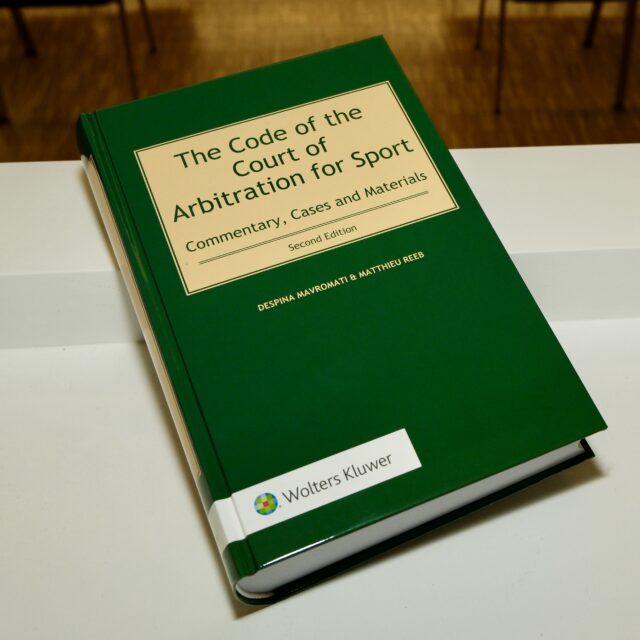
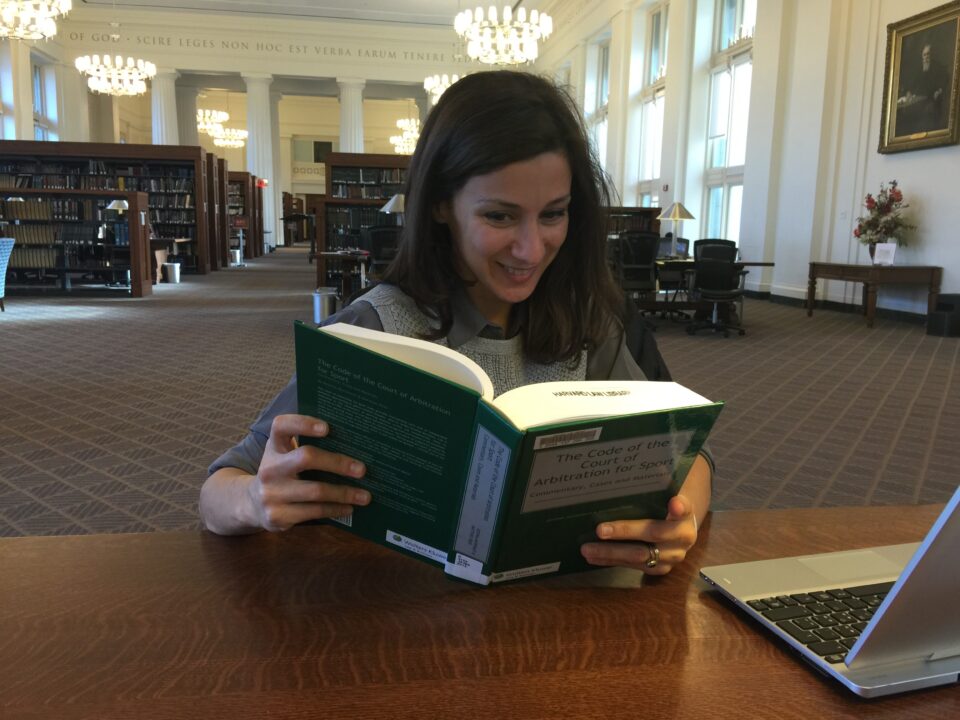
Kluwer Law International 2015 (Despina Mavromati & Matthieu Reeb), March 2015, 760 pages
The Code of the Court of Arbitration for Sport: Commentary, Cases and Materials is a comprehensive exploration of the provisions of the Court of Arbitration for Sport (CAS). Providing detailed analysis of the CAS Rules, this is an indispensable work of reference for all sports law practitioners. Each provision is viewed within the larger context of international arbitration, in Switzerland, and procedural solutions are suggested which are transposable to international arbitration generally.
News
National disputes before CAS, in M. Bernasconi (ed), International Sports Law and Jurisprudence of the CAS

In M. Bernasconi (ed), International Sports Law and Jurisprudence of the CAS, 4th CAS & SAV/FSA Conference Lausanne 2012, Weblaw 2014
This publication is part of a book that includes the presentations made by some of the most experienced specialists in the field of sports and arbitration law at the 4th Lausanne Converence of the Swiss Bar Association (FSA/SAV) and the Court of Arbitration for Sport / Tribunal Arbitral du Sport (CAS/TAS), held on 7 and 8 September, 2012.
News
Indirect detection methods for doping from a legal perspective: the case of the Athlete Biological Passport

Published in the International Journal of Sport Policy and Politics 6, 2/2014, Routledge (Taylor & Francis), pp. 241-258
Indirect methods of detection of violation of an anti-doping rule (ADR) differ from direct methods of detection in many respects. The Athlete Biological Passport (ABP) programme is a new indirect method employed by certain International Federations (IFs) for the detection of ADR violations, based on the longitudinal profiling of an athlete’s biological markers.
News
The Panel’s right to exclude evidence based on Article R57 para. 3 CAS Code: a limit to CAS’ full power of review?

CAS Bulletin 1/2014, pp. 48-57
The CAS Panels’ power of review of a decision appealed against is a well-known feature and fundamental principle of the appeals against decisions issued by the jurisdictional instances of federations and sports-governing bodies to the Court of Arbitration for Sport (CAS). Notwithstanding the Panel’s full power of review, a newly inserted paragraph in Article R57 gives the possibility to the Panel to refuse evidence submitted by the parties “if it was available to them or could reasonably have been discovered by them before the challenged decision was rendered”.

Jurisprudence of the Swiss Federal Tribunal in Appeals against CAS Awards
Published in M. Bernasconi (ed.), Arbitrating Disputes in a Modern Sports World, 5th Conference CAS & FSA / SAV Lausanne 2014, Weblaw 2015
On 5 and 6 September 2014, the 5th edition of the Sports Law Conference organized every two years by the Swiss Bar association and the Court of Arbitration for Sport took place in Lausanne. Despina Mavromati contributed to the book with her article on the jurisprudence of the Swiss Tribunal Federal concerning sports arbitral awards. The book includes several articles and a review of numerous CAS cases in football and in «non-football» matters.

News
Recent Jurisprudence of the Swiss Federal Tribunal on Motions to Set Aside CAS Awards: Some Lessons to be Drawn

ISLR, Issue 1/2014, Sweet & Maxwell 2014, pp. 3-11
The paper discusses the jurisprudence of the Swiss Federal Tribunal (SFT) in motions to set aside CAS awards from 2012 until August 2014. The judgments of the SFT are listed according to the ground for challenge of Article 190 para. 2 Swiss Private International Law Act. The paper also includes a list of the CAS Code provisions discussed (and sometimes interpreted) by the SFT in the various judgments presented.

Despina Mavromati presented a paper on Autonomy and Good Governance of Sports Organizations at the CAS Seminar held in Kuwait City in June 2014.
News
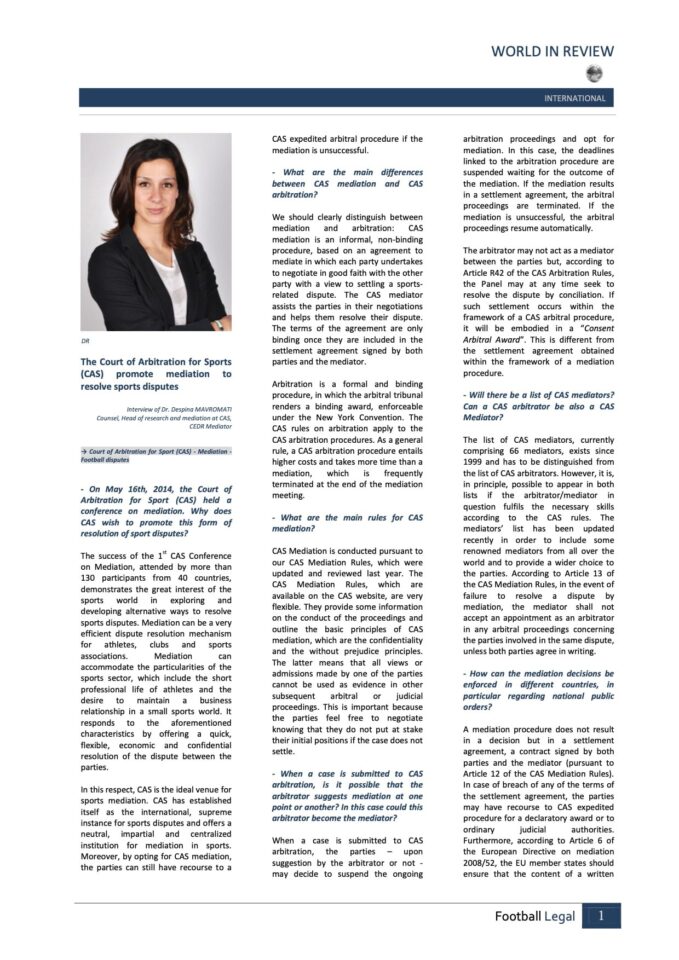
Interview of Despina Mavromati on CAS Mediation at the Football Legal Magazine

Despina Mavromati gave an interview after the 1st CAS Conference on Mediation held at the Olympic Museum on May 16, 2014. See her interview in the first issue of Football Legal.
News
Article R57 of the CAS Code: A Purely Procedural Provision?, ISLR, Issue 2/2013, Sweet & Maxwell (with Pauline Pellaux), pp. 36-44

Article R57 of the CAS Code: A Purely Procedural Provision?,ISLR, Issue 2/2013, Sweet & Maxwell (with Pauline Pellaux), pp. 36-44
News
Les délais dans le Code de l’Arbitrage en matière de sport, CAS Bulletin, 1/2013, pp. 2-12
The paper deals with the time limits according to Article R32 of the CAS Code. It shows how time limits are calculated and describes the consequences in case these are not respected by the parties. The paper further illustrates the conditions for the extension and the suspension of time limits as they have been developed through the CAS case law.
News
Language of procedure before CAS: practice, criteria and impact of the language on the outcome of the case, CAS Bulletin, 1/2012, pp. 39-48
Article R29 of the CAS Code reads as follows:
“The CAS working languages are French and English. In the absence of agreement between the parties, the President of the panel or, if he has not yet been appointed, the President of the relevant Division, shall select one of these two languages as the language of the arbitration at the outset of the procedure, taking into account all pertinent circumstances. Thereafter, the procedure is conducted exclusively in the language selected, unless the parties and the panel agree otherwise.

Status of the Player and Training Compensation, CAS Bulletin, 1/2011, pp. 21-30
The Fédération Internationale de Football Association (FIFA) Regulations on the Status and Transfer of Players foresee, inter alia, a system for the payment of training compensation. As indicated in the Commentary on the FIFA RSTP1, the Regulations create a detailed system for the payment of training compensation so as to encourage the training of young players by awarding financial compensation to clubs that have invested in training young players.