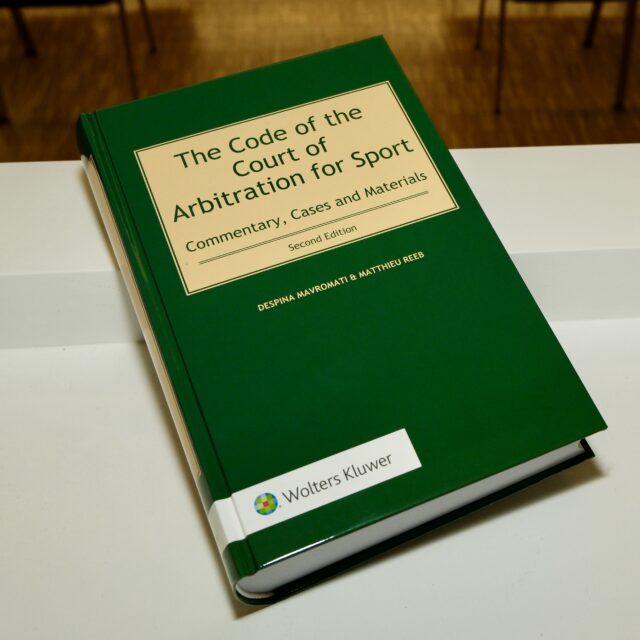


As every year, I prepared my 2025 compilation of notable international sports-related cases. This year included a number of major sporting events, such as the FIFA Club World Cup in the United States and the UEFA Women’s Euro 2025 in Switzerland, but these events did not give rise to many notable disputes decided by the Court of Arbitration for Sport (CAS). The year was nevertheless marked by several landmark rulings – primarily from the European Court of Human Rights (ECtHR) and the Court of Justice of the European Union (CJEU), as well as from the CAS and the Swiss Federal Supreme Court (SFT) – which are briefly presented below.
1) Compilation of Sports-related Judgments rendered by the Swiss Federal Supreme Court (SFT) in 2025
This year was rich in SFT findings regarding CAS’ jurisdiction. In two important judgments, the SFT clarified and reconfirmed the scope of the arbitration agreement in favour of the FIFA tribunal vis-à-vis state courts. Accordingly, FIFA’s jurisdiction under Art. 22 para. 1 (b) RSTP is default for international-dimension disputes but not exclusive, and the parties may validly opt-out or seize national courts for the specific category of labour-law disputes (see my notes on 4A_64/2025 and 4A_92/2025). The SFT also clafiried the admissibility threshold for review of the FIFA jurisdiction by the SFT, which must be raised during the CAS proceedings, even though it is not necessary to explicitly object at the outset of the FIFA proceedings (see my note on 4A_92/2025).
In another judgment, the SFT held that it is immaterial for the validity of the arbitration agreement that an agent lacked the required Swiss licence under the national laws: so long as the foreign seat of the agent is established, alleged breaches of Swiss employment-placement licensing rules cannot retroactively alter the international character of the relationship or invalidate an otherwise autonomous arbitration clause governed by Art. 178 PILA, nor render the dispute non-arbitrable under Art. 177 para. 1) PILA (see my note on 4A_616/2024).
In an interesting dispute related to the extension of the arbitration agreement to non-signatories due to alleged sporting succession, the SFT held that sporting succession is not recognized as a Swiss legal institution (see my note on 4A_188/2025): The fact that the SFT has found sporting succession to be in line with international public policy does not render it part of the Swiss legal order for jurisdictional purposes, limiting thus the effect of sporting succession – or other concepts of lex sportiva – when it comes to the interpretation of arbitration agreements under Art. 178 PILA. In another dispute, the SFT clarified the consequences of the distinction between admissibility and jurisdiction in multi-tier (FIFA & CAS) dispute resolution clauses: accordingly, when a case is rejected by FIFA as being time-bared, the parties cannot bring the claim to CAS and thus circumvent an agreed jurisdiction hierarchy by allowing time limits to lapse (see my note on 4A_230/2025).
With respect to the violation of public policy, the SFT reiterated on numerous occasions that it must be the outcome of the award – and not the panel’s reasoning – that violates public policy, showing the high admissibility threshold for such grievance (see e.g. my notes on 4A_616/2024, 4A_608/2024, and 4A_28/2025). In 2025, and prior to the ECHR Grand Chamber judgment in Semenya v. Switzerland issued in July 2025, the SFT still denied to apply directly the ECHR provisions and repeated that these guarantees fall within the restrictive scope of Art. 190 para. 2 (e) PILA (see my notes on 4A_682/2024 and 4A_544/2024). It is equally found inadmissible to reiterate due process grounds separately invoking Art. 6 ECHR (4A_474/2024). It is now settled federal case law that criminal law principles are not directly applicable in disciplinary proceedings (see my notes on 4A_682/2024 and 4A_544/2024; 4A_474/2024). Furthermore, the disregard of a contractual provision regarding liquidated damages is not violating public policy /pacta sunt servanda when the arbitral tribunal considers said provision as void (see my note on SFT 4A_638/2024).
Moreover, 2025 marked numerous alleged violations of the parties’ right to be heard, which were all dismissed by the SFT: accordingly, there is no such violation when the panel (only) implicitly considers and rejects raised arguments (see my notes on 4A_608/2024 and 4A_168/2025; on arguments regarding the reliability and authenticity of the LIMS evidence, see my note on4A_544/2024); objections to the weighing of testimony typically amount to inadmissible appellate criticism (see my note on 4A_28/2025). The CAS is further not obliged to highlight specific elements of the file relied upon so long as they were on record and discussed at the hearing (see my note on 4A_474/2024).
Finally, the SFT issued two interesting cases regarding requests for revision of CAS Awards under Art. 190a PILA: the first was filed by Russian figure skater Kamila Valieva and relied on an undisclosed expert report allegedly withheld by RUSADA and WADA during the CAS proceedings: the SFT dismissed the request considering that there was no procedural fraud and not a basis to reopen the CAS Award (see my note on 4A_654/2024). In the second, published in December 2025, the SFT admitted the request for revision in view of a final state court decision establishing forgery of a document linked to the outcome of the CAS award (see my note on 4A_268/2025).

2) Landmark sports-related judgments from the European Court of Human Rights (ECtHR) and the Court of Justice of the EU (CJEU) rendered in 2025: the Semenya ECtHR Judgment, the Seraing CJEU Judgment and AG Spielmann’s Opinion of 18 December 2025
The landmark judgment issued by the ECtHR Grand Chamber in Semenya v. Switzerland (see my note here) originates from the exclusion of Caster Semenya (the Athlete) from international women’s competitions under World Athletics’ DSD Regulations, upheld by the CAS in 2019 and by the SFT in 2020 (see also my earlier note on the CAS and SFT proceedings). In its final judgment, the Grand Chamber significantly narrowed the case’s scope, declining jurisdiction over the alleged substantive violations of Articles 8, 13 and 14 ECHR, but finding a violation of Article 6 ECHR, holding that the Athlete had been deprived of her right to a fair hearing due to insufficient judicial review by the SFT.
In essence, the Grand Chamber’s parallels, at a human-rights level, developments seen in Seraing one month later, though based on Article 6 ECHR rather than EU law. While reaffirming the legitimacy and systemic advantages of CAS arbitration, the ECtHR stressed that compulsory arbitration fundamentally alters the standard of judicial review where core human rights are at stake. In this context, the Grand Chamber held that the SFT should not have confined itself to its traditional, extremely narrow public-policy review under Article 190 para. 2 (e) PILA, but should instead have conducted a “particularly rigorous examination” of the CAS award.
Overall, the judgment left unresolved both the substantive legality of the DSD Regulations and the exact contours of such “particularly rigorous” standard imposed on the SFT, confining its intervention strictly to procedural guarantees. The ambiguity remains however critical: it seems highly doubtful that the SFT’s enhanced scrutiny will resemble an expanded arbitrariness test; what seems more likely is that such standard will be akin to a proportionality review of fundamental rights. Unlike Seraing, the judgment does not risk systemic fragmentation through parallel national proceedings, but it nonetheless calls the SFT to raise the bar of review of CAS awards in the specific category of compulsory, human-rights-sensitive cases. With the time limit to request a revision of the CAS Award having now elapsed, the SFT will not deal with the same case again but new challenges remain open, in particular following the reform, by World Athletics, of its eligibility framework imposing a genetic test for all its athletes as of September 2025. It will therefore be for the SFT to establish the contours of this “particularly rigorous examination”.
RFC Seraing SA v. FIFA, C-600/23, Judgment of 1 August 2025, ECLI:EU:C:2025:617 (Seraing Judgment)
The landmark ruling of RFC Seraing SA v. FIFA started with the FIFA’s 2015 ban on Third-Party Ownership (TPO). Following the sanction imposed on Belgian football club RFC Seraing (the Club) by the FIFA Disciplinary Committee, partially upheld by the CAS after an in-depth EU-law compatibility analysis, the case was confirmed by the SFT. Meanwhile, parallel proceedings before the Belgian courts led the Belgian highest instance (Cour de cassation) to refer questions to the CJEU on the extent of national-court review of CAS awards (see also my previous notes on the procedural history of the Seraing saga, the SFT judgment, and the AG Ćapeta Opinion).
In essence, the CJEU found that – consistently with its own case law and the ECHR – compulsory CAS arbitration is not per se incompatible with EU law, provided that effective judicial protection is ensured. Departing from the broader approach suggested in AG Ćapeta’s Opinion (see my note here), the CJEU limited mandatory national-court review to the hard core of EU public policy, namely EU competition law and fundamental freedoms, rather than all EU-law rights. Notwithstanding the numerous advantages of centralized sports arbitration, where such arbitration is imposed as a condition of participation in economic activity within the EU, national courts must be able to review CAS awards effectively, grant interim relief if necessary, and ensure compliance with Articles 19 para. 1 TEU and 47 of the Charter.
The CJEU’s stance regarding its authoritative interpretation of EU law is not new, nor is the existence of EU-public-policy review (already available via the NYC 1958). The novelty here lies rather in its depth and remedial consequences: EU courts may review the interpretation, legal classification, and consequences of EU-public-policy norms applied by CAS, albeit without reopening factual findings (i.e. not a de novo review). Interestingly, the CAS panel in the Seraing CAS Award (composed of three eminent EU-qualified CAS arbitrators) dedicated a large part of its analysis to the compatibility of the TPO ban with EU competition law and the fundamental freedoms and included several factual findings that will eventually bind the Belgian court (c.f. §106 of the Seraing CAS Award). Therefore, it seems that the parties’ choice of arbitrators with deep EU law knowledge (from among the CAS list of arbitrators), will be key in order to ensure that awards are resistant to subsequent national court review.
All in all, national rules conferring res judicata or probative effects on CAS awards must be set aside insofar as they undermine effective judicial protection under EU law. As explained in my note on the CJEU judgment, this produces a calibrated but real tension with arbitration finality, with limited practical reach but tangible risks of delay and fragmentation in the category of compulsory, EU-law-sensitive sports disputes.
In his Opinion issued just before Christmas (see my full note here), AG Spielmann considers that the principle of effective judicial protection under EU law requires that national courts be able to annul unlawful sporting sanctions and, where appropriate, grant interim relief. While EU law does not, as such, preclude disciplinary sanctions imposed by sports federations – provided they pursue legitimate objectives such as the integrity of competitions and comply with the requirements of transparency, objectivity, non-discrimination and proportionality – the absence of review powers at national level may infringe the right to effective judicial review.
Crucially, however, the AG’s conclusions depend on whether the judicial bodies established under Italian sports law qualify as a “court or tribunal” within the meaning of EU law. If that qualification were met, national legislation excluding further judicial review would not necessarily be incompatible with EU law. It is interesting to note that the assessment of that qualification (which is left to the referring court, § 72-113) draws heavily on the criteria developed under Article 6 para. 1 ECtHR in the Ali Riza v. Turkey EctHR Judgment (see also my note on the Ali Riza v. Turkey ECtHR Judgment here).

3) Notable CAS Awards rendered in 2025
Disciplinary / Ethics
From the disciplinary cases issued in 2025, a notable case is the one of the former President of the Royal Spanish Football Federation Luis Rubiales, who appealed the FIFA disciplinary sanctions imposed for breaches of the FIFA Disciplinary Code and Code of Ethics arising from conduct at the 2023 FIFA Women’s World Cup medal ceremony. The CAS upheld FIFA’s assessment that the conduct constituted a serious violation of ethical principles and personal integrity, rejecting arguments based on consent, proportionality, and procedural irregularities. (CAS 2024/A/10384 – Luis Rubiales v. FIFA).
Another interesting CAS Award is the one of Laureano González against the sanction imposed by FIFA on the basis of his ethical responsibility as a federation president for financial governance failures and suspicious transactions. Here again, the CAS confirmed the FIFA decision and the accountability of presidents of member associations for financial conduct occurring during their mandate under the FIFA Code of Ethics, regardless of delegation to internal bodies (TAS 2023/A/9362 Laureano González v. FIFA).
Doping-related disputes
The CAS heard and decided several noteworthy doping-related cases in 2025.
In weightlifting, the CAS Anti-Doping Division (CAS ADD) partially upheld the request by the International Weightlifting Federation (IWF) against Chinese weightlifter Lyu Xiaojun, whose out-of-competition test revealed recombinant erythropoietin (rEPO). The CAS ADD confirmed an ADRV under Art. 2.1 IWF ADR and imposed a four-year ineligibility period, backdating to the date of sample collection due to procedural delays not attributable to the athlete.
In wrestling, the CAS issued its award in the appeal of WADA and the International Wrestling Federation against the Georgian Anti-Doping Agency (GADA) & four Georgian athletes, finding that the sabotage theory retained by the appealed decision was unsupported, due to lack of factual investigation and contradicted by scientific evidence, imposing thus a four-year sanction for intentional use on the athletes (CAS 2024/A/10960, IWF v. G. Giorbelidze & GADA).
In football, the CAS issued its award in the appeal filed by Paul Pogba against a four-year ban imposed for an ADRV following a positive test for DHEA (a prohibited non-specified substance). CAS partially upheld the appeal and reduced the sanction to 18 months for non-intentional ingestion, finding no performance-enhancing evidence and inadvertent consumption (CAS 2024/A/10443, Paul Pogba v. NADO Italia).
In cycling, Miguel Ángel López appealed his four-year sanction due to possession and use of prohibited substance menotropin to the CAS. The appealed decision was fully confirmed by the CAS which concluded that the athlete possessed and used Menotropin during the relevant period, with the ineligibility running from 25 July 2023.
In tennis, the CAS issued its award in the appeal of International Tennis Integrity Agency (ITIA) against a decision finding that Tara Moore had no fault or negligence after she tested positive for prohibited substances boldenone and nandrolone at the 2022 Bogotá tournament, where she argued meat contamination in Colombia. The CAS upheld ITIA’s appeal and imposed a four-year period of ineligibility finding that she had failed to prove the nandrolone concentration was consistent with contaminated meat ingestion and therefore did not establish that the ADRV was not intentional. Moore’s cross-appeal was declared inadmissible.
Finally, the biggest doping-related case of the year did not result – as many would expect – in a CAS award: Tennis player Jannik Sinner, after testing positive for the banned steroid clostebol and being cleared of fault and negligence by an independent tribunal, had this decision appealed by WADA to the CAS, ultimately resulting in a negotiated three-month suspension agreed in early 2025.

Selection / eligibility
2025 also marked several eligibility cases, not least due to geopolitical tensions but also due to genetic testing: With respect to the Russian – and Belarussian athletes’ exclusion from international competitions, the CAS issued its award (operative part only) in the appeal of the Russian Luge Federation together with 6 athletes against the international Luge Federation (FIL), challenging their refusal to implement a programme allowing Russians to compete as Individual Neutral Athletes (AIN), impacting OWG Milano/Cortina 2026 qualification. CAS held the blanket prohibition on AIN participation was disproportionate to the stated safety aim and therefore set aside that prohibition, but maintained the exclusion of RLF athletes from FIL competitions; the athletes’ request for immediate participation was dismissed.
Moreover, the Russian Ski Association (RSF) and 12 Russian athletes and para-athletes together with the Russian Paralympic Committee appealed against the FIS Council resolution “not to facilitate” Russian/Belarusian participation as AINs in FIS qualification events for OWG/Paralympics 2026: CAS partially upheld both appeals (operative part only), ruling the resolution amounted to a blanket exclusion by nationality inconsistent with FIS Statutes (including political neutrality/non-discrimination protections), so athletes meeting IOC AIN criteria must be allowed into FIS qualification events. What is more, Russian para-athletes were allowed to participate under the same conditions as other para-athletes absent an IPC AIN framework, while broader requests were dismissed as within FIS remit.
On the other side, speed skater Daria Kachanova unsuccessfully appealed against the ISU’s refusal to include her on the list of AIN-eligible athletes for OWG 2026 qualifiers, reportedly based on affiliation with CSKA Moscow (linked to the Russian Ministry of Defence).
In October 2025, CAS rejected urgent requests by the Israel Gymnastics Federation (and, in a parallel appeal, six qualified gymnasts) seeking provisional measures to secure Israeli participation in the 2025 World Artistic Gymnastics Championships after Indonesia denied visas. The CAS held that the conditions for interim relief were not met. One appeal was also terminated for lack of jurisdiction, while the other remained pending on the merits (most likely expected in 2026).
Another eligibility decision that is still pending and is expected in 2026 is the one of Olympic champion Imane Khelif, who appealed to CAS against World Boxing’s decision conditioning her eligibility on mandatory genetic sex testing. She sought provisional measures to compete without undergoing the test, but CAS denied the request, leaving the rule in force pending the arbitration proceedings.
Multi-Club Ownership
The CAS also decided several cases relating to multi-club ownership. In FK DAC 1904 v. UEFA, CAS dismissed FK DAC 1904’s appeal against its removal from the 2025/26 UEFA Conference League, holding that UEFA lawfully amended the assessment date and that DAC breached the multi-club ownership rules because the same individual exercised decisive influence through senior management roles at both clubs.
An important case that was heard this summer on an expedited basis by the CAS was the appeal filed by Crystal Palace FC against the decision rendered by UEFA, excluding the club from the 2025/26 UEFA Europa League. CAS dismissed the appeal, ruling that the club was non-compliant with UEFA’s multi-club ownership rules at the fixed assessment date and that UEFA had no discretion to accept governance changes implemented after the regulatory deadline.
Another interesting case arose from the Club World Cup 2025 multi-club ownership rules (Art. 10.1). The CAS, after an expedited procedure and a hearing in May 2025, dismissed consolidated appeals by Club León and CF Pachuca against FIFA’s decision, confirming that governance and trust arrangements were insufficient to remove common control and upholding León’s exclusion while Pachuca remained qualified. CAS also rejected Liga Deportiva Alajuelense’s separate appeal seeking admission in their place (operative decisions with reasons to follow).

4) Selected regulatory and other developments in international sport from 2025 and what to expect in 2026
In September 2025, World Athletics enacted its reforms on the DSD and Female Eligibility regulations, replacing old eligibility rules with a unified framework, requiring athletes wishing to compete in the female category to undergo a one-time SRY gene test to confirm biological sex and establishes eligibility criteria (e.g., restrictions on testosterone exposure after male gender-affirming treatment). In 2026, the federation will enforce these new eligibility rules across its major competitions through an expanded testing schedule (i.e. World Athletics Series, Diamond League, and other leading events). This will likely generate new disputes and challenges concerning privacy, discrimination and proportionality of the regulatory measures.
Also, and while the IOC 2021 framework on Fairness, Inclusion and Non-Discrimination remains in force, the IOC aims to come up with a new policy on eligibility in female sports in early 2026.
Furthermore, in 2025 FIFA continued its FIFA RSTP revision process following the Diarra CJEU judgment following extensive consultation with various stakeholders. In 2026, FIFA will continue and likely proceed to regulatory amendments, softening the effects of joint and several liability and narrowing sporting sanctions for unilateral contractual termination without just cause. Overall, these regulatory developments will further unfold in 2026 and show that international federations are moving towards smoother sanctions and eligibility rules, embedded proportionality tests, in anticipation of review by EU but also national courts and the CAS. With the Milano-Cortina Winter Olympic Games 2026, the FIFA World Cup and the Glasgow Commonwealth Games on the horizon, 2026 is set to be a busy year for sports governance, eligibility and selection – and, inevitably, for sports disputes.